

The DOI matches its DataCite record; 32 of the 32 references it cites were found in a registry or an index; none of the 36 sources its claims cite is checked for support yet.
FP-Agent: Fingerprinting AI Browsing Agents
Open accessAbstract
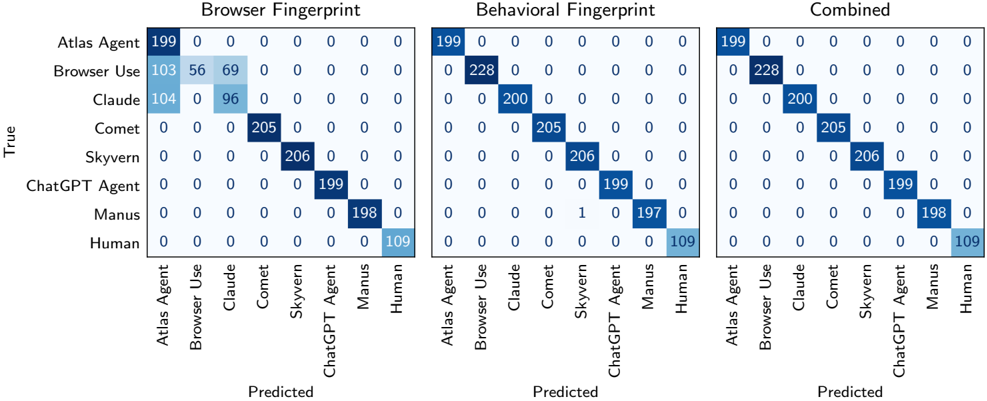
AI browsing agents are an emerging class of AI-powered bots capable of autonomously navigating websites. Unlike traditional web bots, AI browsing agents typically operate using real browsers and perform everyday tasks, making them difficult to detect. Yet little is known about whether existing AI browsing agents can be distinguished from humans and one another based on their browser or behavioral fingerprints. In this paper, we present the first controlled measurement study of seven AI browsing agents and human users. Using an instrumented honey website, we collect browser and behavioral fingerprint features while AI browsing agents and humans perform three tasks: flight booking, online shopping, and forum interaction. We then train FP-Agent, a multi-class classifier, to evaluate the discriminative power of these features. We find that browser fingerprints provide limited discriminative power when shared by multiple AI browsing agents. Behavioral fingerprints, however, are distinctive: differences in typing, scrolling, and mouse behavior separate AI browsing agents from humans and one another. In a case study evaluating Cloudflare's bot detection, FP-Agent detects all seven AI browsing agents, whereas Cloudflare detects only one. Our findings show that behavioral fingerprints are a critical component to reliably detect and control this emerging form of web traffic.
Overview
CoChat Summary
TL;DR
FP-Agent is a controlled measurement study of seven AI browsing agents and human users on an instrumented honey website, using browser and behavioral fingerprints to train a multiclass classifier. It finds browser fingerprints alone are weak, while behavioral fingerprints reliably separate agents from humans and from one another; FP-Agent detects all seven agents whereas Cloudflare blocks only one.
Key findings
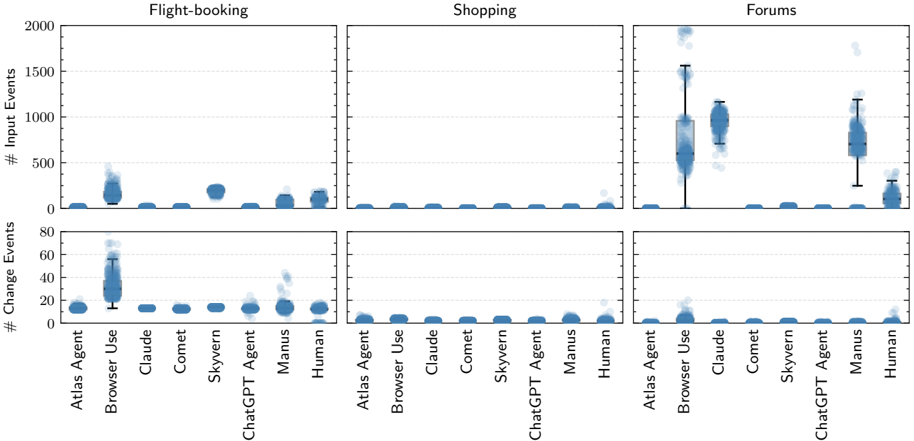
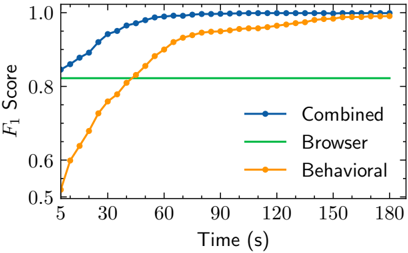
- Browser fingerprints alone provide limited discriminative power: the browser-fingerprint classifier reaches F1 ≈ 0.8 (0.7969 for browsing agents only; 0.8223 with humans), while behavioral fingerprints reach F1 0.9993/0.9994 and combined fingerprints reach 1.0000. Misclassifications occur when Atlas Agent, Browser Use, and Claude share the same browser fingerprint.
- Behavioral fingerprints are highly distinctive. Typing examples: Browser Use averages 5.31 ms inter-key and 10.19 ms hold latency; Skyvern 9.52 ms and 11.33 ms; Manus 1.39 ms and 52.92 ms; Claude below 1 ms when keystroke-based; humans average 120.43 ms inter-key and 97.48 ms hold latency. Browsing agents also produce mouse events only at click time, with no continuous pointer movement.
- In the Cloudflare case study, FP-Agent detects all seven browsing agents, whereas Cloudflare fully blocks only Manus; the other six complete the tasks. Cloudflare does block some provider server-side requests (ClaudeBot, Perplexity-User, ChatGPT-User), but not the locally running Claude and Comet themselves.
- Real-time classification is feasible after short windows: behavioral and combined classifiers improve as behavioral data accumulates, plateauing after roughly 3 minutes and 1 minute, respectively.
Methods
- The authors deployed an instrumented honey website with visitor-specific subpages identified by a 10-character random path string, using FingerprintJS for browser fingerprints and custom JavaScript event listeners for behavioral fingerprints.
- They studied seven browsing agents—Atlas Agent, Browser Use, Claude, Comet, Skyvern, ChatGPT Agent, and Manus—with 1,000 trials per agent split across flight-booking, online-shopping, and forum tasks, plus 56 undergraduate human participants yielding 546 human instances. Local tests used an M1 MacBook Air running macOS 26.2, an Ubuntu 24.04 desktop, and a Windows 10 laptop.
- They processed artifacts into 418 browser-fingerprint and 50 behavioral features, trained XGBoost multiclass classifiers on browser, behavioral, and combined feature sets with an 80-20 train-test split, and analyzed results using XGBoost gain, SHAP, Mann-Whitney U tests, and Brown-Forsythe tests.
Limitations
- Stated: the study is closed-world and not designed to identify unseen browsing agents as distinct classes; coverage is limited across browsing agents, system configurations, human population (undergraduate students), and tasks. A held-out-task experiment shows behavioral-fingerprint F1 drops by as much as 0.369, while the combined classifier drops by at most 0.0684.
- Stated: proprietary browsing agents may update during measurement, and fingerprints should not be assumed stable; ChatGPT Agent produced multiple browser fingerprints over time. The authors also note a likely arms race as future agents adopt more human-like behavior.
- Stated/evident: human participants used their own systems, reducing overlap between human and browsing-agent browser fingerprints, so the absence of shared fingerprints in their data should not be interpreted as evidence that such overlap would not occur in practice. The text also notes Claude could not be automated on Ubuntu because the GUI automation library did not support Wayland.
Model-written summary. Check it against the paper before relying on it.
Integrity signals
Registry
Cites
Statistics
Figures



Verification
Claims the paper makes
0 Valid · 4 Not valid · 17 Not checked · 174 Own results and interpretations
A result the paper reports from its own data — it cites no other source for it, so there is none to check. The quote shows it is in the paper.
In the paper
“We observe that, with the exception of Skyvern, local browsing agents produce stable browser fingerprints within a given test environment.”
§ FP-Agent: Fingerprinting AI Browsing Agents > 5.2.1
plain- Asserted: passes — The authors put it forward as true.
- Checkable: passes — It can be checked against evidence.
- Load-bearing: passes — The paper’s conclusions depend on it.
- Based: passes — The paper gives a reason why it holds.
A result the paper reports from its own data — it cites no other source for it, so there is none to check. The quote shows it is in the paper.
In the paper
“We find that only Atlas Agent, Browser Use, and Claude share fingerprints.”
§ FP-Agent: Fingerprinting AI Browsing Agents > 5.1 Classifier Evaluation
plainstates an association- Asserted: passes — The authors put it forward as true.
- Checkable: passes — It can be checked against evidence.
- Load-bearing: passes — The paper’s conclusions depend on it.
- Based: passes — The paper gives a reason why it holds.
A result the paper reports from its own data — it cites no other source for it, so there is none to check. The quote shows it is in the paper.
In the paper
“For example, Atlas Agent, Browser Use, and Claude consistently report the same screen resolution across trials on the same underlying system: 1440x900 on macOS and 1536x864 on Windows.”
§ FP-Agent: Fingerprinting AI Browsing Agents > 5.2.1
plain- Asserted: passes — The authors put it forward as true.
- Checkable: passes — It can be checked against evidence.
- Load-bearing: unclear — It is unclear whether the paper’s conclusions depend on it.
- Based: passes — The paper gives a reason why it holds.
A result the paper reports from its own data — it cites no other source for it, so there is none to check. The quote shows it is in the paper.
In the paper
“We find that browser fingerprints provide limited discriminative power when shared by multiple AI browsing agents.”
- Also stated in: § 1 INTRODUCTION · plain
“First, browser fingerprints alone provide limited discriminative power, especially when multiple browsing agents share the same browser fingerprint.”
- Also stated in: § Class · plain
“Key Takeaway: Browser fingerprints alone are insufficient to reliably distinguish among browsing agents and humans, particularly when multiple classes share the same browser fingerprint.”
§ FP-Agent: Fingerprinting AI Browsing Agents > Abstract
plain- Asserted: passes — The authors put it forward as true.
- Checkable: passes — It can be checked against evidence.
- Load-bearing: passes — The paper’s conclusions depend on it.
- Based: passes — The paper gives a reason why it holds.
- Rests on an assumption not shown here.
- Also stated in: § 1 INTRODUCTION · plain
A result the paper reports from its own data — it cites no other source for it, so there is none to check. The quote shows it is in the paper.
In the paper
“On macOS, the main difference is that Comet exhibits significantly larger font preference values (𝑝 < 0.01, 𝑟 = 1.00) than Atlas Agent, Browser Use, and Claude, which may likewise reflect enlarged text rendering.”
§ FP-Agent: Fingerprinting AI Browsing Agents > 5.2.1
hedged- Asserted: passes — The authors put it forward as true.
- Checkable: passes — It can be checked against evidence.
- Load-bearing: unclear — It is unclear whether the paper’s conclusions depend on it.
- Based: passes — The paper gives a reason why it holds.
109 more claims
Create a free account to see all 195 claims and every source verdict.
- It may state two separate claims as one. 53
- Probably not a substantial claim. 33
- The quote only partly states this claim. 2
Self-check
Percentages, sums and reported differences re-computed from the paper’s own numbers.
Each contradiction between two passages listed here was confirmed by an independent check.
Rated minor: it would not touch a result — a value no result rests on, a p-value that stays on the same side of the significance level, or a conflict that is clerical, resolved elsewhere in the paper, or outside its own findings.
In the paper
§ FP-Agent: Fingerprinting AI Browsing Agents > 5.3.1 Typing behavior.
“Skyvern programmatically inputs the first 𝑛 -20 characters when 𝑛 > 20, and uses keystrokes with a 10ms inter-key latency for the final 20 characters [96].”
§ FP-Agent: Fingerprinting AI Browsing Agents > 5.3.1 Typing behavior.
“Skyvern types at most 20 characters using keystrokes before switching to programmatic input.”
Citations
Cites
Robust Tests for the Equality of Variances
Brown, M. B., & Forsythe, A. B. (1974) · Journal of the American Statistical Association · doi:10.1080/01621459.1974.10482955 · Cited by 3,216
WebVoyager: Building an End-to-End Web Agent with Large Multimodal Models
He, H., Yao, W., Ma, K., Yu, W., Dai, Y., Zhang, H., Lan, Z., & Yu, D. (2024) · Proceedings of the conference - Association for Computational Linguistics. Meeting · doi:10.18653/v1/2024.acl-long.371 · Cited by 568
The Paradigm-Shift of Social Spambots: Evidence, Theories, and Tools for the Arms Race
Cresci, S., Di Pietro, R., Petrocchi, M., Spognardi, A., & Tesconi, M. (2017) · Proceedings of the 26th International Conference on World Wide Web Companion - WWW '17 Companion · doi:10.1145/3041021.3055135 · Cited by 381
Chicco, D., Sichenze, A., & Jurman, G. (2025) · BioData Mining · doi:10.1186/s13040-025-00465-6 · Cited by 234
Effect sizes for nonparametric tests
Fiel Peres, F. (2026) · Biochemia medica · doi:10.11613/bm.2026.010101 · Cited by 159
(2023) · doi:10.52202/075280-1220 · Cited by 134
TypeNet: Deep Learning Keystroke Biometrics
Acien, A., Morales, A., Monaco, J. V., Vera-Rodríguez, R., & Fiérrez, J. (2021) · IEEE Transactions on Biometrics Behavior and Identity Science · doi:10.1109/tbiom.2021.3112540 · Cited by 126
Koster, M., Illyes, G., Zeller, H., & Sassman, L. (2022) · doi:10.17487/rfc9309 · Cited by 92
Measurement and classification of humans and bots in internet chat
Gianvecchio, S., Xie, M., Wu, Z., & Wang, H. (2008) · Cited by 89
FP-Crawlers: Studying the Resilience of Browser Fingerprinting to Block Crawlers
Vastel, A., Rudametkin, W., Rouvoy, R., & Blanc, X. (2020) · Workshop on Measurements, Attacks, and Defenses for the Web (MADWeb) · doi:10.14722/madweb.2020.23010 · Cited by 81
Research works printed but not linked: 5
- Xiang Deng, Yu Gu, Boyuan Zheng, Shijie Chen, Sam Stevens, Boshi Wang, Huan Sun, and Yu Su. 2023. Mind2web: Towards a generalist agent for the web. Advances in Neural Information Processing Systems 36 (2023), 28091-28114.
- Cormac Herley. 2022. Automated detection of automated traffic. In 31st USENIX Security Symposium (USENIX Security 22). 1615-1632.
- Brian Kondracki, Johnny So, and Nick Nikiforakis. 2022. Uninvited guests: Analyzing the identity and behavior of certificate trans- parency bots. In 31st USENIX Security Symposium (USENIX Security 22). 53-70.
- Seyed M Mirtaheri, Mustafa Emre Dinçtürk, Salman Hooshmand, Gregor V Bochmann, Guy-Vincent Jourdan, and Iosif Viorel Onut. 2013. A brief history of web crawlers. In Proceedings of the 2013 Con- ference of the Center for Advanced Studies on Collaborative Research. 40-54.
- Franziska Roesner and David Kohlbrenner. 2026. Agentic Browsers and the Same-Origin Policy. In Workshop on Agents in the Wild, In- ternational Conference on Learning Representations (ICLR). https:// franziroesner.com/pdf/roesner_kohlbrenner_2026_agentic_sop.pdf
Cited by
A New Era in LLM Security: Exploring Security Concerns in Real-World LLM-based Systems
Wu, F., Zhang, N., Jha, S., McDaniel, P., & Xiao, C. (2024) · arXiv · doi:10.48550/arxiv.2402.18649 · Cited by 23
Fayolle, I., Bouhenniche, S., Pélissier, S., Laperdrix, P., Maurice, C., & Rudametkin, W. (2026) · arXiv (Cornell University) · doi:10.48550/arxiv.2606.30119 · Cited by 5
Get In, Decide, Prove: A Merchant-Side Readiness Benchmark for Agentic CommercePreprint
de Valois-Franklin, A., Bogdan, A., Ibrahim, A., Shaer, I., & Andguladze, T. (2026) · arXiv (Cornell University) · doi:10.48550/arxiv.2610.17378
Comparing Computer Use Behavior Across Multiple Levels of AbstractionPreprint
Mohanbabu, A. G., Natalie, R., Guo, A., & Pavel, A. (2026) · arXiv (Cornell University) · doi:10.48550/arxiv.2610.26703
Correct Answers, Closed Gates: SolveBind for GUI Agents at the Verification BarrierPreprint
Song, X., Peng, H., Su, S., Wu, H., Song, S., Liu, G., Zhang, L., & Liu, D. (2026) · arXiv (Cornell University) · doi:10.48550/arxiv.2610.32223
Metadata
- Authors
- Wang, E., Shafiq, Z., & Vekaria, Y.
- Affiliations
- University of California, Davis (US)
- Venue
- arXiv
- Publisher
- arXiv
- Published
- 2026
- ISSN
- 2331-8422 (ISSN-L)
- arXiv
- 2605.01247
- OpenAlex
- W7160260697
- Semantic Scholar
- 0da1ce7c91aa8405ef864f19fc6a48013a5e244f
- Cited by
- 7
- References
- 32
- Citations by year
- 2026: 6
- Type
- posted content
- Language
- en
- Open access
- green
- arxiv.org
- Licence
- Locations
- arXiv (Cornell University) (submittedVersion, cc-by)
- arXiv (Cornell University) (cc-by)
- Funders
- National Science Foundation (2138139, 2103439)
- Topics
- Physical Sciences › Computer Science › Information Systems › Spam and Phishing Detection
- Physical Sciences › Computer Science › Artificial Intelligence › Internet Traffic Analysis and Secure E-voting
- Physical Sciences › Computer Science › Information Systems › Web Data Mining and Analysis
- Keywords
- browser fingerprinting, behavioral fingerprinting, bot detection, web bots, mouse behavior, typing behavior, scrolling behavior
About these checks
Registry, retraction, Cites and statistics results are computed, not judged, with one exception: a printed reference that no index lists is read once by a model before it counts as a citation error. Claims are extracted by a model and kept only when their quote appears verbatim in the text; each cited source is then checked, with a model’s help, for whether it says what the claim relies on. Those verdicts can be wrong — read the claim’s quote and the cited source before relying on one.
A language model drew the claims from the paper on 2026-11-17, under version 3 of the claim definition (model deepseek-v4.1-flash, prompt extract-v3).
A second model labelled each claim on 2026-11-17 (model jev-1.13-20260917, definition revision gold-guideline-v0.2).
Statistics and arithmetic are recomputed, not judged.
Confidence bands are shown only for fields calibrated on our annotated test set. None is calibrated yet, so no band is shown.
What counts as a claim ›How we measure confidence ›How we check this ›
Are you an author, or do you see a problem with this page? Request a review
How to cite
Cite CoChat for the checks on this page, and the paper for its own findings.
- This page
- CoChat. (2026). Citation check: FP-Agent: Fingerprinting AI Browsing Agents. https://app.cochat.ai/papers/10.48550/arxiv.2605.01247
- The paper
- Wang, E., Shafiq, Z., & Vekaria, Y. (2026). FP-Agent: Fingerprinting AI Browsing Agents. arXiv. https://doi.org/10.48550/arxiv.2605.01247
Data sources
Bibliographic data: Semantic Scholar, OpenAlex, Crossref.
Contains information from the Semantic Scholar Academic Graph Datasets, made available under the ODC Attribution License (ODC-BY 1.0).
Semantic Scholar’s data is described in: Kinney, R., et al. (2023). The Semantic Scholar Open Data Platform. arXiv:2301.10140.
