

AI with Authority, from Application to Silicon
Open accessThe DOI matches its DataCite record; 22 of the 22 references it cites were found in a registry or an index; none of the 32 sources its claims cite is checked for support yet.
Abstract
For sixty years, machine verification has been a major cost overhead, affordable only for exceptional artifacts. Here we report that generative AI inverts this relationship: at AI speed, machine verification is not only economical but essential to productivity --- it is the incorruptible referee that lets one person safely direct autonomous machine work at scale. In five weeks, one researcher on consumer AI subscriptions directed a small fleet of AI agents from application code, through a verified compiler and executive, to a RISC-V processor taped out on a community silicon shuttle; no proof passed through human review, and no RTL was written by a human. The working discipline --- the Salt method --- rests on a proof kernel no hallucinated proof can pass: mathematical claims travel between agents as kernel-checked artifacts, and human attention is reserved for statements, designs, and rulings. Verification is stated link by link, from the Lean 4 kernel to SAT-checked equivalence at the silicon boundary. We publish the complete accounting: theorem provenance, a pre-registered token meter, floor-bounded human time, and an error ledger whose catch numbering runs to #256 --- a monotone counter over the mathematics campaign's append-only flags ledger, maintained 2026-07-07 to 2026-07-20 (one number, #79, was never assigned; later catches are recorded un-numbered) --- against zero incorrect proofs reaching the record.
Overview
CoChat Summary
TL;DR
This case study reports that one researcher, using consumer AI subscriptions over five weeks, directed a five-seat AI agent fleet to build a verified stack from application code through a verified compiler and executive to a RISC-V processor submitted to a community silicon shuttle, with all mathematical claims checked by the Lean 4 kernel and no proof passing human review. It argues that at AI speed machine verification becomes essential rather than a cost overhead, and publishes the Salt method, error ledger, and metered economics.
Key findings
- The Salt method requires five artifacts per prompt (implementation, specification, kernel-checked proof, adversarial tests, certificate) and six required invariants plus six advisory articles; the Lean 4 kernel is the sole arbiter of mathematical truth, with per-theorem axiom audits using only the three standard axioms, no `native_decide`, and no custom axioms. The hardware chain has three independent checkers; links 2 and 4 are SAT-based equivalence checks (Yosys) because as of 2026-08-11 no general Verilog-to-Lean importer exists. The mathematics campaign’s catch ledger runs to #256 (maintained 2026-07-07 to 2026-07-20; #79 never assigned; later catches un-numbered), with zero incorrect proofs reaching the record; all 73 registered headline theorems carry landing dates matching their landing commits, and all 59 landing commits are ancestors of the main branch.
- Demonstration: one person, five weeks, five-seat fleet; the systems stack was built in seven days of elapsed repository history. The design was first submitted 2026-08-10 to Tiny Tapeout’s September 7, 2026 community shuttle and revised before shuttle close (shuttle run 32284710003, shuttle-repository commit `7d2b275`). The 2026-08-10 submission carried 902 flip-flops, of which 288 (31.9%) were emitted from kernel-checked Lean artifacts and 614 from agent-written RTL; at RTL the emission count was 352 of 966 (36.4%). In the shipped revision, 352 kernel-emitted flip-flops are instantiated and the committed synthesis stat records 1,468 sequential cells; no die-level provenance ratio is stated for the shipped design.
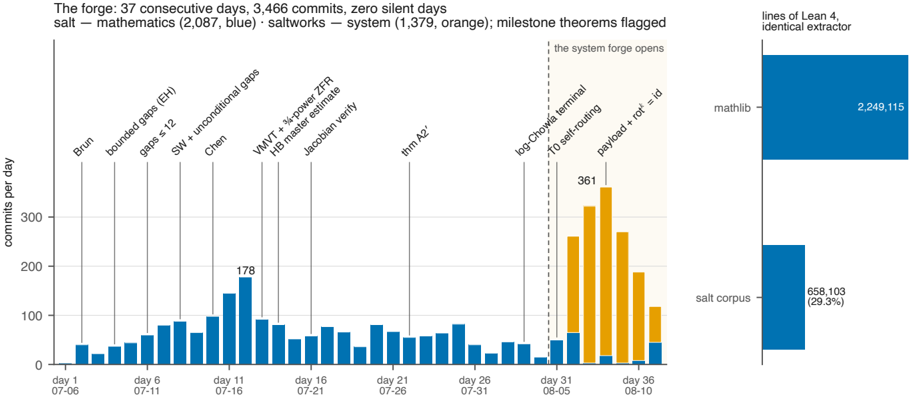
- Mathematics corpus and economics: over 320,000 lines of Lean 4 under the strict extractor (658,103 lines by raw count), produced in 37 days, 29.3% of mathlib’s size by identical extractor. The mathematics repository received 2,087 commits over 37 consecutive days (mean 56.4/day, peak 178); the systems repository received 1,379 commits over 7 days (peak 343). A pre-registered 4.86-day metered window recorded 28.07M output tokens across 36,844 deduplicated API requests, 1,376 commits, and 56,951 inserted Lean lines (376 output tokens per inserted line); human engaged time was bounded at 37 h 21 m across 45 blocks out of 116 h 40 m wall clock. In the mathematics repository, 43.0% of commits landed inside silence windows of at least one hour, 14.5% at four hours, and 8.8% at eight; the longest such window was 20 h 56 m with 26 commits and 12,310 inserted Lean lines.
- Mathematical outcomes: the corpus carries machine-checked proofs of Siegel-Walfisz, the large sieve inequality, Bombieri-Vinogradov, a lower-bound (Rosser-Iwaniec) sieve, Chen’s theorem, the Vinogradov mean value theorem, the Weil bound for Kloosterman sums, a zero-free region beyond de la Vallée Poussin strength, and Matomäki-Radziwiłł/Halász-type machinery. The twin prime conjecture remains a definition, never a theorem; the corpus proves no weight in the relevant Maynard-class can cross the twin gate (M2 ≤ 2 log 2 < 2) and that the least k with Mk > 2 is five, plus a formal gap theorem for parity-invariant sieve certificates. A mid-campaign verification-cost ratio was retracted the same day after a second run swung it by a factor of 52.
Methods
- Design: single-author case study of the Salt method; one human directs five long-running AI agent seats (coordinator, mathematics, compiler, silicon, evidence) sharing a repository and an append-only message bus, using consumer AI subscriptions and Claude-family models.
- Data/sample: two repositories begin from empty trees atop public mathlib, first commit 2026-07-06; mathematics campaign runs 37 consecutive days (2026-07-06 to 2026-08-11); systems repository spans 7 days; corpus and size counts extracted at a single commit on 2026-08-14; priority survey ran 2026-08-11; submitted design is Tiny Tapeout shuttle run 32284710003, shuttle-repository commit `7d2b275`.
- Analysis: Lean 4 kernel against mathlib with per-theorem axiom audits (three standard axioms only; no `native_decide`; no custom axioms); hardware verification chain per link with Lean kernel, SAT-based equivalence (Yosys), and synthesis miter; pre-registered token meter; published-rubric human-time extraction; silence-window instrument; five adversarial search lanes for priority claims; AI-use disclosure.
Limitations
- Paper-stated: no new headline mathematics; twin prime conjecture untouched; celebrated theorems are formalizations of known results; verified-hardware chain has named SAT-only links; one expert practitioner, no estimates for other researchers, teams, or domains; no labor-market claims; priority claims carry as-of dates and will be re-surveyed; corpus supports “present and kernel-checked,” not “authored,” until generated-versus-authored split is published; economics instrument covers the campaign’s final window only; no physical chip exists yet—design is a submission to a community shuttle closing 2026-09-07, vendor estimated delivery 2027-05-12, and no result rests on measured silicon.
- Paper-stated measurement gaps: the token meter postdates every headline theorem, so its 376 output tokens per inserted line must not be extrapolated to the full corpus; human-time extraction has a named 4-minute uncertainty band and excludes machine-authored keystrokes; silence windows are a coarse envelope of presence, not an attention meter; later ledger catches are unclassified and no class-dominance claim is made; no die-level provenance ratio is stated for the shipped design.
- Evident from text: the hardware chain’s non-uniformity means a kernel cannot referee links 2 and 4 today because no general Verilog-to-Lean importer exists as of 2026-08-11; the study’s autonomy tail is bounded (no silence window with landings exceeded 21 hours); and the author is a formal-methods specialist, so the configuration may not generalize.
Model-written summary. Check it against the paper before relying on it.
Integrity signals
Registry
Cites
Statistics
Figures



Verification
Claims the paper makes
0 Valid · 10 Not valid · 16 Not checked · 202 Own results and interpretations
A result the paper reports from its own data — it cites no other source for it, so there is none to check. The quote shows it is in the paper.
In the paper
“The corpus this forge produced is the largest measured dataset in the study: over 320,000 lines of Lean 4 under the paper's strict extractor (registered in the repository record; 658,103 lines by raw count, and both counting methods publish), produced in 37 days - for calibration, 29.3% of the size of mathlib itself, measured with the identical extractor at the pinned revision (Fig. 5).”
plain- Asserted: passes — The authors put it forward as true.
- Checkable: passes — It can be checked against evidence.
- Load-bearing: unclear — It is unclear whether the paper’s conclusions depend on it.
- Based: passes — The paper gives a reason why it holds.
A result the paper reports from its own data — it cites no other source for it, so there is none to check. The quote shows it is in the paper.
In the paper
“4,251 Lean lines”
plain- Asserted: passes — The authors put it forward as true.
- Checkable: passes — It can be checked against evidence.
- Load-bearing: unclear — It is unclear whether the paper’s conclusions depend on it.
- Based: passes — The paper gives a reason why it holds.
A result the paper reports from its own data — it cites no other source for it, so there is none to check. The quote shows it is in the paper.
In the paper
“22,679 Verilog lines across 71 files”
plain- Asserted: passes — The authors put it forward as true.
- Checkable: passes — It can be checked against evidence.
- Load-bearing: unclear — It is unclear whether the paper’s conclusions depend on it.
- Based: passes — The paper gives a reason why it holds.
A result the paper reports from its own data — it cites no other source for it, so there is none to check. The quote shows it is in the paper.
In the paper
“who authored each cell: agent-written RTL 6,944 (61.9%); tool-inserted timing repair 2,611 (23.3%); kernel-emitted 1,443 (12.9%); and clock distribution inserted by clock-tree synthesis 214 (1.9%), which is authored by nobody - a category as distinct from agent-written as from kernel-emitted.”
plain- Asserted: passes — The authors put it forward as true.
- Checkable: passes — It can be checked against evidence.
- Load-bearing: unclear — It is unclear whether the paper’s conclusions depend on it.
- Based: passes — The paper gives a reason why it holds.
A result the paper reports from its own data — it cites no other source for it, so there is none to check. The quote shows it is in the paper.
In the paper
“measured at the GDS by the structural join, which reaches all 288 named flip-flops with zero misattributions”
plain- Asserted: passes — The authors put it forward as true.
- Checkable: passes — It can be checked against evidence.
- Load-bearing: passes — The paper’s conclusions depend on it.
- Based: passes — The paper gives a reason why it holds.
76 more claims
Create a free account to see all 228 claims and to verify the 32 references still open.
- Probably not a substantial claim. 119
- It may state two separate claims as one. 62
Self-check
Percentages, sums and reported differences re-computed from the paper’s own numbers.
Each contradiction between two passages listed here was confirmed by an independent check.
Rated major: it would touch a result — a value a result rests on, reported and recomputed p-values on opposite sides of the significance level, two passages that conflict with no sign which is right, or a cited work retracted before this paper was published.
In the paper
“a 4.86-day window at campaign end recorded 28.07M output tokens across 36,844 deduplicated API requests accompanying 1,376 commits and 56,951 inserted Lean lines - 376 output tokens per inserted line”
Reported 376 · recomputed 492.879844
Rated minor: it would not touch a result — a value no result rests on, a p-value that stays on the same side of the significance level, or a conflict that is clerical, resolved elsewhere in the paper, or outside its own findings.
In the paper
§ 1. Introduction - a personal journey · p. 2
“a 56-author Nature paper on olympiad-grade formal reasoning [13]”
§ References · p. 16
“Published 2025-11-12; 39 authors, all Google DeepMind; framed as a method paper.”
Citations
Cites
An axiomatic basis for computer programming
Hoare, C. A. R. (1969) · Communications of the ACM · doi:10.1145/363235.363259 · Cited by 4,002
Multiplicative Number Theory I
Montgomery, H. L., & Vaughan, R. C. (2006) · Cambridge University Press eBooks · doi:10.1017/cbo9780511618314 · Cited by 1,707
Klein, G., Elphinstone, K., Heiser, G., Andronick, J., Cock, D., Derrin, P., Elkaduwe, D., Engelhardt, K., Kolanski, R., Norrish, M., et al. (2009) · Proceedings of the ACM SIGOPS 22nd symposium on Operating systems principles · doi:10.1145/1629575.1629596 · Cited by 1,633
Assigning meanings to programs
Floyd, R. W. (1967) · Proceedings of Symposia in Applied Mathematics · doi:10.1090/psapm/019/0235771 · Cited by 1,408
Formal verification of a realistic compiler
Leroy, X. (2009) · Communications of the ACM · doi:10.1145/1538788.1538814 · Cited by 1,187
Jing-Run, C. (1973) · Scientia Sinica · doi:10.1360/ya1973-16-2-157 · Cited by 537
Zhang, Y. (2014) · Annals of Mathematics · doi:10.4007/annals.2014.179.3.7 · Cited by 451
A FORMAL PROOF OF THE KEPLER CONJECTURE
HALES, T., ADAMS, M., BAUER, G., DANG, T. D., HARRISON, J., HOANG, L. T., KALISZYK, C., MAGRON, V., MCLAUGHLIN, S., NGUYEN, T. T., et al. (2017) · Forum of Mathematics, Pi · doi:10.1017/fmp.2017.1 · Cited by 342
Maynard, J. (2015) · Annals of Mathematics · doi:10.4007/annals.2015.181.1.7 · Cited by 303
CakeML: a verified implementation of ML
Kumar, R., Myreen, M. O., Norrish, M., & Owens, S. (2014) · Proceedings of the 41st ACM SIGPLAN-SIGACT Symposium on Principles of Programming Languages · doi:10.1145/2535838.2535841 · Cited by 263
Cited by
SaltBench: A Referee-Gated Protocol for Measuring Method Effects in Machine-Checked Software WorkPreprint
Hickey, J. (2026) · arXiv (Cornell University) · doi:10.48550/arxiv.2609.11076
Self-citation
Metadata
- Authors
- Hickey, J.
- Corresponding author
- Hickey, Jason
- Venue
- arXiv
- Publisher
- arXiv
- Published
- 2026
- ISSN
- 2331-8422 (ISSN-L)
- arXiv
- 2608.21356
- OpenAlex
- W7204138659
- Semantic Scholar
- 3075bbfc44604b4a46194d9a4c0bf001ccbc39a8
- Cited by
- 1
- References
- 22
- Citations by year
- 2026: 1
- Type
- posted content
- Language
- en
- Open access
- green
- arxiv.org
- Locations
- arXiv (Cornell University) (submittedVersion)
- arXiv (Cornell University)
- Topics
- Physical Sciences › Computer Science › Software › Logic, programming, and type systems
- Physical Sciences › Computer Science › Computational Theory and Mathematics › Formal Methods in Verification
- Physical Sciences › Computer Science › Hardware and Architecture › Embedded Systems Design Techniques
- Keywords
- generative AI, mechanical verification, AI agents, Lean 4, RISC-V, compiler verification, theorem proving, AI agent orchestration, hardware verification
About these checks
Registry, retraction, Cites and statistics results are computed, not judged, with one exception: a printed reference that no index lists is read once by a model before it counts as a citation error. Claims are extracted by a model and kept only when their quote appears verbatim in the text; each cited source is then checked, with a model’s help, for whether it says what the claim relies on. Those verdicts can be wrong — read the claim’s quote and the cited source before relying on one.
A language model drew the claims from the paper on 2026-11-21, under version 3 of the claim definition (model deepseek-v4.1-flash, prompt extract-v3).
A second model labelled each claim on 2026-11-21 (model jev-1.13-20260917, definition revision gold-guideline-v0.2).
Statistics and arithmetic are recomputed, not judged.
Confidence bands are shown only for fields calibrated on our annotated test set. None is calibrated yet, so no band is shown.
What counts as a claim ›How we measure confidence ›How we check this ›
Are you an author, or do you see a problem with this page? Request a review
How to cite
Cite CoChat for the checks on this page, and the paper for its own findings.
- This page
- CoChat. (2026). Citation check: AI with Authority, from Application to Silicon. https://app.cochat.ai/papers/10.48550/arxiv.2608.21356
- The paper
- Hickey, J. (2026). AI with Authority, from Application to Silicon. arXiv. https://doi.org/10.48550/arxiv.2608.21356
Data sources
Bibliographic data: Semantic Scholar, OpenAlex, Crossref.
Contains information from the Semantic Scholar Academic Graph Datasets, made available under the ODC Attribution License (ODC-BY 1.0).
Semantic Scholar’s data is described in: Kinney, R., et al. (2023). The Semantic Scholar Open Data Platform. arXiv:2301.10140.
