

Qwen3.8-Omni: Towards Native Omni-Modal Agents
Open accessThe DOI matches its DataCite record; 73 of the 73 references it cites were found in a registry or an index; none of the 5 sources its claims cite is checked for support yet.
Abstract
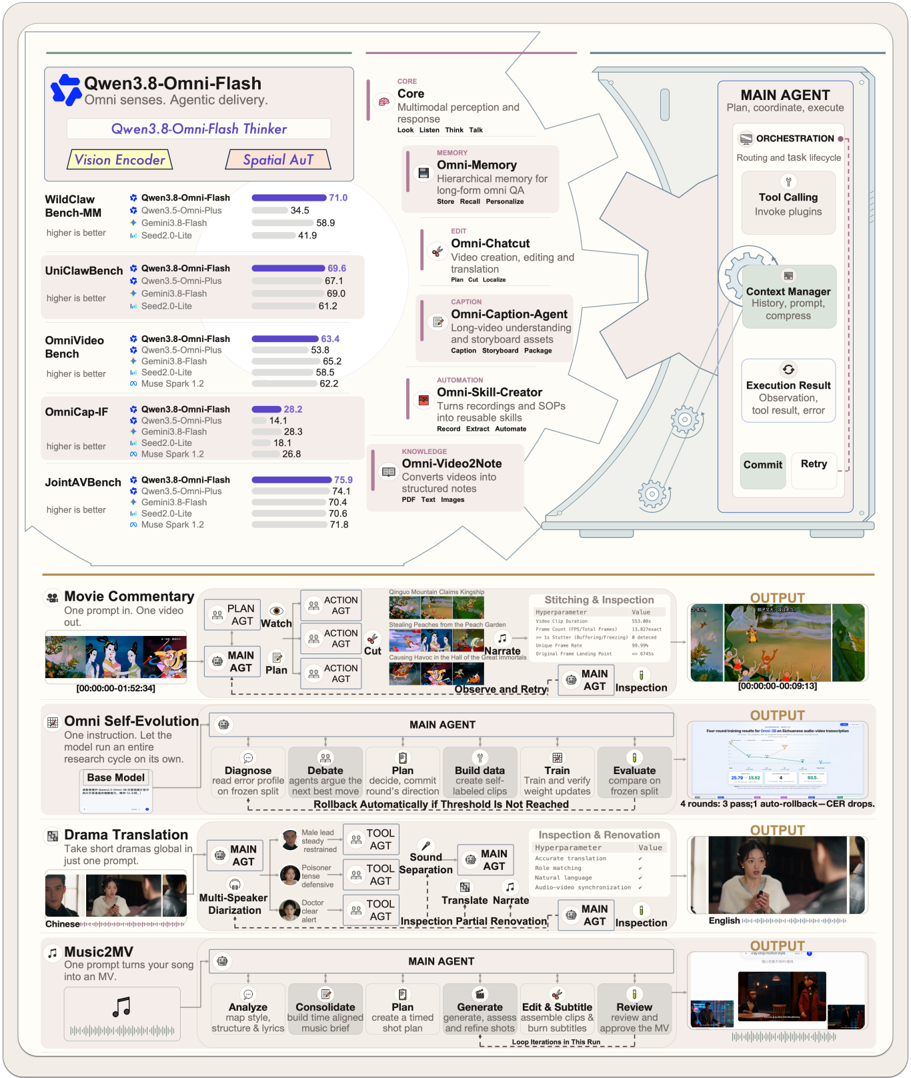
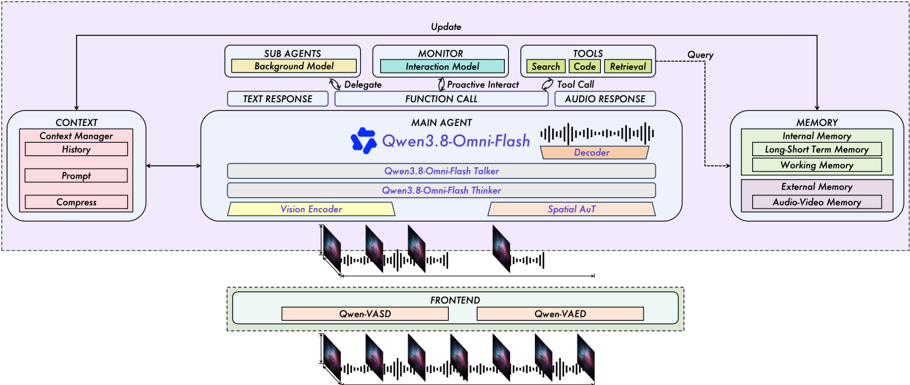
We introduce Qwen3.8-Omni-Flash, a natively multimodal agentic model for real-world multimodal productivity. Compared with previous omni models, which primarily emphasized perception and interaction, Qwen3.8-Omni-Flash substantially improves multimodal understanding and reasoning, as well as performance on long-horizon agentic tasks. These capabilities are supported by a native multimodal co-training strategy that preserves strong text-domain capabilities while facilitating the transfer of agentic capabilities from text to audio and video tasks. The model inherits the sparse mixture-of-experts (MoE) architecture of Qwen3.8-Next and extends the context window to one million tokens, supporting long-context multimodal reasoning and long-horizon planning. These advances enable integration into production workflows as a primary agent or a specialized sub-agent, supporting video editing, long-form audio and video translation, music-conditioned music video or movie generation, and video-based note or omni-skill creation. To address the lack of native audio and video support in existing agent harnesses, we release Qwen-MM-Plugins, a lightweight open-source plugin framework for multimodal productivity. We further frame real-time multimodal interaction as a system-level challenge requiring orchestration of context and memory management, tool use, and sub-agent delegation. Accordingly, we release Qwen-Live-Harness, an open-source framework for building responsive, real-time multimodal agents based on Qwen3.8-Omni-Flash. Extensive evaluations demonstrate that Qwen3.8-Omni-Flash achieves strong performance across multimodal understanding, reasoning, long-horizon agentic execution, and video productivity tasks. These results and the accompanying open-source tools support Qwen3.8-Omni-Flash as a practical foundation for deploying natively multimodal agents in research and production.
Overview
CoChat Summary
TL;DR
Qwen3.8-Omni-Flash is a natively multimodal agentic MoE model with a Thinker-Talker architecture, 1M-token context, and support for text, images, audio, spatial audio, and video. It reports broad gains over Qwen3.5-Omni-Plus across multimodal understanding, long-horizon agentic execution, and realtime interaction, alongside open-source Qwen-MM-Plugins and Qwen-Live-Harness frameworks.
Key findings
- Compared with Qwen3.5-Omni-Plus, it achieves >25% average score increase across 29 audio/audiovisual reasoning and agent evaluations, and reduces estimated API input costs per hour of audio and audiovisual content by >98% and >93%, respectively.
- Multi-speaker ASR improves sharply: AliMeeting Test DER/cpWER drops from 88.1/89.6 to 3.4/17.2; audio-visual reasoning improves on OmniVideoBench (53.8→63.4), Video-MME-v2 (47.9→65.0), and LVOmniBench (53.2→63.3).
- Agentic execution improves over Qwen3.5-Omni-Plus on WildClawBench-MM (34.5→71.0), AgenticVBench (14.5→36.8), OmniGAIA (57.2→74.0), and UniClawBench (67.1→69.6); on OmniVideoBench, agentic evidence gathering raises accuracy from 63.4 to 67.8 while reducing tokens per query from 145,736 to 79,117 (~45.7%).
- In an autonomous research test, it improved Qwen2.5-Omni-3B’s Sichuan dialect ASR CER from 25.79% to 15.30% (~40.7% relative reduction) within 12 hours; realtime API reports TTFC ~0.98–1.03 s for audio-only and ~1.21–1.35 s for audio-video inputs, with generation RTF ~0.153 (~6.5× realtime).
Methods
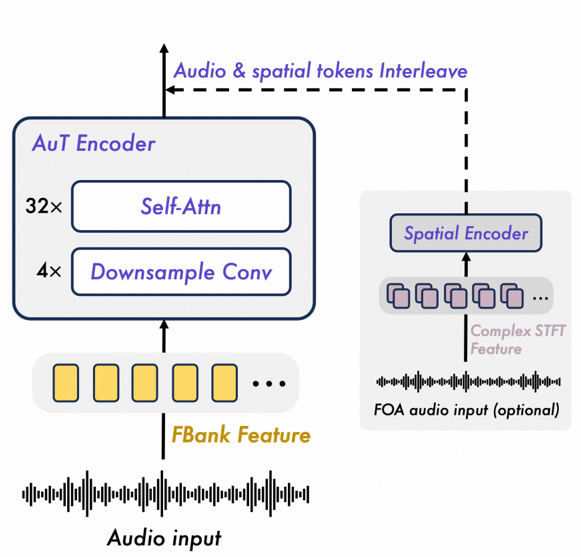
- Architecture: Thinker-Talker with hybrid sparse MoE backbone from Qwen3.8-Next, Gated DeltaNet plus interleaved attention transitioning to Qwen Sparse Attention (QSA); vision encoder, general AuT, and Spatial AuT encoders; native 256K pretraining context extended to 1M after post-training.
- Pretraining: four stages—S1 encoder alignment, S2 general stage on ~2.5T tokens (text 1.1T, audio 0.7T, image 0.35T, video 0.15T, video-audio 0.3T), S3 QSA warmup, S4 QSA joint training. Post-training: multi-teacher distillation followed by unified RL across text, vision, audio, and mixed-modality tasks.
- Evaluation: benchmark suites for text, visual, audio, audio-visual, omni-agentic, and realtime capabilities; baselines include Qwen3.8-Flash, Qwen3.8-27B, Qwen3.7-Plus, Qwen3.5-Omni-Plus, Gemini 3.8 Flash, Seed 2.0 Lite, and Muse Spark 1.2; agentic understanding compared Static vs Qwen Code settings.
Limitations
- The paper states that the agentic token-efficiency result “does not establish a corresponding reduction in end-to-end latency or monetary cost.”
- The paper reports remaining gaps: FLEURS-ASR error 9.3 vs Qwen3.5-Omni-Plus 7.2 and Gemini 3.8 Flash 7.9; FLEURS-S2TT 31.8 vs 32.2/33.0; WenetSpeech (Net) 4.8 vs 3.7; VoiceBench and WildSpeech below Qwen3.5-Omni-Plus and Gemini 3.8 Flash; LongAudioSpan Chain 48.2 below Gemini’s 64.6; Gemini leads AgenticVBench (45.0 vs 36.8) and OmniGAIA (78.6 vs 74.0).
- Evident from the text: many evaluations use in-house benchmarks (e.g., CoWorkBench, SpeechSuperClue) and specific harnesses (Claude Code, OpenClaw, Qwen Code), which limits cross-model comparability and independent reproducibility; the paper does not report independent replication or full training-compute details.
Model-written summary. Check it against the paper before relying on it.
Integrity signals
Registry
Cites
Statistics
Figures
Verification
Claims the paper makes
0 Valid · 18 Not valid · 3 Not checked · 113 Own results and interpretations
In the paper
“Compared with Qwen3.5-Omni-Plus(Qwen Team, 2026c), Qwen3.8-Omni-Flashintroduces several key improvements in scalability, alignment, and real-time interaction:”
§ Qwen3.8-Omni: Towards Native Omni-Modal Agents > 2.1 Architecture
What the sources say
- Not matchedcites Qwen Team, 2026c
An author–year citation the paper’s reference list doesn’t settle. We don’t search these by name.
plainstates a cause- Asserted: passes — The authors put it forward as true.
- Checkable: passes — It can be checked against evidence.
- Load-bearing: unclear — It is unclear whether the paper’s conclusions depend on it.
- Based: passes — The paper gives a reason why it holds.
- Not matched
A result the paper states — it cites no source for it, so there is none to check. The quote shows it is in the paper.
In the paper
“Qwen3.8-Omni-Flashcan also parallelize audio and visual analysis by delegating tasks to multiple subagents as needed.”
§ Qwen3.8-Omni: Towards Native Omni-Modal Agents > 5.1 Long Video Understanding
plainstates a cause- Asserted: passes — The authors put it forward as true.
- Checkable: passes — It can be checked against evidence.
- Load-bearing: unclear — It is unclear whether the paper’s conclusions depend on it.
- Based: unclear — It is unclear why the paper says it holds.
In the paper
“Compared with its predecessor, Qwen3.5-Omni-Plus(Qwen Team, 2026c), it achieves an increase of more than 25% in the average score across 29 evaluations spanning audio reasoning, audiovisual reasoning, and audiovisual agent tasks.”
§ Qwen3.8-Omni: Towards Native Omni-Modal Agents > 1 Introduction
What the sources say
- Not matchedcites Qwen Team, 2026c
An author–year citation the paper’s reference list doesn’t settle. We don’t search these by name.
plainstates a cause- Asserted: passes — The authors put it forward as true.
- Checkable: passes — It can be checked against evidence.
- Load-bearing: passes — The paper’s conclusions depend on it.
- Based: passes — The paper gives a reason why it holds.
- Not matched
A result the paper reports from its own data — it cites no other source for it, so there is none to check. The quote shows it is in the paper.
In the paper
“Extensive evaluations demonstrate that Qwen3.8-Omni-Flashachieves strong performance across multimodal understanding, reasoning, long-horizon agentic execution, and video productivity tasks.”
§ Qwen3.8-Omni: Towards Native Omni-Modal Agents > Abstract
boosted- Asserted: passes — The authors put it forward as true.
- Checkable: passes — It can be checked against evidence.
- Load-bearing: passes — The paper’s conclusions depend on it.
- Based: passes — The paper gives a reason why it holds.
A result the paper reports from its own data — it cites no other source for it, so there is none to check. The quote shows it is in the paper.
In the paper
“The largest improvements over Qwen3.5-Omni-Plusoccur in multi-speaker ASR.”
§ Qwen3.8-Omni: Towards Native Omni-Modal Agents > Multi-speaker recognition and audio understanding.
plainstates an association- Asserted: passes — The authors put it forward as true.
- Checkable: passes — It can be checked against evidence.
- Load-bearing: unclear — It is unclear whether the paper’s conclusions depend on it.
- Based: passes — The paper gives a reason why it holds.
28 more claims
Create a free account to see all 134 claims and every source verdict.
- It may state two separate claims as one. 83
- Probably not a substantial claim. 45
Self-check
Percentages, sums and reported differences re-computed from the paper’s own numbers.
Each contradiction between two passages listed here was confirmed by an independent check.
Rated major: it would touch a result — a value a result rests on, reported and recomputed p-values on opposite sides of the significance level, two passages that conflict with no sign which is right, or a cited work retracted before this paper was published.
In the paper
§ Qwen3.8-Omni: Towards Native Omni-Modal Agents > 6.1.4 Audio-Visual Capabilities
“with its OmniEchoBench score increasing from 23.3 to 41.7.”
§ Qwen3.8-Omni: Towards Native Omni-Modal Agents > 6.1.4 Audio-Visual Capabilities
“OmniEchoBench 43.9 23.3 32.0 28.3 31.3”
Rated minor: it would not touch a result — a value no result rests on, a p-value that stays on the same side of the significance level, or a conflict that is clerical, resolved elsewhere in the paper, or outside its own findings.
In the paper
§ Qwen3.8-Omni: Towards Native Omni-Modal Agents > 6.1.4 Audio-Visual Capabilities
“ties the previous generation on OmniVChat-Bench at 89.0.”
§ Qwen3.8-Omni: Towards Native Omni-Modal Agents > 6.1.4 Audio-Visual Capabilities
“OmniVChat-Bench 89.0 52.1 65.6 45.2 69.8”
Rated minor: it would not touch a result — a value no result rests on, a p-value that stays on the same side of the significance level, or a conflict that is clerical, resolved elsewhere in the paper, or outside its own findings.
In the paper
§ Qwen3.8-Omni: Towards Native Omni-Modal Agents > Multimodal Encoder
“The vision encoder, adopted from Qwen3.8-Next (Qwen Team, 2026a), processes images and sampled video frames.”
§ Qwen3.8-Omni: Towards Native Omni-Modal Agents > Modality # Varieties Supported languages and dialects
“the vision encoder is adopted from Qwen3.5 and the audio encoders are initialized with AuT and Spatial AuT.”
Citations
Cites
DeepSeek-R1: Incentivizing Reasoning Capability in LLMs via Reinforcement Learning
DeepSeek-AI, Guo, D., Yang, D., Zhang, H., Song, J., Wang, P., Zhu, Q., Xu, R., Zhang, R., Ma, S., et al. (2025) · arXiv · doi:10.48550/arxiv.2501.12948 · Cited by 18,918
Measuring Multimodal Mathematical Reasoning with MATH-Vision Dataset
Wang, K., Pan, J., Shi, W., Lu, Z., Ren, H., Zhou, A., Zhan, M., & Li, H. (2024) · neural information processing systems · doi:10.52202/079017-3014 · Cited by 956
Measuring Multimodal Mathematical Reasoning with MATH-Vision Dataset
Wang, K., Pan, J.-T., Shi, W.-K., Lu, Z.-M., Zhan, M.-J., & Li, H.-S. (2024) · arXiv.org · doi:10.48550/arxiv.2402.14804 · Cited by 804
CharXiv: Charting Gaps in Realistic Chart Understanding in Multimodal LLMs
Wang, Z., Xia, M., He, L., Chen, H., Liu, Y., Zhu, R., Liang, K., Wu, X., Liu, H., Malladi, S., et al. (2024) · neural information processing systems · doi:10.52202/079017-3609 · Cited by 491
SWE-Bench Pro: Can AI Agents Solve Long-Horizon Software Engineering Tasks?
Deng, X., Da, J., Pan, E., He, Y. Y., Ide, C., Garg, K., Lauffer, N., Park, A., Pasari, N., Rane, C., et al. (2025) · arXiv · doi:10.48550/arxiv.2509.16941 · Cited by 484
Qwen3.5-Omni Technical ReportPreprint
Qwen Team (2026) · arXiv (Cornell University) · doi:10.48550/arxiv.2604.15804 · Cited by 418
Self-citationWENETSPEECH: A 10000+ Hours Multi-Domain Mandarin Corpus for Speech Recognition
Zhang, B., Lv, H., Guo, P., Shao, Q., Yang, C., Xie, L., Xu, X., Bu, H., Chen, X., Zeng, C., et al. (2022) · IEEE International Conference on Acoustics Speech and Signal Processing · doi:10.1109/icassp43922.2022.9746682 · Cited by 413
VoiceBench: Benchmarking LLM-Based Voice Assistants
Chen, Y., Yue, X., Zhang, C., Gao, X., Tan, R. T., & Li, H. (2026) · Transactions of the Association for Computational Linguistics · doi:10.1162/tacl.a.628 · Cited by 302
CharXiv: Charting Gaps in Realistic Chart Understanding in Multimodal LLMsPreprint
Wang, Z., Xia, M., He, L., et al. (2024) · Neural Information Processing Systems · doi:10.48550/arxiv.2406.18521 · Cited by 278
VoiceBench: Benchmarking LLM-Based Voice Assistants
Chen, Y.-M., Yue, X.-H., Zhang, C., Gao, X.-X., Tan, R., & Li, H.-Z. (2024) · Transactions of the Association for Computational Linguistics · doi:10.48550/arxiv.2410.17196 · Cited by 277
Research works printed but not linked: 3
- Yihui Fu, Luyao Cheng, Shubo Lv, Yukai Jv, Yuxiang Kong, Zhuo Chen, Yanxin Hu, Lei Xie, Jian Wu, Hui Bu, Xin Xu, Jun Du, and Jingdong Chen. Aishell-4: An open source dataset for speech enhancement, separation, recognition and speaker diarization in conference scenario. In Interspeech, 2021. URL https://api.semanticscholar.org/CorpusID:233181491.
- Kabir Khandpur, Kilian Lieret, Carlos E. Jimenez, Ofir Press, and John Yang. SWE-bench Multilingual, 2025. URL https://www.swebench.com/multilingual.html. Accessed: 2026-09-18.
- Chris Rawles, Sarah Clinckemaillie, Yifan Chang, Jonathan Waltz, Gabrielle Lau, Marybeth Fair, Alice Li, William Bishop, Wei Li, Folawiyo Campbell-Ajala, et al. Androidworld: A dynamic benchmarking environment for autonomous agents. In International Conference on Learning Representations, volume 2025, pp. 406-441, 2025.
Cited by
VideoNexus: Video Perception Beyond the Reasoning ContextPreprint
Long, Y., Zheng, X., Chen, W., Zhang, L., Xu, H., Wen, B., & Gao, T. (2026) · arXiv (Cornell University) · doi:10.48550/arxiv.2611.21392 · Cited by 1
Almost Human, Except When It Matters: VoxParity and the Decisions a Voice Should ChangePreprint
Mangla, B. (2026) · arXiv (Cornell University) · doi:10.48550/arxiv.2609.35922
The GUI Is Not the State: Diagnosing State Aliasing in GUI World ModelsPreprint
Liu, D., Jin, C., Yang, W., Wang, H., Yang, J., Zhang, Z., Chen, Z., Huang, H., Cao, J., & He, R. (2026) · arXiv (Cornell University) · doi:10.48550/arxiv.2609.32679
Sayeedi, N. L., Sayeedi, M. F. A., Nazi, Z. A., Sobhani, M. E., & Dipta, S. R. (2026) · arXiv (Cornell University) · doi:10.13016/m2il0e-smya
ADIndex: Layer-Adaptive Sparse Attention Indexing via Group-Level DistillationPreprint
Qi, J.-F., Li, Y.-D., Shi, J.-X., Liu, K., Lan, T., Tang, H.-L., & Li, Y.-F. (2026) · arXiv (Cornell University) · doi:10.48550/arxiv.2611.12956
Metadata
- Authors
- Qwen Team
- Corresponding author
- Qwen Team
- Venue
- arXiv
- Publisher
- arXiv
- Published
- 2026
- ISSN
- 2331-8422 (ISSN-L)
- arXiv
- 2609.25611
- OpenAlex
- W7214110418
- Semantic Scholar
- 34eec6599a554564f81c19cbb5069b9c7ffdda45
- Cited by
- 15
- References
- 57
- Citations by year
- 2026: 15
- Type
- posted content
- Language
- en
- Open access
- green
- arxiv.org
- Licence
- Locations
- arXiv (Cornell University) (submittedVersion, cc-by)
- arXiv (Cornell University) (cc-by)
- Topics
- Physical Sciences › Computer Science › Computer Vision and Pattern Recognition › Multimodal Machine Learning Applications
- Physical Sciences › Computer Science › Artificial Intelligence › Speech and dialogue systems
- Physical Sciences › Computer Science › Computer Vision and Pattern Recognition › Advanced Neural Network Applications
- Keywords
- agentic AI, multimodal reasoning, long-horizon planning, sparse mixture-of-experts, long-context understanding, video editing, tool use
About these checks
Registry, retraction, Cites and statistics results are computed, not judged, with one exception: a printed reference that no index lists is read once by a model before it counts as a citation error. Claims are extracted by a model and kept only when their quote appears verbatim in the text; each cited source is then checked, with a model’s help, for whether it says what the claim relies on. Those verdicts can be wrong — read the claim’s quote and the cited source before relying on one.
A language model drew the claims from the paper on 2026-11-22, under version 3 of the claim definition (model deepseek-v4.1-flash, prompt extract-v3).
A second model labelled each claim on 2026-11-22 (model jev-1.13-20260917, definition revision gold-guideline-v0.2).
Statistics and arithmetic are recomputed, not judged.
Confidence bands are shown only for fields calibrated on our annotated test set. None is calibrated yet, so no band is shown.
What counts as a claim ›How we measure confidence ›How we check this ›
Are you an author, or do you see a problem with this page? Request a review
How to cite
Cite CoChat for the checks on this page, and the paper for its own findings.
- This page
- CoChat. (2026). Citation check: Qwen3.8-Omni: Towards Native Omni-Modal Agents. https://app.cochat.ai/papers/10.48550/arxiv.2609.25611
- The paper
- Qwen Team. (2026). Qwen3.8-Omni: Towards Native Omni-Modal Agents. arXiv. https://doi.org/10.48550/arxiv.2609.25611
Data sources
Bibliographic data: Semantic Scholar, OpenAlex, Crossref.
Contains information from the Semantic Scholar Academic Graph Datasets, made available under the ODC Attribution License (ODC-BY 1.0).
Semantic Scholar’s data is described in: Kinney, R., et al. (2023). The Semantic Scholar Open Data Platform. arXiv:2301.10140.
