

Fermat curves and explicit class field theory for real quadratic number fields
Open accessThe DOI matches its DataCite record; 41 of the 41 references it cites were found in a registry or an index; none of the 87 sources its claims cite is checked for support yet.
Abstract
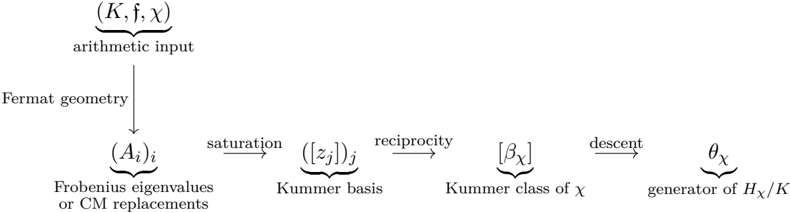
We use Fermat curves with real multiplication and classical CM theory to construct an explicit class field theory for arbitrary real quadratic number fields. The underlying strategy is well-established in computational class field theory, our main contribution is a geometric model to realize this strategy explicitly. This approach complements the recent breakthrough works solving conjectures by Brumer, Stark and Shintani and gives an alternative constructive solution to Hilbert's 12th problem for real quadratic fields.
Overview
CoChat Summary
TL;DR
The paper constructs an explicit class field theory for arbitrary real quadratic number fields using Fermat curves with real multiplication and classical CM theory. It gives a constructive solution to Hilbert’s 12th problem for real quadratic fields via explicit Kummer bases, reciprocity selection, and Galois descent.
Key findings
- Theorem 15.2 assembles explicit generators: for the prime-power coordinate characters \(\chi_{j,p}\), one has \(K^+_{\mathfrak f}=K(\theta_{\chi_{j,p}}: p\mid d_j)\), with defining equations and Galois action (Theorem 1.1).
- The target Kummer classes lie in explicit modules: ordinary case \(W_\Sigma \simeq U_\Sigma/U_\Sigma^n\) (Theorem 4.1), general case \(W^{(1)}_\Sigma \simeq U^{(1)}_\Sigma/(U^{(1)}_\Sigma)^n\) (Theorem 4.2).
- The Kummer bases come from Frobenius eigenvalues of Fermat Jacobians with real multiplication by \(K\): ordinary curve \(C_{n,\Delta}: Y^n+Z^\Delta=1\), general curve \(C_{M,\Delta}: Y^M+Z^\Delta=1\), with Jacobi sums at good primes and Shimura–Taniyama at bad primes; an alternative uses \(C_c: z^c=x(1-x)\) and Jacobi sums at all support primes without requiring RM by \(K\) (Theorem 11.8).
- Examples include \(K=\mathbb Q(\sqrt2)\), \(n=5\), \(\mathfrak f=(1025)\), where \(\theta_\chi\) has minimal polynomial \(X^5-10X^3+\frac{380}{41}X^2+\frac{185}{41}X-\frac{404}{1681}\); and \(K=\mathbb Q(\sqrt5)\), \(\mathfrak p=(4-\sqrt5)\) of norm \(11\), where \(\theta_\chi=3\phi-2\) and \(X^4-3X^3+3X^2-3X+1\) is the minimal polynomial of Shintani’s invariant.
Methods
- Theoretical construction: ray class characters, Kummer theory, Artin reciprocity selection, equivariant Galois descent, and \(p\)-saturation to obtain Kummer bases modulo \(n=p^a\).
- Geometric input: Fermat curves with real multiplication by \(K\), Frobenius determinants on RM eigenspaces, Jacobi sums, and CM/Shimura–Taniyama formulas at bad primes; proofs use Stickelberger/Jacobi factorization and nonvanishing of Dirichlet \(L\)-values at \(0\) and \(1\).
- Computational support: Smith normal form for ray-group coordinates and lattice indices; examples computed with SageMath and Pari, with AI tools used for calculations, proofreading, references, and checking examples.
Limitations
- Stated: “The main mystery of whether there is a geometric replacement for elliptic curves with CM for a real quadratic number field remains completely open!”; the paper also says it does not implement local evaluations at every mixed level, and its uniform algorithm uses principalized CM-ideal inputs rather than exact bad-prime Frobenius values.
- Stated: the power identity can leave a root-of-unity ambiguity, and the paper does not choose a root of that equation; Appendix C also does not specify a minimal \(a_0\).
- Evident from the text: the explicit examples are small, arithmetic evaluations are omitted, and the method relies on class-group/unit computations, saturation/root extraction, and nonvanishing \(L\)-values; no general complexity bounds or full implementation are given.
Model-written summary. Check it against the paper before relying on it.
Integrity signals
Registry
Cites
Statistics
Figures
Verification
Claims the paper makes
0 Valid · 11 Not valid · 61 Not checked · 257 Own results and interpretations
A result the paper states — it cites no source for it, so there is none to check. The quote shows it is in the paper.
In the paper
“Suppose β ∈ E × satisfies (R χ ). For δ ∈ Gal(E/K), let 1 ≤ u δ < n be determined by δ(ζ n ) = ζ u δ n . Then δ([β]) = [β] u δ in E × /E ×n . (2.11) Equivalently, there is c δ ∈ E × such that c n δ = δ(β)/β u δ .”
§ FERMAT CURVES AND EXPLICIT CLASS FIELD THEORY FOR REAL QUADRATIC NUMBER FIELDS > 2.3. Kummer theory after adjoining roots of unity.
plainstates a cause- Asserted: passes — The authors put it forward as true.
- Checkable: passes — It can be checked against evidence.
- Load-bearing: passes — The paper’s conclusions depend on it.
- Based: passes — The paper gives a reason why it holds.
A result the paper states — it cites no source for it, so there is none to check. The quote shows it is in the paper.
In the paper
“These need not equal the Frobenius values, but give the same Kummer module after saturation.”
§ FERMAT CURVES AND EXPLICIT CLASS FIELD THEORY FOR REAL QUADRATIC NUMBER FIELDS > 1.2. The Fermat geometry.
plainstates an association- Asserted: passes — The authors put it forward as true.
- Checkable: passes — It can be checked against evidence.
- Load-bearing: passes — The paper’s conclusions depend on it.
- Based: passes — The paper gives a reason why it holds.
In the paper
“Then Theorem 10. 2 gives A q ℓ (v) = N F/E det(Frob P ℓ | M + v ) det(Frob P ℓ | M + -v ) ∈ U (1 ) Σ .”
§ FERMAT CURVES AND EXPLICIT CLASS FIELD THEORY FOR REAL QUADRATIC NUMBER FIELDS > 1.2. The Fermat geometry.
What the sources say
- Not matchedcites Theorem 10.2
This doesn’t read as a citation we can look up.
plainstates a cause- Asserted: passes — The authors put it forward as true.
- Checkable: passes — It can be checked against evidence.
- Load-bearing: passes — The paper’s conclusions depend on it.
- Based: passes — The paper gives a reason why it holds.
- Not matched
A result the paper states — it cites no source for it, so there is none to check. The quote shows it is in the paper.
In the paper
“At ℓ ∤ M , the determinants are again products of Jacobi sums.”
§ FERMAT CURVES AND EXPLICIT CLASS FIELD THEORY FOR REAL QUADRATIC NUMBER FIELDS > 1.2. The Fermat geometry.
plainstates an association- Asserted: passes — The authors put it forward as true.
- Checkable: passes — It can be checked against evidence.
- Load-bearing: passes — The paper’s conclusions depend on it.
- Based: passes — The paper gives a reason why it holds.
The paper states this without a source or data behind it here, so there is nothing to check it against. The quote shows it is in the paper.
In the paper
“We use Fermat curves with real multiplication and classical CM theory to construct an explicit class field theory for arbitrary real quadratic number fields.”
§ FERMAT CURVES AND EXPLICIT CLASS FIELD THEORY FOR REAL QUADRATIC NUMBER FIELDS > Abstract
plainstates a cause- Asserted: passes — The authors put it forward as true.
- Checkable: passes — It can be checked against evidence.
- Load-bearing: passes — The paper’s conclusions depend on it.
- Based: unclear — It is unclear why the paper says it holds.
146 more claims
Create a free account to see all 329 claims and every source verdict.
- It may state two separate claims as one. 148
- Probably not a substantial claim. 46
Citations
Cites
A Course in Computational Algebraic Number Theory
Cohen, H. (1993) · Graduate Texts in Mathematics · doi:10.1007/978-3-662-02945-9 · Cited by 2,567
Neukirch, J. (1999) · Grundlehren der mathematischen Wissenschaften · doi:10.1007/978-3-662-03983-0 · Cited by 2,428
Introduction to Analytic Number Theory
Apostol, T. M. (1976) · Undergraduate texts in mathematics · doi:10.1007/978-1-4757-5579-4 · Cited by 2,364
Introduction to Cyclotomic Fields
Washington, L. C. (1997) · Graduate texts in mathematics · doi:10.1007/978-1-4612-1934-7 · Cited by 2,010
Berndt, B. C., Williams, K. S., & Evans, R. J. (1998) · Cited by 1,078
Good Reduction of Abelian Varieties
Serre, J.-P., & Tate, J. (1968) · Annals of Mathematics · doi:10.2307/1970722 · Cited by 827
Numbers of solutions of equations in finite fields
Weil, A. (1949) · Bulletin of the American Mathematical Society · doi:10.1090/s0002-9904-1949-09219-4 · Cited by 521
Advanced Topics in Computional Number Theory
Cohen, H. (2000) · Graduate texts in mathematics · doi:10.1007/978-1-4419-8489-0 · Cited by 462
Central Simple Algebras and Galois Cohomology
Gille, P., & Szamuely, T. (2006) · Cambridge University Press eBooks · doi:10.1017/cbo9780511607219 · Cited by 425
Complex multiplication of Abelian varieties and its applications to number theory
志村, 五., & Taniyama, Y. (1961) · Mathematical Society of Japan eBooks · Cited by 376
Research works printed but not linked: 2
- Jean-Pierre Serre. Local Fields, volume 67 of Graduate Texts in Mathematics. Springer, 1979. Translated by Marvin Jay Greenberg.
- Takuro Shintani. On a Kronecker limit formula for real quadratic fields. Journal of the Faculty of Science, the University of Tokyo, Section IA, Mathematics, 24(1):167-199, 1977.
Cited by
Still being checked.
Metadata
- Authors
- Yalkinoglu, B.
- Affiliations
- Centre National de la Recherche Scientifique (FR)
- Corresponding author
- Yalkinoglu, Bora
- ORCID
- Yalkinoglu, Bora
- Venue
- arXiv
- Publisher
- arXiv
- Published
- 2026
- ISSN
- 2331-8422 (ISSN-L)
- arXiv
- 2611.01201
- OpenAlex
- W7225193911
- Semantic Scholar
- 4df8bc08685f14e8e5d5d99cbfb4d5c35c1f4bbb
- Cited by
- 0
- References
- 40
- Type
- posted content
- Language
- en
- Open access
- green
- arxiv.org
- Licence
- Locations
- arXiv (Cornell University) (submittedVersion, cc-by)
- Topics
- Physical Sciences › Mathematics › Algebra and Number Theory › Advanced Algebra and Geometry
- Physical Sciences › Mathematics › Geometry and Topology › Algebraic Geometry and Number Theory
- Physical Sciences › Mathematics › Algebra and Number Theory › Analytic Number Theory Research
- Keywords
- Fermat curves, real quadratic fields, complex multiplication, real multiplication, Stark conjectures
About these checks
Registry, retraction, Cites and statistics results are computed, not judged, with one exception: a printed reference that no index lists is read once by a model before it counts as a citation error. Claims are extracted by a model and kept only when their quote appears verbatim in the text; each cited source is then checked, with a model’s help, for whether it says what the claim relies on. Those verdicts can be wrong — read the claim’s quote and the cited source before relying on one.
A language model drew the claims from the paper on 2026-11-24, under version 3 of the claim definition (model deepseek-v4.1-flash, prompt extract-v3).
A second model labelled each claim on 2026-11-24 (model jev-1.13-20260917, definition revision gold-guideline-v0.2).
Statistics and arithmetic are recomputed, not judged.
Confidence bands are shown only for fields calibrated on our annotated test set. None is calibrated yet, so no band is shown.
What counts as a claim ›How we measure confidence ›How we check this ›
Are you an author, or do you see a problem with this page? Request a review
How to cite
Cite CoChat for the checks on this page, and the paper for its own findings.
- This page
- CoChat. (2026). Citation check: Fermat curves and explicit class field theory for real quadratic number fields. https://app.cochat.ai/papers/10.48550/arxiv.2611.01201
- The paper
- Yalkinoglu, B. (2026). Fermat curves and explicit class field theory for real quadratic number fields. arXiv. https://doi.org/10.48550/arxiv.2611.01201
Data sources
Bibliographic data: Semantic Scholar, OpenAlex, Crossref.
Contains information from the Semantic Scholar Academic Graph Datasets, made available under the ODC Attribution License (ODC-BY 1.0).
Semantic Scholar’s data is described in: Kinney, R., et al. (2023). The Semantic Scholar Open Data Platform. arXiv:2301.10140.
