

The DOI matches its Crossref record; the references it cites are not checked yet.
Exploring the potential synergistic pharmacological and psychological effects of caffeine on exercise performance: a placebo-balanced study
Open accessAbstract
Research specifically investigating the distinct pharmacological and expectancy effects of caffeine using the deceptive placebo-balanced design remains scarce and with contradictory results.The aim of this study was to investigate the potential synergy between the pharmacological and expectancy effects of caffeine on exercise performance by using a placebo-balanced design.Sixteen physically trained athletes (11 males and 5 females; 21.7 ± 5.0 yr) participated in a study with a deceptive protocol including four randomized conditions: placebo informed-placebo ingested (control); placebo informed-caffeine ingested (pharmacological effect); caffeine informed-placebo ingested (expectancy effect); and caffeine informed-caffeine ingested (combined effects).Sixty minutes after ingestion, participants performed a countermovement jump, a standing triple jump, a medicine ball throw and a 20-m running sprint test.Relative to control, the pharmacological effect trial increased standing triple jump distance (+2.1% p = 0.032; Cohen's d= 0.59) and reduced 20-m sprint time (-0.8% p = 0.030; Cohen's d= 0.60).The combined effect trial reduced 20-m sprint time (-0.8% p = 0.021; Cohen's d= 0.64) in comparison to control.The expectancy effect trial did not modify performance in any of the performance tests with respect to control.When averaging the performance across all four tests, improvements relative to the control trial were +0.9%, +0.6% and +1.3% for pharmacological, expectancy and combined effects, respectively.The ingestion of caffeine, whether or not participants expected to receive it, improved exercise performance.This suggests that the primary driver of caffeine's ergogenic effect is its pharmacological action, with only a minor contribution from expectancy.
Overview
The claims and statistics of this paper haven’t been checked yet.
Run the check — free, no account needed. It reads the open-access text and checks the sources it cites.
Integrity signals
Registry
Cites
Statistics
Figures
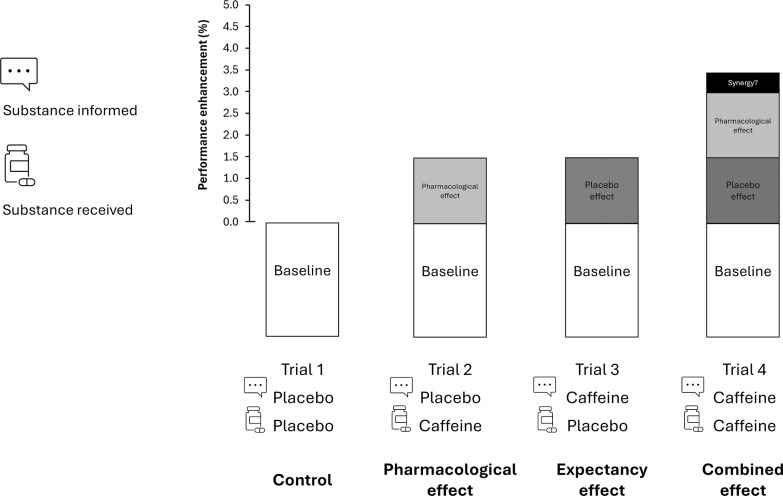
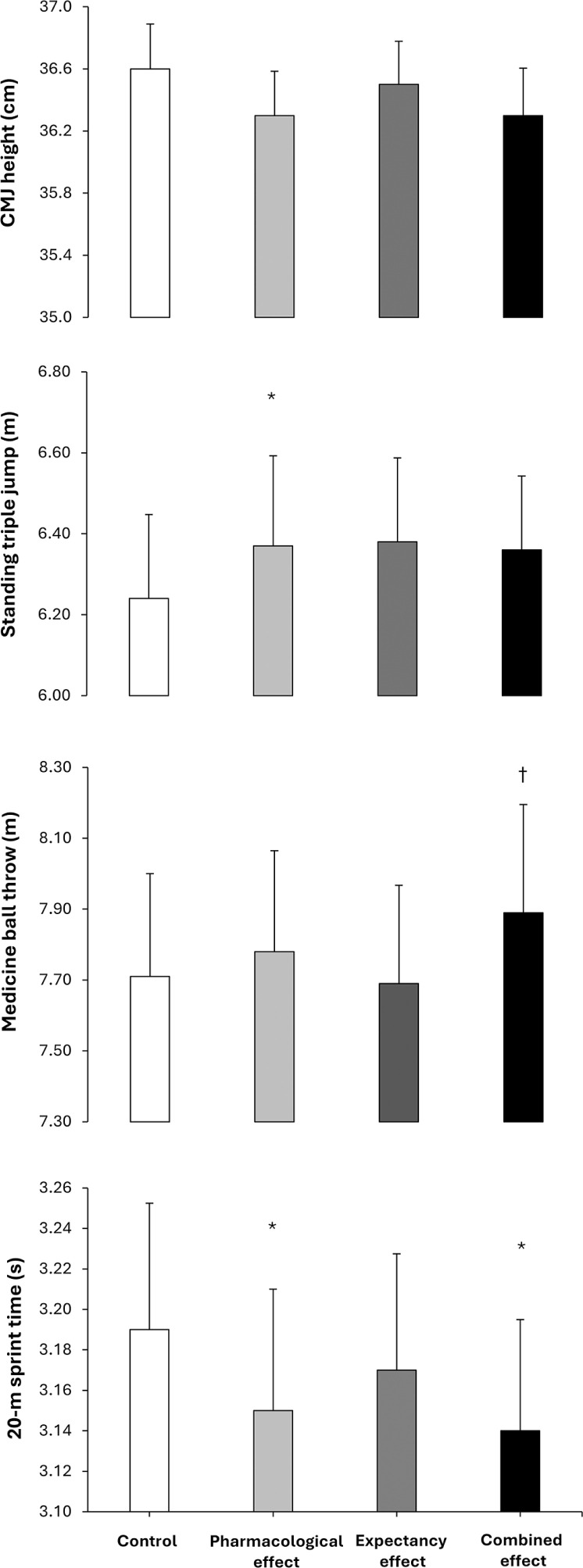
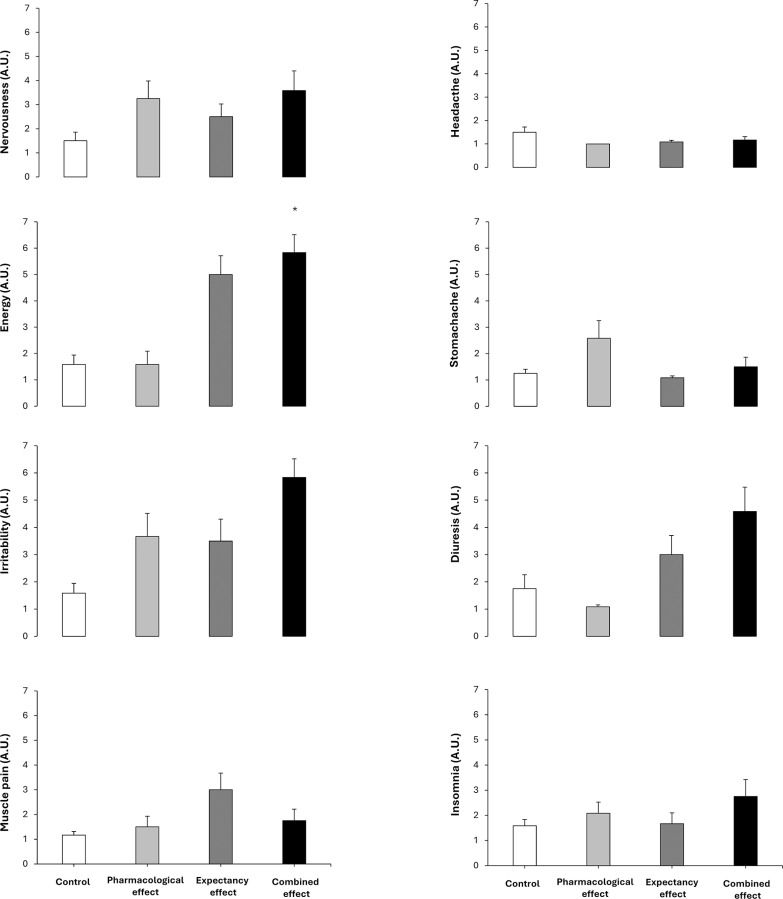
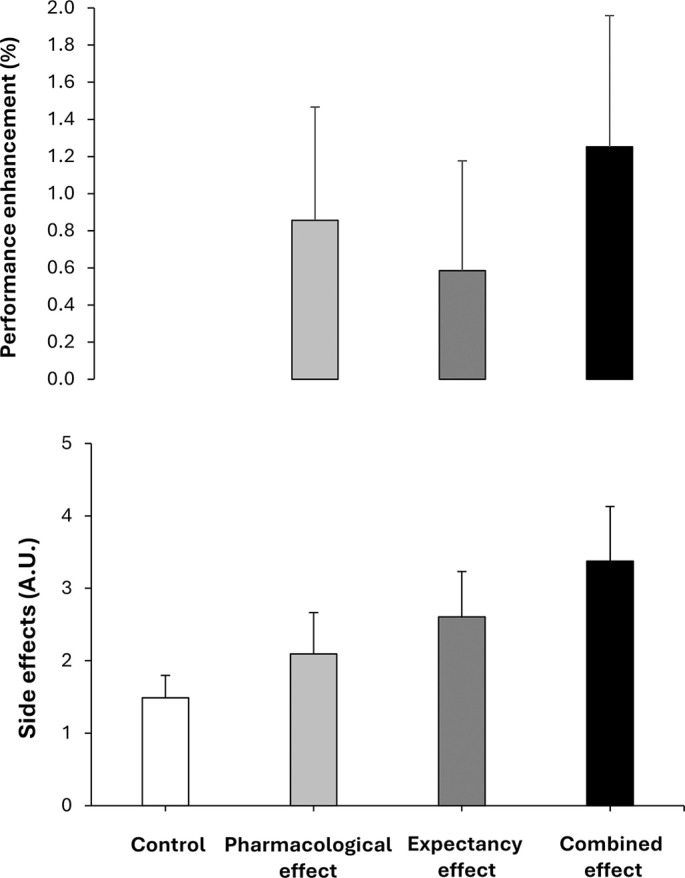
Verification
Claims the paper makes
The claims and statistics of this paper haven’t been checked yet.
Run the check — free, no account needed. It reads the open-access text and checks the sources it cites.
Claims other papers make about this one
Each is checked against this paper’s own text: does it say what the citing paper says it does?
The cited source says what the claim attributes to it.
In the citing paper
“In addition, psychological expectancy and placebo-related effects may further modify perceived or performance responses to caffeine, complicating the attribution of observed effects to pharmacological caffeine exposure alone [105].”
From Pre-Exercise Caffeine as a Modulator of Exercise-Induced Acute Cardiometabolic Responses: A Narrative Review (2026) · cites this paper as [105]
Self-check
Percentages, sums and reported differences re-computed from the paper’s own numbers.
The self-check needs the paper’s full text.
Citations
Cites
The publisher hasn’t deposited this paper’s reference list.
Research works printed but not linked: 2
- [2]Beedie C, Hettinga F. Introduction to the special edition on the placebo effect in sport and exercise. Eur J Sport Sci. 2020; 20(3): 277– 8. doi: 10.1080/17461391.2020.1757682. 32299310 · DOI
- [23]Bühler E, Lachenmeier DW, Schlegel K, Winkler G. Development of a tool to assess the caffeine intake among teenagers and young adults. Ernähr Umsch. 2014; 61(4): 58– 63.
Cited by
Sorted by citations
Geng, H., Zhou, Z., Meng, L., Zhuang, M., & Zhao, Y. (2026) · Metabolites · doi:10.3390/metabo16070478 · Cited by 2
Caffeine and human performance: from molecular mechanisms to exercise and recovery
Leng, J., Yu, J. K., Li, Z. L., Zhang, Y., & Cui, J. (2026) · Frontiers in Physiology · doi:10.3389/fphys.2026.1871149 · Cited by 2
Delleli, S., Díaz‐Lara, J., & Chtourou, H. (2026) · Frontiers in Physiology · doi:10.3389/fphys.2026.1865993
Placebo effects of caffeine on sport performance: a systematic review and meta-analysis
Hurst, P., Hanssen, J., Marticorena, F. M., Schiphof‐Godart, L., de Souza, H. L. R., Marocolo, M., & Saunders, B. (2026) · Journal of the International Society of Sports Nutrition · doi:10.1080/15502783.2026.2747142
Metadata
- Authors
- Coso, J., Lara, B., Gallo-Salazar, C., Areces, F., Aguilar-Navarro, M., Giráldez-Costas, V., Gutiérrez-Hellín, J., Valero, F., & Salinero, J. J.
- Affiliations
- Universidad Rey Juan Carlos (ES)
- HM Hospitales (ES)
- University of Castilla-La Mancha (ES)
- Venue
- Biology of Sport
- Publisher
- Termedia Sp. z.o.o.
- Published
- 2026
- Volume
- 43
- Pages
- 95-105
- ISSN
- 0860-021X (ISSN-L)
- PMC
- PMC12884890
- OpenAlex
- W4412997432
- Cited by
- 3
- References
- 0
- Citations by year
- 2026: 3
- FWCI
- 1.70
- Type
- journal article
- Language
- en
- Open access
- gold
- doi.org
- Licence
- cc-by
- Locations
- Biology of Sport (publishedVersion, cc-by)
- Europe PMC (PubMed Central) (publishedVersion, cc-by)
- PubMed (publishedVersion)
- PubMed Central (publishedVersion, cc-by)
- DOAJ (DOAJ: Directory of Open Access Journals) (submittedVersion, cc-by-sa)
- RUIdeRA - Institutional University Repository (University of Castilla-La Mancha) (submittedVersion, other-oa)
- Funders
- Ministerio de Ciencia e Innovación (.13039/501100011033, / AEI/10, 501100011033, PID2020)
- Agencia Estatal de Investigación (501100011033, 13039, .13039/501100011033, AEI/10)
- Topics
- Health Sciences › Medicine › Pharmacology (medical) › Coffee research and impacts
- Health Sciences › Medicine › Orthopedics and Sports Medicine › Sports Performance and Training
- Social Sciences › Psychology › Developmental and Educational Psychology › Sport Psychology and Performance
- Keywords
- caffeine, exercise performance, placebo effect, expectancy effects, pharmacological activity, ergogenic aids, countermovement jump, medicine ball throw, sprint performance, athletes
About these checks
Registry, retraction, Cites and statistics results are computed, not judged, with one exception: a printed reference that no index lists is read once by a model before it counts as a citation error. Claims are extracted by a model and kept only when their quote appears verbatim in the text; each cited source is then checked, with a model’s help, for whether it says what the claim relies on. Those verdicts can be wrong — read the claim’s quote and the cited source before relying on one.
Statistics and arithmetic are recomputed, not judged.
Confidence bands are shown only for fields calibrated on our annotated test set. None is calibrated yet, so no band is shown.
What counts as a claim ›How we measure confidence ›How we check this ›
Are you an author, or do you see a problem with this page? Request a review
