

The importance of acid-processed meteoric smoke relative to meteoric fragments for crystal nucleation in polar stratospheric clouds
Open accessPublished version of a preprint
The DOI matches its Crossref record; 78 of the 78 references it cites were found in a registry or an index.
Abstract
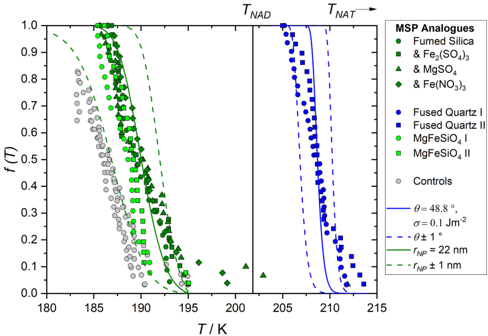
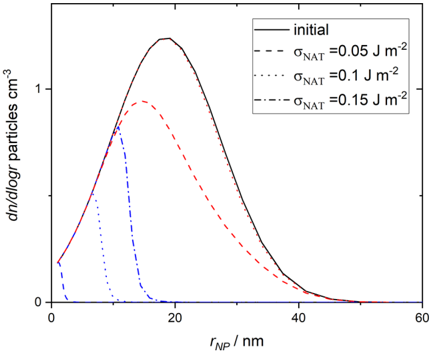
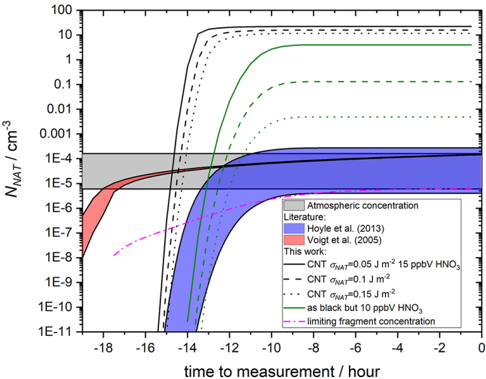
The crystal formation of nitric acid trihydrate (NAT) in the absence of water ice is important for a subset of polar stratospheric clouds (PSCs) and thereby ozone depletion. It has been suggested that either fragmented meteoroids or meteoric smoke particles (MSPs), or possibly both, are important as heterogeneous nuclei of these crystals. Previous work has focused on the nucleating ability of meteoric material in nitric acid in the absence of sulfuric acid. However, it is known that when immersed in stratospheric sulfuric acid droplets, metal-containing meteoric material particles partially dissolve and components can reprecipitate as silica and alumina that have different morphologies to the original meteoric material. Hence, in this study, we experimentally and theoretically explore the relative role that sulfuric acid-processed MSPs and meteoric fragments may play in NAT nucleation in PSCs. We compared meteoric fragments that had recently been prepared (by milling a meteorite sample) to a sample annealed under conditions designed to simulate heating during entry into the Earth's atmosphere. Whilst the addition of sulfuric acid decreased the nucleating ability of the recently milled meteoric material relative to nucleation in binary nitric acid-water solutions (at similar NAT saturation ratio), the annealed meteoric fragments nucleated NAT with a similar effectiveness in both solutions. However, combining our results with measured fluxes of meteoric material to the Earth, sedimentation modelling and recent experiments on fragmentation of incoming meteoroids suggests that it is unlikely for there to be sufficient fragments to contribute to the nucleation of crystalline NAT particles. We then considered silica formed from sulfuric acid-processed MSPs. Our previous work showed that nanoparticulate silica (radius ∼6 nm) is a relatively poor promoter of nucleation compared with micron-scaled silica particles, which were more effective. Both materials have similar chemical and structural (crystallographically amorphous) properties, indicating that size is critical. Here, we account for surface curvature of primary grains using the Classical Nucleation Theory (CNT) to explore this size dependence. This model is able to explain the discrepancy in nucleation effectiveness of fumed silica and fused quartz by treating their nucleating activity (contact angle) as equal but with differing particle size (or surface curvature), assuming interfacial energies that are physically reasonable. Here, we use this CNT model to present evidence that nucleation of NAT on acid-processed MSPs, where the primary grain size is tens of nanometres, is also effective enough to contribute to NAT crystals in early season PSCs where there is an absence of ice. This study demonstrates that the modelling of crystal nucleation in PSCs and resulting ozone depletion relies on an accurate understanding of the transport and chemical processing of MSPs. This will affect estimated sensitivity of stratospheric chemistry to rare events such as large volcanic eruptions and long-term forecasting of ozone recovery in a changing climate.
Overview
The claims and statistics of this paper haven’t been checked yet.
Free: it reads the open-access text and checks the first 5 claims that cite a source we can check. Create a free account to check every claim.
Integrity signals
Registry
Cites
Statistics
Figures
Verification
Claims the paper makes
The claims and statistics of this paper haven’t been checked yet.
Free: it reads the open-access text and checks the first 5 claims that cite a source we can check. Create a free account to check every claim.
Claims other papers make about this one
Each is checked against this paper’s own text: does it say what the citing paper says it does?
The source backs part of the claim, not all of it — or backs it for a different population, condition or comparison.
In the citing paper
“Analogues of meteoric inclusions in sulfuric acid have been shown to be ice nuclei (20, 21).”
From Metals from spacecraft reentry in stratospheric aerosol particles (2023) · cites this paper as [20]
Experimental — accuracy not yet measured
Self-check
Percentages, sums and reported differences re-computed from the paper’s own numbers.
The self-check needs the paper’s full text.
Citations
Cites
Microphysics of Clouds and Precipitation
Pruppacher, H. R., & Klett, J. D. (1978) · Springer eBooks · doi:10.1007/978-94-009-9905-3 · Cited by 3,975
Ice nucleation by particles immersed in supercooled cloud droplets
Murray, B. J., O'Sullivan, D., Atkinson, J. D., & Webb, M. E. (2012) · Chemical Society Reviews · doi:10.1039/c2cs35200a · Cited by 1,341 · cited 4×
“…to the interface between the liquid and the cluster of nucleating crystal, ΔF, and to formation of the crystalline molecular cluster of critical size, above which the crystalline phase grows freely, ΔG*. 80 This rate, Jhet, is defined as equation E1 (Pruppacher and Klett, 1978;Murray et al., 2012).”
BackgroundInfluentialSelf-citationFundamentals of Atmospheric Modeling
Jacobson, M. Z. (2005) · Cambridge University Press eBooks · doi:10.1017/cbo9781139165389 · Cited by 1,334
Size Effect in Heterogeneous Nucleation
Fletcher, N. H. (1958) · The Journal of Chemical Physics · doi:10.1063/1.1744540 · Cited by 1,112
A Direct Measurement of the Terrestrial Mass Accretion Rate of Cosmic Dust
Love, S. G., & Brownlee, D. E. (1993) · Science · doi:10.1126/science.262.5133.550 · Cited by 879 · cited 1×
“A reasonable upper limit to the MIF comes from the Long Duration Exposure Facility (LDEF), which measured pits on surfaces exposed in near-Earth orbit and an assumed velocity of incoming particles to estimate a mass flux of 110 ± 55 ton day-1 (Love and Brownlee, 1993).”
BackgroundThermodynamic Model of the System H+−NH4+−SO42-−NO3-−H2O at Tropospheric Temperatures
Clegg, S. L., Brimblecombe, P., & Wexler, A. S. (1998) · The Journal of Physical Chemistry A · doi:10.1021/jp973042r · Cited by 782 · cited 2×
“Observed melting began at 231 ± 1 K, corresponding to the NAT / H2O ice eutectic temperature and ended at temperatures within 1 K of the NAT melting point (SNAT = 1.01 ± 0.08) for the solution concentration applied (Clegg et al., 1998).”
BackgroundMethodInfluentialCrutzen, P. J., & Arnold, F. (1986) · Nature · doi:10.1038/324651a0 · Cited by 669
Stratospheric aerosol-Observations, processes, and impact on climate
Kremser, S., Thomason, L. W., von Hobe, M., Hermann, M., Deshler, T., Timmreck, C., Toohey, M., Stenke, A., Schwarz, J. P., Weigel, R., et al. (2016) · Reviews of Geophysics · doi:10.1002/2015rg000511 · Cited by 578
Self-citationThe Mesosphere and Metals: Chemistry and Changes
Plane, J. M. C., Feng, W., & Dawkins, E. C. M. (2015) · Chemical Reviews · doi:10.1021/cr500501m · Cited by 344 · cited 1×
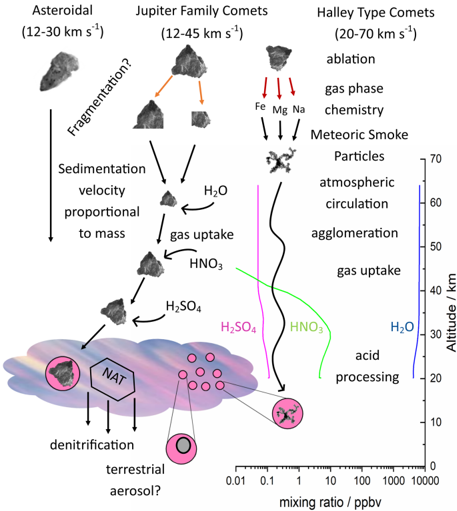
“…partially melted cosmic spherules and meteoric fragments gravitationally sediment according to their size, whilst ablated metal atoms are oxidized to form a variety of species (oxides, hydroxides and carbonates) that then polymerise to form Meteoric Smoke Particles (MSPs) (Plane et al., 2015).”
BackgroundSelf-citationLawrence, Z. D., Perlwitz, J., Butler, A. H., Manney, G. L., Newman, P. A., Lee, S. H., & Nash, E. R. (2020) · Journal of Geophysical Research: Atmospheres · doi:10.1029/2020jd033271 · Cited by 313 · cited 2×
“1 Introduction 35 With record ozone loss observed in the Arctic winter 2019-2020 (Lawrence et al., 2020), it is increasingly clear that understanding the chemistry which occurs in the winter polar vortex is important for predicting future recovery of polar ozone.”
BackgroundDeshler, T., Hervig, M. E., Hofmann, D. J., Rosen, J. M., & Liley, J. B. (2003) · Journal of Geophysical Research: Atmospheres · doi:10.1029/2002jd002514 · Cited by 288
Allende, Mexico, Meteorite Shower
Clarke, C., Jarosewich, E., Mason, B., Nelen, J., Gomez, M., & Hyde, J. R. (1971) · Smithsonian Contributions to the Earth Sciences · doi:10.5479/si.00810274.5.1 · Cited by 261 · cited 1×
“An analogue for meteoric fragments was produced by grinding a sample of the Allende meteorite (Clarke et al., 1971) with a pestle and mortar until it passed through an 18 µm diameter sieve (Endecotts test sieves), referred to as ‘recently ground’ to distinguish from samples held (to these…”
MethodManney, G. L., Livesey, N. J., Santee, M. L., Froidevaux, L., Lambert, A., Lawrence, Z. D., Millán, L. F., Neu, J. L., Read, W. G., Schwartz, M. J., et al. (2020) · Geophysical Research Letters · doi:10.1029/2020gl089063 · Cited by 233
Modeling the composition of liquid stratospheric aerosols
Carslaw, K. S., Peter, T., & Clegg, S. L. (1997) · Reviews of Geophysics · doi:10.1029/97rg00078 · Cited by 187 · cited 2×
“This H2SO4 concentration was chosen as it is similar to the lowest at thermodynamic equilibrium at temperatures where nitric acid hydrates might form in the absence of water ice (Carslaw et al., 1997).”
BackgroundAblation, Flux, and Atmospheric Implications of Meteors Inferred from Stratospheric Aerosol
Cziczo, D. J., Thomson, D. S., & Murphy, D. M. (2001) · Science · doi:10.1126/science.1057737 · Cited by 176 · cited 2×
“Silica suspensions here contained approximately 2.5 wt% silica, around a factor of five larger than atmospheric concentrations (Cziczo et al., 2001).”
BackgroundInfluentialNear‐Complete Local Reduction of Arctic Stratospheric Ozone by Severe Chemical Loss in Spring 2020
Wohltmann, I., von der Gathen, P., Lehmann, R., Maturilli, M., Deckelmann, H., Manney, G. L., Davies, J., Tarasick, D., Jepsen, N., Kivi, R., et al. (2020) · Geophysical Research Letters · doi:10.1029/2020gl089547 · Cited by 174
Wex, H., DeMott, P. J., Tobo, Y., Hartmann, S. M., Rösch, M., Clauss, T., Tomsche, L., Niedermeier, D., & Stratmann, F. (2014) · Atmospheric chemistry and physics · doi:10.5194/acp-14-5529-2014 · Cited by 166
High-speed imaging of ice nucleation in water proves the existence of active sites
Holden, M. A., Whale, T. F., Tarn, M. D., O’Sullivan, D., Walshaw, R. D., Murray, B. J., Meldrum, F. C., & Christenson, H. K. (2019) · Science Advances · doi:10.1126/sciadv.aav4316 · Cited by 164
Self-citationVoigt, C., Schlager, H., Luo, B. P., Dörnbrack, A., Roiger, A., Stock, P., Curtius, J., Vössing, H., Borrmann, S., Davies, S., et al. (2005) · Atmospheric Chemistry and Physics · doi:10.5194/acp-5-1371-2005 · Cited by 161
A physically constrained classical description of the homogeneous nucleation of ice in water
Koop, T., & Murray, B. J. (2016) · The Journal of Chemical Physics · doi:10.1063/1.4962355 · Cited by 159 · cited 2×
“They are larger by a factor of 1.5-10 than current estimates of the value for water ice-liquid interface (Koop and Murray, 2016;Tarn et al., 2021).”
BackgroundMethodInfluentialSelf-citationPolar Stratospheric Clouds: Satellite Observations, Processes, and Role in Ozone Depletion
Tritscher, I., Pitts, M. C., Poole, L. R., Alexander, S. P., Cairo, F., Chipperfield, M. P., Grooß, J., Höpfner, M., Lambert, A., Luo, B., et al. (2021) · Reviews of Geophysics · doi:10.1029/2020rg000702 · Cited by 151
Observations of the chemical composition of stratospheric aerosol particles
Murphy, D. M., Froyd, K. D., Schwarz, J. P., & Wilson, J. C. (2014) · Quarterly Journal of the Royal Meteorological Society · doi:10.1002/qj.2213 · Cited by 141 · cited 5×
“It is well established that acid processing of MSPs results in dissolution of most metal components, leaving silica and alumina solids in suspension (Murphy et al., 2014;Saunders et al., 2012).”
BackgroundInfluentialSánchez-Marroquín, A., Arnalds, Ó., Baustian, K. J., Browse, J., Dagsson‐Waldhauserová, P., Harrison, A. D., Maters, E., Pringle, K. J., Vergara‐Temprado, J., Burke, I. T., et al. (2020) · Science Advances · doi:10.1126/sciadv.aba8137 · Cited by 130
Self-citationThe enhancement and suppression of immersion mode heterogeneous ice-nucleation by solutes
Whale, T. F., Holden, M. A., Wilson, T. W., O’Sullivan, D., & Murray, B. J. (2018) · Chemical Science · doi:10.1039/c7sc05421a · Cited by 127 · cited 1×
“The activity of some heterogeneously nucleating materials has been found in the past to be affected by the presence in solution of, or pre-treatment by, acids or other solutes (Whale et al., 2018;Wex et al., 2014).”
BackgroundSelf-citationCosmic dust fluxes in the atmospheres of Earth, Mars, and Venus
Carrillo-Sánchez, J. D., Gómez-Martín, J. C., Bones, D. L., Nesvorný, D., Pokorný, P., Benna, M., Flynn, G. J., & Plane, J. M. C. (2020) · Icarus · doi:10.1016/j.icarus.2019.113395 · Cited by 116
Self-citationMIPAS detects Antarctic stratospheric belt of NAT PSCs caused by mountain waves
Höpfner, M., Larsen, N., Spang, R., Luo, B., Ma, J., Svendsen, S. H., Eckermann, S. D., Knudsen, B. M., Massoli, P., Cairo, F., et al. (2006) · Atmospheric chemistry and physics · doi:10.5194/acp-6-1221-2006 · Cited by 113
Fine‐grained precursors dominate the micrometeorite flux
Taylor, S., MATRAJT, G., & Guan, Y. (2011) · Meteoritics and Planetary Science · doi:10.1111/j.1945-5100.2011.01292.x · Cited by 105
Hoyle, C. R., Engel, I., Luo, B., Pitts, M. C., POOLE, L. R., Grooß, J., & Peter, T. (2013) · Atmospheric chemistry and physics · doi:10.5194/acp-13-9577-2013 · Cited by 105
Kumar, A., Marcolli, C., & Peter, T. (2019) · Atmospheric chemistry and physics · doi:10.5194/acp-19-6059-2019 · Cited by 104
Representing time-dependent freezing behaviour in immersion mode ice nucleation
Herbert, R. J., Murray, B. J., Whale, T. F., Dobbie, S., & Atkinson, J. D. (2014) · Atmospheric chemistry and physics · doi:10.5194/acp-14-8501-2014 · Cited by 99
Self-citationEffects of temperature on formation of silica gel
Colby, M. W., Osaka, A., & Mackenzie, J. D. (1986) · Journal of Non-Crystalline Solids · doi:10.1016/0022-3093(86)90108-0 · Cited by 89 · cited 2×
“Silica gelation is also known to be strongly temperature dependent (Colby et al., 1986).”
BackgroundHeterogeneous chlorine activation on stratospheric aerosols and clouds in the Arctic polar vortex
Wegner, T., Grooß, J., von Hobe, M., Stroh, F., Sumińska-Ebersoldt, O., Volk, C. M., Hösen, E., Mitev, V., Shur, G. N., & Muller, R. H. (2012) · Atmospheric chemistry and physics · doi:10.5194/acp-12-11095-2012 · Cited by 88 · cited 2×
“Ozone depletion is therefore sensitive to the nucleation of 100 crystalline PSCs, both through the available catalytic aerosol surface and through the denitrification process (Wegner et al., 2012).”
BackgroundA vortex‐scale simulation of the growth and sedimentation of large nitric acid hydrate particles
Carslaw, K. S., Kettleborough, J. A., Northway, M. J., Davies, S., Gao, R., Fahey, D. W., Baumgardner, D. G., Chipperfield, M. P., & Kleinböhl, A. (2002) · Journal of Geophysical Research: Atmospheres · doi:10.1029/2001jd000467 · Cited by 87
Nitric acid trihydrate nucleation and denitrification in the Arctic stratosphere
Grooß, J., Engel, I., Borrmann, S., Frey, W., Günther, G., Hoyle, C. R., Kivi, R., Luo, B., Molleker, S., Peter, T., et al. (2014) · Atmospheric chemistry and physics · doi:10.5194/acp-14-1055-2014 · Cited by 84
Murphy, D. M., Froyd, K. D., Bourgeois, I., Brock, C. A., Kupc, A., Peischl, J., Schill, G. P., Thompson, C. R., Williamson, C. J., & Yu, P. (2021) · Atmospheric Chemistry and Physics · doi:10.5194/acp-21-8915-2021 · Cited by 84
Schneider, J., Weigel, R., Klimach, T., Dragoneas, A., Appel, O., Hünig, A., Molleker, S., Köllner, F., Clemen, H.-C., Eppers, O., et al. (2021) · Atmospheric chemistry and physics · doi:10.5194/acp-21-989-2021 · Cited by 81
Salcedo, D., Molina, L. T., & Molina, M. J. (2000) · The Journal of Physical Chemistry A · doi:10.1021/jp001639s · Cited by 80
Heterogeneous formation of polar stratospheric clouds – Part 2: Nucleation of ice on synoptic scales
Engel, I., Luo, B., Pitts, M. C., POOLE, L. R., Hoyle, C. R., Grooß, J., Dörnbrack, A., & Peter, T. (2013) · Atmospheric chemistry and physics · doi:10.5194/acp-13-10769-2013 · Cited by 80 · cited 1×
“Current models of crystal formation involve 45 heterogeneous nucleation of water ice and nitric acid trihydrate (NAT) (Hoyle et al., 2013;Engel et al., 2013;James et al., 2018;Steiner et al., 2021).”
BackgroundMannel, T., Bentley, M., Boakes, P. D., Jeszenszky, H., Ehrenfreund, P., Engrand, C., Koeberl, C., Levasseur-Regourd, A. C., Romstedt, J., Schmied, R., et al. (2019) · Astronomy and Astrophysics · doi:10.1051/0004-6361/201834851 · Cited by 79
Mannel, T., Bentley, M., Boakes, P., Jeszenszky, H., Ehrenfreund, P., Engrand, C., Koeberl, C., Levasseur-Regourd, A. C., Romstedt, J., Schmied, R., et al. (2019) · Springer Link (Chiba Institute of Technology) · doi:10.1051/0004-6361/201834851/pdf · Cited by 79
Record low ozone values over the Arctic in boreal spring 2020
Dameris, M., Loyola, D. G., Nützel, M., Coldewey-Egbers, M., Lerot, C., Romahn, F., & van Roozendael, M. (2021) · Atmospheric Chemistry and Physics · doi:10.5194/acp-21-617-2021 · Cited by 78
Knopf, D., Koop, T., Luo, B., Weers, U., & Peter, T. (2002) · Atmospheric chemistry and physics · doi:10.5194/acp-2-207-2002 · Cited by 76 · cited 2×
“It has been noted that extrapolation of data from homogeneous experiments to atmospheric conditions could be problematic since the dependence of the surface energy on saturation is unknown (Knopf et al., 2002).”
BackgroundProduction of carbonate and silica nano-particles in stirred bead milling
Wang, Y., & Forssberg, E. (2006) · International Journal of Mineral Processing · doi:10.1016/j.minpro.2006.05.007 · Cited by 70 · cited 2×
“However, mechanical break up of particles to such small 285 sizes is not commonly possible even under controlled laboratory conditions (Wang and Forssberg, 2006).”
BackgroundBrakebusch, M., RANDALL, C. E., Kinnison, D. E., Tilmes, S., Santee, M. L., & Manney, G. L. (2013) · Journal of Geophysical Research Atmospheres · doi:10.1002/jgrd.50226 · Cited by 69
Hydrogen bond studies. XCIV. Diaquaoxonium ion in nitric acid trihydrate
Taesler, I., Delaplane, R. G., & Olovsson, I. (1975) · Acta Crystallographica Section B · doi:10.1107/s056774087500550x · Cited by 64 · cited 1×
“To convert this to a value per surface area, we take a surface molecular density from the 110 345 plane of β-NAT (Wood, 1999), which has four NAT molecules in a planar unit cell 9.4845 × 14.6836 Å (Taesler et al., 1975), giving a value of 0.03 ± 0.01 J m-2.”
MethodInfluentialThe unsuitability of meteoritic and other nuclei for polar stratospheric cloud freezing
Biermann, U. M., Presper, T., Koop, T., Mößinger, J., Crutzen, P. J., & Peter, T. (1996) · Geophysical Research Letters · doi:10.1029/96gl01577 · Cited by 64
Extreme NAT supersaturations in mountain wave ice PSCs: A clue to NAT formation
Luo, B., Voigt, C., Fueglistaler, S. A., & Peter, T. (2003) · Journal of Geophysical Research Atmospheres · doi:10.1029/2002jd003104 · Cited by 63
Ebert, M., Weigel, R., Kandler, K., Günther, G., Molleker, S., Grooß, J.-U., Vogel, B., Weinbruch, S., & Borrmann, S. (2016) · Atmospheric Chemistry and Physics · doi:10.5194/acp-16-8405-2016 · Cited by 60
Subasinghe, D., Campbell-Brown, M. D., & Stokan, E. (2016) · Monthly Notices of the Royal Astronomical Society · doi:10.1093/mnras/stw019 · Cited by 60 · cited 1×
“On heating by atmospheric friction the first processes that may occur are fragmentation or ablation of the incoming meteoroid (Carrillo-Sánchez et al., 2020;Subasinghe et al., 2016).”
BackgroundInteractions of meteoric smoke particles with sulphuric acid in the Earth's stratosphere
Saunders, R. W., Dhomse, S., Tian, W. S., Chipperfield, M. P., & Plane, J. M. C. (2012) · Atmospheric Chemistry and Physics · doi:10.5194/acp-12-4387-2012 · Cited by 57
Self-citationWeigel, R., Volk, C. M., Kandler, K., Hösen, E., Günther, G., Vogel, B., Grooß, J.-U., Khaykin, S., Belyaev, G. V., & Borrmann, S. (2014) · Atmospheric Chemistry and Physics · doi:10.5194/acp-14-12319-2014 · Cited by 56 · cited 5×
“A number of studies have shown that typically 50-80 % of stratospheric liquid aerosol contains a refractory core (Weigel et al., 2014;Schneider et al., 2021;Murphy et al., 2021).”
BackgroundInfluentialNucleation of nitric acid hydrates in polar stratospheric clouds by meteoric material
James, A. D., Brooke, J. S. A., Mangan, T. P., Whale, T. F., Plane, J. M. C., & Murray, B. J. (2018) · Atmospheric chemistry and physics · doi:10.5194/acp-18-4519-2018 · Cited by 52 · cited 15×
“We then combine 305 this with atmospheric measurements of the size distribution of available material and back-trajectory temperature and NOy profiles as in our previous work (James et al., 2018), thereby predicting the cloud crystal number density which can be compared with observations.”
BackgroundMethodResultInfluentialSelf-citationBrooke, J. S. A., Feng, W., Carrillo‐Sánchez, J. D., Mann, G. W., James, A. D., Bardeen, C., Marshall, L., Dhomse, S. S., & Plane, J. M. C. (2017) · Journal of Geophysical Research Atmospheres · doi:10.1002/2017jd027143 · Cited by 51
Self-citationInfrared Spectrum of Nitric Acid Dihydrate: Influence of Particle Shape
Wagner, R., Möhler, O., Saathoff, H., Stetzer, O., & Schurath, U. (2005) · The Journal of Physical Chemistry A · doi:10.1021/jp044997u · Cited by 48
Bertram, A. K., & Sloan, J. J. (1998) · Journal of Geophysical Research Atmospheres · doi:10.1029/98jd00921 · Cited by 46 · cited 4×
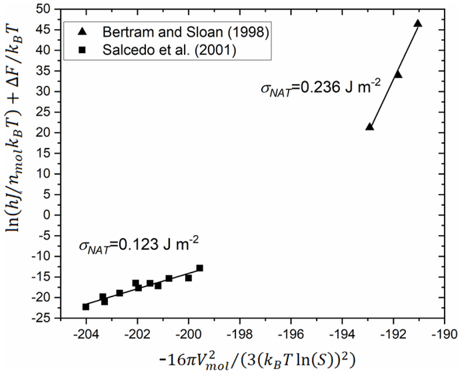
“The value we derive from the measurements of Bertram and Sloan (1998) is 0.236 mJ m-2, somewhat higher than the other constraints.”
BackgroundInfluentialCrystallization Kinetics of HNO3/H2O Films Representative of Polar Stratospheric Clouds
Tisdale, R. T., Middlebrook, A. M., Prenni, A. J., & Tolbert, M. A. (1997) · The Journal of Physical Chemistry A · doi:10.1021/jp9624156 · Cited by 41 · cited 3×
“We select the Tisdale et al. (1997) value for the diffusion activation energy, since it is more relevant to the concentrations used in the homogeneous nucleation experiments, the temperature and saturation data from the homogeneous nucleation 355 experiments, and a molar volume of 5.35 × 10⁻²⁹ cm3…”
BackgroundMethodInfluentialDhomse, S. S., Saunders, R. W., Tian, W., Chipperfield, M. P., & Plane, J. M. C. (2013) · Geophysical Research Letters · doi:10.1002/grl.50840 · Cited by 38 · cited 2×
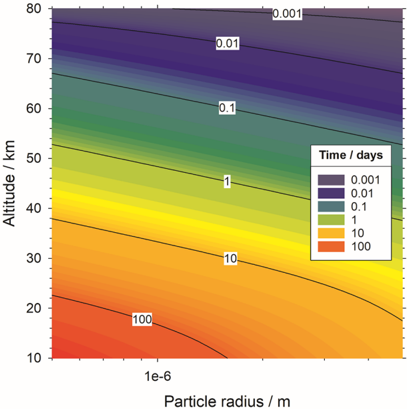
“MSPs are generally small enough that they do not gravitationally sediment at significant 60 speeds, rather they are carried by the atmospheric circulation, with atmospheric lifetimes on the order of several years (Brooke et al., 2017;Dhomse et al., 2013).”
BackgroundSelf-citationZhu, Y., Toon, O. B., Lambert, A., Kinnison, D. E., Brakebusch, M., Bardeen, C., Mills, M. J., & English, J. M. (2015) · Journal of Advances in Modeling Earth Systems · doi:10.1002/2015ms000427 · Cited by 36
Bogdan, A., Molina, M. J., Kulmala, M., MacKenzie, A. R., & Laaksonen, A. (2003) · Journal of Geophysical Research Atmospheres · doi:10.1029/2002jd002605 · Cited by 34
Mann, G. W., Carslaw, K. S., Chipperfield, M. P., Davies, S., & Eckermann, S. D. (2005) · Journal of Geophysical Research Atmospheres · doi:10.1029/2004jd005271 · Cited by 32
Self-citationLarge NAT particle formation by mother clouds: Analysis of SOLVE/THESEO‐2000 observations
Fueglistaler, S. A., Luo, B., Buss, S., Wernli, H., Voigt, C., Müller, M., Neuber, R., Hostetler, C. A., POOLE, L. R., Flentje, H., et al. (2002) · Geophysical Research Letters · doi:10.1029/2001gl014548 · Cited by 29
Fahy, W. D., Maters, E., Miranda, R. G., Adams, M. P., Jahn, L. G., Sullivan, R. C., & Murray, B. J. (2021) · Environmental Science Atmospheres · doi:10.1039/d1ea00071c · Cited by 29
Self-citationThe Turnbull correlation and the freezing of stratospheric aerosol droplets
MacKenzie, A. R., Laaksonen, A., Batris, E., & Kulmala, M. (1998) · Journal of Geophysical Research Atmospheres · doi:10.1029/98jd00169 · Cited by 27 · cited 1×
“Before homogeneous nucleation measurements were available, the Turnbull correlation of the enthalpy of fusion to the surface tension was used to derive a value for NAT (MacKenzie et al., 1998).”
MethodThe uptake of HNO3 on meteoric smoke analogues
Frankland, V. L., James, A. D., Feng, W., & Plane, J. M. C. (2015) · Journal of Atmospheric and Solar-Terrestrial Physics · doi:10.1016/j.jastp.2015.01.010 · Cited by 27 · cited 1×
“As MSPs and fragments descend through the atmosphere, gas-phase species can be taken up on their surfaces (Frankland et al., 2015;James et al., 2017;Saunders et al., 2012).”
BackgroundSelf-citationHomogeneous Freezing of Water Using Microfluidics
Tarn, M. D., Sikora, S. N. F., Porter, G. C. E., Shim, J.-U., & Murray, B. J. (2021) · Micromachines · doi:10.3390/mi12020223 · Cited by 27 · cited 2×
“They are larger by a factor of 1.5-10 than current estimates of the value for water ice-liquid interface (Koop and Murray, 2016;Tarn et al., 2021).”
BackgroundInfluentialSelf-citationSteiner, M., Luo, B., Peter, T., Pitts, M. C., & Stenke, A. (2021) · Geoscientific model development · doi:10.5194/gmd-14-935-2021 · Cited by 25
Adachi, K., Oshima, N., Takegawa, N., Moteki, N., & Koike, M. (2022) · Communications Earth & Environment · doi:10.1038/s43247-022-00469-8 · Cited by 25 · cited 1×
“…mass spectrometer measurements on aircraft also detect significant numbers of meteoric 250 particles (Schneider et al., 2021;Murphy et al., 2021;Adachi et al., 2022), and are able to investigate their composition and atmospheric distribution, but since the sulfate components are also present…”
BackgroundMetastable Nitric Acid Trihydrate in Ice Clouds
Weiss, F., Kubel, F., Gálvez, Ó., Hoelzel, M., Parker, S. F., Baloh, P., Iannarelli, R., Rossi, M. J., & Grothe, H. (2016) · Angewandte Chemie International Edition · doi:10.1002/anie.201510841 · Cited by 22
Metastable nitric acidhydrates—possible constituents of polar stratospheric clouds?
Grothe, H., Tizek, H., & Ortega, I. K. (2007) · Faraday Discussions · doi:10.1039/b702343j · Cited by 21 · cited 1×
“Nitric acid dihydrate (NAD) may also form, though this is not currently considered in atmospheric models (Grothe et al., 2008).”
BackgroundDynamics in Glass Forming Sulfuric and Nitric Acid Hydrates
Frey, M., Didzoleit, H., Gainaru, C. P., & Böhmer, R. (2013) · The Journal of Physical Chemistry B · doi:10.1021/jp407588j · Cited by 21
The uptake of HO2 on meteoric smoke analogues
James, A. D., Moon, D. R., Feng, W., Lakey, P. S. J., Frankland, V. L., Heard, D. E., & Plane, J. M. C. (2016) · Journal of Geophysical Research Atmospheres · doi:10.1002/2016jd025882 · Cited by 20
Self-citationWise, M. E., Brooks, S. D., Garland, R. M., Cziczo, D. J., Martin, S. T., & Tolbert, M. A. (2003) · Journal of Geophysical Research: Atmospheres · doi:10.1029/2003jd003420 · Cited by 19
Bones, D. L., Sanchez, J. D. C., Connell, S. D., Kulak, A. N., Mann, G. W., & Plane, J. M. C. (2022) · Earth and Space Science · doi:10.1029/2021ea001884 · Cited by 19
Self-citationSources of insoluble inclusions in stratospheric sulfate particles
BIGG, E. K. (2012) · Meteoritics & Planetary Science · doi:10.1111/j.1945-5100.2012.01346.x · Cited by 17
Wagner, R., Naumann, K. ‐., Mangold, A., Möhler, O., Saathoff, H., & Schurath, U. (2005) · The Journal of Physical Chemistry A · doi:10.1021/jp0513364 · Cited by 9
Djikaev, Y. S., & Ruckenstein, E. (2017) · The Journal of Chemical Physics · doi:10.1063/1.4979069 · Cited by 5
James, A. D., Pace, F., Sikora, S. N. F., Murray, B. J., Mann, G. W., & Plane, J. M. C. (2022) · EGU General Assembly Conference Abstracts · doi:10.5194/egusphere-egu22-4632 · Cited by 4
Self-citationJames, A. D., Pace, F., Sikora, S. N. F., et al. (2023) · Zenodo (CERN European Organization for Nuclear Research) · doi:10.5281/zenodo.7635845 · Cited by 3
Self-citation
Research works printed but not linked: 1
- Tarn, M. D., Sikora, S. N. F., Porter, G. C. E., Shim, J.-u., and Mur- ray, B. J.: Homogeneous freezing of water using microfluidics, Micromachines, 12, 223, 2021. · DOI
Cited by
Metals from spacecraft reentry in stratospheric aerosol particles
Murphy, D. M., Abou-Ghanem, M., Cziczo, D. J., Froyd, K. D., Jacquot, J., Lawler, M. J., Maloney, C., Plane, J. M. C., Ross, M. N., Schill, G. P., et al. (2023) · Proceedings of the National Academy of Sciences · doi:10.1073/pnas.2313374120 · Cited by 107
“Analogues of meteoric inclusions in sulfuric acid have been shown to be ice nuclei (20, 21).”
BackgroundSelf-citationOpinion: Recent developments and future directions in studying the mesosphere and lower thermosphere
Plane, J. M. C., Gumbel, J., Kalogerakis, K. S., Marsh, D. R., & von Savigny, C. (2023) · Atmospheric chemistry and physics · doi:10.5194/acp-23-13255-2023 · Cited by 49
“…flux was further validated against an important collection of cosmic spherules and micrometeorites from Concordia Research Station, Antarctica (Rojas et al., 2021) The remaining discrepancy in the dust input rate is the very much higher estimates ( > 200 t d − ) from the accumulation of MSPs in”
Self-citationWagner, R., James, A. D., Frankland, V. L., Möhler, O., Murray, B. J., Plane, J. M. C., Saathoff, H., Weigel, R., & Schnaiter, M. (2023) · Atmospheric chemistry and physics · doi:10.5194/acp-23-6789-2023 · Cited by 6
“While the onset of melting of the frozen droplets was mostly in agreement with the NAT/ice eutectic, some experiments indicated the melting or recrystallisation of metastable phases (James et al., 2023).”
Self-citationConnecting JWST Silicate Cloud Observations to Exoplanet Cloud Microphysics with Nimbus
Kiefer, S., Morley, C. V., & Rowland, M. J. (2026) · The Astrophysical Journal · doi:10.3847/1538-4357/ae5101 · Cited by 5
“On Earth this process is studied in connection with the formation of stratospheric aerosols ( D. J. Cziczo et al. 2001; A. D. James et al. 2018, 2023 ) .”
Wang, Y., Schoeberl, M. R., & Taha, G. (2025) · Journal of Quantitative Spectroscopy and Radiative Transfer · doi:10.1016/j.jqsrt.2025.109560 · Cited by 3
Metadata
- Authors
- James, A. D., Pace, F., Sikora, S. N. F., Mann, G. W., Plane, J. M. C., & Murray, B. J.
- Affiliations
- University of Leeds (GB)
- Corresponding author
- James, Alexander D.
- Mann, Graham W.
- Plane, John M. C.
- Murray, Benjamin J.
- Venue
- Atmospheric Chemistry and Physics
- Publisher
- Copernicus GmbH
- Published
- 2023-02-14
- Volume
- 23
- Issue
- 3
- Pages
- 2215-2233
- ISSN
- 1680-7316 (ISSN-L)
- 1680-7324
- OpenAlex
- W4320933043
- Cited by
- 15
- References
- 77
- Citations by year
- 2026: 1 · 2025: 1 · 2024: 2 · 2023: 10
- FWCI
- 1.55
- Type
- journal article
- Language
- en
- Open access
- gold
- doi.org
- Licence
- Locations
- Atmospheric chemistry and physics (publishedVersion, cc-by)
- DOAJ (DOAJ: Directory of Open Access Journals) (submittedVersion, cc-by-sa)
- Funders
- Natural Environment Research Council (NE/R011222/1)
- Topics
- Physical Sciences › Earth and Planetary Sciences › Atmospheric Science › Atmospheric Ozone and Climate
- Physical Sciences › Environmental Science › Global and Planetary Change › Atmospheric aerosols and clouds
- Physical Sciences › Earth and Planetary Sciences › Atmospheric Science › Atmospheric chemistry and aerosols
- Keywords
- polar stratospheric clouds, nitric acid trihydrate, heterogeneous nucleation, meteoric smoke particles, silica nanoparticles, fused silica, classical nucleation theory, particle size effects, surface curvature, ozone depletion, meteoroid fragmentation, interfacial energy, contact angle, fumed silica
About these checks
Registry, retraction, Cites and statistics results are computed, not judged, with one exception: a printed reference that no index lists is read once by a model before it counts as a citation error. Claims are extracted by a model and kept only when their quote appears verbatim in the text; each cited source is then checked, with a model’s help, for whether it says what the claim relies on. Those verdicts can be wrong — read the claim’s quote and the cited source before relying on one.
Statistics and arithmetic are recomputed, not judged.
Confidence bands are shown only for fields calibrated on our annotated test set. None is calibrated yet, so no band is shown.
What counts as a claim ›How we measure confidence ›How we check this ›
Are you an author, or do you see a problem with this page? Request a review
Data sources
Bibliographic data: Semantic Scholar, OpenAlex, Crossref.
Contains information from the Semantic Scholar Academic Graph Datasets, made available under the ODC Attribution License (ODC-BY 1.0).
Semantic Scholar’s data is described in: Kinney, R., et al. (2023). The Semantic Scholar Open Data Platform. arXiv:2301.10140.
