

Observations of meteoric material and implications for aerosol nucleation in the winter Arctic lower stratosphere derived from in situ particle measurements
Open accessPublished version of a preprint
The DOI matches its Crossref record; 63 of the 63 references it cites were found in a registry or an index.
Abstract
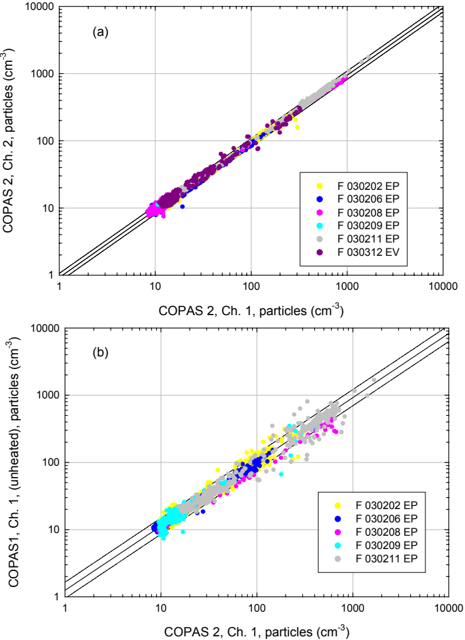
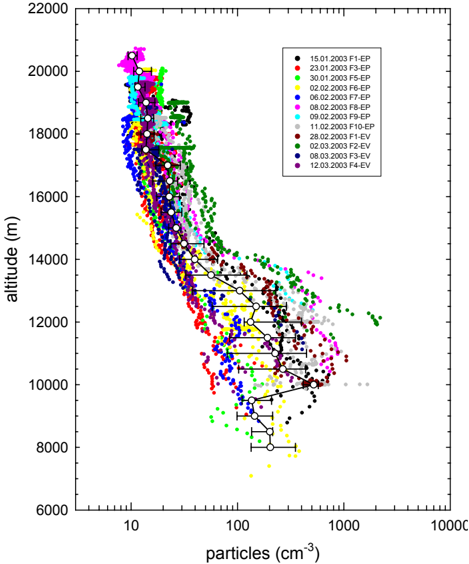
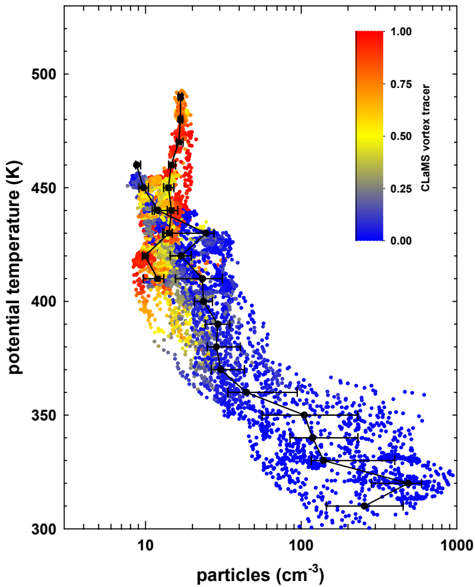
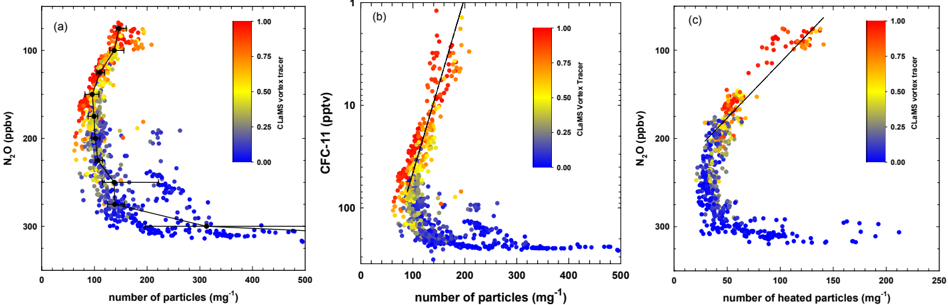
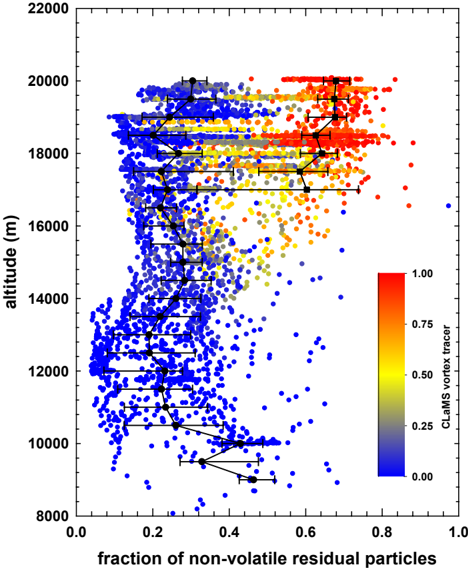
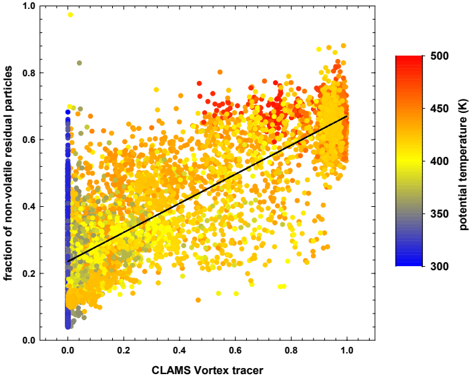
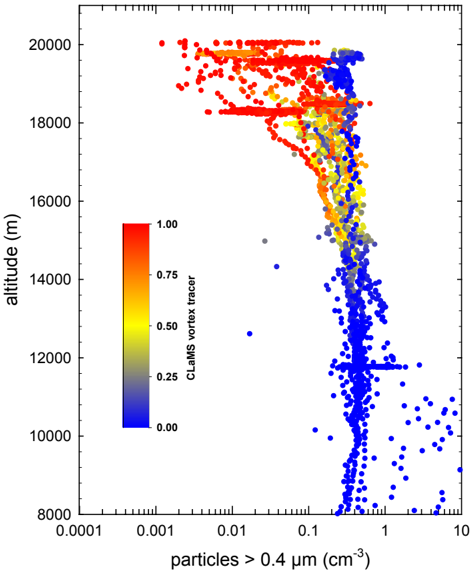
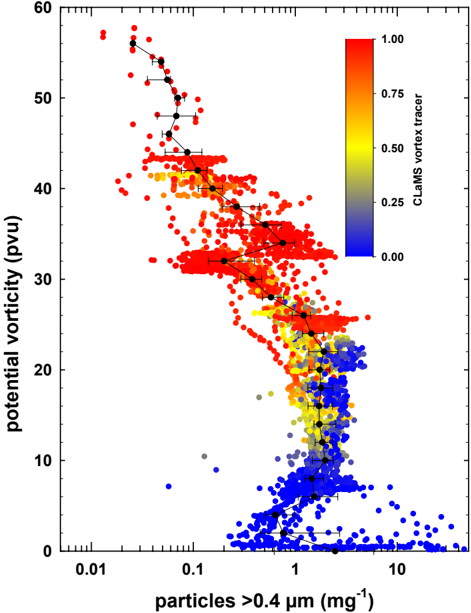
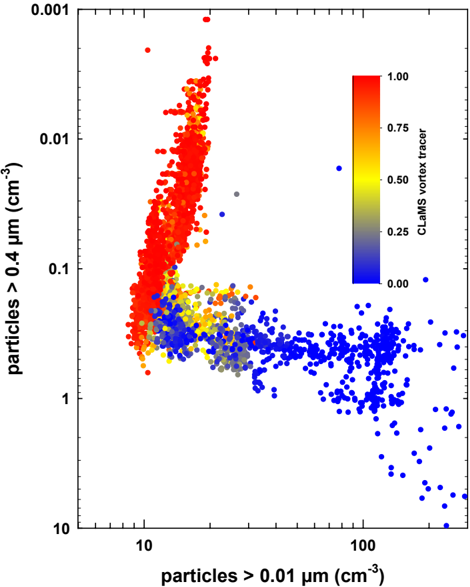
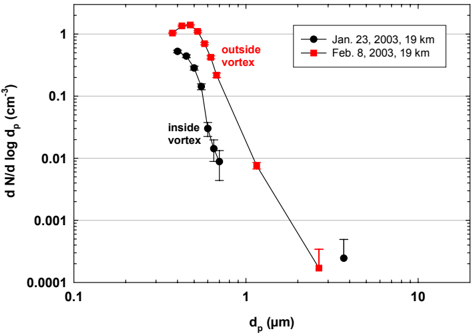
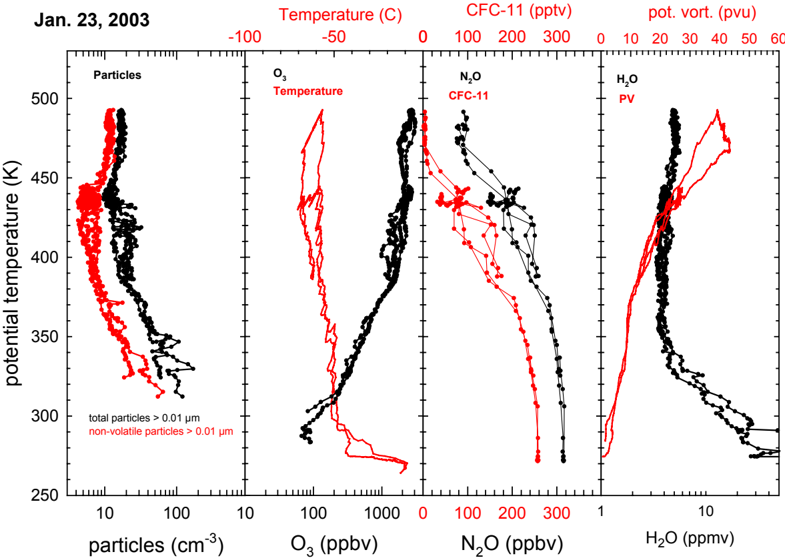
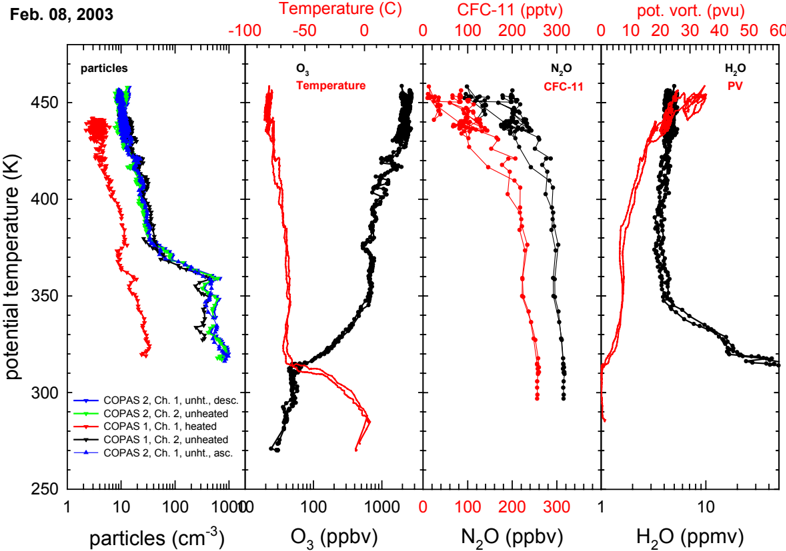
Number concentrations of total and non-volatile aerosol particles with size diameters >0.01 μm as well as particle size distributions (0.4–23 μm diameter) were measured in situ in the Arctic lower stratosphere (10–20.5 km altitude). The measurements were obtained during the campaigns European Polar Stratospheric Cloud and Lee Wave Experiment (EUPLEX) and Envisat-Arctic-Validation (EAV). The campaigns were based in Kiruna, Sweden, and took place from January to March 2003. Measurements were conducted onboard the Russian high-altitude research aircraft Geophysica using the low-pressure Condensation Nucleus Counter COPAS (COndensation PArticle Counter System) and a modified FSSP 300 (Forward Scattering Spectrometer Probe). Around 18–20 km altitude typical total particle number concentrations nt range at 10–20 cm−3 (ambient conditions). Correlations with the trace gases nitrous oxide (N2O) and trichlorofluoromethane (CFC-11) are discussed. Inside the polar vortex the total number of particles >0.01 μm increases with potential temperature while N2O is decreasing which indicates a source of particles in the above polar stratosphere or mesosphere. A separate channel of the COPAS instrument measures the fraction of aerosol particles non-volatile at 250°C. Inside the polar vortex a much higher fraction of particles contained non-volatile residues than outside the vortex (~67% inside vortex, ~24% outside vortex). This is most likely due to a strongly increased fraction of meteoric material in the particles which is transported downward from the mesosphere inside the polar vortex. The high fraction of non-volatile residual particles gives therefore experimental evidence for downward transport of mesospheric air inside the polar vortex. It is also shown that the fraction of non-volatile residual particles serves directly as a suitable experimental vortex tracer. Nanometer-sized meteoric smoke particles may also serve as nuclei for the condensation of gaseous sulfuric acid and water in the polar vortex and these additional particles may be responsible for the increase in the observed particle concentration at low N2O. The number concentrations of particles >0.4 μm measured with the FSSP decrease markedly inside the polar vortex with increasing potential temperature, also a consequence of subsidence of air from higher altitudes inside the vortex. Another focus of the analysis was put on the particle measurements in the lowermost stratosphere. For the total particle density relatively high number concentrations of several hundred particles per cm3 at altitudes below ~14 km were observed in several flights. To investigate the origin of these high number concentrations we conducted air mass trajectory calculations and compared the particle measurements with other trace gas observations. The high number concentrations of total particles in the lowermost stratosphere are probably caused by transport of originally tropospheric air from lower latitudes and are potentially influenced by recent particle nucleation.
Overview
The claims and statistics of this paper haven’t been checked yet.
Free: it reads the open-access text and checks the first 5 claims that cite a source we can check. Create a free account to check every claim.
Integrity signals
Registry
Cites
Statistics
Figures
Verification
Claims the paper makes
The claims and statistics of this paper haven’t been checked yet.
Free: it reads the open-access text and checks the first 5 claims that cite a source we can check. Create a free account to check every claim.
Self-check
Percentages, sums and reported differences re-computed from the paper’s own numbers.
The self-check needs the paper’s full text.
Citations
Cites
Stratosphere‐troposphere exchange
Holton, J. R., Haynes, P. H., McIntyre, M. E., Douglass, A. R., Rood, R. B., & Pfister, L. (1995) · Reviews of Geophysics · doi:10.1029/95rg02097 · Cited by 2,706
An Overview of the Global Historical Climatology Network Temperature Database
Peterson, T. C., & Vose, R. S. (1997) · Bulletin of the American Meteorological Society · doi:10.1175/1520-0477(1997)078<2837:aootgh>2.0.co;2 · Cited by 910
A Lagrangian‐based analysis of extratropical cyclones. I: The method and some applications
Wernli, H., & Davies, H. C. (1997) · Quarterly Journal of the Royal Meteorological Society · doi:10.1002/qj.49712353811 · Cited by 837 · cited 1×
“These calculations were performed with the trajectory tool LAGRANTO (Wernli and Davies, 1997) using wind and temperature fields from the operational ECMWF analyses with a horizontal resolution of 1 degree.”
MethodSelf-citationAn objective determination of the polar vortex using Ertel's potential vorticity
Nash, E. R., Newman, P. A., Rosenfield, J. E., & Schoeberl, M. R. (1996) · Journal of Geophysical Research: Atmospheres · doi:10.1029/96jd00066 · Cited by 581 · cited 1×
“In the CLaMS model the vortex edge is commonly defined by the strongest gradient in potential vorticity (PV) (Nash et al., 1996).”
Murphy, D. M., Thomson, D. S., & Mahoney, M. J. (1998) · Science · doi:10.1126/science.282.5394.1664 · Cited by 571 · cited 2×
“The stratospheric background aerosol is mainly composed of sulfuric acid (H2SO4) and water with some inclusions of meteoric material (Junge and Manson, 1961; Bigg et al., 1970; Murphy et al., 1998; Arnold et al., 1998; Cziczo et al., 2001).”
BackgroundInterrelationships between mixing ratios of long‐lived stratospheric constituents
Plumb, R. A., & Ko, M. K. W. (1992) · Journal of Geophysical Research: Atmospheres · doi:10.1029/92jd00450 · Cited by 375 · cited 2×
“This can be expected as CFC-11 and N 2O are closely correlated stratospheric tracers (Plumb and Ko, 1992).”
BackgroundAtmospheric Chemistry of Meteoric Metals
Plane, J. M. C. (2003) · Chemical Reviews · doi:10.1021/cr0205309 · Cited by 361 · cited 4×
“The ablated material composed of elements as iron, magnesium and silicon re-condenses to form nanometer-sized particles termed meteoritic smoke (Hunten et al., 1980; Turco et al., 1981; Cziczo et al., 2001; Plane 2003).”
BackgroundInfluentialParticle Formation by Ion Nucleation in the Upper Troposphere and Lower Stratosphere
Lee, S.-H., Reeves, J. M., Wilson, J. C., Hunton, D. E., Viggiano, A. A., Miller, T. M., Ballenthin, J. O., & Lait, L. R. (2003) · Science · doi:10.1126/science.1087236 · Cited by 361 · cited 4×
“Nu-10 cleation of new particles has been observed in the polar and mid-latitude lowermost stratosphere (Lee et al., 2003; de Reus et al., 1999; Hermann et al., 2003).”
BackgroundInfluentialAtmospheric ion‐induced nucleation of sulfuric acid and water
Lovejoy, E. R., Curtius, J., & Froyd, K. D. (2004) · Journal of Geophysical Research: Atmospheres · doi:10.1029/2003jd004460 · Cited by 292
Self-citationDeshler, T., Hervig, M. E., Hofmann, D. J., Rosen, J. M., & Liley, J. B. (2003) · Journal of Geophysical Research: Atmospheres · doi:10.1029/2002jd002514 · Cited by 288
Cited by
Stratospheric aerosol-Observations, processes, and impact on climate
Kremser, S., Thomason, L. W., von Hobe, M., Hermann, M., Deshler, T., Timmreck, C., Toohey, M., Stenke, A., Schwarz, J. P., Weigel, R., et al. (2016) · Reviews of Geophysics · doi:10.1002/2015rg000511 · Cited by 578
“, 1997; Deshler et al., 2003; Reeves et al., 2008]. Both Deshler et al. [2003] and Reeves et al. [2008] showed that SAGE II version 6.”
BackgroundSelf-citationIce structures, patterns, and processes: A view across the icefields
Bartels-Rausch, T., Bergeron, V., Cartwright, J. H. E., Escribano, R., Finney, J. L., Grothe, H., Gutiérrez, P. J., Haapala, J., Kuhs, W. F., Pettersson, J. B. C., et al. (2012) · Reviews of Modern Physics · doi:10.1103/revmodphys.84.885 · Cited by 361
“Nitric acid hydrates also form in the troposphere by nucleation on pre-existing ice particles (Voigt et al., 2003) or on meteor ablations (Curtius et al., 2005; Voigt et al., 2005).”
BackgroundThe Mesosphere and Metals: Chemistry and Changes
Plane, J. M. C., Feng, W., & Dawkins, E. C. M. (2015) · Chemical Reviews · doi:10.1021/cr500501m · Cited by 344
Cosmic dust in the earth's atmosphere
Plane, J. M. C. (2012) · Chemical Society Reviews · doi:10.1039/c2cs35132c · Cited by 325
Energetic Particle Influence on the Earth’s Atmosphere
Mironova, I. A., Aplin, K. L., Arnold, F., Bazilevskaya, G. A., Harrison, R. G., Krivolutsky, A. A., Nicoll, K. A., Rozanov, E. V., Turunen, E., & Usoskin, I. G. (2015) · Space Science Reviews · doi:10.1007/s11214-015-0185-4 · Cited by 311
“However, at the cold summer mesopause, water vapour may condense on meteor smoke particles (Curtius et al. 2005).”
A chemical model of meteoric ablation
Vondrak, T., Plane, J. M. C., Broadley, S., & Janches, D. (2008) · Atmospheric Chemistry and Physics · doi:10.5194/acp-8-7015-2008 · Cited by 255
“These nm-sized particles most probably provide ice nuclei for the formation of noctilucent clouds in the summer high latitude mesosphere (Megner et al., 2006), and polar stratospheric clouds in the wintertime polar stratosphere (Curtius et al., 2005).”
The global atmospheric electric circuit and its effects on cloud microphysics
Tinsley, B. A. (2008) · Reports on Progress in Physics · doi:10.1088/0034-4885/71/6/066801 · Cited by 234
“Satellite observations of decadal global cloud cover changes that correlate with the GCR flux (Svensmark and Friis-Christensen 1997) have been identified as due to low level clouds (Marsh and Svensmark 2000). Ion mediated nucleation has been invoked to explain these results, as also those of Harrison and Stephenson (2…”
BackgroundMethodResultInfluentialBardeen, C. G., Toon, O. B., Jensen, E. J., Marsh, D. R., & Harvey, V. L. (2008) · Journal of Geophysical Research: Atmospheres · doi:10.1029/2007jd009515 · Cited by 217
“Curtius et al. [2005] measured the fraction of 193 stratospheric aerosols with a non-volatile component and found a ratio of 3:1 between the 194”
Physics and Dynamics of Clouds and Precipitation
Wang, P. K. (2013) · Cambridge University Press eBooks · doi:10.1017/cbo9780511794285 · Cited by 176
Polar Stratospheric Clouds: Satellite Observations, Processes, and Role in Ozone Depletion
Tritscher, I., Pitts, M. C., Poole, L. R., Alexander, S. P., Cairo, F., Chipperfield, M. P., Grooß, J., Höpfner, M., Lambert, A., Luo, B., et al. (2021) · Reviews of Geophysics · doi:10.1029/2020rg000702 · Cited by 151
“However, SSA, upon which all PSC particles form, has a significant refractory component (Curtius et al., 2005; Weigel et al., 2014).”
Observations of the chemical composition of stratospheric aerosol particles
Murphy, D. M., Froyd, K. D., Schwarz, J. P., & Wilson, J. C. (2014) · Quarterly Journal of the Royal Meteorological Society · doi:10.1002/qj.2213 · Cited by 141
“Most particles in the winter polar vortex contain non-volatile cores hypothesized to be meteoritic material (Curtius et al., 2005).”
InfluentialNucleation of atmospheric aerosol particles
Curtius, J. (2006) · Comptes Rendus Physique · doi:10.1016/j.crhy.2006.10.018 · Cited by 204
Self-citationBönisch, H., Engel, A., Curtius, J., Birner, T., & Hoor, P. M. (2009) · Atmospheric chemistry and physics · doi:10.5194/acp-9-5905-2009 · Cited by 156
Self-citationTorres, O., Bhartia, P. K., Taha, G., Jethva, H., Das, S., Colarco, P., Krotkov, N., Omar, A., & Ahn, C. (2020) · Journal of Geophysical Research: Atmospheres · doi:10.1029/2020jd032579 · Cited by 130
“Although volcanic eruptions are considered the most important source of stratospheric aerosols (Deshler, 2008; Kremser et al., 2016), other sources such as meteoric dust (Bardeen et al., 2008; Curtius et al., 2005) and carbonyl sulfate (Brühl et al., 2012; Deshler et al., 2006) have been identified.”
Evidence for ice particles in the tropical stratosphere from in-situ measurements
de Reus, M., Borrmann, S., Bansemer, A. R., Heymsfield, A. J., Weigel, R., Schiller, C., Mitev, V., Frey, W., Kunkel, D., Kürten, A., et al. (2009) · Atmospheric chemistry and physics · doi:10.5194/acp-9-6775-2009 · Cited by 126
“Each COPAS instrument is a two channel aerosol counter designed for automated low pressure measurements of the particle number concentration (Curtius et al., 2005; Weigel et al., 2009).”
Self-citationCarbonaceous material in aerosol particles in the lower stratosphere and tropopause region
Murphy, D. M., Cziczo, D. J., Hudson, P. K., & Thomson, D. S. (2007) · Journal of Geophysical Research: Atmospheres · doi:10.1029/2006jd007297 · Cited by 115
Global and temporal distribution of meteoric smoke: A two‐dimensional simulation study
Megner, L., Siskind, D. E., Rapp, M., & Gumbel, J. (2008) · Journal of Geophysical Research: Atmospheres · doi:10.1029/2007jd009054 · Cited by 113
“Curtius et al. [2005] have measured the fraction of nonvolatile particles in the Arctic lower stratosphere.”
Metals from spacecraft reentry in stratospheric aerosol particles
Murphy, D. M., Abou-Ghanem, M., Cziczo, D. J., Froyd, K. D., Jacquot, J., Lawler, M. J., Maloney, C., Plane, J. M. C., Ross, M. N., Schill, G. P., et al. (2023) · Proceedings of the National Academy of Sciences · doi:10.1073/pnas.2313374120 · Cited by 107
Hoyle, C. R., Engel, I., Luo, B., Pitts, M. C., POOLE, L. R., Grooß, J., & Peter, T. (2013) · Atmospheric chemistry and physics · doi:10.5194/acp-13-9577-2013 · Cited by 105
Weigel, R., Borrmann, S., Kazil, J., Minikin, A., Stohl, A., Wilson, J. C., Reeves, J. M., Kunkel, D., de Reus, M., Frey, W., et al. (2011) · Atmospheric chemistry and physics · doi:10.5194/acp-11-9983-2011 · Cited by 101
Self-citationMurphy, D. M., Froyd, K. D., Bourgeois, I., Brock, C. A., Kupc, A., Peischl, J., Schill, G. P., Thompson, C. R., Williamson, C. J., & Yu, P. (2021) · Atmospheric Chemistry and Physics · doi:10.5194/acp-21-8915-2021 · Cited by 84
“There is probably also formation of new sulfuric acid particles higher in the stratosphere over the winter poles (Wilson et al., 1989), although this must be distinguished from meteoric smoke descending in the same regions (Curtius et al., 2005).”
von Hobe, M., Bekki, S., Borrmann, S., Cairo, F., D’Amato, F., Donfrancesco, G. D., Dörnbrack, A., Ebersoldt, A., Ebert, M., Emde, C., et al. (2013) · Atmospheric chemistry and physics · doi:10.5194/acp-13-9233-2013 · Cited by 86
“Nevertheless, the hypothesis by Curtius et al. (2005) that the enhanced non-volatile aerosol in the polar vortex mainly consists of meteoritic smoke particles needs further refine-ments.”
Self-citationHeterogeneous formation of polar stratospheric clouds – Part 2: Nucleation of ice on synoptic scales
Engel, I., Luo, B., Pitts, M. C., POOLE, L. R., Hoyle, C. R., Grooß, J., Dörnbrack, A., & Peter, T. (2013) · Atmospheric chemistry and physics · doi:10.5194/acp-13-10769-2013 · Cited by 80
Nitric acid trihydrate nucleation and denitrification in the Arctic stratosphere
Grooß, J., Engel, I., Borrmann, S., Frey, W., Günther, G., Hoyle, C. R., Kivi, R., Luo, B., Molleker, S., Peter, T., et al. (2014) · Atmospheric chemistry and physics · doi:10.5194/acp-14-1055-2014 · Cited by 84
“A potential source of heterogeneous nuclei is meteoritic dust immersed in stratospheric aerosol particles (Curtius et al., 2005).”
Self-citationA laboratory study of meteor smoke analogues: Composition, optical properties and growth kinetics
Saunders, R. W., & Plane, J. M. C. (2006) · Journal of Atmospheric and Solar-Terrestrial Physics · doi:10.1016/j.jastp.2006.09.006 · Cited by 76
Pre-activation of aerosol particles by ice preserved in pores
Marcolli, C. (2017) · Atmospheric chemistry and physics · doi:10.5194/acp-17-1595-2017 · Cited by 80
Borrmann, S., Kunkel, D., Weigel, R., Minikin, A., Deshler, T., Wilson, J. C., Curtius, J., Volk, C. M., Homan, C. D., Ulanovsky, A., et al. (2010) · Atmospheric Chemistry and Physics · doi:10.5194/acp-10-5573-2010 · Cited by 71
“(For comparison: Values as high as 70% to 80% were reported by Curtius et al. (2005), for meteoric dust subsiding inside the polar vortex within the same potential temperature band.)”
Self-citationMolleker, S., Borrmann, S., Schlager, H., Luo, B., Frey, W., Klingebiel, M., Weigel, R., Ebert, M., Mitev, V., Matthey, R., et al. (2014) · Atmospheric chemistry and physics · doi:10.5194/acp-14-10785-2014 · Cited by 78
Self-citationImpacts of Cosmic Dust on Planetary Atmospheres and Surfaces
Plane, J. M. C., Flynn, G. J., Määttänen, A., Moores, J. E., Poppe, A. R., Sanchez, J. D. C., & Listowski, C. (2017) · Space Science Reviews · doi:10.1007/s11214-017-0458-1 · Cited by 74
“Inside the Arctic polar vortex up to 75% of aerosol particles can contain refractory material i.e. thermally stable residuals which are almost certainly MSPs, transported downwards by the prevailing meridional circulation during winter (Curtius et al. 2005; Weigel et al. 2014).”
Renard, J., Brogniez, C., Berthet, G., Bourgeois, Q., Gaubicher, B., Chartier, M., Balois, J. Y., Verwaerde, C., Auriol, F., Francois, P., et al. (2008) · Journal of Geophysical Research Atmospheres · doi:10.1029/2008jd010150 · Cited by 65
“[1985], Cziczo et al. [2001] and Curtius et al.”
Frey, W., Borrmann, S., Kunkel, D., Weigel, R., de Reus, M., Schlager, H., Roiger, A., Voigt, C., Hoor, P. M., Curtius, J., et al. (2011) · Atmospheric chemistry and physics · doi:10.5194/acp-11-5569-2011 · Cited by 72
“This indicates that the newly formed particles consist mostly of sulfuric acid and water as shown by Weigel et al. (2009) and Curtius et al. (2005).”
Self-citationKaiser, J., Engel, A., Borchers, R., & Röckmann, T. (2006) · Atmospheric chemistry and physics · doi:10.5194/acp-6-3535-2006 · Cited by 62
“The fact that the high-latitude Kiruna 03/03 samples contained mesospheric air agrees with CO 2 and SF 6 analyses of the same set of samples analyzed here (Engel et al., 2006) and concomitant aerosol measurements (Curtius et al., 2006).”
Ebert, M., Weigel, R., Kandler, K., Günther, G., Molleker, S., Grooß, J.-U., Vogel, B., Weinbruch, S., & Borrmann, S. (2016) · Atmospheric Chemistry and Physics · doi:10.5194/acp-16-8405-2016 · Cited by 60
Self-citationSchneider, J., Weigel, R., Klimach, T., Dragoneas, A., Appel, O., Hünig, A., Molleker, S., Köllner, F., Clemen, H.-C., Eppers, O., et al. (2021) · Atmospheric chemistry and physics · doi:10.5194/acp-21-989-2021 · Cited by 81
Self-citationOzone depletion in the Arctic and Antarctic stratosphere induced by wildfire smoke
Ansmann, A., Ohneiser, K., Chudnovsky, A., Knopf, D., Eloranta, E. W., Villanueva, D., Seifert, P., Radenz, M., Barja, B., Zamorano, F., et al. (2022) · Atmospheric chemistry and physics · doi:10.5194/acp-22-11701-2022 · Cited by 79
“Observations show that more than 50 % of these sulfate particles within the polar vortex region contain insoluble meteoritic substances (Curtius et al., 2005; Weigel et al., 2014).”
Weigel, R., Hermann, M., Curtius, J., Voigt, C., Walter, S., Böttger, T., Lepukhov, B., Belyaev, G. V., & Borrmann, S. (2009) · Atmospheric measurement techniques · doi:10.5194/amt-2-243-2009 · Cited by 65
Self-citationLangowski, M., von Savigny, C., Burrows, J. P., Feng, W., Plane, J. M. C., Marsh, D. R., Janches, D., Sinnhuber, M., Aikin, A. C., & Liebing, P. (2015) · Atmospheric chemistry and physics · doi:10.5194/acp-15-273-2015 · Cited by 60
Cairo, F., Pommereau, J., Law, K. S., Schlager, H., Garnier, A. E., Fierli, F., Ern, M., Streibel, M., Arabas, S., Borrmann, S., et al. (2010) · Atmospheric chemistry and physics · doi:10.5194/acp-10-2237-2010 · Cited by 61
Self-citationInteractions of meteoric smoke particles with sulphuric acid in the Earth's stratosphere
Saunders, R. W., Dhomse, S., Tian, W. S., Chipperfield, M. P., & Plane, J. M. C. (2012) · Atmospheric Chemistry and Physics · doi:10.5194/acp-12-4387-2012 · Cited by 57
Weigel, R., Volk, C. M., Kandler, K., Hösen, E., Günther, G., Vogel, B., Grooß, J.-U., Khaykin, S., Belyaev, G. V., & Borrmann, S. (2014) · Atmospheric Chemistry and Physics · doi:10.5194/acp-14-12319-2014 · Cited by 56
“During EUPLEX, a considerable difference in the vertical distribution of N10 exists between the A- and B- periods, which might be related to an air mass exchange with mid-latitudes during the vortex break-up (Curtius et al., 2005; Werner et al., 2010).”
InfluentialSelf-citationCampbell, P., & Deshler, T. (2014) · Journal of Geophysical Research: Atmospheres · doi:10.1002/2013jd019710 · Cited by 48
Peter, T., & Grooß, J. (2011) · Royal Society of Chemistry eBooks · doi:10.1039/9781849733182-00108 · Cited by 56
Voigt, C., Dörnbrack, A., Wirth, M., Groß, S., Pitts, M. C., POOLE, L. R., Baumann, R., Ehard, B., Sinnhuber, B., Woiwode, W., et al. (2018) · Atmospheric chemistry and physics · doi:10.5194/acp-18-15623-2018 · Cited by 55
Khaykin, S., Engel, I., Vömel, H., Formanyuk, I., Kivi, R., Korshunov, L. I., Krämer, M., Lykov, A., Meier, S., Naebert, T., et al. (2013) · Atmospheric chemistry and physics · doi:10.5194/acp-13-11503-2013 · Cited by 45
Detection of meteoric smoke particles in the mesosphere by a rocket-borne mass spectrometer
Robertson, S., Dickson, S., Horányi, M., Sternovsky, Z., Friedrich, M., Janches, D., Megner, L., & Williams, B. P. (2013) · Journal of Atmospheric and Solar-Terrestrial Physics · doi:10.1016/j.jastp.2013.07.007 · Cited by 47
Weigel, R., Mahnke, C., Baumgartner, M., Dragoneas, A., Vogel, B., Ploeger, F., Viciani, S., D’Amato, F., Bucci, S., Legras, B., et al. (2021) · Atmospheric chemistry and physics · doi:10.5194/acp-21-11689-2021 · Cited by 49
“The measurement properties of COPAS are described in detail by Weigel et al. (2009), and its performance has been demonstrated by several studies (Curtius et al., 2005; de Reus et al., 2009; Borrmann et al., 2010; Frey et al., 2011; Weigel et al., 2011, 2014).”
Self-citationSaunders, R. W., Möhler, O., Schnaiter, M., Benz, S., Wagner, R., Saathoff, H., Connolly, P. J., Burgess, R., Murray, B. J., Gallagher, M., et al. (2010) · Atmospheric Chemistry and Physics · doi:10.5194/acp-10-1227-2010 · Cited by 39
“…aircraft in the 1960's (Mossop, 1963) and, more recently, via sampling and in situ measurements (Murphy et al., 1998; Cziczo et al., 2001, 2004; Curtius et al., 2005), the existence, although long predicted from theoretical and modelling work (Rosinski and Snow, 1961; Hunten et al., 1980), let…”
Quantifying transport into the Arctic lowermost stratosphere
Werner, A., Volk, C. M., Иванова, Е. В., Wetter, T., Schiller, C., Schlager, H., & Konopka, P. (2010) · Atmospheric chemistry and physics · doi:10.5194/acp-10-11623-2010 · Cited by 38
“This observation of transport from the tropical tropopause region is consistent with trajectory studies presented in Curtius et al. (2005).”
Self-citationMahnke, C., Weigel, R., Cairo, F., Vernier, J., Afchine, A., Krämer, M., Mitev, V., Matthey, R., Viciani, S., D’Amato, F., et al. (2021) · Atmospheric chemistry and physics · doi:10.5194/acp-21-15259-2021 · Cited by 44
Self-citationThe SCOUT-O3 Darwin Aircraft Campaign: rationale and meteorology
Brunner, D., Siegmund, P., May, P. T., Chappel, L., Schiller, C., Muller, R. H., Peter, T., Fueglistaler, S. A., MacKenzie, A. R., Fix, A. R., et al. (2009) · Atmospheric chemistry and physics · doi:10.5194/acp-9-93-2009 · Cited by 40
Self-citationGabrielli, P., Plane, J. M. C., Boutron, C. F., Hong, S., Cozzi, G., Cescon, P., Ferrari, C., Crutzen, P. J., Petit, J., Lipenkov, V., et al. (2006) · Earth and Planetary Science Letters · doi:10.1016/j.epsl.2006.08.015 · Cited by 35
von Savigny, C., & Hoffmann, C. G. (2020) · Atmospheric measurement techniques · doi:10.5194/amt-13-1909-2020 · Cited by 39
Reappraising the appropriate calculation of a common meteorological quantity: potential temperature
Baumgartner, M., Weigel, R., Harvey, A. H., Plöger, F., Achatz, U., & Spichtinger, P. (2020) · Atmospheric chemistry and physics · doi:10.5194/acp-20-15585-2020 · Cited by 38
Self-citationZhu, Y., Toon, O. B., Lambert, A., Kinnison, D. E., Brakebusch, M., Bardeen, C., Mills, M. J., & English, J. M. (2015) · Journal of Advances in Modeling Earth Systems · doi:10.1002/2015ms000427 · Cited by 36
Langowski, M., von Savigny, C., Burrows, J. P., Fussen, D., Dawkins, E. C. M., Feng, W., Plane, J. M. C., & Marsh, D. R. (2017) · Atmospheric measurement techniques · doi:10.5194/amt-10-2989-2017 · Cited by 30
“These meteoric smoke particles are thought to play a significant role in the formation of noctilucent clouds (see, e.g., Rapp and Thomas, 2006) in the summer polar mesosphere and for aerosols and clouds in the stratosphere (see, e.g., Murphy et al., 1998; Voigt et al., 2005; Curtius et al., 2005).”
Day, K. A., Taylor, M. J., & Mitchell, N. J. (2012) · Atmospheric chemistry and physics · doi:10.5194/acp-12-1571-2012 · Cited by 29
“Ultimately, diabatic subsidence transports some of the “meteor smoke” particles carried by this circulation down into the lower stratosphere, where they may influence ozone and, potentially, climate, (e.g.,Plumb et al., 2002; Curtius et al., 2005).”
Frey, W., Borrmann, S., Fierli, F., Weigel, R., Mitev, V., Matthey, R., Ravegnani, F., Sitnikov, N., Ulanovsky, A., & Cairo, F. (2014) · Atmospheric chemistry and physics · doi:10.5194/acp-14-13223-2014 · Cited by 28
Self-citationWoiwode, W., Oelhaf, H., Gulde, T., Piesch, C., Maucher, G., Ebersoldt, A., Keim, C., Höpfner, M., Khaykin, S., Ravegnani, F., et al. (2012) · Atmospheric measurement techniques · doi:10.5194/amt-5-1205-2012 · Cited by 28
“Different types of particles also can result from or nucleate on meteoritic material (e.g. Curtius et al., 2005).”
Self-citationMöhler, O., Bunz, H., & Stetzer, O. (2006) · Atmospheric chemistry and physics · doi:10.5194/acp-6-3035-2006 · Cited by 25
“Other recent studies speculate nitric acid hydrates to form het-10 erogeneously on solid nuclei (Voigt et al., 2005) originating from e.g. meteor ablation (Curtius et al., 2005).”
Measurements of aerosols and charged particles on the BEXUS18 stratospheric balloon
Brattich, E., Castillo, E. S., Giulietti, F., Renard, J., Tripathi, S., Ghosh, K., Berthet, G., Vignelles, D., & Tositti, L. (2019) · Annales Geophysicae · doi:10.5194/angeo-37-389-2019 · Cited by 26
“While as a rule, in situ observations, either onboard stratospheric balloons either onboard aircrafts, are fairly demanding and costly (e.g., Hunton et al., 2005; Curtius et al., 2005; Andersson et al., 2013; Watanabe et al., 2004; Murphy et al, 2014; Sugita et al., 1999; ; Matsumura et al., 2001; Hervig and Deshler,…”
The MAGIC meteoric smoke particle sampler
Hedin, J., Giovane, F., Waldemarsson, T., Gumbel, J., Blum, J., Stroud, R. M., Marlin, L., Moser, J., Siskind, D. E., Jansson, K., et al. (2014) · Journal of Atmospheric and Solar-Terrestrial Physics · doi:10.1016/j.jastp.2014.03.003 · Cited by 25
Impact of mesospheric intrusions on ozone‐tracer relations in the stratospheric polar vortex
Muller, R. H., Tilmes, S., Grooß, J., Engel, A., Oelhaf, H., Wetzel, G., Huret, N., Pirre, M., Catoire, V., Toon, G. C., et al. (2007) · Journal of Geophysical Research Atmospheres · doi:10.1029/2006jd008315 · Cited by 22
SAGE III aerosol extinction validation in the Arctic winter: comparisons with SAGE II and POAM III
Thomason, L. W., POOLE, L. R., & RANDALL, C. E. (2007) · Atmospheric chemistry and physics · doi:10.5194/acp-7-1423-2007 · Cited by 21
Weigel, R., Mahnke, C., Baumgartner, M., Krämer, M., Spichtinger, P., Spelten, N., Afchine, A., Rolf, C., Viciani, S., D’Amato, F., et al. (2021) · Atmospheric chemistry and physics · doi:10.5194/acp-21-13455-2021 · Cited by 22
“COPAS is an established instrument for high-altitude application, and its data were used and discussed in various studies (e.g. in Curtius et al., 2005; Borrmann et al., 2010; Frey et al., 2011; Weigel et al., 2011, 2014; Schumann et al., 2017; Höpfner et al., 2019).”
Self-citationCharge balance for the mesosphere with meteoric dust particles
Asmus, H., Robertson, S., Dickson, S., Friedrich, M., & Megner, L. (2014) · Journal of Atmospheric and Solar-Terrestrial Physics · doi:10.1016/j.jastp.2014.07.010 · Cited by 19
Hladil, J., Čejchan, P., Bábek, O., Koptíková, L., Navrátil, T., & Kubínová, P. (2010) · ASEP · Cited by 20
Bones, D. L., Sanchez, J. D. C., Connell, S. D., Kulak, A. N., Mann, G. W., & Plane, J. M. C. (2022) · Earth and Space Science · doi:10.1029/2021ea001884 · Cited by 19
“Indeed, many stratospheric particles have been shown to contain refractory cores (Curtius et al., 2005; Cziczo et al., 2001; Ebert et al., 2016; Murphy et al., 1998; Voigt et al., 2005; Weigel et al., 2014), and chemical analysis (Ebert et al.”
Lockdown Amid COVID-19 Ascendancy over Ambient Particulate Matter Pollution Anomaly
Hassan, M. A., Mehmood, T., Lodhi, E., Bilal, M., Dar, A. A., & Liu, J. (2022) · International Journal of Environmental Research and Public Health · doi:10.3390/ijerph192013540 · Cited by 20
“At a continental site with moderated pollution, the concentration of these particles varied with attitude: least in the stratosphere (<10 particles/cm3 at 20 km altitude) [18] and most in the troposphere (>1000 particles/cm3).”
Lambert, A., Santee, M. L., & Livesey, N. J. (2016) · Atmospheric chemistry and physics · doi:10.5194/acp-16-15219-2016 · Cited by 19
Polar stratospheric ice cloud above Spitsbergen
Maturilli, M., & Dörnbrack, A. (2006) · Journal of Geophysical Research Atmospheres · doi:10.1029/2005jd006967 · Cited by 18
“Yet, the enhanced fraction of non-volatile particles (meteoritic dust) inside the polar vortex might increase heterogeneous nucleation rates [Curtius et al., 2005].”
Scattering properties of sands 2 Results for sands from different origins
Renard, J., Francis, M., Hadamcik, E., Daugeron, D., Couté, B., Gaubicher, B., & Jeannot, M. (2010) · Applied Optics · doi:10.1364/ao.49.003552 · Cited by 15
Renard, J., Berthet, G., Levasseur-Regourd, A. C., Beresnev, S. A., Miffre, A., Rairoux, P., Vignelles, D., & Jégou, F. (2020) · Atmosphere · doi:10.3390/atmos11101031 · Cited by 19
“The fraction of stratospheric particles, which are not entirely composed of volatile material (mainly water and sulfuric acid), is then evaluated by calculating the difference between these two channels [11].”
Langowski, M., von Savigny, C., Burrows, J. P., Rozanov, V. V., Dunker, T., Hoppe, U. ‐., Sinnhuber, M., & Aikin, A. C. (2016) · Atmospheric measurement techniques · doi:10.5194/amt-9-295-2016 · Cited by 13
Stude, J., Aufmhoff, H., Schlager, H., Rapp, M., Arnold, F., & Strelnikov, B. (2021) · Atmospheric measurement techniques · doi:10.5194/amt-14-983-2021 · Cited by 10
Self-citationPotential climatic effects of meteoric smoke in the Earth's paleo‐atmosphere
Saunders, R. W., Forster, P. M. D. F., & Plane, J. M. C. (2007) · Geophysical Research Letters · doi:10.1029/2007gl029648 · Cited by 11
“[19] These values were calculated by assuming a uniform, global distribution of the meteoric smoke and modifying the Chylek and Wong [1995] treatment to account for the aerosol being above the tropopause, by making the absorption term an additional negative forcing.”
Ebert, M., Weigel, R., Weinbruch, S., Schneider, L., Kandler, K., Lauterbach, S., Köllner, F., Plöger, F., Günther, G., Vogel, B., et al. (2024) · Atmospheric chemistry and physics · doi:10.5194/acp-24-4771-2024 · Cited by 14
Self-citationHatch, C. D., Gough, R. V., Toon, O. B., & Tolbert, M. A. (2007) · The Journal of Physical Chemistry B · doi:10.1021/jp075828n · Cited by 8
Vortex-wide chlorine activation by a mesoscale PSC event in the Arctic winter of 2009/10
Wegner, T., Pitts, M. C., POOLE, L. R., Tritscher, I., Grooß, J., & Nakajima, H. (2016) · Atmospheric chemistry and physics · doi:10.5194/acp-16-4569-2016 · Cited by 7
“…relative to the frost point (T − Tfrost) for the following conditions: pressure= 30 hPa, HNO3= 15 ppbv, H2O= 5 ppmv, particle number density N = 10 cm−3 (Curtius et al., 2005), and lognormal geometric standard deviation σ = 1.6 (Lambert et al., 2012) which describes the width of the distribution.”
Influentialvon Hobe, M., Bekki, S., Borrmann, S., Cairo, F., D’Amato, F., Donfrancesco, G. D., Dörnbrack, A., Ebersoldt, A., Ebert, M., Emde, C., et al. (2012) · doi:10.5194/acpd-12-30661-2012 · Cited by 7
Self-citationKorshunov, V. A., Merzlyakov, E. G., & Yudakov, A. A. (2019) · Atmospheric and Oceanic Optics · doi:10.1134/s1024856019010081 · Cited by 5
“The measurements [35] indicate that particle concentration is several-fold higher inside the polar vortex than in extra-vortex areas, with the large particle concentration gradient existing in the region of ∼20° in latitude relative to the vortex center [36].”
The complex origin and spatial distribution of non-pure sulfate particles (NSPs) in the stratospherePreprint
Renard, J., Berthet, G., Levasseur-Regourd, A. C., Beresnev, S. A., Miffre, A., Rairoux, P., Vignelles, D., & Jégou, F. (2019) · doi:10.5194/acp-2019-904 · Cited by 5
Polar Stratospheric Cloud Observations at Concordia Station by Remotely Controlled Lidar Observatory
Liberto, L. D., Colao, F., Serva, F., Bracci, A., Cairo, F., & Snels, M. (2024) · Remote Sensing · doi:10.3390/rs16122228 · Cited by 4
The Composition and Stratospheric Fate of Aerosol Particles Originating in the Polar Vortex
Lawler, M. J., Schill, G. P., Murphy, D. M., Abou‐Ghanem, M., Brock, C. A., Lyu, M., Ahern, A. T., Taylor, S. J., Hintsa, E. J., Moore, F. L., et al. (2025) · Journal of Geophysical Research Atmospheres · doi:10.1029/2025jd043530 · Cited by 7
“Previous work has shown that a large fraction of particles near the polar vortex contain refractory materials (Curtius et al., 2005; Weigel et al., 2014), consistent with the presence of meteoric metals, which have been clearly identified and shown to be ubiquitous in stratospheric aerosol (Murphy…”
Schneider, J., Schulz, C., Rubach, F., Ludwig, A., Wilsch, J., Joppe, P., Gurk, C., Molleker, S., Poulain, L., Obersteiner, F., et al. (2025) · Atmospheric measurement techniques · doi:10.5194/amt-18-5103-2025 · Cited by 5
Self-citationNucleation modeling of the Antarctic stratospheric CN layer and derivation of sulfuric acid profiles
Münch, S., & Curtius, J. (2017) · Atmospheric chemistry and physics · doi:10.5194/acp-17-7581-2017 · Cited by 3
Self-citationZalach, J., von Savigny, C., Langenbach, A., Baumgarten, G., Lübken, F., & Bourassa, A. (2020) · Atmosphere · doi:10.3390/atmos11080773 · Cited by 8
“Meteoric smoke particles also play an essential role for the formation of noctilucent clouds (or polar mesospheric clouds), which are water ice clouds near the polar summer mesopause [5].”
Иванова, Е. В., Volk, C. M., Riediger, O., Klein, H. A., Sitnikov, N., Ulanovskii, A. E., Yushkov, V., Ravegnani, F., Möbius, T., & Schmidt, U. (2008) · doi:10.5194/acpd-8-16123-2008 · Cited by 3
“More generally, the parametric coordinate system {χi ,∆χi} is useful in characterizing the evolution in the polar vortex of any observed quantity whose spatial distribution is heavily influenced by transport, e.g. also aerosol particles (Curtius et al., 2005).”
Self-citationAn unrecognized mode of small particles in the lower stratosphere
Lyu, M., Ahern, A. T., Schill, G. P., Lawler, M. J., Murphy, D. M., Taylor, S. J., Fodel, A., Abou‐Ghanem, M., Gurganus, C. W., Zhu, Y., et al. (2026) · Science · doi:10.1126/science.adw8939 · Cited by 6
Shiraishi, K., Hayashi, M., Fujiwara, M., Shibata, T., Watanabe, M., Iwasaka, Y., Neuber, R., & Yamanouchi, T. (2011) · Polar Science · doi:10.1016/j.polar.2011.08.003 · Cited by 2
“Sulfate aerosols containing meteoritic smoke particles may also contribute to the formation of solid particles (Bogdan et al., 2003; Curtius et al., 2005).”
Sternovsky, Z., Robertson, S., Dickson, S., Gumbel, J., Hedin, J., Strelnikov, B., Asmus, H., & Havnes, O. (2014) · Journal of Atmospheric and Solar-Terrestrial Physics · doi:10.1016/j.jastp.2014.01.018 · Cited by 2
Polar Stratospheric Clouds in the Arctic
Cairo, F., & Colavitto, T. (2020) · Springer polar sciences · doi:10.1007/978-3-030-33566-3_7 · Cited by 2
Cosmic and Atmospheric Nanosilicates
Bromley, S. T., & Plane, J. M. C. (2016) · Series in materials science and engineering · doi:10.1201/b19528-17 · Cited by 1
Space-borne observations of meteoric metal layers in the upper atmosphere
Dawkins, E. C. M. (2014) · White Rose eTheses Online (University of Leeds, The University of Sheffield, University of York)
Experimental and theoretical investigation of nucleation and growth of atmospheric aerosols
Zhao, J. (2007) · OakTrust (Texas A&M University Libraries) · Cited by 1
Tracer-tracer Relations as a Tool for Research on Polar Ozone Loss
Muller, R. H. (2010) · JuSER (Forschungszentrum Jülich)
Mahnke, C. (2021) · Atmospheric chemistry and physics · doi:10.5194/acp-2020-1241-ac1
Weigel, R. (2021) · Atmospheric chemistry and physics · doi:10.5194/acp-2020-1285-ac1
Self-citation(2020) · Atmospheric chemistry and physics · doi:10.5194/acp-2020-660-rc1
(2021) · Atmospheric chemistry and physics · doi:10.5194/acp-2020-1285-rc4
(2021) · Atmospheric chemistry and physics · doi:10.5194/acp-2020-1241-rc2
Metadata
- Authors
- Curtius, J., Weigel, R., Vössing, H.-J., Wernli, H., Werner, A., Volk, C.-M., Konopka, P., Krebsbach, M., Schiller, C., Roiger, A., Schlager, H., Dreiling, V., & Borrmann, S.
- Affiliations
- Johannes Gutenberg University Mainz (DE)
- Max Planck Institute for Chemistry (DE)
- Goethe University Frankfurt (DE)
- Forschungszentrum Jülich (DE)
- Deutsches Zentrum für Luft- und Raumfahrt e. V. (DLR) (DE)
- ORCID
- Venue
- Atmospheric Chemistry and Physics
- Publisher
- Copernicus GmbH
- Published
- 2005-11-15
- Volume
- 5
- Issue
- 11
- Pages
- 3053-3069
- ISSN
- 1680-7316 (ISSN-L)
- 1680-7324
- OpenAlex
- W1999266004
- Cited by
- 116
- References
- 61
- Citations by year
- 2026: 1 · 2025: 2 · 2024: 4 · 2023: 4 · 2022: 8 · 2021: 14 · 2020: 7 · 2019: 3 · 2018: 1 · 2017: 4 · 2016: 7 · 2015: 4 · 2014: 8 · 2013: 8 · 2012: 6
- FWCI
- 3.83
- Type
- journal article
- Language
- en
- Open access
- gold
- doi.org
- Licence
- Locations
- Atmospheric chemistry and physics (publishedVersion, cc-by)
- elib (German Aerospace Center) (acceptedVersion)
- HAL (submittedVersion, other-oa)
- DOAJ (DOAJ: Directory of Open Access Journals) (submittedVersion, cc-by-sa)
- Max Planck Institute for Plasma Physics (submittedVersion)
- JuSER (Forschungszentrum Jülich) (submittedVersion, other-oa)
- Publication Server of Goethe University Frankfurt am Main (Goethe University Frankfurt) (submittedVersion, cc-by)
- MPG.PuRe (Max Planck Society) (submittedVersion)
- Topics
- Physical Sciences › Earth and Planetary Sciences › Atmospheric Science › Atmospheric Ozone and Climate
- Physical Sciences › Environmental Science › Global and Planetary Change › Atmospheric aerosols and clouds
- Physical Sciences › Earth and Planetary Sciences › Atmospheric Science › Atmospheric chemistry and aerosols
- Keywords
- meteoric smoke, aerosol nucleation, polar vortex, nitrous oxide, trichlorofluoromethane, potential temperature, particle number concentration, particle size distribution, sulfuric acid condensation, subsidence
About these checks
Registry, retraction, Cites and statistics results are computed, not judged, with one exception: a printed reference that no index lists is read once by a model before it counts as a citation error. Claims are extracted by a model and kept only when their quote appears verbatim in the text; each cited source is then checked, with a model’s help, for whether it says what the claim relies on. Those verdicts can be wrong — read the claim’s quote and the cited source before relying on one.
Statistics and arithmetic are recomputed, not judged.
Confidence bands are shown only for fields calibrated on our annotated test set. None is calibrated yet, so no band is shown.
What counts as a claim ›How we measure confidence ›How we check this ›
Are you an author, or do you see a problem with this page? Request a review
Data sources
Bibliographic data: Semantic Scholar, OpenAlex, Crossref.
Contains information from the Semantic Scholar Academic Graph Datasets, made available under the ODC Attribution License (ODC-BY 1.0).
Semantic Scholar’s data is described in: Kinney, R., et al. (2023). The Semantic Scholar Open Data Platform. arXiv:2301.10140.
