

The DOI matches its Crossref record.
Words matter: interpretations and implications of “para” in paraprofessional
Open accessAbstract
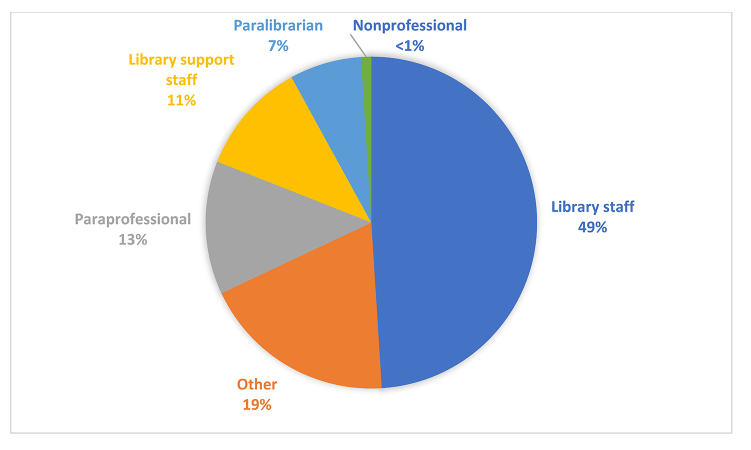
Objective: While studies from the early 1990s show that library staff in nonlibrarian roles interpret the term “paraprofessional” as being demeaning to their roles, no recent research has been conducted on this topic. This study aims to investigate if health sciences library staff continue to have similar negative associations with the term “paraprofessional” and to determine if another term is preferred.Methods: The authors conducted a literature review to identify terms used to categorize library staff in nonlibrarian roles. Using these terms, we created an online Qualtrics survey asking participants to rank terms by preference. We distributed the survey via thirty-six professional email discussion lists, including MEDLIB-L, thirty-three MLA chapter and caucus email discussion lists, DOCLINE-L, and ACRL-HSIG-L. Survey participants included full-time and part-time health sciences library staff in any nonlibrarian position. Responses from librarians were not accepted.Results: Based on 178 completed surveys, “library staff” was the top choice of 49% of participants, over “other” (19%), “paraprofessional” (13%), “library support staff” (11%), “paralibrarian” (7%), and “nonprofessional” (1%). Although “library staff” was the top choice of participants across all ages, older participants (aged 45–75) preferred “library support staff” and “paraprofessional” to a greater degree than younger participants (aged 18–44), while younger participants preferred “other” to a greater degree. Out of 36 participants who specifically mentioned the terms “paraprofessional” or “paralibrarian,” 32 (89%) of those comments were negative, indicating that the “para” in “paraprofessional” and “paralibrarian” is either insulting, inapplicable, or unfamiliar.Conclusions: Our results suggest that although the term “paraprofessional” may not intentionally be used to demean library staff, many library staff interpret the term to be demeaning to their roles. Instead, “library staff,” a more inclusive and less divisive term, was preferred by survey participants. In accordance with our results, we believe the term “paraprofessional” should no longer be used in library and information scholarly literature or professional discourse.
Overview
The claims and statistics of this paper haven’t been checked yet.
Run the check — free, no account needed. It reads the open-access text and checks the sources it cites.
Integrity signals
Registry
Cites
Statistics
Figures
Verification
Claims the paper makes
The claims and statistics of this paper haven’t been checked yet.
Run the check — free, no account needed. It reads the open-access text and checks the sources it cites.
Self-check
Percentages, sums and reported differences re-computed from the paper’s own numbers.
The self-check needs the paper’s full text.
Citations
Cites
No references could be resolved yet.
Research works printed but not linked: 10
- [3]Oberg LR The emergence of the paraprofessional in academic libraries: perceptions and realities. Coll Res Libr. 1992 3; 53(2): 99– 112. DOI: 10.5860/crl_53_02_99. · DOI
- [4]Zhu L The role of paraprofessionals in technical services in academic libraries. Libr Resour Tech Serv. 2012 7; 56(3): 127– 54. DOI: 10.5860/lrts.56n3.127. · DOI
- [6]Gremmels GS Staffing trends in college and university libraries. Ref Serv Rev. 2013 6; 41(2): 233– 52. DOI: 10.1108/00907321311326165. · DOI
- [7]Cox EJ, Myers AKD What is a professional cataloger? Libr Resourc Tech Serv. 2011 4; 54(4): 212– 26. DOI: 10.5860/lrts.54n4.212. · DOI
- [8]Dinkins D, Ryan SM Measuring referrals: the use of paraprofessionals at the reference desk. J Acad Libr. 2010 7; 36(4): 279– 86.
- [17]Vela S Knowledge management, diversity, and professional hierarchies in libraries. J Libr Adm. 2018 1; 58(8): 835– 60. DOI: 10.1080/01930826.2018.1516950. · DOI
- [18]Hill C The professional divide: examining workplace relationships between librarians and library technicians. Aust Libr J. 2014, 4; 63(1): 23– 34. DOI: 10.1080/00049670.2014.890020. · DOI
- [19]Litwin R The library paraprofessional movement and the deprofessionalization of librarianship. Progress Libr. 2009 Summer-Fall; 33: 43– 60. (Available from: < http://www.progressivelibrariansguild.org/PL/PL33/043.pdf>. [ cited 2 Oct 2020].)
- [20]Brown J, Ferretti JA, Leung S, Méndez-Brady ML We here: speaking our truth. Libr Trends. 2018 Summer; 67(1): 163– 81. DOI: 10.1353/lib.2018.0031. · DOI
- [24]Medical Library Association Diversity and Inclusion Task Force. Medical Library Association Diversity and Inclusion Task Force 2019 survey report preprint available MLAConnect [Internet]. 13 2 2020 [ cited 3 May 2020]. < https://www.mlanet.org/blog/mla-diversity-and-inclusion-task-force-2019-survey-report-preprint>. PMC7441896 32843882
Cited by
Glusker, A., Emmelhainz, C., Estrada, N., & Dyess, B. (2022) · Journal of Library Administration · doi:10.1080/01930826.2022.2026119 · Cited by 39
“The term “library staff” refers to library employees who are in positions that do not have the title “librarian” and which do not require the MLIS (Master of Library and Information Science) degree, in line with the definition established by Schilperoort and colleagues (Schilperoort et al., 2021).”
Result
Metadata
- Authors
- Schilperoort, H., Quezada, A., & Lezcano, F.
- Affiliations
- University of Southern California (US)
- ORCID
- Schilperoort, Hannah
- Venue
- Journal of the Medical Library Association
- Published
- 2021-01-07
- Volume
- 109
- Issue
- 1
- Pages
- 13-22
- ISSN
- 1536-5050 (ISSN-L)
- 1558-9439
- PMC
- PMC7772989
- OpenAlex
- W3121107273
- Cited by
- 5
- References
- 0
- Citations by year
- 2025: 1 · 2023: 1 · 2022: 2 · 2021: 1
- FWCI
- 0.15
- Type
- journal article
- Language
- en
- Open access
- diamond
- doi.org
- Locations
- Journal of the Medical Library Association JMLA (publishedVersion, cc-by)
- Europe PMC (PubMed Central) (publishedVersion, cc-by)
- PubMed Central (publishedVersion, cc-by)
- PubMed (publishedVersion)
- DOAJ (DOAJ: Directory of Open Access Journals) (submittedVersion, cc-by-sa)
- Funders
- University of Southern California
- Topics
- Social Sciences › Library and Information Sciences › Library Science and Information
- Social Sciences › Library and Information Sciences › Library Science and Administration
- Social Sciences › Library and Information Sciences › Information Science and Libraries
- Keywords
- medical libraries, library support staff, professional identity, inclusive language
- MeSH terms
- Humans, Libraries, Medical, Library Science, Library Services, Professional Competence, Librarians, Professional Role
About these checks
Registry, retraction, Cites and statistics results are computed, not judged, with one exception: a printed reference that no index lists is read once by a model before it counts as a citation error. Claims are extracted by a model and kept only when their quote appears verbatim in the text; each cited source is then checked, with a model’s help, for whether it says what the claim relies on. Those verdicts can be wrong — read the claim’s quote and the cited source before relying on one.
Statistics and arithmetic are recomputed, not judged.
Confidence bands are shown only for fields calibrated on our annotated test set. None is calibrated yet, so no band is shown.
What counts as a claim ›How we measure confidence ›How we check this ›
Are you an author, or do you see a problem with this page? Request a review
How to cite
Cite CoChat for the checks on this page, and the paper for its own findings.
- This page
- CoChat. (2026). Citation check: Words matter: interpretations and implications of “para” in paraprofessional. https://app.cochat.ai/papers/10.5195/jmla.2021.933
- The paper
- Schilperoort, H., Quezada, A., & Lezcano, F. (2021). Words matter: interpretations and implications of “para” in paraprofessional. Journal of the Medical Library Association. https://doi.org/10.5195/jmla.2021.933
Data sources
Bibliographic data: Semantic Scholar, OpenAlex, Crossref.
Contains information from the Semantic Scholar Academic Graph Datasets, made available under the ODC Attribution License (ODC-BY 1.0).
Semantic Scholar’s data is described in: Kinney, R., et al. (2023). The Semantic Scholar Open Data Platform. arXiv:2301.10140.
