

Self-Refine: Iterative Refinement with Self-Feedback
Open accessThe DOI matches its DataCite record; 48 of the 54 references it cites were found in a registry or an index; 12 of the 22 sources its claims cite were checked for support.
Abstract
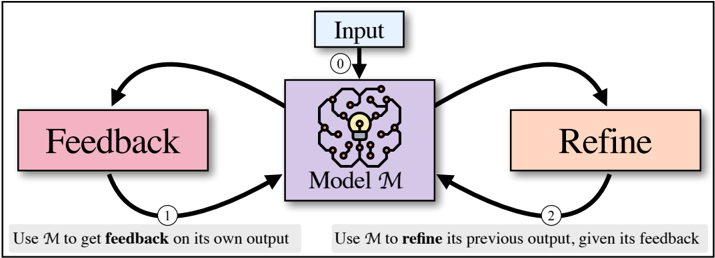
Like humans, large language models (LLMs) do not always generate the best output on their first try. Motivated by how humans refine their written text, we introduce Self-Refine, an approach for improving initial outputs from LLMs through iterative feedback and refinement. The main idea is to generate an initial output using an LLMs; then, the same LLMs provides feedback for its output and uses it to refine itself, iteratively. Self-Refine does not require any supervised training data, additional training, or reinforcement learning, and instead uses a single LLM as the generator, refiner, and feedback provider. We evaluate Self-Refine across 7 diverse tasks, ranging from dialog response generation to mathematical reasoning, using state-of-the-art (GPT-3.5, ChatGPT, and GPT-4) LLMs. Across all evaluated tasks, outputs generated with Self-Refine are preferred by humans and automatic metrics over those generated with the same LLM using conventional one-step generation, improving by ~20% absolute on average in task performance. Our work demonstrates that even state-of-the-art LLMs like GPT-4 can be further improved at test time using our simple, standalone approach.
Overview
CoChat Summary
TL;DR
SELF-REFINE improves large language model outputs by iteratively generating self-feedback and refining the same model’s output without supervised training, additional training, or reinforcement learning. Across 7 diverse tasks, it improves over one-step generation by ∼20% absolute on average, with especially large gains on preference-based tasks.
Key findings
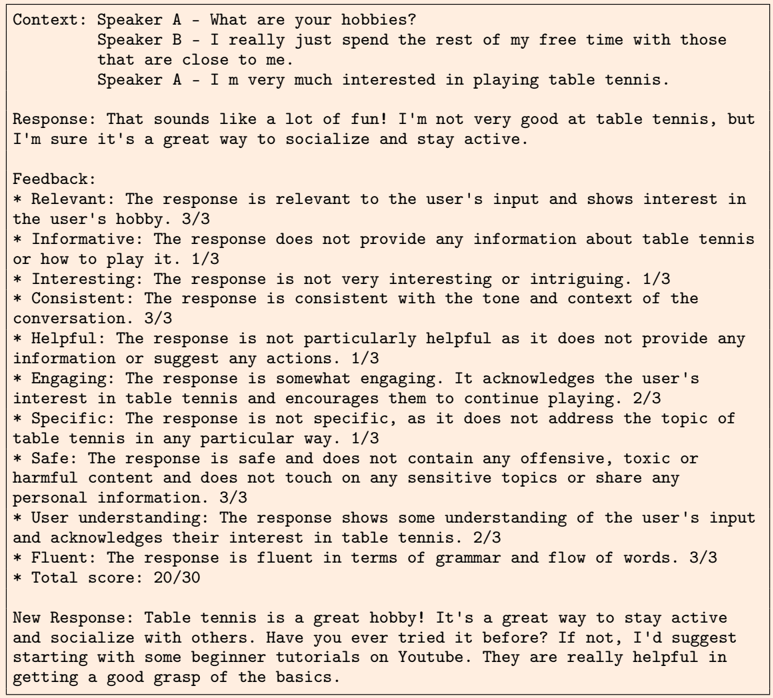
- SELF-REFINE consistently improved GPT-3.5, ChatGPT, and GPT-4 across all evaluated tasks. Examples include GPT-4 Dialogue Response Generation improving from 25.4 to 74.6 (+49.2), GPT-4 Code Optimization from 27.3 to 36.0 (+8.7), and GPT-4 Constrained Generation from 15.0 to 45.0 (+30.0).
- Feedback quality matters: in Code Optimization, SELF-REFINE feedback scored 27.5 vs. 26.0 for generic feedback and 24.8 for no feedback; in Sentiment Reversal, 43.2 vs. 31.2 vs. 0; in Acronym Generation, 56.4 vs. 54.0 vs. 48.0.
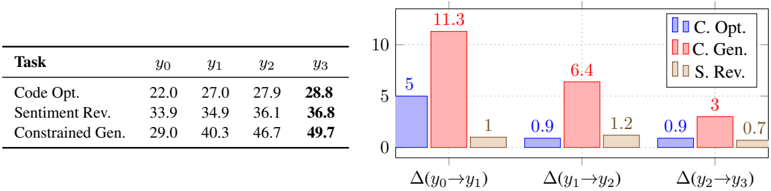
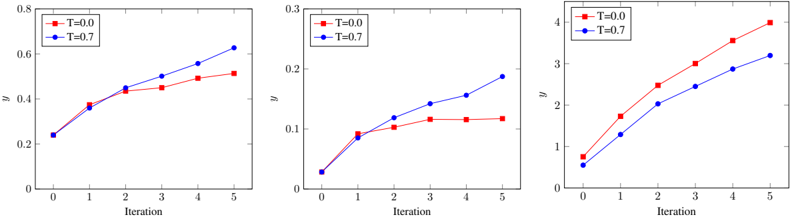
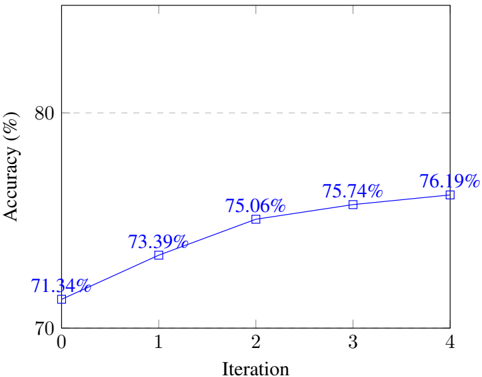
- Iterative refinement generally improves outputs, with diminishing returns: Code Optimization rose from 22.0 at y0 to 28.8 at y3; Sentiment Reversal from 33.9 to 36.8; Constrained Generation from 29.0 to 49.7.
- Math Reasoning gains were modest: GPT-3.5 64.1 to 64.1 (0), ChatGPT 74.8 to 75.0 (+0.2), GPT-4 92.9 to 93.1 (+0.2). With oracle feedback, GPT-3 improved by 4.8% and GPT-4 by 0.7%.
Methods
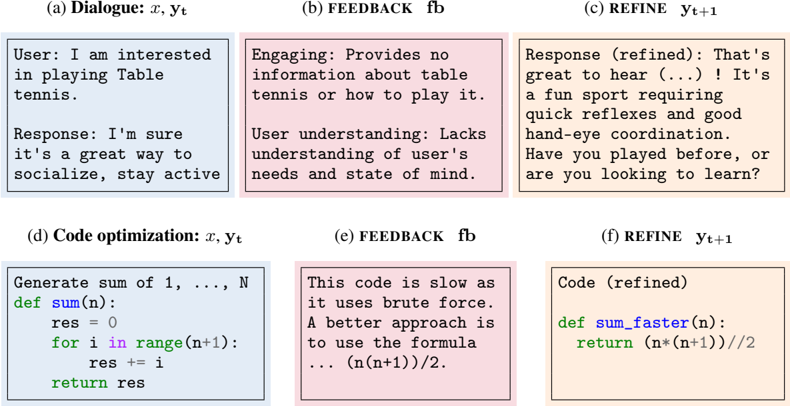
- SELF-REFINE alternates between FEEDBACK and REFINE using the same model M: initial output y0 = M(pgen ∥ x); feedback fbt = M(pfb ∥ x ∥ yt); refinement yt+1 = M(prefine ∥ x ∥ y0 ∥ fb0 ∥ … ∥ yt ∥ fbt). It iterates until a stopping condition or up to a maximum of 4 iterations, using few-shot prompts and no supervised training, additional training, or reinforcement learning.
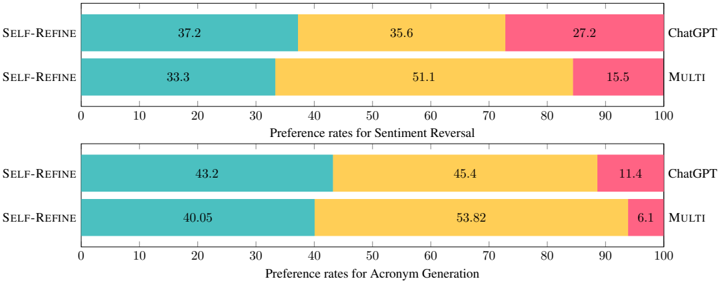
- Evaluation covered 7 tasks: Dialogue Response Generation, Code Optimization, Code Readability Improvement, Math Reasoning, Sentiment Reversal, Acronym Generation, and Constrained Generation (CommonGen-Hard). Base LLMs were GPT-3.5 (text-davinci-003), ChatGPT (gpt-3.5-turbo), GPT-4, and CODEX for code tasks. Metrics included task-specific metrics, human preference, and GPT-4 preference.
- Analysis included ablations on feedback quality and iteration count, comparison against generating multiple outputs, testing Vicuna-13B, and a qualitative error analysis of 70 samples for Code Optimization and Math Reasoning.
Limitations
- Stated: the base models need sufficient few-shot modeling or instruction-following abilities to provide feedback and refine in-context; Vicuna-13B struggled to generate feedback in the required format and often failed to refine properly.
- Stated: experiments used non-open-sourced models (GPT-3.5, ChatGPT, GPT-4, CODEX), whose pretraining corpus, sizes, and biases are not fully described, and which are not free to use; datasets were exclusively English; the approach does not explicitly guard against bad actors steering models toward toxic or harmful text.
- Evident from the text: human A/B evaluations were conducted by the authors, and GPT-4 was used as a proxy for human preference with reported correlations of 82% for Sentiment Reversal, 68% for Acronym Generation, and 71% for Dialogue Response Generation. The paper also notes Math Reasoning gains are limited by the model’s inability to accurately identify errors, with ChatGPT feedback being “everything looks good” for 94% of instances.
Model-written summary. Check it against the paper before relying on it.
Integrity signals
Registry
Cites
Statistics
Figures



Verification
Claims the paper makes
11 Valid · 2 Not valid · 4 Not checked · 107 Own results and interpretations
Every source the paper cites for this claim was checked and supports it.
In the paper
“In code-generation tasks, SELF-REFINE improves the initial generation by up to absolute 13% when applied to strong code models such as Codex (code-davinci-002; Chen et al., 2021).”
§ SELF-REFINE: Iterative Refinement with Self-Feedback > Refine Feedback
What the sources say
- Supportedcites Chen et al., 2021 source
The Chen et al. citation sits in the parenthetical identifying Codex, rather than after the reported SELF-REFINE improvement. Section 3, “Code Fine-Tuning” (p. 4), describes producing Codex and evaluating it on code-generation tasks, supporting that identification. (LLM, conf=0.86)
plainstates a cause- Asserted: passes — The authors put it forward as true.
- Checkable: passes — It can be checked against evidence.
- Load-bearing: passes — The paper’s conclusions depend on it.
- Based: passes — The paper gives a reason why it holds.
- Supported
The cited sources support only part of this claim — read each source’s verdict below.
In the paper
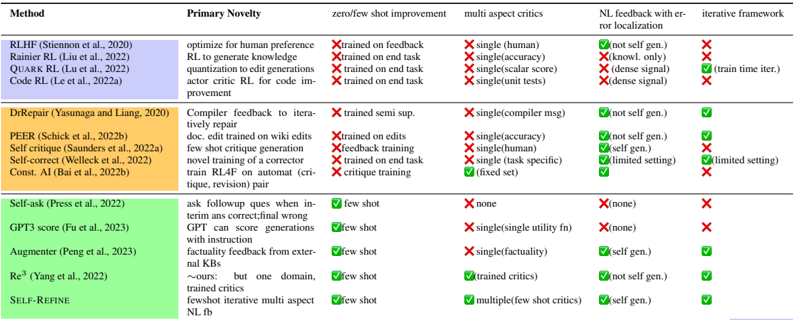
“Second, these reinforcement learning methods require updating the model's parameters, unlike SELF-REFINE.”
§ SELF-REFINE: Iterative Refinement with Self-Feedback > B Broader Related Work
What the sources say
- Supportedcites Stiennon et al., 2020 source
The Introduction (p. 2) says the policy is updated using PPO, and §3.4 (p. 6) describes a learned RL policy with parameters. This supports the claim about the reinforcement-learning methods discussed; the contrast with SELF-REFINE is the citing authors’ framing, not a finding attributed to this source. (LLM, conf=0.90)
- Not matchedcites Lu et al., 2022
Couldn’t be matched to a paper in Crossref, so it can’t be checked.
- Not matchedcites Le et al., 2022a
Couldn’t be matched to a paper in Crossref, so it can’t be checked.
- Supportedcites Stiennon et al. (2020) source
The Introduction (p. 2) says the policy is trained through reinforcement learning and updated using PPO. Section 3.4 (p. 6) also describes the learned RL policy as having parameters. The comparison with SELF-REFINE is the citing authors’ own framing, not a claim this source is needed to establish. (LLM, conf=0.92)
- Not matchedcites Lu et al. (2022)
Couldn’t be matched to a paper in Crossref, so it can’t be checked.
- Not matchedcites Le et al. (2022a)
Couldn’t be matched to a paper in Crossref, so it can’t be checked.
plain- Asserted: passes — The authors put it forward as true.
- Checkable: passes — It can be checked against evidence.
- Load-bearing: unclear — It is unclear whether the paper’s conclusions depend on it.
- Based: passes — The paper gives a reason why it holds.
- Supported
The cited sources support only part of this claim — read each source’s verdict below.
In the paper
“This adjustment notably enhanced performance in the Math Reasoning task, with GPT-3 improving by 4.8% and GPT-4 by 0.7% Table 9.”
§ SELF-REFINE: Iterative Refinement with Self-Feedback > H.1 Using Oracle Feedback
What the sources say
- Partly supportedcites Welleck et al., 2022 sourceExperimental — accuracy not yet measured
Section 3.5 (pp. 8–9) reports that correcting only incorrect outputs and adding explicit feedback improve results in math program synthesis. It does not report the claimed 4.8% GPT-3 or 0.7% GPT-4 gains; its math results use different models and figures. The cited paper’s Table 9 concerns E2E hyperparameters, not those gains. (LLM, conf=0.86)
plainstates a cause- Asserted: passes — The authors put it forward as true.
- Checkable: passes — It can be checked against evidence.
- Load-bearing: unclear — It is unclear whether the paper’s conclusions depend on it.
- Based: passes — The paper gives a reason why it holds.
- Partly supported
The cited sources support only part of this claim — read each source’s verdict below.
In the paper
“These methods differ from SELF-REFINE (and more generally, refinement-based approaches) in that the model cannot access feedback on an intermediate generation.”
§ SELF-REFINE: Iterative Refinement with Self-Feedback > B Broader Related Work
What the sources say
- Partly supportedcites Stiennon et al., 2020 sourceExperimental — accuracy not yet measured
The Introduction (p. 2) says this paper’s RL policy is updated using a reward for the entire generated summary, and a note on p. 6 explicitly says the reward model gives no rewards at intermediate time steps. That supports the distinction for this method, but not the broader claim that reinforcement-learning approaches generally cannot access feedback on intermediate generations. (LLM, conf=0.84)
- Not matchedcites Lu et al., 2022
Couldn’t be matched to a paper in Crossref, so it can’t be checked.
- Not matchedcites Le et al., 2022a
Couldn’t be matched to a paper in Crossref, so it can’t be checked.
plain- Asserted: passes — The authors put it forward as true.
- Checkable: passes — It can be checked against evidence.
- Load-bearing: unclear — It is unclear whether the paper’s conclusions depend on it.
- Based: passes — The paper gives a reason why it holds.
- Partly supported
A result the paper states — it cites no source for it, so there is none to check. The quote shows it is in the paper.
In the paper
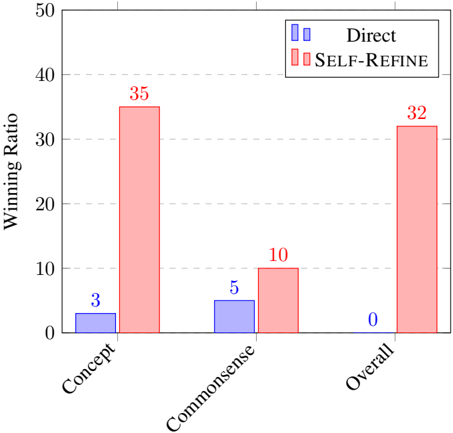
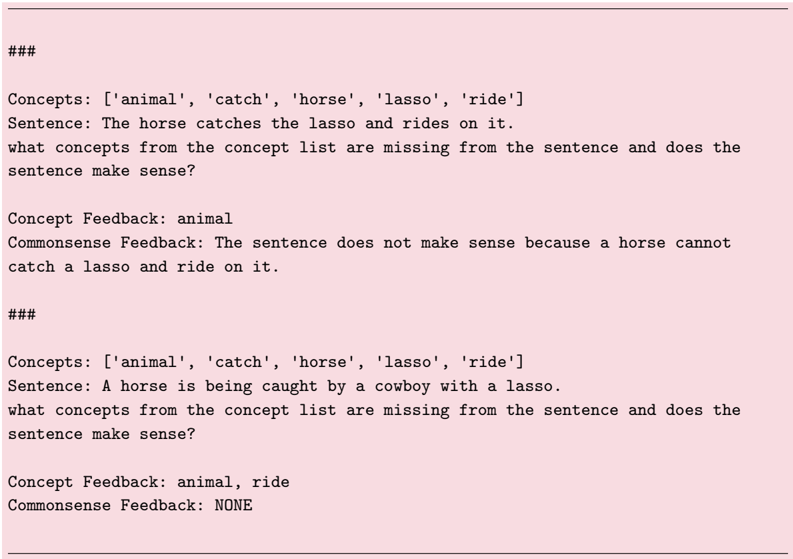
“One of the tasks in which we observe the highest gains compared to the base models is Constrained Generation, where the model is asked to generate a sentence containing up to 30 given concepts.”
§ SELF-REFINE: Iterative Refinement with Self-Feedback > 3.3 Results
plainstates an association- Asserted: passes — The authors put it forward as true.
- Checkable: passes — It can be checked against evidence.
- Load-bearing: unclear — It is unclear whether the paper’s conclusions depend on it.
- Based: passes — The paper gives a reason why it holds.
61 more claims
Create a free account to see all 124 claims and every source verdict.
- Probably not a substantial claim. 25
- It may state two separate claims as one. 35
- The quote only partly states this claim. 5
Claims other papers make about this one
Each is checked against this paper’s own text: does it say what the citing paper says it does?
The cited source doesn’t support the claim as written.
In the citing paper
“Self-Refine is effective but is limited to single-generation reasoning tasks.”
From Reflexion: Language Agents with Verbal Reinforcement Learning (2023) · cites this paper as [15]
Checked by a reasoning model — may be wrong.
Experimental — accuracy not yet measuredThe cited source doesn’t support the claim as written.
In the citing paper
“However, this approach is suboptimal as it lacks problem-specific modeling, that is it does not recognize the constraints to be followed, and only prompts the model to evaluate and improve its responses without clear guidance on what to focus on.”
From LLM Self-Correction with DeCRIM: Decompose, Critique, and Refine for Enhanced Following of Instructions with Multiple Constraints (2024) · cites this paper as Madaan et al. (2023)
Checked by a reasoning model — may be wrong.
Experimental — accuracy not yet measuredThe cited source doesn’t support the claim as written.
In the citing paper
“Retry-based refinement methods Madaan et al. [2023], Gou et al. [2024] often discard the entire context and regenerate from scratch, losing correct intermediate work.”
From Reason Popper-ly: Patching In-Context Reasoning with Inductive Logic Programming (2026) · cites this paper as Madaan et al. [2023]
Checked by a reasoning model — may be wrong.
Experimental — accuracy not yet measuredThe cited source doesn’t support the claim as written.
In the citing paper
“They unfairly instruct the models to generate initial responses that have problems intentionally, over-evaluating selfcorrection performance.”
From When Can LLMs Actually Correct Their Own Mistakes? A Critical Survey of Self-Correction of LLMs (2024) · cites this paper as Madaan et al., 2023
Checked by a reasoning model — may be wrong.
Experimental — accuracy not yet measuredThe source backs part of the claim, not all of it — or backs it for a different population, condition or comparison.
In the citing paper
“Recent research has shifted toward enabling agents to autonomously self-improve when provided with suitable interactive environments.”
From A Survey of Large Language Models (2026) · cites this paper as [277]
Experimental — accuracy not yet measured
65 more claims about this paper
Create a free account to see every claim other papers make about this one.
Self-check
Percentages, sums and reported differences re-computed from the paper’s own numbers.
Each contradiction between two passages listed here was confirmed by an independent check.
Rated major: it would touch a result — a value a result rests on, reported and recomputed p-values on opposite sides of the significance level, two passages that conflict with no sign which is right, or a cited work retracted before this paper was published.
In the paper
§ Q: There were nine computers in the server room.Five more computers were installed each day, from monday to thursday.How many computers are now in the server room?
“| This work | SELF-REFINE w/ GPT-3.5 SELF-REFINE w/ ChatGPT | 62.4 75.1 | | | SELF-REFINE w/ GPT-4 | 94.5 |”
§ SELF-REFINE: Iterative Refinement with Self-Feedback > 3.1 Instantiating SELF-REFINE
“Math Reasoning 64.1 64.1 (0) 74.8 75.0 (↑0.2) 92.9 93.1 (↑0.2)”
Rated major: it would touch a result — a value a result rests on, reported and recomputed p-values on opposite sides of the significance level, two passages that conflict with no sign which is right, or a cited work retracted before this paper was published.
In the paper
“| SELF-REFINE wins | 36.0 | 48.0 | 54.0 | | INIT wins | 23.0 | 18.0 | 16.0 | | Both are equal | 41.0 | 50.0 | 30.0 |”
Reported 100 · recomputed 116
Rated minor: it would not touch a result — a value no result rests on, a p-value that stays on the same side of the significance level, or a conflict that is clerical, resolved elsewhere in the paper, or outside its own findings.
In the paper
“* Well-known: CSCLE is not a well-known acronym.5/5 * Total score: 23/25”
§ SELF-REFINE: Iterative Refinement with Self-Feedback > Q Acronym Generation
Reported 23 · recomputed 24
Rated minor: it would not touch a result — a value no result rests on, a p-value that stays on the same side of the significance level, or a conflict that is clerical, resolved elsewhere in the paper, or outside its own findings.
In the paper
§ SELF-REFINE: Iterative Refinement with Self-Feedback > 3.1 Instantiating SELF-REFINE
“We use greedy decoding with a temperature of 0.7 for all setups.”
§ SELF-REFINE: Iterative Refinement with Self-Feedback > L.2 Experiments
“We consider the temperature of both T = 0.0 (greedy) and T = 0.7 (sampling) for decoding Natural Language suggestion from the critique model.We always use a temperature T = 0.0 (greedy) when decoding Programming Language from the code editor.”
Rated minor: it would not touch a result — a value no result rests on, a p-value that stays on the same side of the significance level, or a conflict that is clerical, resolved elsewhere in the paper, or outside its own findings.
In the paper
§ SELF-REFINE: Iterative Refinement with Self-Feedback > 3.3 Results
“Generally, GPT-4+SELF-REFINE performs better than GPT-3.5+SELF-REFINEand ChatGPT+SELF-REFINE across all tasks”
§ SELF-REFINE: Iterative Refinement with Self-Feedback > 3.1 Instantiating SELF-REFINE
“Sentiment Reversal 8.8 30.4 (↑21.6)11.4 43.2 (↑31.8)3.8 36.2 (↑32.4)”
4 more findings
Create a free account to see every finding of this check.
Citations
Cites
Language Models are Few-Shot Learners
Brown, T. B., Mann, B., Ryder, N., Subbiah, M., Kaplan, J., Dhariwal, P., Neelakantan, A., Shyam, P., Sastry, G., Askell, A., et al. (2020) · arXiv · doi:10.48550/arxiv.2005.14165 · Cited by 23,372
LLaMA: Open and Efficient Foundation Language Models
Touvron, H., Lavril, T., Izacard, G., Martinet, X., Lachaux, M.-A., Lacroix, T., Rozière, B., Goyal, N., Hambro, E., Azhar, F., et al. (2023) · arXiv · doi:10.48550/arxiv.2302.13971 · Cited by 4,602 · cited 2×
“We also experiment with Vicuna-13b (Chiang et al., 2023), a version of LLaMA-13b (Touvron et al., 2023) fine-tuned on conversations sourced from the web.”
BackgroundMethodChain-Of-Thought Prompting Elicits Reasoning in Large Language Models
Wei, J., Wang, X., Schuurmans, D., Bosma, M., Ichter, B., Xia, F., Chi, E., Le, Q. V., & Zhou, D. (2022) · Advances in Neural Information Processing Systems 35 · doi:10.52202/068431-1800 · Cited by 4,505
The Architecture of Complexity
Simon, H. A. (1991) · Facets of Systems Science · doi:10.1007/978-1-4899-0718-9_31 · Cited by 4,433 · cited 1×
“Iterative self -refinement is a fundamental characteristic of human problem-solving (Simon, 1962; Flower and Hayes, 1981; Amabile, 1983).”
BackgroundChain-of-Thought Prompting Elicits Reasoning in Large Language Models
Wei, J., Wang, X., Schuurmans, D., Bosma, M., Ichter, B., Xia, F., Chi, E., Le, Q., & Zhou, D. (2022) · arXiv · doi:10.48550/arxiv.2201.11903 · Cited by 4,263
Training language models to follow instructions with human feedback
Ouyang, L., Wu, J., Jiang, X., Almeida, D., Wainwright, C. L., Mishkin, P., Zhang, C., Agarwal, S., Slama, K., Ray, A., et al. (2022) · arXiv · doi:10.48550/arxiv.2203.02155 · Cited by 4,208
Interval Estimation for a Binomial Proportion
Brown, L. D., Cai, T. T., & DasGupta, A. (2001) · Statistical Science · doi:10.1214/ss/1009213286 · Cited by 3,538 · cited 1×
“Table 13 shows results from Table 1 with Wilson confidence interval (Brown et al., 2001) (at α= 99% confidence interval) and statistical significance.”
BackgroundCharacter-level Convolutional Networks for Text Classification
Zhang, X., Zhao, J., & LeCun, Y. (2015) · arXiv (Cornell University) · doi:10.48550/arxiv.1509.01626 · Cited by 3,205 · cited 11×
“Dataset: (Zhang et al., 2015) 1000 review passages x: The food was fantastic.”
BackgroundMethodInfluentialTraining Language Models to Follow Instructions with Human Feedback
Ouyang, L., Wu, J., Jiang, X., Almeida, D., Wainwright, C., Mishkin, P., Zhang, C., Agarwal, S., Slama, K., Ray, A., et al. (2022) · Advances in Neural Information Processing Systems 35 · doi:10.52202/068431-2011 · Cited by 3,117 · cited 4×
“5 (text-davinci-003 and gpt-3.5-turbo; OpenAI; Ouyang et al., 2022) and GPT-4 (OpenAI, 2023) by 5-40% absolute improvement.”
BackgroundInfluentialEvaluating Large Language Models Trained on Code
Chen, M., Tworek, J., Jun, H., Yuan, Q., Pinto, H. P. D. O., Kaplan, J., Edwards, H., Burda, Y., Joseph, N., Brockman, G., et al. (2021) · arXiv · doi:10.48550/arxiv.2107.03374 · Cited by 1,436
Research works printed but not linked: 3
- Sanjoy Dasgupta, Daniel Hsu, Stefanos Poulis, and Xiaojin Zhu. 2019. Teaching a black-box learner. In Proceedings of the 36th International Conference on Machine Learning, ICML 2019, 9-15 June 2019, Long Beach, California, USA, volume 97 of Proceedings of Machine Learning Research, pages 1547-1555. PMLR.
- William Saunders, Catherine Yeh, Jeff Wu, Steven Bills, Long Ouyang, Jonathan Ward, and Jan Leike. 2022a. Self-critiquing models for assisting human evaluators.
- Timo Schick, Jane Dwivedi-Yu, Zhengbao Jiang, Fabio Petroni, Patrick Lewis, Gautier Izacard, Qingfei You, Christoforos Nalmpantis, Edouard Grave, and Sebastian Riedel. 2022a. Peer: A collaborative language model. · DOI · Paper page
Cited by
DeepSeek-R1: Incentivizing Reasoning Capability in LLMs via Reinforcement Learning
DeepSeek-AI, Guo, D., Yang, D., Zhang, H., Song, J., Wang, P., Zhu, Q., Xu, R., Zhang, R., Ma, S., et al. (2025) · arXiv · doi:10.48550/arxiv.2501.12948 · Cited by 18,918
A survey on large language model based autonomous agents
Wang, L., Ma, C., Feng, X., Zhang, Z., Yang, H., Zhang, J., Chen, Z., Tang, J., Chen, X., Lin, Y., et al. (2024) · Frontiers of Computer Science · doi:10.1007/s11704-024-40231-1 · Cited by 1,941
Toward expert-level medical question answering with large language models
Singhal, K., Tu, T., Gottweis, J., Sayres, R., Wulczyn, E., Amin, M., Hou, L., Clark, K., Pfohl, S. R., Cole-Lewis, H., et al. (2025) · Nature Medicine · doi:10.1038/s41591-024-03423-7 · Cited by 1,734
A Brief Overview of ChatGPT: The History, Status Quo and Potential Future Development
Wu, T., He, S., Liu, J., Sun, S., Liu, K., Han, Q.-L., & Tang, Y. (2023) · IEEE/CAA Journal of Automatica Sinica · doi:10.1109/jas.2023.123618 · Cited by 1,452
“It should be noted that currently proposed technologies such as Toolformer [102] and Plugin7 can partially alleviate the problem of factual errors, and a large amount of work has been proposed [103]−[105].”
BackgroundTree of Thoughts: Deliberate Problem Solving with Large Language Models
Yao, S., Yu, D., Zhao, J., Shafran, I., Griffiths, T. L., Cao, Y., & Narasimhan, K. (2023) · arXiv · doi:10.48550/arxiv.2305.10601 · Cited by 1,158
Metadata
- Authors
- Madaan, A., Tandon, N., Gupta, P., Hallinan, S., Gao, L., Wiegreffe, S., Alon, U., Dziri, N., Prabhumoye, S., Yang, Y., Gupta, S., Majumder, B. P., Hermann, K., Welleck, S., Yazdanbakhsh, A., & Clark, P.
- ORCID
- Venue
- arXiv
- Publisher
- arXiv
- Published
- 2023
- Pages
- 46534-46594
- ISSN
- 1049-5258 (ISSN-L)
- arXiv
- 2303.17651
- OpenAlex
- W7133236450
- Cited by
- 2,314
- References
- 52
- Citations by year
- 2026: 1329 · 2025: 460 · 2024: 338 · 2023: 186
- FWCI
- 260.57
- Type
- conference paper
- Language
- en
- Open access
- green
- arxiv.org
- Licence
- Locations
- neural information processing systems (publishedVersion)
- arXiv (Cornell University) (submittedVersion, cc-by)
- arXiv (Cornell University) (cc-by)
- Topics
- Physical Sciences › Computer Science › Artificial Intelligence › Topic Modeling
- Physical Sciences › Computer Science › Artificial Intelligence › Natural Language Processing Techniques
- Physical Sciences › Computer Science › Artificial Intelligence › Speech and dialogue systems
- Keywords
- iterative refinement, self-feedback, large language models, mathematical reasoning
About these checks
Registry, retraction, Cites and statistics results are computed, not judged, with one exception: a printed reference that no index lists is read once by a model before it counts as a citation error. Claims are extracted by a model and kept only when their quote appears verbatim in the text; each cited source is then checked, with a model’s help, for whether it says what the claim relies on. Those verdicts can be wrong — read the claim’s quote and the cited source before relying on one.
The claim verdicts this report counts are experimental: their accuracy is not yet measured.
A language model drew the claims from the paper on 2026-10-07, under version 3 of the claim definition (model deepseek-v4.1-flash, prompt extract-v3).
A second model labelled each claim on 2026-10-07 (model jev-1.13-20260917, definition revision gold-guideline-v0.2).
Cited sources are checked with a language model’s help (gpt-6-sol).
Statistics and arithmetic are recomputed, not judged.
Confidence bands are shown only for fields calibrated on our annotated test set. None is calibrated yet, so no band is shown.
What counts as a claim ›How we measure confidence ›How we check this ›
Are you an author, or do you see a problem with this page? Request a review
How to cite
Cite CoChat for the checks on this page, and the paper for its own findings.
- This page
- CoChat. (2026). Citation check: Self-Refine: Iterative Refinement with Self-Feedback. https://app.cochat.ai/papers/10.48550/arxiv.2303.17651
- The paper
- Madaan, A., Tandon, N., Gupta, P., Hallinan, S., Gao, L., Wiegreffe, S., Alon, U., Dziri, N., Prabhumoye, S., Yang, Y., Gupta, S., Majumder, B. P., Hermann, K., Welleck, S., Yazdanbakhsh, A., & Clark, P. (2023). Self-Refine: Iterative Refinement with Self-Feedback. arXiv. https://doi.org/10.48550/arxiv.2303.17651
Data sources
Bibliographic data: Semantic Scholar, OpenAlex, Crossref.
Contains information from the Semantic Scholar Academic Graph Datasets, made available under the ODC Attribution License (ODC-BY 1.0).
Semantic Scholar’s data is described in: Kinney, R., et al. (2023). The Semantic Scholar Open Data Platform. arXiv:2301.10140.
