

The DOI matches its DataCite record.
Investigating Breakdowns In Human Robot Interaction: A Conversation Analysis Guided Single Case Study Of A Human-Robot Communication In A Museum Environment
Open accessAbstract
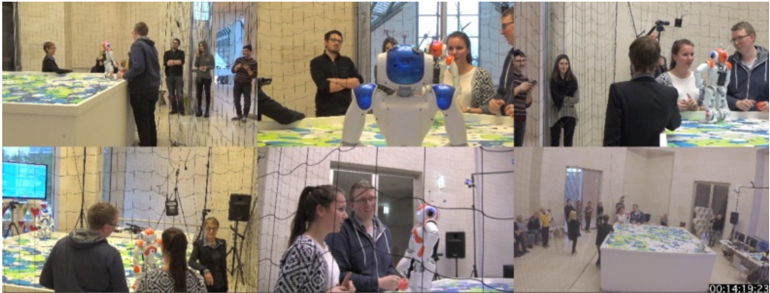
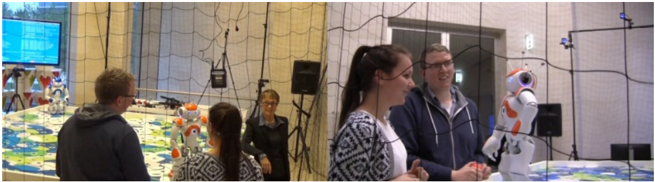
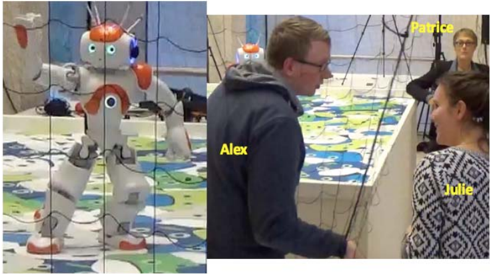
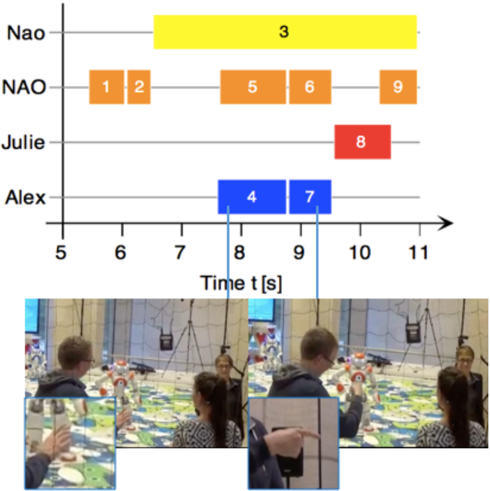
In a single case study, we show how a conversation analysis (CA) approach can shed light onto the sequential unfolding of human-robot interaction. Relying on video data, we are able to show that CA allows us to investigate the respective turn-taking systems of humans and a NAO robot in their dialogical dynamics, thus pointing out relevant differences. Our fine grained video analysis points out occurring breakdowns and their overcoming, when humans and a NAO-robot engage in a multimodally uttered multi-party communication during a sports guessing game. Our findings suggest that interdisciplinary work opens up the opportunity to gain new insights into the challenging issues of human robot communication in order to provide resources for developing mechanisms that enable complex human-robot interaction (HRI).
Overview
The claims and statistics of this paper haven’t been checked yet.
Run the check — free, no account needed. It reads the open-access text and checks the sources it cites.
Integrity signals
Registry
Cites
Statistics
Figures
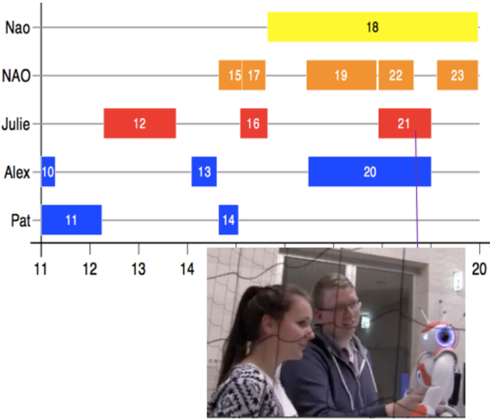
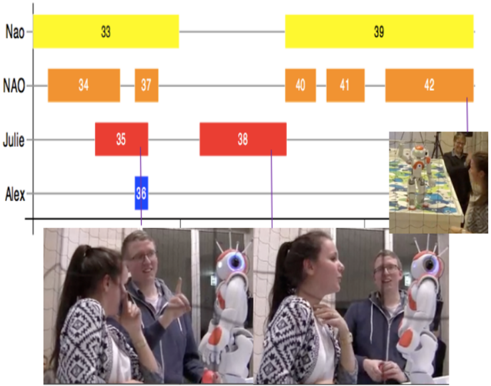
Verification
Claims the paper makes
The claims and statistics of this paper haven’t been checked yet.
Run the check — free, no account needed. It reads the open-access text and checks the sources it cites.
Claims other papers make about this one
Each is checked against this paper’s own text: does it say what the citing paper says it does?
The source backs part of the claim, not all of it — or backs it for a different population, condition or comparison.
In the citing paper
“these sounds regularly lead to confusion (Arend et al. 2017).”
From AI in situated action: a scoping review of ethnomethodological and conversation analytic studies (2025) · cites this paper as Arend et al. 2017
Experimental — accuracy not yet measuredThe cited source says what the claim attributes to it.
In the citing paper
“In order to learn more about the system when trouble arises, users also turn to system-external resources when available, such as a manual or a co-present expert such as, in the cases reviewed, the researcher or designer (see Alač et al. 2011; Arend et al. 2017; Muhle 2008).”
From AI in situated action: a scoping review of ethnomethodological and conversation analytic studies (2025) · cites this paper as Arend et al. 2017
The cited source says what the claim attributes to it.
In the citing paper
“Pelikan et al. (2020) studied Cozmo, a robot that only uses non-verbal sounds, whereas the other studies discussed a Nao that took verbal turns (Pelikan and Broth 2016; Arend et al. 2017).”
From AI in situated action: a scoping review of ethnomethodological and conversation analytic studies (2025) · cites this paper as Arend et al. 2017
The cited source says what the claim attributes to it.
In the citing paper
“EM/CA studies focus on exploring whether and how machines constitute proper interactional parties, or to what extent the human and non-human participants are treated differently in interaction (Arend et al. 2017; Licoppe and Rollet 2020; Reeves and Porcheron 2022).”
From AI in situated action: a scoping review of ethnomethodological and conversation analytic studies (2025) · cites this paper as Arend et al. 2017
Self-check
Percentages, sums and reported differences re-computed from the paper’s own numbers.
The self-check needs the paper’s full text.
Citations
Cites
Still being checked.
Research works printed but not linked: 17
- M. Goodrich & A. Schultz, "Human-Robot Interaction: A Survey", in Foundation and Trends in Human-Computer Interaction, vol. 1, no 3, 2007, pp. 203-275.
- J. Markowitz (ed.), Robots that Talk and Listen. Berlin: De Gruyter, 2015.
- H. R. M. Pelikan & M. Broth, "Why that Nao? How Humans Adapt to a Conventional Humanoid Robot in Taking Turns-at-Talk", in Proceedings of the 2016 CHI Conference on Human Factors in Computing Systems, 2016, pp. 4921-4932.
- B. Arend, P. Sunnen, P. Fixmer & M Sujbert, "Perspectives do matter - Expanding Multimodal Interaction Analysis with Joint Screen", in Classroom Discourse, Special Issue Multimodality, vol. 5, no 1, 2014, pp. 38-50.
- B. Arend, P. Sunnen, "Dialogic Classroom Talk -Rethinking 'Messy' Classroom Interaction", in Proceedings of the 10th EAPRIL (European Association for Practitioner Research on Improving Learning in Education and Professional Practice) conference, 2016, pp. 424-434.
- P. Linell, "Dialogism and the Distributed Language Approach: a rejoinder to Steffensen", in Language Sciences, vol. 50, 2015, pp. 120- 126.
- M.M. Bakhtin, Speech Genres and Other Late Essays. Austin: University of Texas Press, 1986.
- V.N. Volosinov, V.N., Marxism and the Philosophy of Language. Cambridge: Harvard University Press, 1973, p. 86.
- P. ten Have, Doing Conversation Analysis. Los Angeles: Sage Publications, 2007.
- H. Sacks, E.A. Schegloff, & G. Jefferson, "A simplest systematics for the organisation of turn taking in conversation", in Language, vol. 50, no 4, 1974, pp. 596-735.
- A. Deppermann, H. Blühdorn, "Negation als Verfahren des Adressatenzuschnitts: Verstehenssteuerung durch Interpretationsrestriktionen", in Deutsche Sprache: Zeitschrift für Theorie, Praxis, Dokumentation, Themenheft: Interaktionale Linguistik des Verstehens, vol. 13, no 1, 2013, pp. 6-30.
- C. Heath, "Talk and recipiency: sequential organization in speech and body movement", in J. Maxwell Atkinson & J. Heritage (eds.), Structures of Social Action. Studies in Conversation Analysis, Cambridge: Cambridge University Press, 1984, p. 250.
- E. Schegloff, Sequence Organization in Interaction. A primer in Conversation Analysis. Cambridge: Cambridge University Press, 2007.
- K. Pitsch, R. Gehle & S. Wrede, "Addressing Multiple Participants: A Museum Robot's Gaze Shapes Visitor Participation", in Proceedings of ICSR 2013, 2013, pp. 587-588.
- B. Arend, "Contribution d'un outil de transcription dans la mise en mots de l'analyse d'un processus de conception collaborative observe ́ dans sa profondeur phe ńome ńale", inRecherches Qualitatives, Logiciels Pour l'analyse Qualitative: Innovations Techniques et Sociales, vol. 9, 2010, pp.95-108.
- E. Holt, "On the nature of 'laughables': laughter as a response to overdone figurative phrases", in Pragmatics, vol. 21, no 3, 2011, pp. 393-410.
- B. Mutlu, S. Andrist & A. Sauppé, "Enabling human-robot dialogue", in J. Markowitz (ed.), Robots that Talk and Listen. Berlin: De Gruyter, 2015, pp. 81-124.
Cited by
Sorted by citations
“Pepper, what do you mean?” Miscommunication and repair in robot-led survey interaction
Stommel, W., de Rijk, L., & Boumans, R. (2022) · 2022 31st IEEE International Conference on Robot and Human Interactive Communication (RO-MAN) · doi:10.1109/ro-man53752.2022.9900528 · Cited by 19
AI in situated action: a scoping review of ethnomethodological and conversation analytic studies
Mlynář, J., de Rijk, L., Liesenfeld, A., Stommel, W., & Albert, S. (2025) · AI & SOCIETY · doi:10.1007/s00146-024-01919-x · Cited by 18
Matsumoto, K., Sasayama, M., Yoshida, M., Kita, K., & Ren, F. (2022) · Electronics · doi:10.3390/electronics11050695 · Cited by 4
Robot Sound in Interaction : Analyzing and Designing Sound for Human-Robot Coordination
Pelikan, H. R. M. (2023) · Studies in language and culture · doi:10.3384/9789180751179 · Cited by 3
Arend, B., & Sunnen, P. (2018) · IAFOR Journal of Language Learning · doi:10.22492/ijll.3.2.01 · Cited by 3
Self-citation
Metadata
- Authors
- Arend, B., Sunnen, P., & Caire, P.
- Affiliations
- University of Luxembourg (LU)
- Venue
- Zenodo
- Publisher
- Zenodo
- Published
- 2017-03-02
- OpenAlex
- W2611347176
- Cited by
- 5
- References
- 0
- Citations by year
- 2023: 1 · 2022: 2 · 2018: 2
- FWCI
- 0.78
- Type
- journal article
- Language
- en
- Open access
- green
- zenodo.org
- Licence
- Locations
- Zenodo (CERN European Organization for Nuclear Research) (submittedVersion, cc-by)
- Zenodo (CERN European Organization for Nuclear Research) (cc-by)
- Topics
- Social Sciences › Psychology › Social Psychology › Social Robot Interaction and HRI
- Physical Sciences › Computer Science › Artificial Intelligence › Speech and dialogue systems
- Social Sciences › Arts and Humanities › Language and Linguistics › Language, Discourse, Communication Strategies
- Keywords
- human-robot interaction, conversation analysis, turn-taking, NAO robot, multimodal communication, multi-party communication, museum environment, dialogue dynamics
About these checks
Registry, retraction, Cites and statistics results are computed, not judged, with one exception: a printed reference that no index lists is read once by a model before it counts as a citation error. Claims are extracted by a model and kept only when their quote appears verbatim in the text; each cited source is then checked, with a model’s help, for whether it says what the claim relies on. Those verdicts can be wrong — read the claim’s quote and the cited source before relying on one.
Statistics and arithmetic are recomputed, not judged.
Confidence bands are shown only for fields calibrated on our annotated test set. None is calibrated yet, so no band is shown.
What counts as a claim ›How we measure confidence ›How we check this ›
Are you an author, or do you see a problem with this page? Request a review
How to cite
Cite CoChat for the checks on this page, and the paper for its own findings.
- This page
- CoChat. (2026). Citation check: Investigating Breakdowns In Human Robot Interaction: A Conversation Analysis Guided Single Case Study Of A Human-Robot Communication In A Museum Environment. https://app.cochat.ai/papers/10.5281/zenodo.1130168
- The paper
- Arend, B., Sunnen, P., & Caire, P. (2017). Investigating Breakdowns In Human Robot Interaction: A Conversation Analysis Guided Single Case Study Of A Human-Robot Communication In A Museum Environment. Zenodo. https://doi.org/10.5281/zenodo.1130168
