

The DOI matches its Crossref record.
Social Criticism in Aravind Adiga’s The White Tiger
Abstract
Social criticism is a form of criticism that deals with the shortcomings and flawed structures of the society in order to reform them. In India, since the inception of English writings, a number of works especially novels have been written in order to underscore several burning socio-cultural issues which have been problematic for the smooth functioning of the society. Aravind Adiga’s epistolary novel, The White Tiger, is one such novel that tells the venturesome story of a character named Balram Halwai who writes a series of letters to Mr. Wen Jiabao, the Prime Minister of China. In these letters, he elaborates his struggles, his moral degradation and his social upliftment as a result of his daredevilry and hard work. He also mentions how the corrupt behaviour of a number of government officials in the country has helped him to raise his status. Throughout the novel, Adiga tries to portray one or other social, political, religious or cultural problems which hinder the progress of his country. In the novel, he raises many crucial issues of the country such as hunger, oppression, poverty, illiteracy, sufferings, corruption in government offices, unemployment, dowry system, prostitution, rotten political system, feudalism, wrong doings of the religious heads etc. Most of these issues are based on the grounds of caste, class and religion which heavily influence Indian society.
Overview
The claims and statistics of this paper haven’t been checked yet.
Run the check — free, no account needed. It reads the open-access text and checks the sources it cites.
Integrity signals
Registry
Cites
Statistics
Figures
Verification
Claims the paper makes
The claims and statistics of this paper haven’t been checked yet.
Run the check — free, no account needed. It reads the open-access text and checks the sources it cites.
Claims other papers make about this one
Each is checked against this paper’s own text: does it say what the citing paper says it does?
In the citing paper
“Kumar (2022) state social criticism is a form of academic or journalistic criticism that focuses on numerous sociocultural issues in contemporary life.This sort of criticism focuses on society's flaws and weaknesses to reform them.”
From Flouting Maxim as Social Criticism: Rhetorical Manifestations in Wilde’s The Importance of Being Earnest (2026) · cites this paper as Kumar (2022)
Self-check
Percentages, sums and reported differences re-computed from the paper’s own numbers.
The self-check needs the paper’s full text.
Citations
Cites
No references could be resolved yet.
Research works printed but not linked: 2
- Dwivedi, A.N. “Review of The White Tiger.” Research and Criticism: New Series, vol. 1, 2010, pp. 154-155.
- Kumar, Vishnu. “Social Criticism in the Novels of Mulk Raj Anand and U R Ananthamurthy: Untouchable, Coolie, Samskara and Bharathipura.” Chapter vi: Conclusion, P. Hd. Research Thesis, Department of English &MEL, 2020. shodhganga.inflibnet.ac.in, http://hdl.handle.net/10603/311792. Accessed on 01 Jan. 2021.
Cited by
Rani, S., & Utami, A. I. (2026) · Rainbow: Journal of Literature, Linguistics and Culture Studies · doi:10.15294/rainbow.v15i2.57513
Metadata
- Authors
- Kumar, D. B.
- Venue
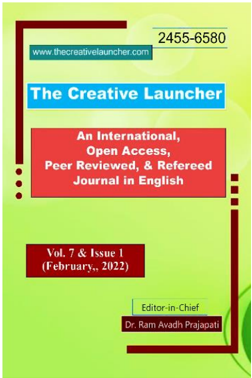
- The Creative Launcher
- Publisher
- Perception Publishing
- Published
- 2022-02-28
- Volume
- 7
- Issue
- 1
- Pages
- 79-85
- ISSN
- 2455-6580
- Cited by
- 0
- References
- 0
About these checks
Registry, retraction, Cites and statistics results are computed, not judged, with one exception: a printed reference that no index lists is read once by a model before it counts as a citation error. Claims are extracted by a model and kept only when their quote appears verbatim in the text; each cited source is then checked, with a model’s help, for whether it says what the claim relies on. Those verdicts can be wrong — read the claim’s quote and the cited source before relying on one.
Statistics and arithmetic are recomputed, not judged.
Confidence bands are shown only for fields calibrated on our annotated test set. None is calibrated yet, so no band is shown.
What counts as a claim ›How we measure confidence ›How we check this ›
Are you an author, or do you see a problem with this page? Request a review
Data sources
Bibliographic data: Semantic Scholar, OpenAlex, Crossref.
Contains information from the Semantic Scholar Academic Graph Datasets, made available under the ODC Attribution License (ODC-BY 1.0).
Semantic Scholar’s data is described in: Kinney, R., et al. (2023). The Semantic Scholar Open Data Platform. arXiv:2301.10140.
