

The DOI matches its Crossref record; 15 of the 16 references it cites were found in a registry or an index, and 1 are not checked yet.
The Effect of Shifting to Student-Centered Learning: Implementing Student-Centered Reading
Open accessAbstract
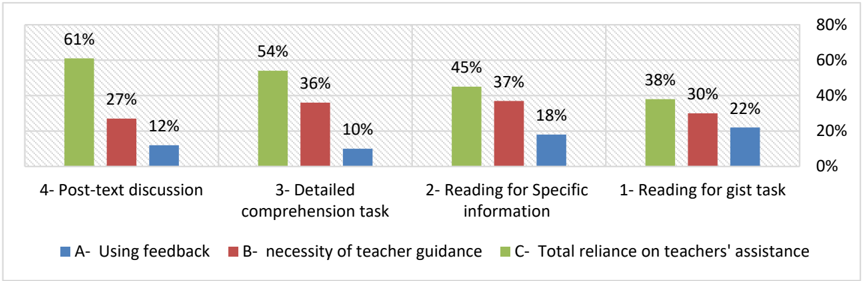
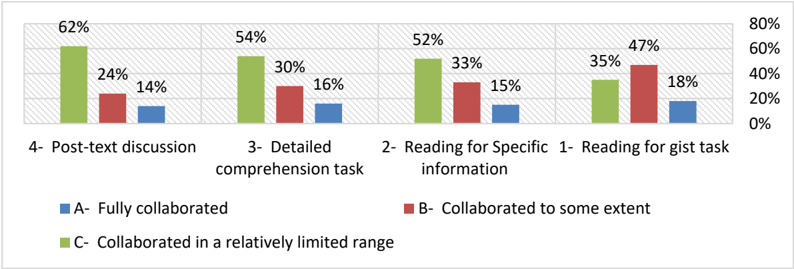
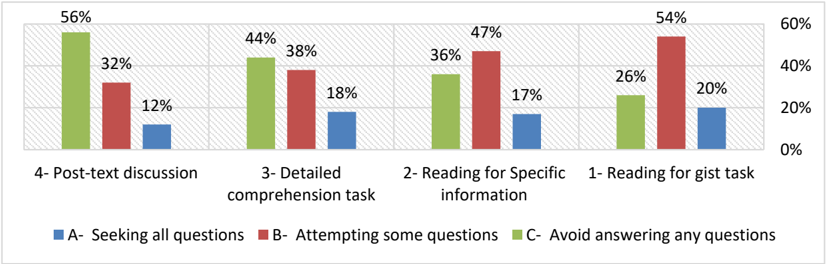
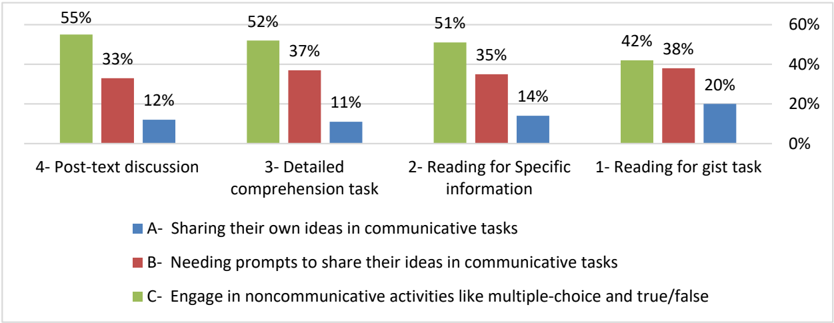
The "traditional" forms of teaching are extremely familiar to students, who frequently favor learning that is focused on receiving instruction and reproducing knowledge. This study aims to examine the effects of these traditional forms of teaching practices, such as teacher-centered learning on EFL learners' engagement in implementing student-centered reading. The study uses an observation checklist and interview as tools for collecting data from twelve EFL elementary reading classes and their teachers. The statistically analyzed data has shown that whenever reading activities demand deeper, personalized discussion, the learners engage less and rely more on their teachers for assistance. When interacting with non-communicative tasks, EFL students take full ownership of their own learning; however, when interacting with communicative tasks, they require teacher prompting. Furthermore, learners' collaboration with each other on achieving reading tasks was, in most cases, either done to some extent or in a very limited range. Thus, EFL learners maintained dependency in carrying out reading activities through their preference for non-communicative tasks over communicative tasks and their collaboration upon reading activities in a limited range. Based on this, the design of communicative reading activities demands prompting, and learners need to be encouraged and guided for engagement. Students may be more receptive and interested if they are more informed about the advantages and effectiveness of student-centered learning. In spite of the effectiveness of student-centered learning in many contexts, it needs to be redefined to fit within the culture and specific EFL learning and teaching contexts.
Overview
The claims and statistics of this paper haven’t been checked yet.
Run the check — free, no account needed. It reads the open-access text and checks the sources it cites.
Integrity signals
Registry
Cites
Statistics
Figures
Verification
Claims the paper makes
The claims and statistics of this paper haven’t been checked yet.
Run the check — free, no account needed. It reads the open-access text and checks the sources it cites.
Claims other papers make about this one
Each is checked against this paper’s own text: does it say what the citing paper says it does?
The cited source says what the claim attributes to it.
In the citing paper
“Furthermore, this type of student-centered learning helps teachers transition from being the sole source of information to becoming facilitators who guide students in discovering the meaning of each topic (Minalla, 2023).”
From Wordwall and Interactive Flat Panel (IFP) as Student-Centered, Deep Learning-Based Media for Islamic Education in Elementary Schools (2026) · cites this paper as Minalla, 2023
Self-check
Percentages, sums and reported differences re-computed from the paper’s own numbers.
The self-check needs the paper’s full text.
Citations
Cites
International Journal of Instruction
Staddon, R. V. (2018) · International Journal of Instruction · doi:10.12973/iji · Cited by 679
McCombs, B. L., & Whisler, J. S. (1997) · Cited by 636
McCombs, B. L., & Whisler, J. S. (1997) · Medical Entomology and Zoology · Cited by 520
Student Centered Classroom, The
Johnson, E. (2013) · Routledge eBooks · doi:10.4324/9781315852706 · Cited by 190
Factors Underlying Low Achievement of Saudi EFL Learners
Alrabai, F. (2016) · International Journal of English Linguistics · doi:10.5539/ijel.v6n3p21 · Cited by 143
Investigating Reading Challenges Faced by EFL Learners at Elementary Level
Khan, R. M. I., Shahbaz, M., Kumar, T., & Khan, I. (2020) · Register Journal · doi:10.18326/rgt.v13i2.277-292 · Cited by 66
Pham, T. T. H. (2011) · Journal of Higher Education Policy and Management · doi:10.1080/1360080x.2011.605226 · Cited by 47
Jordan, L., Bovill, C., Othman, S. M., Saleh, A. M., Shabila, N. P., & Watters, N. (2013) · Teaching in Higher Education · doi:10.1080/13562517.2013.827649 · Cited by 38
The effect of student centered instructional approaches on student success
Gelişli, Y. (2009) · Procedia - Social and Behavioral Sciences · doi:10.1016/j.sbspro.2009.01.085 · Cited by 35
Lee, S. J., & Branch, R. M. (2017) · Innovations in Education and Teaching International · doi:10.1080/14703297.2017.1285716 · Cited by 31
Research works printed but not linked: 7
- Al Asmari, A. (2015). Communicative Language Teaching in EFL university context: Challenges for teachers. Journal of Language Teaching and Research, 6(5), 976-984. https://doi.org/10.17507/jltr.0605. · DOI
- Brahm, T., & Gebhardt, A. (2011). Motivation deutschsprachiger Studierender in der »Bologna-Ära«. Zeitschrift für Hochschulentwicklung, 6(2), 15-29.
- Du Plessis, E. (2020). Student teachers' perceptions, experiences, and challenges regarding learner-centered teaching. South African Journal of Education, 40(1).
- Kalanzadeh, G. (2011). Perceived Problems in Using Communicative Language Teaching (CLT) By EFL Iranian Teachers. Conference: ICLLL, January, 2011.
- Jones, L. (2007). The Student-Centered Classroom. Cambridge: Cambridge University Press.
- Mina, S., & Zohreh, S. (2015). Iranian English Teachers' Beliefs about Teacher-centered Education vs. Their Beliefs about Actual Classroom Roles. DU Journal, Humanities and Social Sciences, 8(5), 471-484.
- Tani, M. (2005). Quiet, but only in class: Reviewing the in-class participation of Asian students. In Higher Education Research and Development Society of Australia Conference, Sydney, New South Wales. Retrieved September (Vol. 5, p. 2007).
Cited by
Aulia, M. G., Rokhimawan, M. A., Rifkiya, A., & Arawinda, T. (2025) · J-PAI · doi:10.18860/jpai.v11i2.31516 · Cited by 7
Hadi, A., & Fazira, L. (2025) · Datokarama English Education Journal · doi:10.24239/dee.v6i1.114 · Cited by 4
Minalla, A. A. (2024) · World Journal of English Language · doi:10.5430/wjel.v14n4p166 · Cited by 1
Self-citationRiza, M. D., Sunandar, M. A., & Rahman, S. F. A. (2024) · International Journal of Mathematics and Science Education · doi:10.62951/ijmse.v1i3.255 · Cited by 1
Baharsyah, A. T., Kusumawati, R., & Mushoffa, A. (2026) · Jurnal Progress: Wahana Kreativitas dan Intelektualitas · doi:10.31942/pgrs.v14i1.15219
“Furthermore, this type of student-centered learning helps teachers transition from being the sole source of information to becoming facilitators who guide students in discovering the meaning of each topic (Minalla, 2023).”
Metadata
- Authors
- Minalla, A. A.
- Affiliations
- University of Tabuk (SA)
- Corresponding author
- Minalla, Amir Abdalla
- Venue
- Journal of Curriculum and Teaching
- Publisher
- Sciedu Press
- Published
- 2023-08-15
- Volume
- 12
- Issue
- 4
- Pages
- 107
- ISSN
- 1927-2677 (ISSN-L)
- 1927-2685
- OpenAlex
- W4386168033
- Cited by
- 5
- References
- 15
- Citations by year
- 2026: 1 · 2025: 3 · 2024: 1
- FWCI
- 5.61
- Type
- journal article
- Language
- en
- Open access
- diamond
- dx.doi.org
- Locations
- Journal of Curriculum and Teaching (publishedVersion, cc-by)
- Topics
- Social Sciences › Arts and Humanities › Language and Linguistics › EFL/ESL Teaching and Learning
- Social Sciences › Education › Innovative Teaching Methods
- Social Sciences › Education › English Language Learning and Teaching
- Keywords
- student-centered learning, EFL reading instruction, teacher-centered instruction, student engagement, learner autonomy, peer collaboration, elementary English learners
About these checks
Registry, retraction, Cites and statistics results are computed, not judged, with one exception: a printed reference that no index lists is read once by a model before it counts as a citation error. Claims are extracted by a model and kept only when their quote appears verbatim in the text; each cited source is then checked, with a model’s help, for whether it says what the claim relies on. Those verdicts can be wrong — read the claim’s quote and the cited source before relying on one.
Statistics and arithmetic are recomputed, not judged.
Confidence bands are shown only for fields calibrated on our annotated test set. None is calibrated yet, so no band is shown.
What counts as a claim ›How we measure confidence ›How we check this ›
Are you an author, or do you see a problem with this page? Request a review
Data sources
Bibliographic data: Semantic Scholar, OpenAlex, Crossref.
Contains information from the Semantic Scholar Academic Graph Datasets, made available under the ODC Attribution License (ODC-BY 1.0).
Semantic Scholar’s data is described in: Kinney, R., et al. (2023). The Semantic Scholar Open Data Platform. arXiv:2301.10140.
