

Increasing Use of Promotional Language in Orthopaedic Surgery Abstracts—An Analysis of 112,916 Abstracts 1985 to 2020
Open accessThe DOI matches its Crossref record; 21 of the 21 references it cites were found in a registry or an index.
Abstract
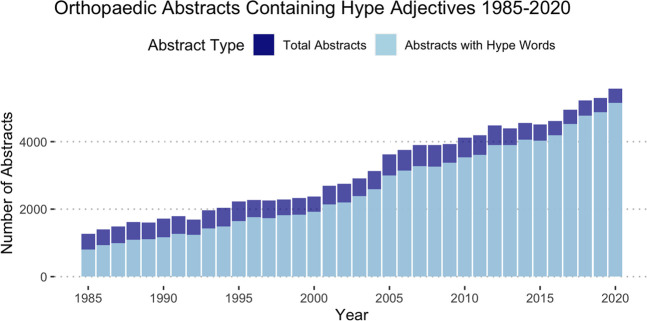
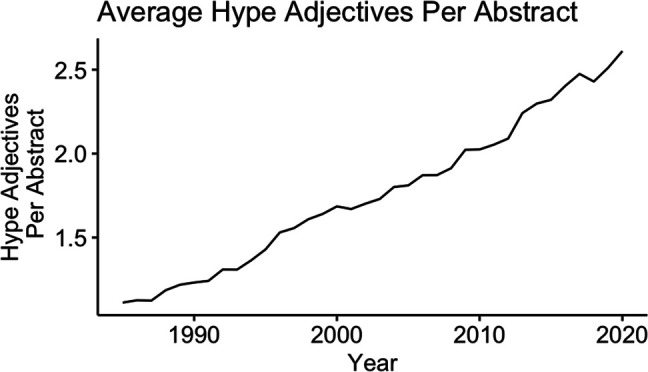
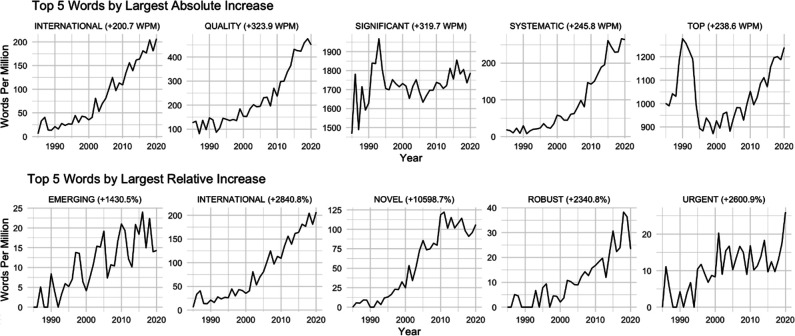
Background: Increasing use of “hype” language (eg, language overstating research impact) has been documented in the scientific community. Evaluating language in abstracts is important because readers may use abstracts to extrapolate findings to entire publications. Our purpose was to assess the frequency of hype language within orthopaedic surgery. Methods: One hundred thirty-nine hype adjectives were previously identified using a linguistics approach. All publicly available abstracts from 18 orthopaedic surgery journals between 1985 and 2020 were obtained, and hype adjectives were tabulated. Change in frequency of these adjectives was calculated. Results: A total of 112,916 abstracts were identified. 67.0% (948/1414) of abstracts in 1985 contained hype adjectives, compared with 92.5% (5287/5714) in 2020. The average number of hype adjectives per abstract increased by 136% (1.1 to 2.6). Of the 139 adjectives, 87 (62.5%) increased in frequency and 40 (28.7%) decreased in frequency while 12 (9%) were not used. The hype adjectives with the largest absolute increases in frequency were quality (+324wpm), significant (+320wpm), systematic (+246wpm), top (+239wpm), and international (+201wpm). The five hype adjectives with the largest relative increases in frequency were novel (+10500%), international (+2850%), urgent (+2600%), robust (+2300%), and emerging (+1400%). Conclusion: Promotional language is increasing in orthopaedic surgery abstracts. Authors, editors, and reviewers should seek to minimize the usage of nonobjective language.
Overview
The claims and statistics of this paper haven’t been checked yet.
Free: it reads the open-access text and checks the first 5 claims that cite a source we can check. Create a free account to check every claim.
Integrity signals
Registry
Cites
Statistics
Figures
Verification
Claims the paper makes
The claims and statistics of this paper haven’t been checked yet.
Free: it reads the open-access text and checks the first 5 claims that cite a source we can check. Create a free account to check every claim.
Claims other papers make about this one
Each is checked against this paper’s own text: does it say what the citing paper says it does?
The cited source says what the claim attributes to it.
In the citing paper
“The use of promotional language in published research papers has soared in the last decades1–3.”
From Scientific publications that use promotional language in the abstract receive more citations and public attention (2025) · cites this paper as [3]
Self-check
Percentages, sums and reported differences re-computed from the paper’s own numbers.
The self-check needs the paper’s full text.
Citations
Cites
Boutron, I. (2010) · JAMA · doi:10.1001/jama.2010.651 · Cited by 842
Boutron, I., Altman, D. G., Hopewell, S., Vera-Badillo, F., Tannock, I., & Ravaud, P. (2014) · Journal of Clinical Oncology · doi:10.1200/jco.2014.56.7503 · Cited by 368
‘Spin’ in published biomedical literature: A methodological systematic review
Chiu, K., Grundy, Q., & Bero, L. (2017) · PLOS Biology · doi:10.1371/journal.pbio.2002173 · Cited by 317
rentrez: An R package for the NCBI eUtils API
Winter, D. (2017) · The R Journal · doi:10.32614/rj-2017-058 · Cited by 244
Press Releases: Translating Research Into News
Woloshin, S., & Schwartz, L. M. (2002) · JAMA · doi:10.1001/jama.287.21.2856 · Cited by 187
Khan, M. S., Lateef, N., Siddiqi, T. J., Rehman, K. A., Alnaimat, S., Khan, S. U., Riaz, H., Murad, M. H., Mandrola, J., Doukky, R., et al. (2019) · JAMA Network Open · doi:10.1001/jamanetworkopen.2019.2622 · Cited by 93
Millar, N., Salager-Meyer, F., & Budgell, B. (2019) · English for Specific Purposes · doi:10.1016/j.esp.2019.02.004 · Cited by 85
Toci, G. R., Elsner, J. A., Bigelow, B. F., Bryant, B. R., & LaPorte, D. M. (2020) · Journal of surgical education · doi:10.1016/j.jsurg.2020.08.024 · Cited by 62
Millar, N., Batalo, B., & Budgell, B. (2022) · JAMA Network Open · doi:10.1001/jamanetworkopen.2022.28676 · Cited by 57 · cited 4×
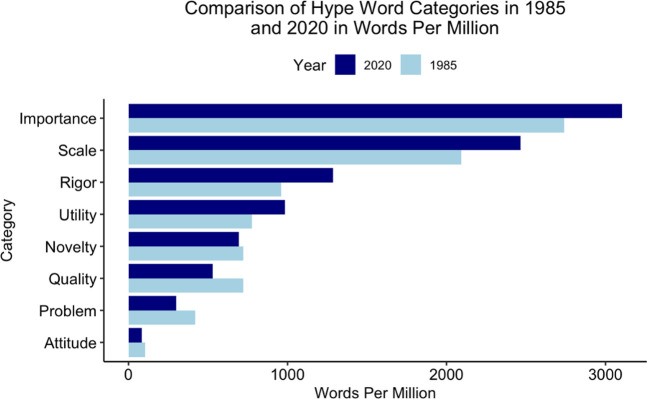
“4,8,9 The frequency of each hype adjective and the frequency of each semantic category were calculated for each individual year from 1985 to 2020 (35 separate years).”
BackgroundMethodInfluentialHow should novelty be valued in science?
Cohen, B. A. (2017) · eLife · doi:10.7554/elife.28699 · Cited by 52
Cited by
Li, Z., Lin, J., & Jinfen, X. (2025) · Journal of English for Academic Purposes · doi:10.1016/j.jeap.2025.101535 · Cited by 9
Stavrova, O., Kleinberg, B., Evans, A. M., & Ivanović, M. (2025) · Communications Psychology · doi:10.1038/s44271-025-00293-8 · Cited by 8
“The use of promotional language in published research papers has soared inthelastdecades 1 – 3 .”
Guidance on navigating the research gap in medical literature and points of caution
EL-Sobky, T. A., & Mahmoud, S. (2026) · Journal of Musculoskeletal Surgery and Research · doi:10.25259/jmsr_586_2025
Metadata
- Authors
- Halvorson, R. T., Wong, L. H., & Feeley, B. T.
- Affiliations
- University of California, San Francisco (US)
- Corresponding author
- Feeley, Brian T.
- Venue
- JAAOS: Global Research and Reviews
- Published
- 2024-05
- Volume
- 8
- Issue
- 5
- ISSN
- 2474-7661 (ISSN-L)
- PMC
- PMC11111393
- OpenAlex
- W4398205808
- Cited by
- 4
- References
- 21
- Citations by year
- 2026: 2 · 2025: 2
- FWCI
- 5.92
- Type
- journal article
- Language
- en
- Open access
- gold
- dx.doi.org
- Licence
- cc-by-nd
- Locations
- JAAOS Global Research and Reviews (publishedVersion, cc-by-nd)
- PubMed Central (publishedVersion, cc-by-nd)
- PubMed (publishedVersion)
- eScholarship (California Digital Library) (submittedVersion, cc-by-nd)
- Topics
- Social Sciences › Library and Information Sciences › Academic Writing and Publishing
- Social Sciences › Library and Information Sciences › scientometrics and bibliometrics research
- Social Sciences › Library and Information Sciences › Academic Publishing and Open Access
- Keywords
- promotional language, scientific writing
- MeSH terms
- Abstracting and Indexing, Humans, Language, Orthopedics, Periodicals as Topic, Orthopedic Procedures
About these checks
Registry, retraction, Cites and statistics results are computed, not judged, with one exception: a printed reference that no index lists is read once by a model before it counts as a citation error. Claims are extracted by a model and kept only when their quote appears verbatim in the text; each cited source is then checked, with a model’s help, for whether it says what the claim relies on. Those verdicts can be wrong — read the claim’s quote and the cited source before relying on one.
Statistics and arithmetic are recomputed, not judged.
Confidence bands are shown only for fields calibrated on our annotated test set. None is calibrated yet, so no band is shown.
What counts as a claim ›How we measure confidence ›How we check this ›
Are you an author, or do you see a problem with this page? Request a review
How to cite
Cite CoChat for the checks on this page, and the paper for its own findings.
- This page
- CoChat. (2026). Citation check: Increasing Use of Promotional Language in Orthopaedic Surgery Abstracts—An Analysis of 112,916 Abstracts 1985 to 2020. https://app.cochat.ai/papers/10.5435/jaaosglobal-d-24-00109
- The paper
- Halvorson, R. T., Wong, L. H., & Feeley, B. T. (2024). Increasing Use of Promotional Language in Orthopaedic Surgery Abstracts—An Analysis of 112,916 Abstracts 1985 to 2020. JAAOS: Global Research and Reviews. https://doi.org/10.5435/jaaosglobal-d-24-00109
Data sources
Bibliographic data: Semantic Scholar, OpenAlex, Crossref.
Contains information from the Semantic Scholar Academic Graph Datasets, made available under the ODC Attribution License (ODC-BY 1.0).
Semantic Scholar’s data is described in: Kinney, R., et al. (2023). The Semantic Scholar Open Data Platform. arXiv:2301.10140.
