

Digital Sovereignty and federalism: Data Interoperability and AI governance
Open accessThe DOI matches its Crossref record; 3 of the 3 references it cites were found in a registry or an index; none of the 53 sources its claims cite is checked for support yet.
Abstract
Canada is at a strategic inflection point. Its digital sovereignty depends directly on three inseparable levers: data interoperability across federal, provincial and territorial (FPT) governments; sovereign cloud infrastructure; and the responsible adoption of artificial intelligence (AI) in the public sector. These levers form an integrated architecture that drives productivity, digital security, government modernization and the country’s capacity to address the current fragmentation of public information systems. Analysis of the 2025 federal budget confirms an ambitious repositioning around productivity, economic sovereignty, infrastructure resilience and digital transformation. However, in the absence of an explicit FPT framework for data interoperability, investments remain dispersed and struggle to produce systemic effects. Canada nonetheless has structural advantages: a tradition of intergovernmental collaboration an internationally respected national statistical system and a proven ability to build shared governance mechanisms. Today’s fragmentation, spread across fourteen heterogeneous digital infrastructures with divergent standards, metadata and identifiers, directly undermines public-sector efficiency, critical-infrastructure security and the responsible use of AI. The CIRANO Burgundy Report (CIRANO, 2025) underscores that the Canadian federation has the conceptual foundations to build federated data governance, provided the legislative framework is modernized (including an update to Bill C-27), institutional responsibilities are clarified, and mutualization of resources approaches are strengthened. International comparisons, particularly with the European Union, show that jurisdictions that have successfully advanced digital transformation rely on robust interoperability architectures, common repositories, standardized trust frameworks and mechanisms for pooling digital capabilities. Technical considerations demonstrate concretely what is required: harmonized metadata, common identifiers, secure sharing mechanisms, sovereign cloud infrastructures and compatible modular services. Recent steps—the creation of the Office of Digital Transformation (ODT), investments announced in Budget 2025 and the emerging vision for a sovereign cloud, are significant but insufficient without a structured FPT framework for public-sector data interoperability and AI adoption. This analysis highlights that data interoperability must be recognized as essential infrastructure, on par with energy networks and transportation corridors. It is indispensable for consistent public services, lower transaction costs, stronger privacy protection, crisis resilience and value creation through AI. The identification of high-value FPT data, risk management, digital operational sovereignty and the role of shared entities reinforce the need for a permanent FPT Board on data interoperability and AI. By harmonizing standards, investments and institutional capacities, FPT governments can transform current digital fragmentation into a driver of cohesion, productivity, sovereignty and public innovation. FPT interoperability and responsible AI are not technical add-ons; they are the foundations of a strong, sustainable and truly sovereign Canadian digital economy.
Overview
CoChat Summary
## TL;DR
Canada’s digital sovereignty, the paper argues, depends on linking federal, provincial, and territorial data interoperability with sovereign cloud infrastructure and responsible public-sector AI. Budget 2025 is presented as a useful start, but the authors say it lacks the explicit FPT governance framework needed to turn fragmented digital investments into systemic change.
## Key findings
- The paper says Canada’s digital landscape is split across “fourteen heterogeneous digital infrastructures,” with divergent standards, metadata, and identifiers, which undermines efficiency, security, and responsible AI use.
- It identifies three inseparable levers for digital sovereignty: FPT data interoperability, sovereign cloud infrastructure, and responsible AI adoption in the public sector.
- Budget 2025 includes major relevant commitments, including $925.6 million over five years for a sovereign cloud and a plan to generate $60 billion in savings over five years through federal modernization.
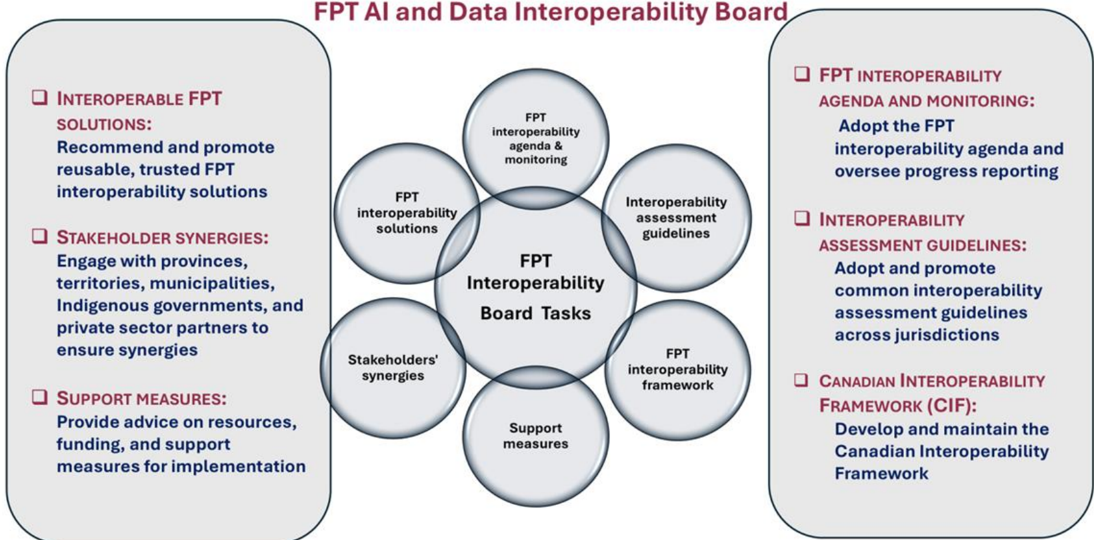
- The authors argue that Canada needs a formal FPT governance body—described as an FPT board or council on data interoperability and AI adoption—to coordinate standards, ethics, data governance, and AI deployment.
- The paper proposes five priorities, including treating interoperability and sovereign computing as essential infrastructure, building an integrated data-computing-AI strategy, and deploying a national AI backbone based on a public supercomputer administered by an independent FPT organization.
## Methods
- This is a policy analysis / discussion paper grounded in Budget 2025, the authors’ earlier CIRANO work, OECD and EU references, the Government of Canada’s AI and sovereignty initiatives, and the Council of Canadian Academies’ 2025 report.
- The analysis compares Canada’s federal situation with EU interoperability and AI governance models, and then derives recommendations for Canada’s FPT context.
- It also includes a technical appendix outlining standards and tools for metadata, semantic interoperability, privacy-preserving data sharing, and sovereign-cloud security.
## Limitations
- The paper does not report original empirical data, survey results, or statistical tests; it is a conceptual and policy-oriented report based on document analysis and comparison.
- The text makes evident that many claims are normative or forward-looking rather than demonstrated outcomes (text makes evident).
- The paper itself states that a key gap remains: Canada does not yet have a formal FPT framework for data interoperability, so its recommendations have not yet been implemented.
Model-written summary. Check it against the paper before relying on it.
Integrity signals
Registry
Cites
Statistics
Figures

Verification
Claims the paper makes
0 Valid · 30 Not valid · 41 Not checked · 86 Own results and interpretations
A result the paper states — it cites no source for it, so there is none to check. The quote shows it is in the paper.
In the paper
“The strategy raises a capacity challenge: staff reductions coincide with rising demand for digital skills.”
plainstates an association- Asserted: passes — The authors put it forward as true.
- Checkable: passes — It can be checked against evidence.
- Load-bearing: passes — The paper’s conclusions depend on it.
- Based: passes — The paper gives a reason why it holds.
A result the paper states — it cites no source for it, so there is none to check. The quote shows it is in the paper.
In the paper
“Nor does it incorporate Indigenous data governance, which is essential for legitimacy, trust and equity.”
plain- Asserted: passes — The authors put it forward as true.
- Checkable: passes — It can be checked against evidence.
- Load-bearing: passes — The paper’s conclusions depend on it.
- Based: passes — The paper gives a reason why it holds.
A result the paper states — it cites no source for it, so there is none to check. The quote shows it is in the paper.
In the paper
“It does not extend to vast data ecosystems managed by provinces and territories, which are critical to health, energy, the environment, employment, social services, internal trade and major risk and disaster management -pillars of national resilience and public AI training.”
plain- Asserted: passes — The authors put it forward as true.
- Checkable: passes — It can be checked against evidence.
- Load-bearing: passes — The paper’s conclusions depend on it.
- Based: passes — The paper gives a reason why it holds.
A conclusion the paper draws from its own results — it cites no other source for it, so there is none to check. The quote shows it is in the paper.
In the paper
“For Canada, the EU experience demonstrates that jurisdictional diversity can be an asset when effective coordination mechanisms are in place.”
boostedstates a possible cause- Asserted: passes — The authors put it forward as true.
- Checkable: passes — It can be checked against evidence.
- Load-bearing: passes — The paper’s conclusions depend on it.
- Based: passes — The paper gives a reason why it holds.
None of the sources cited for this claim could be matched to a paper, so there is nothing to check it against.
In the paper
“Converging analyses -including the OECD report and CIRANO's work iv , lead to a single conclusion: Canada cannot successfully execute the proposed digital transformation without FPT data interoperability and coordinated AI governance.”
What the sources say
- Not matchedcites OECD report
This doesn’t read as a citation we can look up.
- Not matchedcites CIRANO's work iv
This doesn’t read as a citation we can look up.
boostedstates a cause- Asserted: passes — The authors put it forward as true.
- Checkable: passes — It can be checked against evidence.
- Load-bearing: passes — The paper’s conclusions depend on it.
- Based: passes — The paper gives a reason why it holds.
- Not matched
18 more claims
Create a free account to see all 157 claims and every source verdict.
- Probably not a substantial claim. 126
- It may state two separate claims as one. 57
- Borderline: one of the tests for a substantial claim is unclear. 1
Citations
Cites
The publisher hasn’t deposited this paper’s reference list.
Metadata
- Authors
- Dudoit, A., & Labillois, T.
- Affiliations
- Pratt and Whitney Canada (Canada) (CA)
- ORCID
- Labillois, Tony
- Venue
- CIRANO Burgundy Report
- Publisher
- CIRANO
- Published
- 2025-12
- OpenAlex
- W4416877172
- Semantic Scholar
- e605f4b4118760a364579cfed0f8d66df332857c
- Cited by
- 0
- References
- 0
- Type
- report
- Language
- en
- Open access
- gold
- doi.org
- Topics
- Social Sciences › Political Science and International Relations › E-Government and Public Services
- Social Sciences › Political Science and International Relations › Security, Politics, and Digital Transformation
- Social Sciences › Law › Digitalization, Law, and Regulation
- Keywords
- digital sovereignty, federalism, data interoperability, AI governance, public sector AI adoption, intergovernmental cooperation, metadata harmonization, data sharing, digital transformation, European Union comparison, critical infrastructure security, privacy preservation
About these checks
Registry, retraction, Cites and statistics results are computed, not judged, with one exception: a printed reference that no index lists is read once by a model before it counts as a citation error. Claims are extracted by a model and kept only when their quote appears verbatim in the text; each cited source is then checked, with a model’s help, for whether it says what the claim relies on. Those verdicts can be wrong — read the claim’s quote and the cited source before relying on one.
A language model drew the claims from the paper on 2026-10-11, under version 3 of the claim definition (model deepseek-v4.1-flash, prompt extract-v3).
A second model labelled each claim on 2026-10-11 (model jev-1.13-20260917, definition revision gold-guideline-v0.2).
Statistics and arithmetic are recomputed, not judged.
Confidence bands are shown only for fields calibrated on our annotated test set. None is calibrated yet, so no band is shown.
What counts as a claim ›How we measure confidence ›How we check this ›
Are you an author, or do you see a problem with this page? Request a review
How to cite
Cite CoChat for the checks on this page, and the paper for its own findings.
- This page
- CoChat. (2026). Citation check: Digital Sovereignty and federalism: Data Interoperability and AI governance. https://app.cochat.ai/papers/10.54932/dnan8237
- The paper
- Dudoit, A., & Labillois, T. (2025). Digital Sovereignty and federalism: Data Interoperability and AI governance. CIRANO Burgundy Report. https://doi.org/10.54932/dnan8237
Data sources
Bibliographic data: Semantic Scholar, OpenAlex, Crossref.
Contains information from the Semantic Scholar Academic Graph Datasets, made available under the ODC Attribution License (ODC-BY 1.0).
Semantic Scholar’s data is described in: Kinney, R., et al. (2023). The Semantic Scholar Open Data Platform. arXiv:2301.10140.
