

The DOI matches its Crossref record; 1 of the 1 references it cites were found in a registry or an index.
Decision Drivers for Search Engine Usage – The Mediating and Moderating Role of Lock-in Effects
Abstract
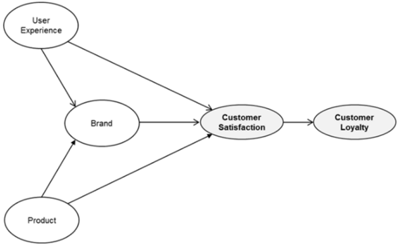
This study analyzes the central factors influencing the satisfaction and future use of search engines. It examines the influence of technological lock-in effects (e. g. operating systems / browsers providing pre-settings), as well as basic product- and brand-related factors (e. g. search results, user experience, brand image). Data was collected via a quantitative online survey in Germany, which resulted in 236 respondents providing statements about their most recently used search engine. The data shows that all independent variables have a strong impact on the satisfaction with a search engine as well as future usage and explain a lot of the variance of the dependent variables. The satisfaction with the core product has the strongest impact, followed by brand-related aspects and user experience. The results also show an impact of a search engine preset in the browser effects that influences the role of brand and the evaluation of different product characteristics.
Overview
The claims and statistics of this paper haven’t been checked yet.
Run the check — free, no account needed. It reads the open-access text and checks the sources it cites.
Integrity signals
Registry
Cites
Statistics
Figures
Verification
Claims the paper makes
The claims and statistics of this paper haven’t been checked yet.
Run the check — free, no account needed. It reads the open-access text and checks the sources it cites.
Claims other papers make about this one
Each is checked against this paper’s own text: does it say what the citing paper says it does?
The cited source says what the claim attributes to it.
In the citing paper
“This combination is consistent with previous research integrating U&G with technology-adoption perspectives in AI-enabled services and search-engine contexts (Knuth & Masuhr, 2021;McLean & Osei-Frimpong, 2019).”
From From search results to generative answers: A mixed-methods study of credibility assessment and trust formation in AI Overviews (2027) · cites this paper as Knuth & Masuhr, 2021
Self-check
Percentages, sums and reported differences re-computed from the paper’s own numbers.
The self-check needs the paper’s full text.
Citations
Cites
Gratifications Sought and Media Exposure: An Expectancy Value Model
PALMGREEN, P., & RAYBURN, J. D. (1982) · Communication Research · doi:10.1177/009365082009004004 · Cited by 243 · cited 1×
“It is also assumed that they are aware of their wishes and can articulate them (Katz et al., 1974; Hugger, 2008; Palmgreen & Rayburn, 1982).”
Background
Research works printed but not linked: 31
- Aaker, D.A. (1996). Measuring brand equity across products and markets. California Management Review, 38(2), 102-112. https://doi.org/10.2307/41165845 · DOI
- Bagozzi, R., P., & Yi, T. (1988). On the evaluation of structural equation models. Journal of the Academy of Marketing Science, 16(1), 74-94. https://doi.org/10.1007/BF02723327 · DOI · Paper page
- Bailey, P., Thomas, P., & Hawking, D. (2007). Does brand name influence perceived Search result quality? Yahoo!, Google, and WebKumara. 12 th Australasian Document Computing Symposium.
- Chin, W. W. (1998). The partial least squares approach to structural equation modeling, in: G. A. Marcoulides (Eds), Modern methods for business research (pp. 295-358.). Mahwah: Psychology Press.
- Fornell, C., Larcker, D. F. (1981). Evaluating structural equation models with unobservable variables and measurement error. Journal of Marketing Research, 18, 39-50. https://doi.org/10.2307/3151312. · DOI · Paper page
- Henseler, J., Ringle, C., Sarstedt, M. (2015). A new criterion for assessing discriminant validity in variance-based structural equation modeling. Journal of the Academy of Marketing Science, 43, 115-135. https://doi.org/10.1007/s11747-014-0403-8 · DOI · Paper page
- Heskett, J., Sasser, W., & Schlesinger, L. (1997). The service profit chain. New York: Free Press.
- Höchstötter, N., & Koch, M. (2009). Standard Parameters for Searching Behaviour in Search Engines and their empirical Evaluation. Journal of Information Science, 35(1), 45-65.
- ijbm.ccsenet.org International Journal of Business and Management Vol. 16, No. 10; 2021 https://doi.org/10.1177/0165551508091311 · DOI
- Hugger, K. U. (2008). Uses-and-Gratification-Approach und Nutzenansatz. In Sander, U., von Gross, F., Hugger, K. U. (Eds.), Handbuch Medienpädagogik (pp. 173-178). Wiesbaden: Springer VS.
- Jansen, B. J., Zhang, M., & Schultz, C. D. (2009). Brand and its Effect on User Perception of Search Engine Performance. Journal of the American Society for Information Science and Technology, 60(8), 1572-1579. https://doi.org/10.1002/asi.21081 · DOI
- Katz, E., Blumler, J. G., & Gurevitch, M. (1974). Utilization of Mass Communication by the individual. In J. G. Blumler, K. E. (Eds.), Uses of Mass Communication (pp. 19-32). Beverly Hills: Sage.
- Katz, E., & Foulkes, D. (1962). On the Use of the Mass Media as 'escape' -Clarification of a Concept. Public Opinion Quarterly, 377-388. Volume?
- Keller, K. L. (1993). Conceptualizing, Measuring, and Managing Customer-based Brand Equity. Journal of Marketing, 57(1), 1-22. https://doi.org/10.2307/1252054 · DOI
- Lance, C. E., Butts, M. M., & Michels, L. C. (2006). The Sources of Four Commonly Reported Cutoff Criteria. What Did They Really Say? Organizational Research Methods, 9, 202-220. https://doi.org/10.1177/1094428105284919 · DOI · Paper page
- Lewandowski, D. (2013). Challenges for search engine retrieval effectiveness evaluations: Universal Search and user intents, and results presentation. In G. Pasi, B. G., & L. Jain (Eds.), Quality issues in the Management of Web Information (pp. 179-196). Berlin Heidelberg: Springer.
- Lewandowski, D. (2014). Wie lässt sich die Zufriedenheit der Suchmaschinennutzer mit ihren Suchergebnissen erklären? In Krah, H., & Müller-Terpitz, R. (Eds.), Suchmaschinen (pp. 35-52). Berlin, Berlin: Logos.
- Lewandowski, D. (2015). Suchmaschinen verstehen. Berlin Heidelberg: Springer.
- Lewandowski, D., & Höchstötter, N. (2007). Qualitätsmessung bei Suchmaschinen. Informatik-Spektrum, 30(3), 159-169. https://doi.org/10.1007/s00287-007-0152-x · DOI
- Nunnally, J. C. (1978). Psychometric theory. New York: McGraw-Hill.
- Paal, B. P. (2013). Markt-und Meinungsmacht der Suchmaschinen. In Krah H., Müller-Terpitz, R. (Eds.), Suchmaschinen (pp. 11-34). Berlin: Logos.
- Palanisamy, R. (2013). Evaluation of Search Engines: A Conceptual Model and Research Issues. International Journal of Business and Management, 8(6), 1-15. https://doi.org/10.5539/ijbm.v8n6p1 · DOI
- Palos-Sanchez, P., Martin-Velicia, F., & Ramon Saura, J. (2018). Complexity in the Acceptance of Sustainable Search Engines on the Internet: An Analysis of Unobserved Heterogeneity with FIMIX-PLS. Complexity, (Special Issue), 1-19. https://doi.org/10.1155/2018/6561417 · DOI
- Pauly-Grundmann, D. (2010). Markenbewertung -Der objektivierte Markenwert unter besonderer Berücksichtigung des Income Approach. Wiesbaden: Springer.
- Peris, M., & Nüttgens, M. (2011). Anwendung der Unified Theory of Acceptance and Use of Technology zur Akzeptanzbestimmung von Web 2.0-Anwendungen in KMU-Netzwerken. 6th Conference on Professional Knowledge Management: From Knowledge to Action.
- Quirmbach, S. M. (2012). Suchmaschinen -User Experience, Usability und nutzerzentrierte Website-Gestaltung. Berlin Heidelberg: Springer Vieweg.
- Schäfer, S., Pittner, N., Magin, M., & Stark, B. (2015). Google: Alles nur Marke? Eine experimentelle Untersuchung zur Qualitätsbewertung von Suchmaschinen-Trefferlisten aus der Nutzerperspektive. In Pagel, S. (Ed.), Schnittstellen (in) der Medienökonomie (pp. 240-256). Baden-Baden: Nomos.
- Sirdeshmukh, D., Ahmad, N. B., Khan, M. S., & Ashill, N. J. (2018). Drivers of user loyalty, intention and commitment to a search engine: An exploratory study. Journal of Retailing and Consumer Services, 44, 71- 81. https://doi.org/10.1016/j.jretconser.2018.06.002 · DOI
- Speicher, M., Both, A., & Gaedke, M. (2015). S.O.S.: Does Your Search Engine. CHI, 15, 1005-1014.
- Venkatesh, V., Thong, J. Y. L., & Xu, X. (2012). Consumer Acceptance and Use of Information Technology: Extending the Unified Theory of Acceptance and Use of Technology. MIS Quarterly, 36(1), 157-178. https://doi.org/10.2307/41410412 · DOI · Paper page
- Wong, K. K. K. (2016). Mediation analysis, categorical moderation analysis, and higher-order constructs modeling in partial least squares structural equation modeling (PLS-SEM): A B2B example using SmartPLS. The Marketing Bulletin, 26, 1-22.
Cited by
Sorted by citations
Casermeiro-Corpas, Y., Rejón-Guardia, F., Vallespín, M., & Molinillo, S. (2027) · Information Processing & Management · doi:10.1016/j.ipm.2026.105211
Metadata
- Authors
- Knuth, I., & Masuhr, J.
- Venue
- International Journal of Business and Management
- Published
- 2021-09-17
- Volume
- 16
- Issue
- 10
- Pages
- 86
- ISSN
- 1833-8119
- 1833-3850
- Cited by
- 4
- References
- 1
About these checks
Registry, retraction, Cites and statistics results are computed, not judged, with one exception: a printed reference that no index lists is read once by a model before it counts as a citation error. Claims are extracted by a model and kept only when their quote appears verbatim in the text; each cited source is then checked, with a model’s help, for whether it says what the claim relies on. Those verdicts can be wrong — read the claim’s quote and the cited source before relying on one.
Statistics and arithmetic are recomputed, not judged.
Confidence bands are shown only for fields calibrated on our annotated test set. None is calibrated yet, so no band is shown.
What counts as a claim ›How we measure confidence ›How we check this ›
Are you an author, or do you see a problem with this page? Request a review
How to cite
Cite CoChat for the checks on this page, and the paper for its own findings.
- This page
- CoChat. (2026). Citation check: Decision Drivers for Search Engine Usage – The Mediating and Moderating Role of Lock-in Effects. https://app.cochat.ai/papers/10.5539/ijbm.v16n10p86
- The paper
- Knuth, I., & Masuhr, J. (2021). Decision Drivers for Search Engine Usage – The Mediating and Moderating Role of Lock-in Effects. International Journal of Business and Management. https://doi.org/10.5539/ijbm.v16n10p86
