

Whose Knowledge Counts? Western Accreditation, University Rankings, and the Marginalization of Indigenous Institutions
Open accessThe DOI matches its Crossref record; 1 of the 1 references it cites were found in a registry or an index; none of the 63 sources its claims cite is checked for support yet.
Abstract
The global higher education landscape is increasingly dominated by Western-centric accreditation standards and university ranking systems, often framing institutional quality and legitimacy through a narrow, Euro-American lens. This dominance has significant implications for Indigenous universities and knowledge systems, which are frequently marginalized or devalued despite their critical contributions to cultural preservation, community engagement, and locally relevant scholarship. Drawing on a critical review of accreditation frameworks, global ranking methodologies, and case studies of Indigenous institutions, this paper interrogates whose knowledge is prioritized in global higher education. It highlights the structural inequities that favor Western epistemologies, the challenges Indigenous universities face in gaining recognition, and the broader consequences for educational sovereignty and epistemic justice. The study advocates for reconceptualizing quality assurance and recognition systems to inclusively value diverse epistemologies, promote culturally responsive higher education, and advance the legitimacy of Indigenous knowledge within global academic discourse.
Overview
CoChat Summary
TL;DR
This critical review argues that Western accreditation and university ranking systems privilege Euro-American epistemologies and marginalize Indigenous institutions and knowledge systems. It uses decolonial theory, epistemic justice, and cognitive justice to call for pluralistic, culturally responsive evaluation frameworks.
Key findings
- Western accreditation and rankings privilege standardized metrics such as research output, citation impact, and reputation surveys, while undervaluing community-embedded, relational, oral, and culturally grounded knowledge (McKenna, 2024; Bellantuono et al., 2021; Maali, 2025).
- Indigenous institutions face testimonial injustice (knowledge dismissed as “non-rigorous”), hermeneutical injustice (accreditation standards not accounting for oral traditions), resource inequities, cultural marginalization, and visibility constraints (Table 2; Fricker, 2007; Duria, 2025; Ajmani et al., 2024).
- The paper proposes redesigning accreditation with culturally responsive and community-focused criteria, adopting inclusive ranking methodologies that value social impact and cultural contribution, supporting institutional autonomy, building capacity for global policy participation, and pursuing empirical research on Indigenous quality criteria (Table 3; Way Forward).
- No quantitative findings or numeric results are reported; the paper is a conceptual and critical review.
Methods
- Design: critical review and conceptual analysis of accreditation frameworks, global ranking methodologies, and case studies of Indigenous institutions; no empirical data collection is described.
- Data/sample: literature and secondary sources, including examples such as intercultural universities in Mexico, the African Rural University case, and community-centred Indigenous institutions in Australia; no sample size or dataset is reported.
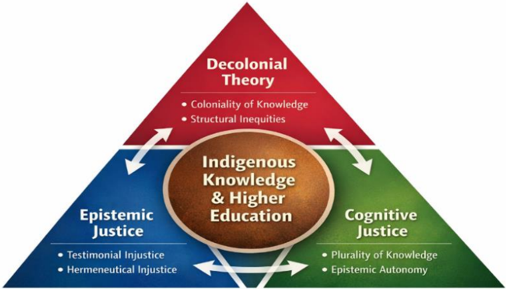
- Analysis: synthesis through three interrelated frameworks—Decolonial Theory, Epistemic Justice, and Cognitive Justice—to interrogate whose knowledge counts and propose inclusive evaluation models.
Limitations
- Stated as literature gaps: limited empirical research centring Indigenous institutions; few studies directly interrogating accreditation and Indigenous epistemologies; neglect of Indigenous conceptualisations of quality; global representation bias toward settler-colonial contexts such as Australia, Canada, and New Zealand; and limited concrete alternative evaluative models.
- Evident from the text: no primary empirical data, systematic review protocol, or quantitative evidence is presented; conclusions rest on conceptual argument and secondary literature, so no causal or generalizable empirical claims are tested.
- Evident from the text: the paper does not specify a formal search strategy, inclusion criteria, or case-selection method for the reviewed literature and cases.
Model-written summary. Check it against the paper before relying on it.
Integrity signals
Registry
Cites
Statistics
Figures
Verification
Claims the paper makes
0 Valid · 2 Not valid · 42 Not checked · 8 Own results and interpretations
A conclusion the paper draws from its own results — it cites no other source for it, so there is none to check. The quote shows it is in the paper.
In the paper
“However, the lack of systematic inclusion of such institutions in global ranking and accreditation narratives underscores persistent epistemic exclusion.”
plainstates an association- Asserted: passes — The authors put it forward as true.
- Checkable: passes — It can be checked against evidence.
- Load-bearing: passes — The paper’s conclusions depend on it.
- Based: passes — The paper gives a reason why it holds.
None of the sources cited for this claim could be matched to a paper, so there is nothing to check it against.
In the paper
“Such systems disproportionately valorise metrics like research output, citation impact, and reputational surveys, often at the expense of locally grounded, community-embedded, and Indigenous forms of knowledge production (QS World University Rankings, 2025; Bellantuono et al., 2021).”
What the sources say
- Not matchedcites QS World University Rankings, 2025
An author–year citation the paper’s reference list doesn’t settle. We don’t search these by name.
- Not matchedcites Bellantuono et al., 2021
An author–year citation the paper’s reference list doesn’t settle. We don’t search these by name.
plainstates a cause- Asserted: passes — The authors put it forward as true.
- Checkable: passes — It can be checked against evidence.
- Load-bearing: passes — The paper’s conclusions depend on it.
- Based: passes — The paper gives a reason why it holds.
- Not matched
A conclusion the paper draws from its own results — it cites no other source for it, so there is none to check. The quote shows it is in the paper.
In the paper
“Epistemic justice is particularly relevant for understanding how Indigenous scholars and institutions are systematically marginalised within accreditation and ranking systems that valorise Western forms of knowledge production.”
plainstates a cause- Asserted: passes — The authors put it forward as true.
- Checkable: passes — It can be checked against evidence.
- Load-bearing: passes — The paper’s conclusions depend on it.
- Based: unclear — It is unclear why the paper says it holds.
A conclusion the paper draws from its own results — it cites no other source for it, so there is none to check. The quote shows it is in the paper.
In the paper
“These biases compound existing inequalities, limiting the visibility and perceived legitimacy of Indigenous-led universities and colleges that pursue alternative educational missions centred on social transformation, local sustainability, and intergenerational knowledge stewardship.”
plainstates a cause- Asserted: passes — The authors put it forward as true.
- Checkable: passes — It can be checked against evidence.
- Load-bearing: passes — The paper’s conclusions depend on it.
- Based: passes — The paper gives a reason why it holds.
In the paper
“These structural obstacles are reinforced by evaluative cultures that privilege Western research norms, such as positivist approaches and published outputs, over community-based, relational, and Indigenous knowledge practices (Anderson et al., 2025).”
What the sources say
- Not matchedcites Anderson et al., 2025
An author–year citation the paper’s reference list doesn’t settle. We don’t search these by name.
plainstates a cause- Asserted: passes — The authors put it forward as true.
- Checkable: passes — It can be checked against evidence.
- Load-bearing: passes — The paper’s conclusions depend on it.
- Based: passes — The paper gives a reason why it holds.
- Not matched
19 more claims
Create a free account to see all 52 claims and every source verdict.
- It may state two separate claims as one. 18
- Probably not a substantial claim. 13
- The quote only partly states this claim. 1
Self-check
Percentages, sums and reported differences re-computed from the paper’s own numbers.
Each contradiction between two passages listed here was confirmed by an independent check.
Rated minor: it would not touch a result — a value no result rests on, a p-value that stays on the same side of the significance level, or a conflict that is clerical, resolved elsewhere in the paper, or outside its own findings.
In the paper
§ REFERENCES
“Estera, P., Shahjahan, R., & Kezar, A. (2016/2025). Higher education in the age of global rankings: Decolonial perspectives. Journal of Education Policy, 35(7), 921 -938.”
§ REFERENCES
“Shahjahan, R., & Kezar, A. (2020). Higher education in the age of global rankings: Decolonial perspectives. Journal of Education Policy, 35(7), 921 -938.”
Citations
Cites
The publisher hasn’t deposited this paper’s reference list.
Research works printed but not linked: 14
- [1]1. Ajmani, R., Sharma, D., & Duria, L. (2024). Epistemic justice in higher education: Indigenous perspectives and institutional recognition. Journal of Higher Education Equity, 17(3), 45 -67.
- [2]2. Anderson, P., Torres, H., & Maali, R. (2025). Indigenous postgraduate experiences in higher education: Challenges, agency, and cultural continuity. Intercultural Education Review, 38(2), 101 -123.
- [3]3. Bellantuono, L., Ricci, F., & Rizzi, A. (2021). Revisiting university rankings: Structural biases and global inequalities. Higher Education Quarterly, 75(4), 561 -580.
- [4]4. Duria, L. (2025). Hermeneutical injustice and Indigenous knowledge in global academia. Journal of Decolonial Studies, 10(1), 22 -41.
- [5]5. Estera, P., Shahjahan, R., & Kezar, A. (2016/2025). Higher education in the age of global rankings: Decolonial perspectives. Journal of Education Policy, 35(7), 921 -938.
- [7]7. Gadd, E. (2021). University rankings and global inequities: Assessing methodological biases. Global Higher Education Review, 9(2), 78 -95.
- [8]8. Intercultural Universities in Mexico. (2025). Intercultural higher education models and Indigenous inclusion. Journal of Intercultural Studies, 42(1), 15 -34.
- [9]9. Maali, R. (2025). Cognitive justice and Indigenous educational sovereignty. Pacific Education Journal, 12(1), 35 -58.
- [11]11. neoliberal governance of higher education. International Journal of Higher Education Policy, 21(3), 145 -162.
- [11]11. Mignolo, W. (2018). The decolonial option: Epistemic diversity and higher education. Routledge.
- [12]12. Quijano, A. (2025). Coloniality of knowledge in higher education systems. Decolonial Horizons, 9(2), 11 -28.
- [13]13. Shahjahan, R., & Kezar, A. (2020). Higher education in the age of global rankings: Decolonial perspectives. Journal of Education Policy, 35(7), 921 -938.
- [16]16. Nabobo-Baba, U. (2013). Teaching and learning in culturally safe contexts in Fiji: A review of Indigenous approaches. Suva: University of the South Pacific Press.
- [17]17. Embedding Indigenous knowledge in education. (2025). Journal of Indigenous Knowledge Studies, 18(1), 55 -70.
Metadata
- Authors
- Lecturer and PhD Scholar University of Fiji, F. I., & Sharma, D.
- Affiliations
- University of Fiji (FJ)
- Corresponding author
- Sharma, Davendra
- Venue
- International journal of social sciences, language and linguistics
- Published
- 2026-02-01
- Volume
- 06
- Issue
- 02
- Pages
- 12-20
- ISSN
- 2051-686X (ISSN-L)
- OpenAlex
- W7127199876
- Cited by
- 0
- References
- 0
- FWCI
- 0.00
- Type
- journal article
- Language
- en
- Open access
- bronze
- doi.org
- Locations
- International Journal of Social Sciences Language and Linguistics (publishedVersion)
- International Journal of Social Sciences Language and Linguistics (publishedVersion, cc-by)
- Neliti (submittedVersion)
- Topics
- Social Sciences › Education › Higher Education Governance and Development
- Social Sciences › Health › Indigenous Health, Education, and Rights
- Social Sciences › Education › Global Education Systems and Policies
- Keywords
- indigenous universities, higher education accreditation, university rankings, Western epistemology, epistemic justice, educational sovereignty, quality assurance, international higher education
About these checks
Registry, retraction, Cites and statistics results are computed, not judged, with one exception: a printed reference that no index lists is read once by a model before it counts as a citation error. Claims are extracted by a model and kept only when their quote appears verbatim in the text; each cited source is then checked, with a model’s help, for whether it says what the claim relies on. Those verdicts can be wrong — read the claim’s quote and the cited source before relying on one.
A language model drew the claims from the paper on 2026-10-04, under version 3 of the claim definition (model deepseek-v4.1-flash, prompt extract-v3).
A second model labelled each claim on 2026-10-04 (model jev-1.13-20260917, definition revision gold-guideline-v0.2).
Statistics and arithmetic are recomputed, not judged.
Confidence bands are shown only for fields calibrated on our annotated test set. None is calibrated yet, so no band is shown.
What counts as a claim ›How we measure confidence ›How we check this ›
Are you an author, or do you see a problem with this page? Request a review
How to cite
Cite CoChat for the checks on this page, and the paper for its own findings.
- This page
- CoChat. (2026). Citation check: Whose Knowledge Counts? Western Accreditation, University Rankings, and the Marginalization of Indigenous Institutions. https://app.cochat.ai/papers/10.55640/ijssll-06-02-02
- The paper
- Lecturer and PhD Scholar University of Fiji, F. I., & Sharma, D. (2026). Whose Knowledge Counts? Western Accreditation, University Rankings, and the Marginalization of Indigenous Institutions. International journal of social sciences, language and linguistics. https://doi.org/10.55640/ijssll-06-02-02
Data sources
Bibliographic data: Semantic Scholar, OpenAlex, Crossref.
Contains information from the Semantic Scholar Academic Graph Datasets, made available under the ODC Attribution License (ODC-BY 1.0).
Semantic Scholar’s data is described in: Kinney, R., et al. (2023). The Semantic Scholar Open Data Platform. arXiv:2301.10140.
