

The DOI matches its Crossref record; 29 of the 29 references it cites were found in a registry or an index.
Use and Avoidance of Seclusion and Restraint: Consensus Statement of the American Association for Emergency Psychiatry Project BETA Seclusion and Restraint Workgroup
Open accessAbstract
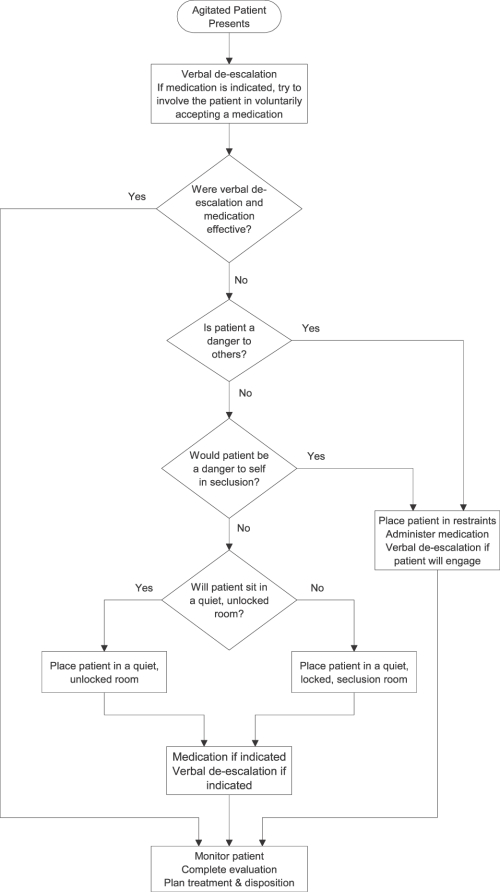
Issues surrounding reduction and/or elimination of episodes of seclusion and restraint for patients with behavioral problems in crisis clinics, emergency departments, inpatient psychiatric units, and specialized psychiatric emergency services continue to be an area of concern and debate among mental health clinicians. An important underlying principle of Project BETA (Best practices in Evaluation and Treatment of Agitation) is noncoercive de-escalation as the intervention of choice in the management of acute agitation and threatening behavior. In this article, the authors discuss several aspects of seclusion and restraint, including review of the Centers for Medicare and Medicaid Services guidelines regulating their use in medical behavioral settings, negative consequences of this intervention to patients and staff, and a review of quality improvement and risk management strategies that have been effective in decreasing their use in various treatment settings. An algorithm designed to help the clinician determine when seclusion or restraint is most appropriate is introduced. The authors conclude that the specialized psychiatric emergency services and emergency departments, because of their treatment primarily of acute patients, may not be able to entirely eliminate the use of seclusion and restraint events, but these programs can adopt strategies to reduce the utilization rate of these interventions.
Overview
The claims and statistics of this paper haven’t been checked yet.
Run the check — free, no account needed. It reads the open-access text and checks the sources it cites.
Integrity signals
Registry
Cites
Statistics
Figures
Verification
Claims the paper makes
The claims and statistics of this paper haven’t been checked yet.
Run the check — free, no account needed. It reads the open-access text and checks the sources it cites.
Claims other papers make about this one
Each is checked against this paper’s own text: does it say what the citing paper says it does?
The source backs part of the claim, not all of it — or backs it for a different population, condition or comparison.
In the citing paper
“The use of seclusion and restraint also varies drastically between services, jurisdictions and countries, with up to 300-fold differences in the rate of use found in one review (91).”
From The benefits and harms of inpatient involuntary psychiatric treatment: a scoping review (2025) · cites this paper as [91]
Experimental — accuracy not yet measured
Self-check
Percentages, sums and reported differences re-computed from the paper’s own numbers.
The self-check needs the paper’s full text.
Citations
Cites
Frueh, B. C., Knapp, R. G., Cusack, K., Grubaugh, A. L., Sauvageot, J. A., Cousins, V. C., Yim, E., Robins, C. S., Monnier, J., & Hiers, T. G. (2005) · Psychiatric Services · doi:10.1176/appi.ps.56.9.1123 · Cited by 545
Restraint and seclusion: a review of the literature
Fisher, W. A. (1994) · American Journal of Psychiatry · doi:10.1176/ajp.151.11.1584 · Cited by 454
Adverse Effects Associated with Physical Restraint
Mohr, W. K., Petti, T. A., & Mohr, B. D. (2003) · The Canadian Journal of Psychiatry · doi:10.1177/070674370304800509 · Cited by 369
Violence against emergency department workers
GATES, D. M., Ross, C. S., & McQueen, L. (2006) · Journal of Emergency Medicine · doi:10.1016/j.jemermed.2005.12.028 · Cited by 290
Smith, G. M., Davis, R. H., Bixler, E. O., Lin, H.-M., Altenor, A., Altenor, R. J., Hardentstine, B. D., & Kopchick, G. A. (2005) · Psychiatric Services · doi:10.1176/appi.ps.56.9.1115 · Cited by 273
Overview of Project BETA: Best practices in Evaluation and Treatment of Agitation
Holloman, G., & Zeller, S. (2012) · Western Journal of Emergency Medicine · doi:10.5811/westjem.2011.9.6865 · Cited by 188
Self-citationDonat, D. C. (2003) · Psychiatric Services · doi:10.1176/appi.ps.54.8.1119 · Cited by 128
Eliminating Seclusion and Restraint in Recovery-Oriented Crisis Services
Ashcraft, L., & Anthony, W. A. (2008) · Psychiatric Services · doi:10.1176/ps.2008.59.10.1198 · Cited by 120
Borckardt, J. J., Madan, A., Grubaugh, A. L., Danielson, C. K., Pelic, C., HARDESTY, S. J., Hanson, R. F., Herbert, J. M., Cooney, H., Benson, A. R., et al. (2011) · Psychiatric Services · doi:10.1176/ps.62.5.pss6205_0477 · Cited by 117
A prospective study of the complication rate of use of patient restraint in the emergency department
Zun, L. S. (2003) · Journal of Emergency Medicine · doi:10.1016/s0736-4679(02)00738-2 · Cited by 111
V IOLENCE A GAINST E MERGENCY M EDICAL S ERVICES P ERSONNEL
Grange, J. T., & Corbett, S. W. (2002) · Prehospital Emergency Care · doi:10.1080/10903120290938526 · Cited by 102
Brief Reports: A Program to Reduce Use of Physical Restraint in Psychiatric Inpatient Facilities
Jonikas, J. A., Cook, J. Α., Rosen, C., Laris, A., & Kim, J.-B. (2004) · Psychiatric Services · doi:10.1176/appi.ps.55.7.818 · Cited by 97
Association Between Seclusion and Restraint and Patient-Related Violence
Khadivi, A., Patel, R. C., Atkinson, A. R., & Levine, J. M. (2004) · Psychiatric Services · doi:10.1176/appi.ps.55.11.1311 · Cited by 95
Staff training decreases use of seclusion and restraint in an acute psychiatric hospital
Forster, P. L., Cavness, C., & Phelps, M. (1999) · Archives of Psychiatric Nursing · doi:10.1016/s0883-9417(99)80037-5 · Cited by 87
Sullivan, A. M. T., Bezmen, J., Barron, C. T., Rivera, J. J., Curley-Casey, L., & Marino, D. (2005) · Psychiatric Quarterly · doi:10.1007/s11089-005-5581-3 · Cited by 84
Downey, L. V. A., Zun, L. S., & Gonzales, S. J. (2007) · General Hospital Psychiatry · doi:10.1016/j.genhosppsych.2007.07.006 · Cited by 67
Lewis, M., Taylor, K., & Parks, J. (2009) · Issues in Mental Health Nursing · doi:10.1080/01612840802694171 · Cited by 63
Special Section on Seclusion and Restraint: Introduction to the Special Section
Busch, A. B. (2005) · Psychiatric Services · doi:10.1176/appi.ps.56.9.1104 · Cited by 61
Reducing Restraint Use in a Public Psychiatric Inpatient Service
McCue, R. E., Urcuyo, L., Lilu, Y., Tobias, T., & Chambers, M. J. (2004) · The Journal of Behavioral Health Services & Research · doi:10.1007/bf02287384 · Cited by 58
Aggression Exposure and Mental Health Among Nurses
Lam, L. T.-M. (2002) · Advances in Mental Health · doi:10.5172/jamh.1.2.89 · Cited by 44
Relationship of Restraint Use, Patient Injury, andAssaults on Ems Personnel
Cheney, P. R., Gossett, L. K., Fullerton‐Gleason, L., Weiss, S. J., Ernst, A. A., & Sklar, D. P. (2006) · Prehospital Emergency Care · doi:10.1080/10903120500541050 · Cited by 34
The use of seclusion in emergency medicine
Zun, L. S., & Downey, L. V. A. (2005) · General Hospital Psychiatry · doi:10.1016/j.genhosppsych.2005.05.001 · Cited by 27
Patients' Reports of Traumatic or Harmful Experiences Within the Psychiatric Setting
Frueh, B. C., Knapp, R. G., Cusack, K., Grubaugh, A. L., Sauvageot, J. A., Cousins, V. C., Yim, E., Robins, C. S., Monnier, J., & Hiers, T. G. (2005) · DigitalGeorgetown (Georgetown University Library) · Cited by 26
Commentary: Reducing Restraint and Seclusion: A View From the Trenches
Sharfstein, S. S. (2008) · Psychiatric Services · doi:10.1176/ps.2008.59.2.197 · Cited by 23
Commentary: Reducing Restraint and Seclusion: A View From the Trenches
Sharfstein, S. S. (2008) · Psychiatric Services · doi:10.1176/appi.ps.59.2.197 · Cited by 12
Pennsylvania State Hospital System's Seclusion and Restraint Reduction Program
Smith, G. M., Davis, R. H., Bixler, E. O., Lin, H.-M., Altenor, A., Altenor, R. J., Hardentstine, B. D., & Kopchick, G. A. (2005) · DigitalGeorgetown (Georgetown University Library) · Cited by 12
Reducing Restraint Use in a Public Psychiatric Inpatient Service
McCue, R. E., Urcuyo, L., Lilu, Y., et al. (2004) · The Journal of Behavioral Health Services & Research · doi:10.1097/00075484-200404000-00009 · Cited by 4
Psychiatric Emergency Department: Where Treatment Should Begin
Levin, A. R. (2011) · Psychiatric News · doi:10.1176/pn.46.14.psychnews_46_14_12_1 · Cited by 3
A Program to Reduce Use of Physical Restraint in Psychiatric Inpatient Facilities
Jonikas, J. A., Cook, J. Α., Rosen, C., Laris, A., & Kim, J.-B. (2004) · DigitalGeorgetown (Georgetown University Library) · Cited by 3
Cited by
Sorted by citations
Assessment and management of agitation in psychiatry: Expert consensus
Garriga, M., Pacchiarotti, I., Kasper, S. F., Zeller, S. L., Allen, M. H., Vázquez, G. H., Baldaçara, L., San, L., McAllister-Williams, H., Fountoulakis, K. Ν., et al. (2016) · The World Journal of Biological Psychiatry · doi:10.3109/15622975.2015.1132007 · Cited by 331
Nordstrom, K., Berlin, J. S., Nash, S. S., Shah, S. B., Schmelzer, N. A., & Worley, L. L. M. (2019) · Western Journal of Emergency Medicine · doi:10.5811/westjem.2019.6.42422 · Cited by 136
Roppolo, L. P., Morris, D. W., Khan, F., Downs, R., Metzger, J., Carder, T., Wong, A. H., & Wilson, M. P. (2020) · JACEP Open · doi:10.1002/emp2.12138 · Cited by 130
Experiences of Individuals Who Were Physically Restrained in the Emergency Department
Wong, A. H.-W., Ray, J. M., Rosenberg, A. P., Crispino, L. J., Parker, J., McVaney, C., Iennaco, J. D., Bernstein, S. L., & Pavlo, A. J. (2020) · JAMA Network Open · doi:10.1001/jamanetworkopen.2019.19381 · Cited by 126
Schnitzer, K., Merideth, F. L., Macias‐Konstantopoulos, W., Hayden, D., Shtasel, D. L., & Bird, S. (2020) · Academic Emergency Medicine · doi:10.1111/acem.14092 · Cited by 108
Metadata
- Authors
- Knox, D., & Holloman, G.
- Affiliations
- University of Mississippi Medical Center (US)
- Venue
- Western Journal of Emergency Medicine
- Published
- 2012-02-01
- Volume
- 13
- Issue
- 1
- Pages
- 35-40
- ISSN
- 1936-900X (ISSN-L)
- 1936-9018
- PMC
- PMC3298214
- OpenAlex
- W2125055618
- Cited by
- 234
- References
- 29
- Citations by year
- 2026: 10 · 2025: 16 · 2024: 16 · 2023: 21 · 2022: 20 · 2021: 23 · 2020: 20 · 2019: 16 · 2018: 13 · 2017: 22 · 2016: 18 · 2015: 18 · 2014: 6 · 2013: 11 · 2012: 3
- FWCI
- 13.76
- Type
- journal article
- Language
- en
- Open access
- gold
- doi.org
- Licence
- cc-by-nc
- Locations
- Western Journal of Emergency Medicine (publishedVersion, cc-by-nc)
- Europe PMC (PubMed Central) (publishedVersion, cc-by-nc)
- PubMed Central (publishedVersion, cc-by-nc)
- PubMed (publishedVersion)
- DOAJ (DOAJ: Directory of Open Access Journals) (submittedVersion)
- eScholarship (California Digital Library) (submittedVersion, cc-by-nc)
- Topics
- Social Sciences › Psychology › Clinical Psychology › Healthcare Decision-Making and Restraints
- Health Sciences › Medicine › Psychiatry and Mental health › Electroconvulsive Therapy Studies
- Health Sciences › Medicine › Emergency Medicine › Restraint-Related Deaths
- Keywords
- seclusion, physical restraint, de-escalation, acute agitation, psychiatric emergency care, emergency department, psychiatric ward, quality improvement, risk management, coercion in mental health care
About these checks
Registry, retraction, Cites and statistics results are computed, not judged, with one exception: a printed reference that no index lists is read once by a model before it counts as a citation error. Claims are extracted by a model and kept only when their quote appears verbatim in the text; each cited source is then checked, with a model’s help, for whether it says what the claim relies on. Those verdicts can be wrong — read the claim’s quote and the cited source before relying on one.
Statistics and arithmetic are recomputed, not judged.
Confidence bands are shown only for fields calibrated on our annotated test set. None is calibrated yet, so no band is shown.
What counts as a claim ›How we measure confidence ›How we check this ›
Are you an author, or do you see a problem with this page? Request a review
