

The DOI matches its Crossref record; 67 of the 67 references it cites were found in a registry or an index.
Treatment advances in Vitiligo: An Updated Review
Open accessAbstract
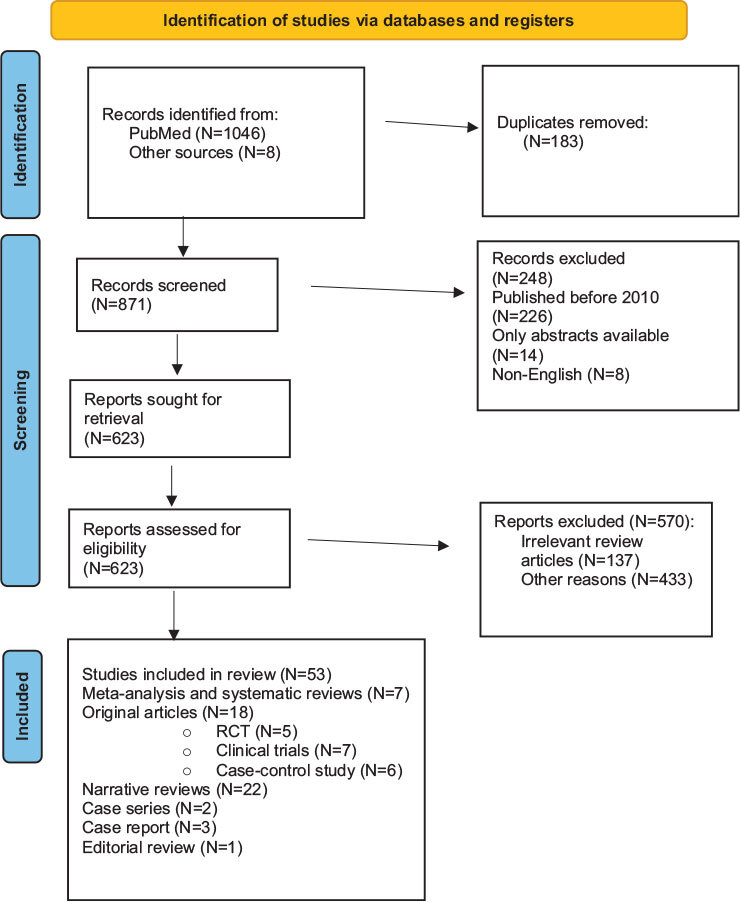
INTRODUCTION: Vitiligo is a common disorder of depigmentation caused by the progressive destruction of melanocytes that affects the skin, hair, and mucous membranes, clinically presenting as depigmented macules and leukotrichia. This condition, affecting millions of people worldwide, has a significant psychosocial burden on patients' quality of life, particularly in relation to skin colour. The etiopathogenesis of this disorder is obscure, but multiple factors contribute to the loss of melanocytes in the skin, like oxidative stress, inflammation, genetics, and autoimmunity. The treatment of vitiligo has been challenging over the past years, but recent developments in understanding the etiopathogenesis of the disease have paved the way for the development of more effective and promising therapeutic treatment options. OBJECTIVE: The aim of this review was to provide an overview of the underlying mechanisms and highlight the latest advances in the treatment of vitiligo. METHODOLOGY: This review was performed according to PRISMA (Preferred Reporting Items for Systematic Reviews and Metanalyses) guidelines. A comprehensive search of the literature was carried out through the PubMed electronic database from inception to 31 December 2023 using the following search terms "vitiligo" AND "JAK inhibitors", "vitiligo" AND "prostaglandin", " vitiligo" AND " afamelanotide", "vitiligo" AND "antioxidants", "vitiligo" AND "vitamin D3", "vitiligo" AND "statins", "vitiligo" AND "TNF-alpha", "vitiligo" AND "interleukin", "vitiligo" AND "light therapy". Two independent reviewers screened titles, abstracts, and full texts to select papers dealing with vitiligo and its treatment. CONCLUSION: The advent of treatment modalities like Janus kinase inhibitors, prostaglandin analogues, antioxidants, TNF-α inhibitors, targeted phototherapy, and excimer lasers has revolutionized the therapeutic possibilities, offering a ray of hope to the individuals suffering from this devastating condition.
Overview
The claims and statistics of this paper haven’t been checked yet.
Run the check — free, no account needed. It reads the open-access text and checks the sources it cites.
Integrity signals
Registry
Cites
Statistics
Figures
Verification
Claims the paper makes
The claims and statistics of this paper haven’t been checked yet.
Run the check — free, no account needed. It reads the open-access text and checks the sources it cites.
Claims other papers make about this one
Each is checked against this paper’s own text: does it say what the citing paper says it does?
The source backs part of the claim, not all of it — or backs it for a different population, condition or comparison.
In the citing paper
“Narrowband UVB phototherapy is a cornerstone modality that promotes melanocyte proliferation, migration from hair follicles, and immunomodulation by suppressing pathogenic T-cell responses.”
From The Cutaneous Immune Microenvironment in Selected Inflammatory Skin Diseases: Linking Histopathology, Mechanisms, and Targeted Therapy (2026) · cites this paper as [53]
Experimental — accuracy not yet measuredThe source backs part of the claim, not all of it — or backs it for a different population, condition or comparison.
In the citing paper
“Combination therapies, particularly JAK inhibitors with phototherapy, appear to enhance efficacy and durability of response.”
From The Cutaneous Immune Microenvironment in Selected Inflammatory Skin Diseases: Linking Histopathology, Mechanisms, and Targeted Therapy (2026) · cites this paper as [53]
Experimental — accuracy not yet measuredThe source backs part of the claim, not all of it — or backs it for a different population, condition or comparison.
In the citing paper
“Conventional treatments such as topical corticosteroids and calcineurin inhibitors remain first-line for reducing local inflammation and halting disease progression.”
From The Cutaneous Immune Microenvironment in Selected Inflammatory Skin Diseases: Linking Histopathology, Mechanisms, and Targeted Therapy (2026) · cites this paper as [53]
Experimental — accuracy not yet measuredThe cited source says what the claim attributes to it.
In the citing paper
“Advances in understanding the interferon-γ/JAK-STAT axis have led to clinical use of JAK inhibitors in vitiligo, most notably with topical ruxolitinib for nonsegmental vitiligo, while systemic JAK inhibitors remain under investigation or off-label in many settings.”
From The Cutaneous Immune Microenvironment in Selected Inflammatory Skin Diseases: Linking Histopathology, Mechanisms, and Targeted Therapy (2026) · cites this paper as [53]
The cited source says what the claim attributes to it.
In the citing paper
“Overall, modern vitiligo management is shifting toward targeted, mechanism-based interventions designed not only to induce repigmentation but also to maintain long-term disease control [53,54].”
From The Cutaneous Immune Microenvironment in Selected Inflammatory Skin Diseases: Linking Histopathology, Mechanisms, and Targeted Therapy (2026) · cites this paper as [53]
Self-check
Percentages, sums and reported differences re-computed from the paper’s own numbers.
The self-check needs the paper’s full text.
Citations
Cites
Bergqvist, C., & Ezzedine, K. (2020) · Dermatology · doi:10.1159/000506103 · Cited by 799
Ezzedine, K., Lim, H. W., Suzuki, T., Katayama, I., Hamzavi, I. H., Lan, C.-C. E., Goh, B. K., Anbar, T. S., de Catro, C. C. S., Lee, A. Y., et al. (2012) · Pigment Cell & Melanoma Research · doi:10.1111/j.1755-148x.2012.00997.x · Cited by 701
The IL-23/IL-17 Pathway in Inflammatory Skin Diseases: From Bench to Bedside
Liu, T., Li, S., Ying, S., Tang, S., Ding, Y., Li, Y., Qiao, J., & Fang, H. (2020) · Frontiers in Immunology · doi:10.3389/fimmu.2020.594735 · Cited by 406
Roy, T., Boateng, S. T., Uddin, M. B., Banang‐Mbeumi, S., Yadav, R. K., Bock, C. R., Folahan, J. T., Siwe‐Noundou, X., Walker, A. L., King, J. A. C., et al. (2023) · Cells · doi:10.3390/cells12121671 · Cited by 183
Lambert, C., Zappia, J., Sanchez, C., Florin, A., Dubuc, J., & Henrotin, Y. E. (2021) · Frontiers in Medicine · doi:10.3389/fmed.2020.607186 · Cited by 180
Ezzedine, K., Peeva, E., Yamaguchi, Y., Cox, L. A., Banerjee, A., Han, G., Hamzavi, I. H., Ganesan, A. K., Picardo, M., Thaçi, D., et al. (2022) · Journal of the American Academy of Dermatology · doi:10.1016/j.jaad.2022.11.005 · Cited by 169
The Role of Oxidative Stress in the Pathogenesis of Vitiligo: A Culprit for Melanocyte Death
Xuan, Y., Yang, Y., Xiang, L. F., & Zhang, C. (2022) · Oxidative Medicine and Cellular Longevity · doi:10.1155/2022/8498472 · Cited by 158
Richmond, J. M., Strassner, J. P., Rashighi, M., Agarwal, P., Garg, M., Essien, K. I., Pell, L., & Harris, J. E. (2018) · Journal of Investigative Dermatology · doi:10.1016/j.jid.2018.10.032 · Cited by 155
Comorbidities in vitiligo: comprehensive review
Dahir, A. M., & Thomsen, S. F. (2018) · International Journal of Dermatology · doi:10.1111/ijd.14055 · Cited by 148
Mohammad, T. F., Al-Jamal, M., Hamzavi, I. H., Harris, J. E., Leone, G., Cabrera, R., Lim, H. W., Pandya, A. G., & Esmat, S. M. (2017) · Journal of the American Academy of Dermatology · doi:10.1016/j.jaad.2016.12.041 · Cited by 138
Research works printed but not linked: 2
- Zahoor M, Shaukat S, Khan MS, Ahmad TJ. Comparison of efficacy and safety of 0.005% calcipotriol ointment versus 0.05% betamethasone dipropionate ointment versus calcipotriol plus betamethasone ointment for the treatment of vitiligo. J Pak Assoc Dermatol [Internet]. 2017;27(1):30-6. Available from: http://jpad.com.pk/index.php/jpad/article/view/1023
- Feng Y, Lu Y. Advances in vitiligo: Update on therapeutic targets. Front Immunol. 2022;13:986918. DOI: 10.3389/fimmu.2022.986918. PMID: 36119071. · DOI
Cited by
Sorted by citations
The Neuro‐Endocrinal Regulation in Vitiligo
Liu, W., Ma, W., Xue, X., & Li, S. (2025) · Pigment Cell & Melanoma Research · doi:10.1111/pcmr.70029 · Cited by 9
Lipidome Complexity in Physiological and Pathological Skin Pigmentation
Bastonini, E., Kovacs, D., Maresca, V., Ottaviani, M., Nardo, A. D., Flori, E., Cardinali, G., & Briganti, S. (2025) · International Journal of Molecular Sciences · doi:10.3390/ijms26146785 · Cited by 7
Tinca, A. C., Cozac-Szoke, A. R., & Cotoi, O. S. (2026) · Dermatopathology · doi:10.3390/dermatopathology13020022 · Cited by 1
“Overall, modern vitiligo management is shifting toward targeted, mechanism-based interventions designed not only to induce repigmentation but also to maintain long-term disease control [53,54].”
Lee, Y.-J., & Hyun, C. (2025) · International Journal of Molecular Sciences · doi:10.3390/ijms26167721 · Cited by 1
From melanocyte loss to targeted therapy: A comprehensive review of vitiligo management
Dan, D. D., Prabitha, P., & Agalgave, V. C. (2025) · Letters in Drug Design & Discovery · doi:10.1016/j.lddd.2025.100111 · Cited by 1
Metadata
- Authors
- Binti Ismail, I., Jabeen Bhat, Y., & Shurjeel ul Islam, M.
- Affiliations
- Department of dermatology venereology and leprosy GMC Srinagar
- ORCID
- Jabeen Bhat, Yasmeen
- Venue
- Dermatology Practical & Conceptual
- Publisher
- Mattioli1885
- Published
- 2025-01-29
- Volume
- 15
- Issue
- 1
- Pages
- 4600
- ISSN
- 2160-9381 (ISSN-L)
- PMC
- PMC11928143
- OpenAlex
- W4406955572
- Cited by
- 15
- References
- 67
- Citations by year
- 2026: 7 · 2025: 8
- FWCI
- 1.79
- Type
- journal article
- Language
- en
- Open access
- diamond
- doi.org
- Licence
- cc-by-nc
- Locations
- Dermatology Practical & Conceptual (publishedVersion, cc-by-nc)
- PubMed Central (publishedVersion, cc-by-nc)
- PubMed (publishedVersion)
- DOAJ (DOAJ: Directory of Open Access Journals) (submittedVersion, cc-by-sa)
- Topics
- Life Sciences › Biochemistry, Genetics and Molecular Biology › Cell Biology › melanin and skin pigmentation
- Health Sciences › Medicine › Dermatology › Dermatologic Treatments and Research
- Health Sciences › Medicine › Dermatology › Hair Growth and Disorders
- Keywords
- vitiligo, depigmentation, melanocyte loss, vitiligo treatment, JAK inhibitors, prostaglandin analogues, afamelanotide, antioxidants, vitamin D3, statins, TNF-alpha inhibitors, interleukin inhibitors, targeted phototherapy, excimer laser, oxidative stress, autoimmunity, etiopathogenesis
About these checks
Registry, retraction, Cites and statistics results are computed, not judged, with one exception: a printed reference that no index lists is read once by a model before it counts as a citation error. Claims are extracted by a model and kept only when their quote appears verbatim in the text; each cited source is then checked, with a model’s help, for whether it says what the claim relies on. Those verdicts can be wrong — read the claim’s quote and the cited source before relying on one.
Statistics and arithmetic are recomputed, not judged.
Confidence bands are shown only for fields calibrated on our annotated test set. None is calibrated yet, so no band is shown.
What counts as a claim ›How we measure confidence ›How we check this ›
Are you an author, or do you see a problem with this page? Request a review
How to cite
Cite CoChat for the checks on this page, and the paper for its own findings.
- This page
- CoChat. (2026). Citation check: Treatment advances in Vitiligo: An Updated Review. https://app.cochat.ai/papers/10.5826/dpc.1501a4600
- The paper
- Binti Ismail, I., Jabeen Bhat, Y., & Shurjeel ul Islam, M. (2025). Treatment advances in Vitiligo: An Updated Review. Dermatology Practical & Conceptual. https://doi.org/10.5826/dpc.1501a4600
