

The Impact of Boko Haram Insurgency on Nigerian National Security
Open accessThe DOI matches its Crossref record; 7 of the 8 references it cites were found in a registry or an index; none of the 27 sources its claims cite is checked for support yet.
Abstract
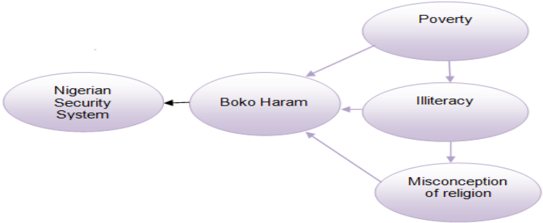
Jama'atul Ahlus Sunnah Lid daawati wal Jihad popularly known as Boko Haram, which means western education is forbidden emerged around 2002 as a local Islamic movement mainly for preaching and charity to people in Maiduguri Borno State. The activities of the group changed in 2009 after the Nigerian government crackdown on its followers as a result of which spiritual and political leader Muhammad Yusuf was killed. From 2009 to 2015 Boko Haram insurgency claimed the lives of more than 13,000 people. The group has intensified its attacks on security agents and their formations, top governmental establishments, schools, Mosques, and the general populace. The group kidnapped 250 schoolgirls in Chibok in April 2014. The threat posed by the group is undermining the existence of Nigeria as one sovereign political territory. In August 2014, the sect leader declared areas under their control as new Islamic Caliphate which would be governed according to strict Islamic laws. The objective of this study is to examine the threats of Boko Haram insurgency on Nigerian national security. The study also revealed that poverty and misconception of religion were the major factors that facilitated the emergence and development of Boko Haram. The researchers recommend that Nigerian Government should address the root and symptom of the problem by eradicating poverty, providing employment to the people and enhancing security efforts.
Overview
CoChat Summary
TL;DR
This study examines threats posed by Boko Haram to Nigerian national security and recommends multi-dimensional responses addressing both symptoms and root causes. Using a qualitative questionnaire with Nigerian security personnel, it links the insurgency to poverty, illiteracy, and religious misconception while documenting weakened security capacity and regional spillover.
Key findings
- Boko Haram insurgency claimed more than 13,000 lives from 2009 to 2015 and kidnapped 250 schoolgirls in Chibok in April 2014; in August 2014 the sect declared areas under its control a new Islamic Caliphate.
- Respondents reported severe threats to Nigerian security: superior Boko Haram weaponry, poor/outdated weapons and logistics, corruption, intelligence gaps, and morale collapse; about 90% said Boko Haram remained faceless within the mainstream Nigerian population, and about 200 military personnel were sentenced to death and about 300 expelled.
- Poverty and economic deprivation were central: NBS (2012) reported high relative poverty in the northeast/northwest (76.3% and 77.7%, respectively), and the paper cites 64 million Nigerian youths unemployed and 1.6 million under-employed.
- Respondents recommended modern weaponry, incentives, dialogue, employment creation, anti-corruption measures, prosecution of sponsors, community policing, intelligence gathering, and regional cooperation with Cameroon, Chad, and Niger.
Methods
- Qualitative study using an analytic/thematic approach; data were gathered via a structured questionnaire administered to Nigerian security agents, including police ASPs, DSS senior intelligence officers, NSCDC inspectors, and Army lieutenants.
- Thematic analysis following Braun and Clarke (2006) was used to identify, analyse, and report patterns in the data. Sample size and sampling procedure are not stated.
Limitations
- The paper states no limitations.
- Evident from the text: no sample size, sampling strategy, or questionnaire details are reported; findings are largely descriptive and rely on security personnel perspectives, with some percentages but no inferential statistics.
- Evident from the text: the provided text contains internal inconsistencies (e.g., relative poverty figures for northeast/northwest) and fragmented/repeated sections, which limits reproducibility.
Model-written summary. Check it against the paper before relying on it.
Integrity signals
Registry
Cites
Statistics
Figures
Verification
Claims the paper makes
0 Valid · 0 Not valid · 23 Not checked · 23 Own results and interpretations
A result the paper reports from its own data — it cites no other source for it, so there is none to check. The quote shows it is in the paper.
In the paper
“About 90 % of the respondents opined that Boko Haram remained faceless within mainstream Nigerian population.”
§ The Impact of Boko Haram Insurgency on Nigerian National Security > 3.2 Research Question 1: What are the threats of Boko Haram insurgency on Nigerian security system?
plain- Asserted: passes — The authors put it forward as true.
- Checkable: passes — It can be checked against evidence.
- Load-bearing: unclear — It is unclear whether the paper’s conclusions depend on it.
- Based: passes — The paper gives a reason why it holds.
- Rests on an assumption not shown here.
A result the paper states — it cites no source for it, so there is none to check. The quote shows it is in the paper.
In the paper
“This has affected the public confidence towards security matters.”
§ The Impact of Boko Haram Insurgency on Nigerian National Security > 3.2 Research Question 1: What are the threats of Boko Haram insurgency on Nigerian security system?
plainstates a cause- Asserted: passes — The authors put it forward as true.
- Checkable: passes — It can be checked against evidence.
- Load-bearing: passes — The paper’s conclusions depend on it.
- Based: passes — The paper gives a reason why it holds.
- Rests on an assumption not shown here.
A result the paper reports from its own data — it cites no other source for it, so there is none to check. The quote shows it is in the paper.
In the paper
“In short, most of the respondents as they are security men, believed that the conflicts have affected them individually as well as within their respective security agencies.”
§ The Impact of Boko Haram Insurgency on Nigerian National Security > 3.2 Research Question 1: What are the threats of Boko Haram insurgency on Nigerian security system?
plain- Asserted: passes — The authors put it forward as true.
- Checkable: passes — It can be checked against evidence.
- Load-bearing: unclear — It is unclear whether the paper’s conclusions depend on it.
- Based: passes — The paper gives a reason why it holds.
- Rests on an assumption not shown here.
A result the paper reports from its own data — it cites no other source for it, so there is none to check. The quote shows it is in the paper.
In the paper
“Question of the questionnaire revealed that Boko Haram has posed the challenge of weapons armament and another ballistics possession.”
§ The Impact of Boko Haram Insurgency on Nigerian National Security > 3.2 Research Question 1: What are the threats of Boko Haram insurgency on Nigerian security system?
plainstates a cause- Asserted: passes — The authors put it forward as true.
- Checkable: passes — It can be checked against evidence.
- Load-bearing: unclear — It is unclear whether the paper’s conclusions depend on it.
- Based: passes — The paper gives a reason why it holds.
- Rests on an assumption not shown here.
A result the paper states — it cites no source for it, so there is none to check. The quote shows it is in the paper.
In the paper
“Hence, the targeting of security officers even on private life has placed the men of these services extremely in danger.”
§ The Impact of Boko Haram Insurgency on Nigerian National Security > 3.2 Research Question 1: What are the threats of Boko Haram insurgency on Nigerian security system?
plainstates a cause- Asserted: passes — The authors put it forward as true.
- Checkable: passes — It can be checked against evidence.
- Load-bearing: passes — The paper’s conclusions depend on it.
- Based: passes — The paper gives a reason why it holds.
- Rests on an assumption not shown here.
21 more claims
Create a free account to see all 46 claims and to verify the 4 references still open.
- It may state two separate claims as one. 14
- Probably not a substantial claim. 7
Self-check
Percentages, sums and reported differences re-computed from the paper’s own numbers.
Each contradiction between two passages listed here was confirmed by an independent check.
Rated minor: it would not touch a result — a value no result rests on, a p-value that stays on the same side of the significance level, or a conflict that is clerical, resolved elsewhere in the paper, or outside its own findings.
In the paper
§ The Impact of Boko Haram Insurgency on Nigerian National Security > 2.3 Conceptual Framework
“the Northeast of the country where Boko Haram is strong has the higher figure of 77.7% of relative poverty.”
§ The Impact of Boko Haram Insurgency on Nigerian National Security > 2.1.1 Poverty Theory
“The northeast and north-west zones have the higher figure of 76.3% and 77.7% relative poverty respectively (NBS, 2012).”
Citations
Cites
Using thematic analysis in psychology
Braun, V., & Clarke, V. (2006) · Qualitative Research in Psychology · doi:10.1191/1478088706qp063oa · Cited by 194,414
Boko Haram and National Security Challenges in Nigeria; Causes and Solutions
(2013) · Cited by 68
Nigeria’s Boko Haram: Frequently Asked Questions
(2014) · Cited by 52
Boko Haram insurgency in Nigeria as a symptom of poverty and political alienation
Adenrele, A. R. (2012) · IOSR Journal of Humanities and Social Science · doi:10.9790/0837-0352126 · Cited by 35
Nigeria’s Troubled North: Interrogating the Drivers of Public Support for Boko Haram
Olojo, A. (2013) · Terrorism and Counter-Terrorism Studies · doi:10.19165/2013.1.07 · Cited by 14
Research works printed but not linked: 1
- [19]19. Zenn, J. (2014). Boko Haram and the kidnapping of the Chibok schoolgirls. CTC Sentinel, 7(5), 1- 8.https://www.ctc.usma.edu/posts/boko-haram-and-the-kidnapping-of-the-chibok- schoolgirls
Cited by
An Analysis of the Causes and Consequences of Kidnapping in Nigeria
Ibrahim, B., & Mukhtar, J. I. (2017) · African Research Review · doi:10.4314/afrrev.v11i4.11 · Cited by 67
“info The strength of the theory, according to Siegel (2010), is that it explains victimisation patterns in the social structure.”
BackgroundUsing the polio programme to deliver primary health care in Nigeria: implementation research
Bawa, S. B., McNab, C., Nkwogu, L., Braka, F., Obinya, E., Galway, M., Mirelman, A. J., Hammanyero, K. I., Safiyanu, G., Chukwuji, M., et al. (2018) · Bulletin of the World Health Organization · doi:10.2471/blt.18.211565 · Cited by 32
An Integrated Theoretical Approach to the Persistence of Boko Haram Violent Extremism in Nigeria
(2017) · doi:10.1080/15423166.2017.1331746 · Cited by 20
“While it is possible to directly attack the sect’s camps in the North-East, as evident from the capture of Camp Zero in Sambisa Forest in Borno State, Boko Haram is a manifestation of a deeper problem and this is the discussion this paper seeks to provoke.”
BackgroundInfluentialThe impact of Boko Haram threat on economic activities in Cameroon: perceptions of people in Yaoundé
Opoku, M. P., Sakah, B. N., & Alupo, B. A. (2016) · Behavioral Sciences of Terrorism and Political Aggression · doi:10.1080/19434472.2016.1231212 · Cited by 10
“The deep seated marginalization and ‘perceived’ unfair distribution of the national cake explains the radicalization of the youth in especially Northern Nigeria (Shuaibu et al., 2015).”
BackgroundResultInfluential
Metadata
- Authors
- Shuaibu, S. S., Salleh, M. A., & Shehu, A. Y.
- Affiliations
- Sultan Zainal Abidin University (MY)
- ORCID
- Salleh, Mohd Afandi
- Venue
- International Journal of Academic Research in Business and Social Sciences
- Published
- 2015-07-05
- Volume
- 5
- Issue
- 6
- ISSN
- 2222-6990 (ISSN-L)
- OpenAlex
- W1410300284
- Cited by
- 30
- References
- 8
- Citations by year
- 2025: 2 · 2024: 2 · 2021: 5 · 2020: 6 · 2019: 5 · 2018: 5 · 2017: 4 · 2016: 1
- FWCI
- 11.06
- Type
- journal article
- Language
- en
- Open access
- hybrid
- doi.org
- Licence
- cc-by
- Locations
- International Journal of Academic Research in Business and Social Sciences (publishedVersion, cc-by)
- RePEc: Research Papers in Economics (submittedVersion)
- Topics
- Social Sciences › Sociology and Political Science › Terrorism, Counterterrorism, and Political Violence
- Social Sciences › Sociology and Political Science › Diverse Research Studies Overview
- Social Sciences › Anthropology › African Studies and Geopolitics
- Keywords
- Boko Haram, insurgency, national security, Nigeria, Islamic extremism, poverty, religious extremism, Islamic caliphate, security threats
About these checks
Registry, retraction, Cites and statistics results are computed, not judged, with one exception: a printed reference that no index lists is read once by a model before it counts as a citation error. Claims are extracted by a model and kept only when their quote appears verbatim in the text; each cited source is then checked, with a model’s help, for whether it says what the claim relies on. Those verdicts can be wrong — read the claim’s quote and the cited source before relying on one.
A language model drew the claims from the paper on 2026-10-10, under version 3 of the claim definition (model deepseek-v4.1-flash, prompt extract-v3).
A second model labelled each claim on 2026-10-10 (model jev-1.13-20260917, definition revision gold-guideline-v0.2).
Statistics and arithmetic are recomputed, not judged.
Confidence bands are shown only for fields calibrated on our annotated test set. None is calibrated yet, so no band is shown.
What counts as a claim ›How we measure confidence ›How we check this ›
Are you an author, or do you see a problem with this page? Request a review
How to cite
Cite CoChat for the checks on this page, and the paper for its own findings.
- This page
- CoChat. (2026). Citation check: The Impact of Boko Haram Insurgency on Nigerian National Security. https://app.cochat.ai/papers/10.6007/ijarbss/v5-i6/1676
- The paper
- Shuaibu, S. S., Salleh, M. A., & Shehu, A. Y. (2015). The Impact of Boko Haram Insurgency on Nigerian National Security. International Journal of Academic Research in Business and Social Sciences. https://doi.org/10.6007/ijarbss/v5-i6/1676
Data sources
Bibliographic data: Semantic Scholar, OpenAlex, Crossref.
Contains information from the Semantic Scholar Academic Graph Datasets, made available under the ODC Attribution License (ODC-BY 1.0).
Semantic Scholar’s data is described in: Kinney, R., et al. (2023). The Semantic Scholar Open Data Platform. arXiv:2301.10140.
