

Prevalence of syphilis and associated factors among pregnant women in Brazil: systematic review and meta-analysis
Open accessThe DOI matches its Crossref record; 44 of the 44 references it cites were found in a registry or an index.
Abstract
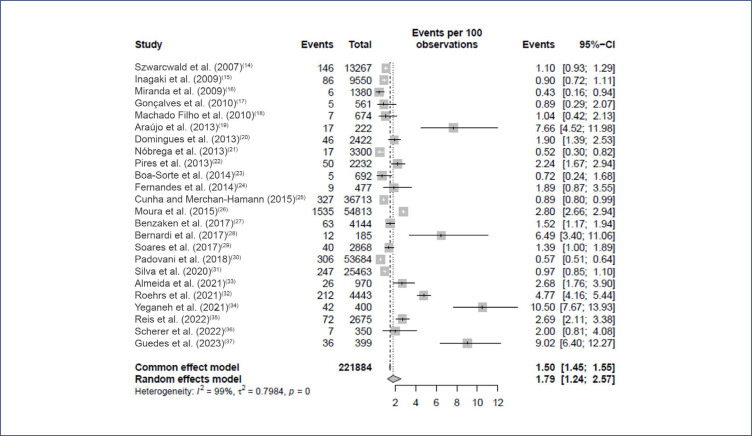
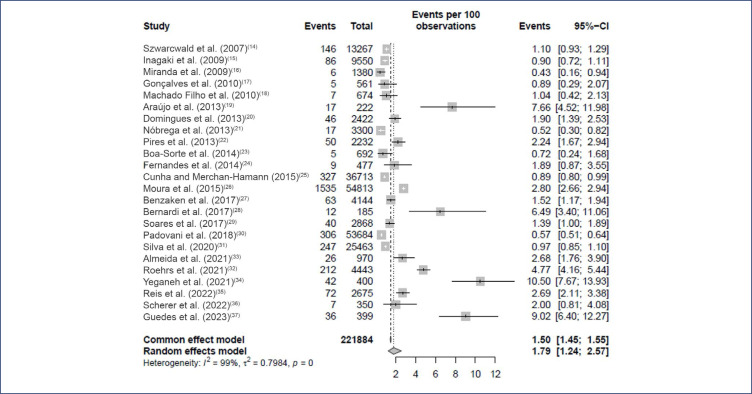
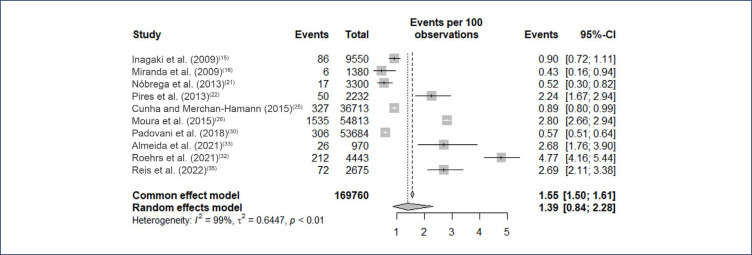
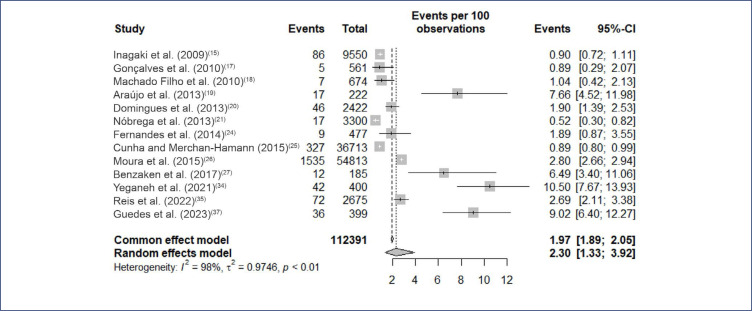
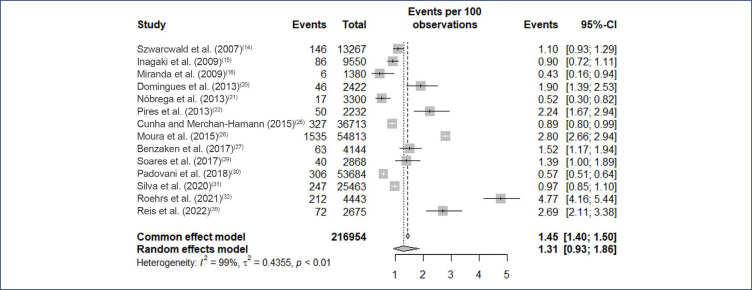
Objective: This systematic review accompanied by a meta-analysis aimed to estimate the prevalence of syphilis in pregnant women in Brazil and describe its associated factors. Methods: Following the establishment the search strategies and the registration of the review protocol in PROSPERO, we conducted a search for relevant articles in the Pubmed, LILACS, Science Direct, SciELO and Web of Science databases. Our inclusion criteria were cross-sectional studies published between 2005 and 2023, with no language restrictions. The combined prevalence of syphilis infection was estimated using the random effects model in the R Software with a 95% confidence interval (95% CI) and p < 0.01 as statistically significant. Results: A total of 24 articles were recruited, which together investigated 221,884 women. The combined prevalence of syphilis in pregnant women in Brazil was 1.79% (95% CI: 1.24-2.57%), and the main factors associated with its occurrence were black and brown skin color, low education and factors related to the partner. Conclusion: There was a high prevalence of syphilis in pregnancy in Brazil, mainly associated with socioeconomic factors.
Overview
The claims and statistics of this paper haven’t been checked yet.
Free: it reads the open-access text and checks the first 5 claims that cite a source we can check. Create a free account to check every claim.
Integrity signals
Registry
Cites
Statistics
Figures
Verification
Claims the paper makes
The claims and statistics of this paper haven’t been checked yet.
Free: it reads the open-access text and checks the first 5 claims that cite a source we can check. Create a free account to check every claim.
Claims other papers make about this one
Each is checked against this paper’s own text: does it say what the citing paper says it does?
The cited source says what the claim attributes to it.
In the citing paper
“significantly lower than that in high-burden regions such as sub-Saharan Africa (> 2%) and Brazil (1.79%) [39, 40]”
From prevalence of syphilis among pregnant women in China: a systematic review and meta-analysis (2026) · cites this paper as [40]
Self-check
Percentages, sums and reported differences re-computed from the paper’s own numbers.
The self-check needs the paper’s full text.
Citations
Cites
The PRISMA 2020 statement: An updated guideline for reporting systematic reviews
Page, M. J., McKenzie, J. E., Bossuyt, P. M., Boutron, I., Hoffmann, T. C., Mulrow, C. D., Shamseer, L., Tetzlaff, J. M., Akl, E. A., Brennan, S. E., et al. (2021) · BMJ · doi:10.1136/bmj.n71 · Cited by 108,283
Quantifying publication bias in meta-analysis
Lin, L., & Chu, H. (2018) · Biometrics · doi:10.1111/biom.12817 · Cited by 1,674
Miranda, A. E., Saraceni, V., Pereira, G. F. M., da Silveira, M. F., & Araújo, M. A. L. (2017) · Revista Panamericana de Salud Pública · doi:10.26633/rpsp.2017.44 · Cited by 228
Padovani, C., de Oliveira, R. R., & Pelloso, S. M. (2018) · Revista Latino-Americana de Enfermagem · doi:10.1590/1518-8345.2305.3019 · Cited by 173
Sífilis materna e congênita, subnotificação e difícil controle
Lafetá, K. R. G., Júnior, H. M., Silveira, M. F., & Paranaiba, L. M. R. (2016) · Revista Brasileira de Epidemiologia · doi:10.1590/1980-5497201600010006 · Cited by 141 · cited 1×
“(8,9) It is believed that knowledge about the prevalence of syphilis during pregnancy in the country and its possible associated factors, based on studies with primary data, can provide subsidies for the establishment of public health policies aimed at controlling and preventing the disease, in…”
BackgroundSífilis gestacional e congênita em Palmas, Tocantins, 2007-2014 *
Cavalcante, P. A. D. M., Pereira, R. B. D. L., & Castro, J. G. D. (2017) · Epidemiologia e Serviços de Saúde · doi:10.5123/s1679-49742017000200003 · Cited by 134 · cited 1×
“…of syphilis in pregnancy, namely, the limited understanding about the importance of measures to prevent sexually transmitted infections (STIs), (41,42) and the low adherence to prenatal care, (6) resulting in the failure to carry out the tests recommended by the Ministry of Health, including the…”
BackgroundSífilis congênita: evento sentinela da qualidade da assistência pré-natal
Domingues, R. M. S. M., Saracen, V., Hartz, Z. M. D. A., & Leal, M. D. C. (2013) · Revista de Saúde Pública · doi:10.1590/s0034-89102013000100019 · Cited by 132
Cardoso, A. R., Araújo, M. A. L., Cavalcante, M. D. S., Frota, M. A., & de Melo, S. P. (2018) · Ciência & Saúde Coletiva · doi:10.1590/1413-81232018232.01772016 · Cited by 126 · cited 1×
“…of syphilis in pregnancy, namely, the limited understanding about the importance of measures to prevent sexually transmitted infections (STIs), (41,42) and the low adherence to prenatal care, (6) resulting in the failure to carry out the tests recommended by the Ministry of Health, including…”
BackgroundJoseph Davey, D., Shull, H., Billings, J., Wang, D., Adachi, K., & Klausner, J. (2016) · Sexually Transmitted Diseases · doi:10.1097/olq.0000000000000460 · Cited by 125
Gestational and congenital syphilis: maternal, neonatal characteristics and outcome of cases
Soares, L. G., Zarpelon, B. L., Soares, L. G., Baratieri, T., Lentsck, M. H., & Mazza, V. D. A. (2017) · Revista Brasileira de Saúde Materno Infantil · doi:10.1590/1806-93042017000400010 · Cited by 78
Self-citation
Research works printed but not linked: 7
- Ministério da Saúde Secretaria de Vigilância em Saúde Boletim Epidemiológico – Sífilis 2022 [citado 2023 Oct 10] 6 6 Número especial. Available from: https://www.gov.br/saude/pt-br/centrais-de-conteudo/publicacoes/boletins/epidemiologicos/especiais/2022/boletim-epidemiologico-de-sifilis-numero-especial-out-2022
- Amâncio VC Graciano AR Cozer AM Assis LP Dias DC Epidemiologia da sífilis congênita no estado de Goiás Rev Educ Saúde 2016 4 2 58 63
- Joanna Briggs Institute Checklist for prevalence studies critical appraisal tools for use in jbi systematic reviews 2020 [cited 2023 Oct 10] Available from: https://jbi.global/sites/default/files/2020-08/Checklist_for_Prevalence_Studies.pdf
- Szwarcwald CL Barbosa A Junior Miranda AE Paz LC Resultados do estudo sentinela-parturiente, 2006: desafios para o controle da sífilis congênita no Brasil DST J Bras Doenças Sex Transm 2007 19 3-4 128 133
- Cunha AR Merchan-Hamann E Sífilis em parturientes no Brasil: prevalência e fatores associados, 2010 a 2011 Rev Panam Salud Publica 2015 38 6 479 486 27440096
- Bernardi LE Ramos MC Silva MS Rossetti ML Pilot evaluation of a rapid immunochromatographic test for the diagnosis of gestational syphilis DST J Bras Doenças Sex Transm 2017 29 3 106 109 10.5533/DST-2177-8264-201729307 · doi:10.5533/dst-2177-8264-201729307
- Ministério da Saúde Secretaria de Vigilância em Saúde. Departamento de Doenças de Condições Crônicas e Infecções Sexualmente Transmissíveis. Protocolo clínico e diretrizes terapêuticas para atenção integral às pessoas com Infecções Sexualmente Transmissíveis – IST Brasília (DF) Ministério da Saúde 2022 [citado 2023 Jul 19] Disponével em: https://www.gov.br/aids/pt-br/centrais-de-conteudo/pcdts/2022/ist/pcdt-ist-2022_isbn-1.pdf/view
Cited by
Sífilis em gestantes no estado do Pará de 2013 a 2022: um estudo epidemiológico
de Oliveira, M. D. F. M., Morais, E. D. S., & Conde, Í. E. P. (2025) · Pará Research Medical Journal · doi:10.5327/prmj.924 · Cited by 1
prevalence of syphilis among pregnant women in China: a systematic review and meta-analysis
Cheng, J., Song, B., Sun, Y., Huang, H., Jiang, T., & Kuai, D. (2026) · BMC Pregnancy and Childbirth · doi:10.1186/s12884-026-08986-6
Rocha, M. T. D., Coelho, N., Pinto, F. F., Ferreira, G. S., & Araújo, I. (2026) · RECIMA21 - Revista Científica Multidisciplinar · doi:10.47820/recima21.v7i9.9043
Alarcon, M. R. J., Neves, P. A. R., da Silva, D. C., Pereira, L. A. A., Veríssimo, M. D. L. Ó. R., Moreira, R., & Malta, M. B. (2026) · The Brazilian Journal of Infectious Diseases · doi:10.1016/j.bjid.2026.105969
Metadata
- Authors
- Mundim de Oliveira, I., Santos, R. C. D., Alves Silva, R., Figueiredo Alves, R. R., Teodoro Martins, B. C., & Soares, L. R.
- Affiliations
- Universidade Federal de Goiás (BR)
- ORCID
- Venue
- Revista Brasileira de Ginecologia e Obstetrícia
- Published
- 2024
- Volume
- 46
- ISSN
- 0100-7203 (ISSN-L)
- 1806-9339
- PMC
- PMC11460426
- OpenAlex
- W4399580133
- Cited by
- 4
- References
- 44
- Citations by year
- 2026: 3 · 2025: 1
- FWCI
- 0.23
- Type
- journal article
- Language
- en
- Open access
- diamond
- doi.org
- Licence
- cc-by
- Locations
- Revista Brasileira Ginecologia e Obstetrícia (publishedVersion, cc-by)
- PubMed Central (publishedVersion, cc-by)
- PubMed (publishedVersion)
- DOAJ (DOAJ: Directory of Open Access Journals) (submittedVersion)
- Topics
- Health Sciences › Medicine › Infectious Diseases › Syphilis Diagnosis and Treatment
- Life Sciences › Immunology and Microbiology › Microbiology › Reproductive tract infections research
- Health Sciences › Medicine › Public Health, Environmental and Occupational Health › HIV, TB, and STIs Epidemiology
- Keywords
- syphilis, pregnancy, prevalence, risk factors, socioeconomic factors, skin color, educational attainment, Brazil
- MeSH terms
- Brazil, Cross-Sectional Studies, Female, Humans, Pregnancy, Pregnancy Complications, Infectious, Risk Factors, Socioeconomic Factors, Syphilis, Prevalence
About these checks
Registry, retraction, Cites and statistics results are computed, not judged, with one exception: a printed reference that no index lists is read once by a model before it counts as a citation error. Claims are extracted by a model and kept only when their quote appears verbatim in the text; each cited source is then checked, with a model’s help, for whether it says what the claim relies on. Those verdicts can be wrong — read the claim’s quote and the cited source before relying on one.
Statistics and arithmetic are recomputed, not judged.
Confidence bands are shown only for fields calibrated on our annotated test set. None is calibrated yet, so no band is shown.
What counts as a claim ›How we measure confidence ›How we check this ›
Are you an author, or do you see a problem with this page? Request a review
Data sources
Bibliographic data: Semantic Scholar, OpenAlex, Crossref.
Contains information from the Semantic Scholar Academic Graph Datasets, made available under the ODC Attribution License (ODC-BY 1.0).
Semantic Scholar’s data is described in: Kinney, R., et al. (2023). The Semantic Scholar Open Data Platform. arXiv:2301.10140.
