

The DOI matches its Crossref record; 5 of the 5 references it cites were found in a registry or an index.
Cybersecurity Of Work From Anywhere Model For Government : A Systematic Literature Review
Open accessAbstract
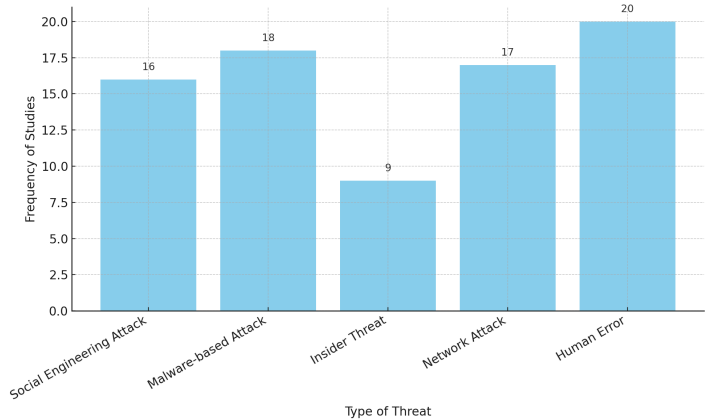
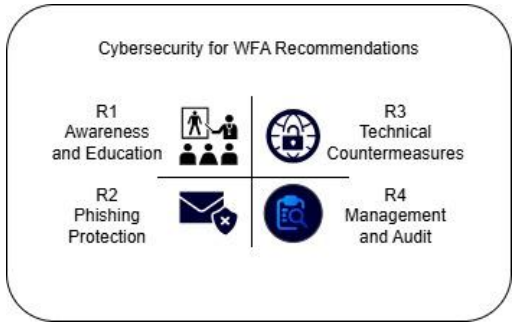
Presidential Regulation No. 21 of 2023 grants Indonesian civil servants (ASN) location flexibility, creating cybersecurity challenges that institutions and authorities have yet to fully address. Existing frameworks such as ISO 27001 and NIST provide only general remote work guidelines, lacking specific recommendations for the Work From Anywhere (WFA) model. This gap poses significant risks to data security and government operations, particularly as cyber incidents reported by the National Cyber and Crypto Agency of Indonesia (BSSN) continue to rise. The 2023 Indonesian Cybersecurity Landscape report recorded 347 suspected cyber incidents, including data breaches and the exposure of over 1.6 million records on the darknet, affecting numerous stakeholders. This study employs a Systematic Literature Review (SLR) to identify cybersecurity threats associated with remote work and explore effective mitigation techniques. The findings reveal five primary threats classified into two categories: human-centric threats (social engineering attacks, insider threats, and human errors) and technology-centric threats (malware-based and network attacks). To address these threats, the study identifies four key best practice themes: Awareness and Education, Phishing Protection, Technical Countermeasures, and Management and Audit. These themes provide a structured approach to enhancing cybersecurity in WFA environments. The results of this study serve as valuable input for formulating policy and technical guidelines to implement WFA in government settings. Future research should explore supply chain security, integration of WFA with on-site operations, cultural factors in security compliance, and governance frameworks to enhance cybersecurity resilience in government WFA environments.
Overview
The claims and statistics of this paper haven’t been checked yet.
Run the check — free, no account needed. It reads the open-access text and checks the sources it cites.
Integrity signals
Registry
Cites
Statistics
Figures
Verification
Claims the paper makes
The claims and statistics of this paper haven’t been checked yet.
Run the check — free, no account needed. It reads the open-access text and checks the sources it cites.
Claims other papers make about this one
Each is checked against this paper’s own text: does it say what the citing paper says it does?
The source backs part of the claim, not all of it — or backs it for a different population, condition or comparison.
In the citing paper
“Resource constraints and skills shortages create implementation bottlenecks (Asyrofi & Nugraha, 2025).”
From Comprehensive Cybersecurity Framework for Digital Governance: Threat Assessment, Risk Mitigation, and Regulatory Compliance in Indonesia (2025) · cites this paper as Asyrofi & Nugraha, 2025
Experimental — accuracy not yet measuredThe cited source says what the claim attributes to it.
In the citing paper
“Research on cybersecurity challenges in remote work environments highlights that Presidential Regulation No. 21 of 2023 granting Indonesian civil servants location flexibility creates cybersecurity challenges requiring comprehensive framework development (Asyrofi & Nugraha, 2025).”
From Comprehensive Cybersecurity Framework for Digital Governance: Threat Assessment, Risk Mitigation, and Regulatory Compliance in Indonesia (2025) · cites this paper as Asyrofi & Nugraha, 2025
The check wasn’t confident either way, so it gives no verdict — never disputed.
In the citing paper
“These obstacles particularly impact developing economies with limited cybersecurity infrastructure investment (Asyrofi & Nugraha, 2025).”
From Comprehensive Cybersecurity Framework for Digital Governance: Threat Assessment, Risk Mitigation, and Regulatory Compliance in Indonesia (2025) · cites this paper as Asyrofi & Nugraha, 2025
Experimental — accuracy not yet measured
Self-check
Percentages, sums and reported differences re-computed from the paper’s own numbers.
The self-check needs the paper’s full text.
Citations
Cites
The PRISMA 2020 statement: An updated guideline for reporting systematic reviews
Page, M. J., McKenzie, J. E., Bossuyt, P. M., Boutron, I., Hoffmann, T. C., Mulrow, C. D., Shamseer, L., Tetzlaff, J. M., Akl, E. A., Brennan, S. E., et al. (2021) · BMJ · doi:10.1136/bmj.n71 · Cited by 108,283
Wohlin, C. (2014) · Proceedings of the 18th International Conference on Evaluation and Assessment in Software Engineering · doi:10.1145/2601248.2601268 · Cited by 4,234
The NIST Cybersecurity Framework (CSF) 2.0
National Institute of Standards and Technology (2024) · doi:10.6028/nist.cswp.29 · Cited by 266
A review of state-of-the-art malware attack trends and defense mechanisms
Ferdous, J., Islam, R., Mahboubi, A., & Islam, M. Z. (2023) · IEEE Access · doi:10.1109/access.2023.3328351 · Cited by 98
Detecting Insider Threat via a Cyber-Security Culture Framework
Georgiadou, A., Mouzakitis, S., & Askounis, D. (2022) · Journal of Computer Information Systems · doi:10.1080/08874417.2021.1903367 · Cited by 65
Research works printed but not linked: 36
- Prithwiraj Choudhury, Camelia Foroughi, and Barbara Larson. "Work From Anywhere: The Productivity Effects of Geographic Flexibility". In: Strategic Management Journal 42.4 (Apr. 2021), pp. 655-683.
- National Institute of Standards and Technology (NIST). User's Guide to Telework and Bring Your Own Device (BYOD) Security. Tech. rep. Gaithersburg, MD: National Institute of Standards and Technology, 2016. DOI: 10.6028/NIST.SP.800-114r1. · DOI
- National Institute of Standards and Technology (NIST). Guide to Enterprise Telework, Remote Access, and Bring Your Own Device (BYOD) Security. Tech. rep. Gaithersburg, MD: National Institute of Standards and Technology, 2016. DOI: 10.6028/NIST.SP.800-46r2. · DOI
- M. Mahyoub et al. Cybersecurity Challenge Analysis of Work-from-Anywhere (WFA) and Recommenda- tions guided by a User Study. arXiv preprint arXiv:2409.07567. 2024. · arXiv
- R. Klint. "Cybersecurity in home-office environments: An examination of security best practices post Covid". MA thesis. Sweden: University of Skövde, 2023.
- L. Galajda. "A study of information security awareness on teleworking security risks and rec- ommendations since Covid19 pandemic". MA thesis. Sweden: Luleå University of Technology, 2023.
- S. Gumilang, R. Sutanto, and A. G. Dohamid. "Security Standard Recommendation of Teleworking in Government". In: International Journal Of Humanities Education And Social Sciences (IJHESS) 2.6 (2023), pp. 2070-2077.
- J. Jesson, L. Matheson, and F. M. Lacey. Doing Your Literature Review: Traditional and Systematic Techniques. London, UK: SAGE Publications Ltd, 2011.
- R. T. Watson and J. Webster. "Analysing the past to prepare for the future: Writing a literature review a roadmap for release 2.0". In: Journal of Decision Systems 29.3 (2020), pp. 129-147.
- R. Naidoo. "A multi-level influence model of COVID-19 themed cybercrime". In: European Journal of Information Systems (EJIS) 29.3 (2020), pp. 306-321.
- A. M. Abukari and E. K. Bankas. "Some Cyber Security Hygienic Protocols For Teleworkers In Covid-19 Pandemic Period And Beyond". In: International Journal of Scientific and Engineering Research (IJSER) 11.4 (2020), pp. 1401-1407.
- R. Palanisamy, A. A. Norman, and M. L. Mat Kiah. "BYOD Security Risks and Mitigation Strategies: Insights from IT Security Experts". In: Journal of Organizational Computing and Electronic Commerce 31.4 (2021), pp. 320-342.
- N. A. A. Othman, A. A. Norman, and M. L. Mat Kiah. "Information System Audit for Mobile Device Security Assessment". In: 3rd International Cyber Resilience Conference (CRC). IEEE Access, 2021.
- L. Astaja et al. "Cyber Security Risks and Challenges in Remote Work Under The COVID-19 Pandemic". In: 16th International Strategic Management Conference (ISMC). European Proceedings of Social and Behavioural Sciences. 2021, pp. 12-22.
- J. R. C. Nurse et al. "Remote Working Pre-and Post-COVID-19: An Analysis of New Threats and Risks to Security and Privacy". In: HCI International 2021 -Posters. Ed. by C. Stephanidis, M. Antona, and S. Ntoa. Vol. 1421. Communications in Computer and Information Science. Springer, 2021, pp. 583-590.
- K. Bicakci, Y. Uzunay, and M. Khan. "Towards Zero Trust: The Design and Implementation of a Secure End-Point Device for Remote Working". In: International Conference on Information Security and Cryptology (ISCTURKEY). IEEE Access, 2021.
- D. Gogri. "Threats and Mitigation Strategies in Remote Work Scenarios: A Cybersecurity Perspec- tive Post -COVID-19". In: International Journal of Science and Research (IJSR) 11.1 (2022), pp. 1687- 1694.
- N. Khantamonthon and K. Chimmanee. "Digital Forensic Analysis of Ransomware Attacks on Virtual Private Networks: A Case Study in Factories". In: 6th International Conference on Information Technology (InCIT). IEEE Access, 2022.
- S. M. Pedapudi and N. Vadlamani. "A Comprehensive Network Security Management in Virtual Private Network Environment". In: International Conference on Applied Artificial Intelligence and Computing (ICAAIC). IEEE Access, 2022.
- M. Kaur, S. Parkin, and M. Janssen. "I needed to solve their overwhelmness: How System Ad- ministration Work was Affected by COVID-19". In: Proceedings of the ACM on Human-Computer Interaction 6.CSCW2 (2022), p. 390.
- M. Plachkinova and L. Janczewski. "Comparing Information Security Compliance Between New Zealand, USA, and Vietnam". In: Journal of Computer Information Systems (2023), pp. 1-16.
- S. Keshvadi. "Enhancing Western Organizational Cybersecurity Resilience through Tailored Edu- cation for Non-Technical Employees". In: International Humanitarian Technology Conference (IHTC). IEEE Access, 2023.
- Q. Alsayfi and A. Alsirhani. "The Impact of Remote Work on Corporate Security". In: 3rd International Conference on Computing and Information Technology (ICCIT). IEEE Access, 2023.
- P. Soubhagyalakshmi and K. S. Reddy. "An efficient security analysis of bring your own device". In: IAES International Journal of Artificial Intelligence (IJ-AI) 12.2 (2023), pp. 696-703.
- V. V. Muthuswamy. "Cyber Security Challenges Faced by Employees in the Digital Workplace of Saudi Arabia's Digital Nature Organization". In: International Journal of Cyber Criminology 17.1 (2023), pp. 40-53.
- L. R. Mohan, R. K. Sambandam, and R. Gokulapriya. "Cached-N-Proxy: An Intelligent Proxy Algorithm for Preventing Insider Email Threats to Mail Servers". In: International Conference on Contemporary Computing and Communications (InC4). IEEE Access, 2024.
- B. V. Raghav, N. S. Sree, and S. Pamitha. "A Comprehensive Analysis on Online Masquerade Attacks". In: 3rd International Conference on Applied Artificial Intelligence and Computing (ICAAIC). IEEE Access, 2024.
- A. Fikry et al. "Defining the Beauty of Cyber Hygiene: A Retrospective Look". In: IEEE Engineering Management Review 52.2 (2024).
- R. Palanisamy, A. A. Norman, and M. L. Mat Kiah. "Employees' BYOD Security Policy Compliance in the Public Sector". In: Journal of Computer Information Systems 64.1 (2024), pp. 62-77.
- P. V. Falade and P. O. Momoh. "Evaluating the Permissions of Monitoring Mobile Applications for Remote Employees: Analysing the Impact on Employer Trust and Employee Privacy Concerns". In: International Journal of Scientific Research in Computer Science and Engineering 12.1 (2024), pp. 42-52.
- M. Ozer et al. "The Shifting Landscape of Cybersecurity: The Impact of Remote Work and COVID- 19 on Data Breach Trends". In: Computer Science, Computer Engineering, Applied Computing (CSCE). IEEE Access, 2024.
- R. B. Permadi and K. Ramli. "Analysis of Measuring Information Security Awareness for Employees at Institution XYZ". In: MALCOM: Indonesian Journal of Machine Learning and Computer Science 4 (2024), pp. 1330-1338.
- F. Mouton, L. Leenen, and H. S. Venter. "Social engineering attack examples, templates and scenarios". In: Computers & Security 59 (2016), pp. 186-209.
- H. Abroshan et al. "Phishing Happens beyond Technology: The Effects of Human Behaviors and Demographics on Each Step of a Phishing Process". In: IEEE Access 9 (2021), pp. 44928-44949.
- N. Hoque et al. "Network attacks: Taxonomy, tools and systems". In: Journal of Network and Computer Applications 40 (2014), pp. 307-324.
- E. P. Subagyo and K. Ramli. "Analyzing the Impact of Information Security Awareness Training to the Employees of Telco Company XYZ". In: Budapest International Research and Critics Institute (BIRCI-Journal) 5 (2022), pp. 8799-8808.
Cited by
Sorted by citations
Mualim, W. M. A., Marta, F. Y. D., & Meiyenti, I. (2025) · Jurnal Teknik Informatika dan Teknologi Informasi · doi:10.55606/jutiti.v5i3.6379
Metadata
- Authors
- Asyrofi, M. F., & Nugraha, I. G. D.
- Affiliations
- University of Indonesia (ID)
- Venue
- International Journal of Electrical, Computer, and Biomedical Engineering
- Published
- 2025-05-21
- Volume
- 3
- Issue
- 1
- ISSN
- 3026-5258 (ISSN-L)
- OpenAlex
- W4411013234
- Cited by
- 5
- References
- 5
- Citations by year
- 2026: 3 · 2025: 2
- FWCI
- 0.82
- Type
- journal article
- Language
- en
- Open access
- diamond
- doi.org
- Locations
- International Journal of Electrical Computer and Biomedical Engineering (publishedVersion, cc-by)
- Topics
- Physical Sciences › Computer Science › Information Systems › Information and Cyber Security
- Physical Sciences › Computer Science › Computer Networks and Communications › Cybersecurity and Information Systems
- Physical Sciences › Computer Science › Computer Networks and Communications › Network Security and Intrusion Detection
- Keywords
- work from anywhere, government cybersecurity, remote work, public sector employees, social engineering, insider threats, phishing protection, malware, network attacks, human error, cybersecurity best practices, technical countermeasures, cybersecurity governance, data breaches, Indonesia
About these checks
Registry, retraction, Cites and statistics results are computed, not judged, with one exception: a printed reference that no index lists is read once by a model before it counts as a citation error. Claims are extracted by a model and kept only when their quote appears verbatim in the text; each cited source is then checked, with a model’s help, for whether it says what the claim relies on. Those verdicts can be wrong — read the claim’s quote and the cited source before relying on one.
Statistics and arithmetic are recomputed, not judged.
Confidence bands are shown only for fields calibrated on our annotated test set. None is calibrated yet, so no band is shown.
What counts as a claim ›How we measure confidence ›How we check this ›
Are you an author, or do you see a problem with this page? Request a review
