

The DOI matches its Crossref record.
Conceptualizing a Model of Status Consumption Theory: An Exploration of the Antecedents and Consequences of the Motivation to Consume for Status
Abstract
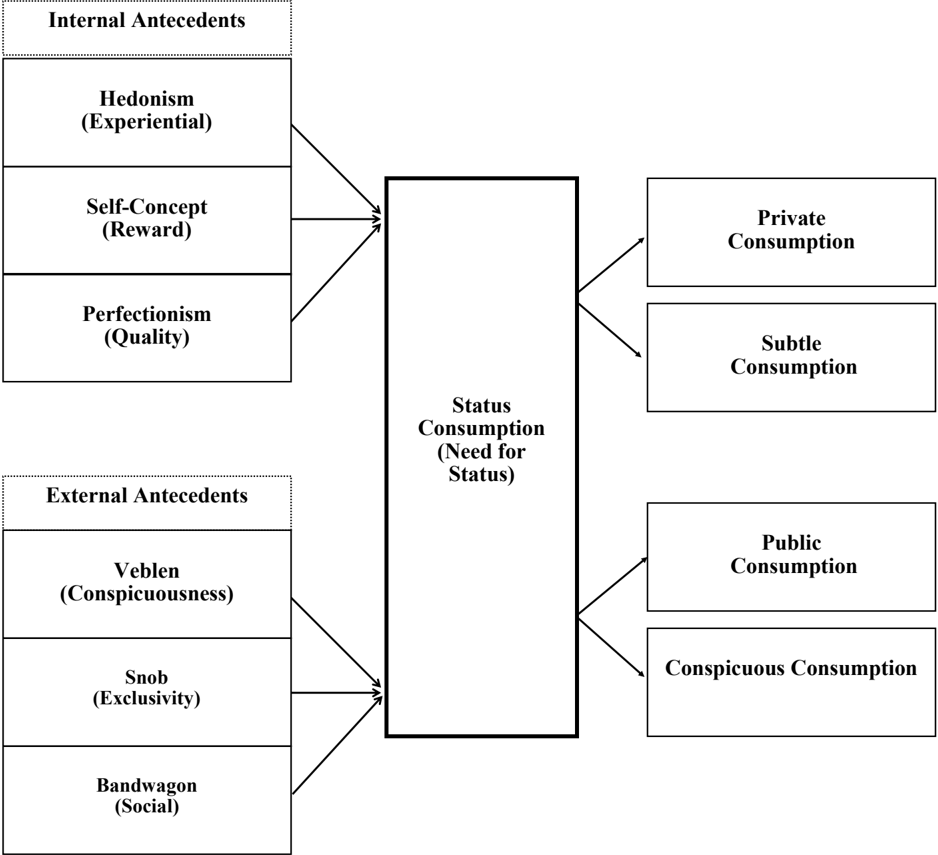
This paper examines the various motivations for consuming status products and proposes a conceptual model of status consumption that incorporates these differing motivations. Specifically, we propose that motivations for status consumption can be external (social) and/or internal (personal). Internal motivations focus on expressing inner values and tastes rather than group concerns, and include hedonism, perfectionism (a desire for quality), and self-reward and may result in more private and/or subtle consumption of status products. External motivations to consumer for status focus on the social effects of owning luxury products and include conspicuous consumption (the Veblen effect), exclusivity (the Snob effect), and social identity (the Bandwagon effect) and may result in more public and/or conspicuous consumption of status products. The managerial and research implications of the model are also explored.
Overview
The claims and statistics of this paper haven’t been checked yet.
Run the check — free, no account needed. It reads the open-access text and checks the sources it cites.
Integrity signals
Registry
Cites
Statistics
Figures
Verification
Claims the paper makes
The claims and statistics of this paper haven’t been checked yet.
Run the check — free, no account needed. It reads the open-access text and checks the sources it cites.
Claims other papers make about this one
Each is checked against this paper’s own text: does it say what the citing paper says it does?
The cited source says what the claim attributes to it.
In the citing paper
“Considering that external (social) influences play a role in conspicuous consumption (Eastman & Eastman, 2015), the role of interpersonal influence in this tendency will be more evident.”
From The Moderating Role of Self-Concept Clarity in the Relationship between Susceptibility to Interpersonal Influence and Conspicuous Consumption (2026) · cites this paper as Eastman & Eastman, 2015
The cited source says what the claim attributes to it.
In the citing paper
“Since external (social) influences play a role in conspicuous consumption (Eastman & Eastman, 2015), the evaluations of others are important for consumers with high susceptibility to interpersonal influence.”
From The Moderating Role of Self-Concept Clarity in the Relationship between Susceptibility to Interpersonal Influence and Conspicuous Consumption (2026) · cites this paper as Eastman & Eastman, 2015
Self-check
Percentages, sums and reported differences re-computed from the paper’s own numbers.
The self-check needs the paper’s full text.
Citations
Cites
No references could be resolved yet.
Research works printed but not linked: 56
- Amatulli, C. and G. Guido (2012), "Externalised vs. Internalised Consumption of Luxury Goods: Propositions and Implications for Luxury Retail Marketing," The International Review of Retail, Distribution and Consumer Research, 22 (2), 189-207.
- Bagwell, L.S. and B. D. Bernheim (1996), "Veblen Effects in a Theory of Conspicous Consumption," American Economic Review, 86 (3), 349-373.
- Bain (2012), "Bain projects global luxury goods market will grow overall by 10% in 2012, though major structural shifts in market emerge," http://www.bain.com/about/press/ press-releases/bain-projects-global-luxury- goods-market-will-grow-ten-percent-in- 2012.aspx, found June 18, 2014.
- Bearden, W.O. and M. J. Etzel (1982), "Reference Group Influence on Product and Brand Purchase Decisions," Journal of Consumer Research, 9 (September), 183-194.
- Berger, J. and M. Ward (2010), "Subtle Signals of Inconspicuous Consumption," Journal of Consumer Research, 37, 555-569.
- Clark, R.A., J.J. Zboja, and R.E. Goldsmith. (2007), "Status Consumption and Role- Relaxed Consumption: A Tail of Two Retail Consumers," Journal of Retailing & Consumer Services, 14 (1), 45-59.
- Dittmar, H. (1994), "Material Possessions as Stereotypes: Material Images of Different Socio-Economic Groups," Journal of Economic Psychology, 15, 561-585.
- Dubois, B., S. Czellar, and G. Laurent (2005), "Consumer Segments Based on Attitudes Toward Luxury: Empirical Evidence From Twenty Countries," Marketing Letters, 16 (2), 115-128.
- Dubois, B. and P. Duquesne (1993), "The Market for Luxury Goods: Income Versus Culture," European Journal of Marketing, 27 (1), 35-44.
- Holt, D. B. (1995), "How Consumers Consume: A Typology of Consumption Practices," Journal of Consumer Research, 22 (1), 1-16.
- Hudders, L. (2012), "Why the Devil Wears Prada: Consumers' Purchase Motives for Luxuries," Journal of Brand Management, 19 (7), 609-622,
- Husic, M. and Cicic, M. (2009), "Luxury Consumption Factors," Journal of Fashion Marketing and Management Vol. 13 No. 2, pp. 231-245.
- Kapferer, J. N. (1998),"Why are we seduced by luxury brands?" Journal of Brand Management, 6(1), 44-49.
- Kastanakis, M.N. and G. Balabanis (2012), "Between the Mass and the Class: Antecedents of the "Bandwagon" Luxury Consumption Behavior," Journal of Business Research, 65, 1399-1407.
- Leibenstein, H (1950), "Bandwagon, Snob, and Veblen Effects in the Theory of Consumer Demand," Quarterly Journal of Economics, 64,183-207.
- Lertwannawit, A. and R. Mandhachitara (2012), "Interpersonal Effects on Fashion Consciousness and Status Consumption Moderated by Materialism in Metropolitan Men," Journal of Business Research, 65, 1408-1416.
- Mason, R. (1992), "Modelling The Demand for Status Goods," Association for Consumer Research Proceedings, 88-95.
- Mason, R.S. (2001), "Conspicuous Consumption: A Literature Review," European Journal of Marketing, 18 (3), 26-39.
- Nelissen, R. M.A., and M. H.C. Meijers (2011), "Social Benefits of Luxury Brands as Costly Signals of Wealth and Status," Evolution and Human Behavior, 32 (5), 343-355.
- Dubois, B. and C. Paternault (1995, July/ August), "Observations: Understanding the World of International Luxury Brands: The "Dream Formula"," Journal of Advertising Research, 69-76.
- Eastman, J. K. and K. L. Eastman (2011), "Perceptions of Status Consumption and the Economy," Journal of Business & Economic Research 9 (7), 9-19.
- Eastman, J.K., R.E. Goldsmith, L.R. Flynn (1999), "Status Consumption in Consumer Behavior: Scale Development and Validation," Journal of Marketing Theory and Practice, 7, 41-52.
- Eng, T-Y, J. Bogaert (2010), "Psychological and Cultural Insights Into Consumption of Luxury Western Brands in India," Journal of Customer Behaviour, 9 (1), 55-75.
- Gardyn, R. (2002), "Oh, The Good Life," American Demographics, November, Vol. 24 No. 10, pp. 31-35.
- Goldsmith, R.E., L.R. Flynn, and D. Kim (2010), "Status Consumption and Price Sensitivity," Journal of Marketing Theory and Practice, 18 (4), 323-338.
- Goldsmith, R.E. and R.A. Clark (2012), "Materialism, Status Consumption, and Consumer Independence," The Journal of Social Psychology, 152 (1), 43-60.
- Han, Y.J., J.C. Nunes, and X. Dreze (2010), "Signaling Status With Luxury Goods: The Role of Brand Prominence," Journal of Marketing, 74, 15-30.
- Heine, K. (2010), "Identification and Motivation of Participants for Luxury Consumer Surveys Through Viral Participation Acquisition," Electronic Journal of Business Research Methods, 8 (4), 135-143.
- Holbrook, M.B. and E.C. Hirschman (1982), "The Experiential Aspects of Consumption: Consumer Fantasies, Feelings, and Fun," Journal of Consumer Research, 9 (September), 132-140.
- Shukla, P. (2008), "Conspicuous Consumption Among Middle Age Consumers: Psychological and Brand Antecedents," Journal of Product & Brand Management, 17 (1), 25-36.
- Shukla, P. (2010), "Status Consumption In Cross-National Context," International Marketing Review, 27 (1), 108-129.
- Shukla, P. (2011), "Impact of Interpersonal Influences, Brand Origin and Brand Image on Luxury Purchase Intentions: Measuring Interfunctional Interactions and a Cross- National Comparison," Journal of World Business, 46, 242-252.
- Sirgy, M. J. (1982), "Self-Concept in Consumer Behavior: A Critical Review," Journal of Consumer Research, 9 (December), 287-300.
- Silverstein, M.J. and Fiske, N. (2003, April), "Luxury for the Masses," Harvard Business Review, 48-57.
- Solomon, M.R. (1983), "The Role of Products as Social Stimuli: A Symbolic Interactionism Perspective," Journal of Consumer Research, 10 (December), 319-329.
- Trigg, A.B. (2001), "Veblen, Bourdieu, and Conspicuous Consumption," Journal of Economic Issues, XXXV (1), 99-115.
- Truong, Y., Simmons, G., McColl, R., and Kitchen, P.J. (2008)," Status and Conspicuousness -Are They Related? Strategic Marketing Implications for Luxury Brands," Journal of Strategic Marketing, July, Vol. 16 No. 3, pp. 189-203.
- Tsai, S. (2005), "Impact of Personal Orientation on Luxury-Brand Purchase Value: An International Investigation," International Journal of Market Research, 47 (4), 429-454.
- Veblen, T. (1899), The Theory of the Leisure Class, Penguin, New York.
- Vickers, J.S. and Renand, F. (2003), "The Marketing of Luxury Goods: An Exploratory Study -Three Conceptual Dimensions," The Marketing Review, 3, 459-478.
- Vigneron, F. and Johnson, L. (1999)," A Review and Conceptual Framework of Prestige-Seeking Consumer Behavior," Academy of Marketing Science Review, available at www.amsreview.org/articles/ vigneron01-1999.pdf.
- Vigneron, F. and L.W. Johnson (2004), "Measuring Perceptions of Brand Luxury," Journal of Brand Management, 11 (6), 484-506.
- O'Cass, A. and H. Frost (2002), "Status Brands: Examining the Effects of Non- Product-Related Brand Associations on Status and Conspicuous Consumption," Journal of Product & Brand Management, 11 (2), 67-88.
- O'Cass, A. and H. McEwen, (2004), "Exploring Consumer Status and Conspicuous Consumption," Journal of Consumer Behaviour, Vol. 4 No. 1, pp. 25-39.
- Packard, V. (1959), The Status Seekers, McGraw Hill, New York.
- Park, Kwang-Soo, Yvette Reisinger, and Eun- Hee Noh. "Luxury shopping in tourism." International Journal of Tourism Research 12.2 (2010): 164-178.
- Phau, I. and E. Cheong (2009), "How Young Adult Consumers Evaluate Diffusion Brands: Effects of Brand Loyalty and Status Consumption," Journal of International Consumer Marketing, 21, 109-123.
- Phau, I and M. Teah (2009), "Devil Wears (Counterfeit) Prada: A Study of Antecendents and Outcomes of Attitudes Towards Counterfeits of Luxury Brands," Journal of Consumer Marketing, 26 (1), 15-27.
- Podoshen, J.S. and S. A. Andrzejewski (2012), "An Examination of the Relationships Between Materialism, Conspicuous Consumption, Impulse Buying, and Brand Loyalty," Journal of Marketing Theory and Practice, 20 (3), 319-333.
- Richins, M.L. (1994a), "Valuing Things: The Public and Private Meanings of Possessions," Journal of Consumer Research, 21 (December), 504-521.
- Richins, M.L. (1994b), "Special Possessions and the Expression of Material Values," Journal of Consumer Research, 21 (December), 522-533.
- Rucker, D.D. and A.D. Galinsky (2008), "Desire to Acquire: Powerlessness and Compensatory Consumption," Journal of Consumer Research, 35 (August), 257-267.
- Wang, Y. and V. Griskevicus (2014), "Conspicuous Consumption, Relationships, and Rivals: Women's Luxury Products as Signals to Other Women," Journal of Consumer Research, 40 (February), 834-851.
- Weidmann, K-P, N. Hennigs, and A. Siebels, (2009), "Value-Based Segmentation of Luxury Consumption Behavior," Psychology & Marketing, 26 (7), 625-651.
- Wilcox, K., H.M. Kim, and S. Sen (2009), "Why Do Consumers Buy Counterfeit Luxury Brands," Journal of Marketing Research, 46 (2), 247-257.
- Wong, N.Y. and A.C. Ahuvia (1998), "Personal Taste and Family Face: Luxury Consumption in Confucian and Western Societies," Psychology & Marketing, 15 (5), 423-441.
Cited by
Sorted by citations
(2026) · International Journal of Marketing, Communication and New Media · doi:10.54663/2182-9306.2026.v.14.n.26.204-227
Metadata
- Authors
- EASTMAN, J. K., & EASTMAN, K. L.
- Venue
- Marketing Management Journal
- Publisher
- Marketing Management Association
- Published
- 2015-01-01
- Volume
- 25
- Issue
- 1
- ISSN
- 2329-9762
- 1534-973X
- Cited by
- 19
- References
- 0
- Language
- en
About these checks
Registry, retraction, Cites and statistics results are computed, not judged, with one exception: a printed reference that no index lists is read once by a model before it counts as a citation error. Claims are extracted by a model and kept only when their quote appears verbatim in the text; each cited source is then checked, with a model’s help, for whether it says what the claim relies on. Those verdicts can be wrong — read the claim’s quote and the cited source before relying on one.
Statistics and arithmetic are recomputed, not judged.
Confidence bands are shown only for fields calibrated on our annotated test set. None is calibrated yet, so no band is shown.
What counts as a claim ›How we measure confidence ›How we check this ›
Are you an author, or do you see a problem with this page? Request a review
How to cite
Cite CoChat for the checks on this page, and the paper for its own findings.
- This page
- CoChat. (2026). Citation check: Conceptualizing a Model of Status Consumption Theory: An Exploration of the Antecedents and Consequences of the Motivation to Consume for Status. https://app.cochat.ai/papers/10.63963/001c.151079
- The paper
- EASTMAN, J. K., & EASTMAN, K. L. (2015). Conceptualizing a Model of Status Consumption Theory: An Exploration of the Antecedents and Consequences of the Motivation to Consume for Status. Marketing Management Journal. https://doi.org/10.63963/001c.151079
