

The DOI matches its Crossref record.
The Business of Blessing: Commercialization of Christian Ministry in Pentecostal, Charismatic, and Evangelical Movements
Abstract
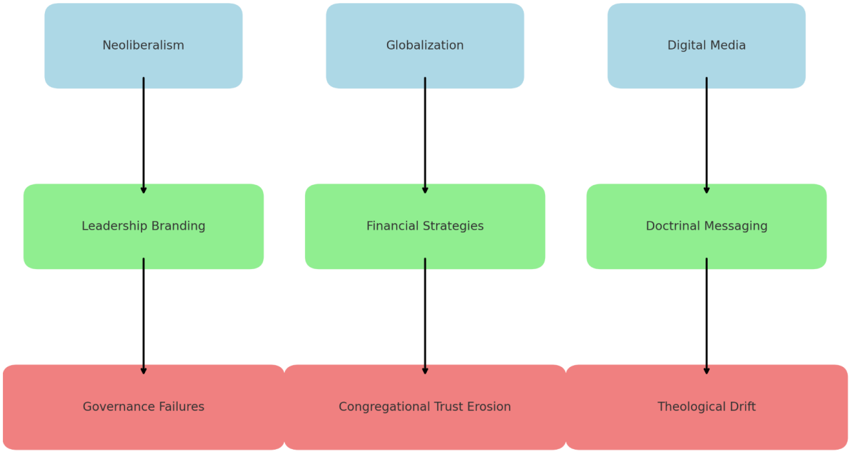
This study examines the growing commercialization of Christian ministry from interdisciplinary perspectives in business studies and theology. Drawing on Q1/Q2 literature, investigative reports, NGO data, and media coverage, we analyze how Pentecostal, Charismatic, and Evangelical churches worldwide — especially in Africa — increasingly adopt market-driven practices. We document branding and marketing strategies (e.g. televising worship, “faith branding,” celebrity pastors), financial behaviors (tithes, miracle offerings, product sales), doctrinal shifts (prosperity theology, transactional faith), and governance failures (lack of accountability, celebrity cults). Using Institutional Theory, Agency Theory, and Virtue Ethics as lenses, we propose a conceptual model linking macro drivers (neoliberalism, globalization, digital media) to micro-level ministry practices. Methodologically, we perform qualitative content analysis and case comparisons, using secondary data and NLP tools for thematic synthesis. Key findings show that commercialization has introduced entrepreneurial dynamism into ministry but also inflated financialization and ethical risks, often at odds with traditional ecclesiology. Theologically, these trends challenge notions of stewardship, humility, and sacrificial service. We offer actionable recommendations for seminaries, congregations, and policymakers to safeguard ministry integrity (e.g. stronger governance frameworks, theological education reforms). Finally, we propose future research directions and foresight scenarios, anticipating how AI, globalization, and digital religiosity will shape ministry in the next 10–15 years.
Overview
The claims and statistics of this paper haven’t been checked yet.
Run the check — free, no account needed. It reads the open-access text and checks the sources it cites.
Integrity signals
Registry
Cites
Statistics
Figures
Verification
Claims the paper makes
The claims and statistics of this paper haven’t been checked yet.
Run the check — free, no account needed. It reads the open-access text and checks the sources it cites.
Claims other papers make about this one
Each is checked against this paper’s own text: does it say what the citing paper says it does?
In the citing paper
“As opined by Sangwa & Placide, (2025), this shift has led to structural splits, moral failures, and internal disputes among church members, as leaders have abandoned their spiritual duties to gain prestige and material benefits.”
From SERVANT LEADERSHIP IN PASTORAL EPISTLES: A STUDY OF 1 TIMOTHY IN THE 21ST CENTURY CHURCH (2026) · cites this paper as Sangwa & Placide, (2025)
Self-check
Percentages, sums and reported differences re-computed from the paper’s own numbers.
The self-check needs the paper’s full text.
Citations
Cites
No references could be resolved yet.
Research works printed but not linked: 5
- Einstein, M. (2008). Brands of faith: Marketing religion in a commercial age. Routledge. https://www.culturaldiplomacy.org/academy/pdf/research/books/nation_brandi ng/Brands_Of_Faith_-_Mara_Einstein.pdf
- • Manyike, C., & Zondi, T. (2018). Church breakaways as a prototype of commercialisation and commodification of religion in the Pentecostal Church Movement in South Africa. HTS Teologiese Studies, 74(2). https://doi.org/10.17570/stj.2018.v4n2.a29 • Mashau, T. D., & Kgatle, M. S. (2019). Prosperity gospel and the culture of greed in post-colonial Africa: Constructing an alternative African Christian Theology of Ubuntu. Verbum et Ecclesia, 40(1), 1-9. https://doi.org/10.4102/ve.v40i1.1901 · DOI
- • Mudimeli, L., Muthivhi, M., & James, G. (2023). Fakery and wealth in African Charismatic Christianity: moving beyond the prosperity gospel as script. In K. Lauterbach & M. Vähäkangas (Eds.), Faith in African Lived Christianity (pp. 111-132). Brill.researchgate.net • Pew Research Center. (2011). Global Christianity: A report on the size and distribution of the world's Christian population. https://www.pewresearch.org/religion/2011/12/19/global-christianity-exec/ • Kgatle, M. S. (2022). Prophets competing against each other in a commercial age: Have some prophets or neoprophetic churches gone too far? HTS Teologiese Studies, 78(1), Article 6340. https://doi.org/10.4102/hts.v78i1.6340 · DOI
- Sakib, N.H. (2020). Institutional Isomorphism. In: Farazmand, A. (eds) Global Encyclopedia of Public Administration, Public Policy, and Governance. Springer, Cham. https://doi.org/10.1007/978-3-319-31816-5_3932-1 · DOI
- Smith, D. J. (2021). The Pentecostal prosperity gospel in Nigeria: Paradoxes of corruption and inequality. Journal of Modern African Studies, 59(1), 103-122. https://doi.org/10.1017/S0022278X20000622 • Vähäkangas, M., & Lauterbach, K. (Eds.). (2023). Fakery and wealth in African Charismatic Christianity: Moving beyond the prosperity gospel as script. In Faith in African lived Christianity (pp. 111-132). Brill. · DOI
Cited by
SERVANT LEADERSHIP IN PASTORAL EPISTLES: A STUDY OF 1 TIMOTHY IN THE 21ST CENTURY CHURCH
JATAU, P. D. (2026) · International Journal of Humanities, Educational and Literary Research and Innovations · doi:10.66837/ijhelri01/41/06
Metadata
- Authors
- SANGWA, S., & Mutabazi, P.
- Venue
- Open Journal of Business Theology (ISSN : 2788-709X)
- Publisher
- Center for Faith and Work
- Published
- 2025-05-16
- Volume
- 5
- Issue
- 2
- ISSN
- 2788-709X
- Cited by
- 1
- References
- 0
About these checks
Registry, retraction, Cites and statistics results are computed, not judged, with one exception: a printed reference that no index lists is read once by a model before it counts as a citation error. Claims are extracted by a model and kept only when their quote appears verbatim in the text; each cited source is then checked, with a model’s help, for whether it says what the claim relies on. Those verdicts can be wrong — read the claim’s quote and the cited source before relying on one.
Statistics and arithmetic are recomputed, not judged.
Confidence bands are shown only for fields calibrated on our annotated test set. None is calibrated yet, so no band is shown.
What counts as a claim ›How we measure confidence ›How we check this ›
Are you an author, or do you see a problem with this page? Request a review
How to cite
Cite CoChat for the checks on this page, and the paper for its own findings.
- This page
- CoChat. (2026). Citation check: The Business of Blessing: Commercialization of Christian Ministry in Pentecostal, Charismatic, and Evangelical Movements. https://app.cochat.ai/papers/10.65655/016ts873
- The paper
- SANGWA, S., & Mutabazi, P. (2025). The Business of Blessing: Commercialization of Christian Ministry in Pentecostal, Charismatic, and Evangelical Movements. Open Journal of Business Theology (ISSN : 2788-709X). https://doi.org/10.65655/016ts873
Data sources
Bibliographic data: Semantic Scholar, OpenAlex, Crossref.
Contains information from the Semantic Scholar Academic Graph Datasets, made available under the ODC Attribution License (ODC-BY 1.0).
Semantic Scholar’s data is described in: Kinney, R., et al. (2023). The Semantic Scholar Open Data Platform. arXiv:2301.10140.
