

Transformative Learning, Emotional Intelligence, and Resilience: Testing an IntegrativeDevelopmental Model among University Students
Open accessThe DOI matches its Crossref record; 10 of the 10 references it cites were found in a registry or an index; none of the 15 sources its claims cite is checked for support yet.
Abstract
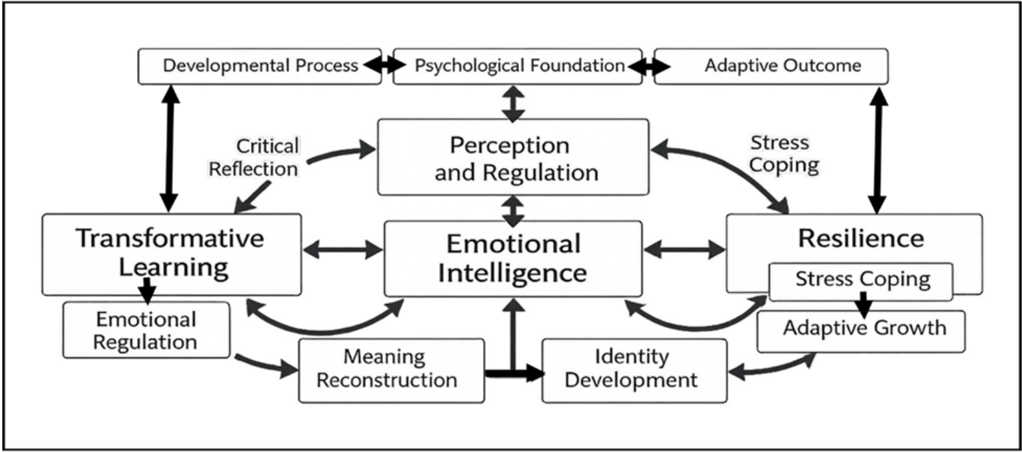
This study tested an integrative developmental model linking transformative learning, emotional intelligence, and psychological resilience among university students. Grounded in Transformative Learning Theory, the Ability Model of Emotional Intelligence, and contemporary Resilience Theory, the research conceptualized transformative learning as a formative educational process that strengthens emotional competence and adaptive functioning. A cross-sectional survey was conducted with 742 undergraduate students from private universities in East Africa. Confirmatory Factor Analysis supported the validity and reliability of the three latent constructs. Structural Equation Modeling demonstrated satisfactory model fit (CFI = .93, TLI = .92, RMSEA = .051, SRMR = .044). Transformative learning significantly predicted emotional intelligence (β = .58, p < .001) and resilience (β = .42, p < .001), while emotional intelligence also directly predicted resilience (β = .34, p < .001). Bootstrapping analyses indicated partial mediation, with transformative learning exerting both direct and indirect effects on resilience. The model explained 34% of the variance in emotional intelligence and 49% in resilience. Multi-group invariance analyses confirmed structural equivalence across gender. Findings underscore the role of transformative pedagogy in cultivating emotional maturity and adaptive resilience, reinforcing higher education’s responsibility in fostering holistic student development.
Overview
CoChat Summary
TL;DR
In a cross-sectional SEM study of 742 undergraduates at a private East African university, transformative learning was positively associated with emotional intelligence and resilience, with emotional intelligence partially mediating the transformative learning–resilience link. The model fit acceptably and was invariant across gender, but causal and developmental claims are limited by same-time self-report data.
Key findings
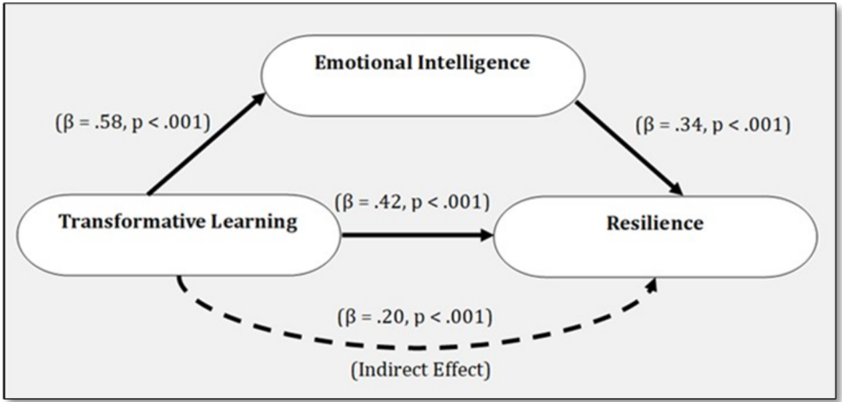
- The structural model showed satisfactory fit (CFI = .93, TLI = .92, RMSEA = .051, SRMR = .044). Transformative learning was positively associated with emotional intelligence (β = .58, p < .001) and resilience (β = .42, p < .001); emotional intelligence was positively associated with resilience (β = .34, p < .001). The indirect path from transformative learning to resilience through emotional intelligence was significant (β = .20, 95% CI [.14, .27]), consistent with partial mediation. The model explained 34% of variance in emotional intelligence and 49% in resilience.
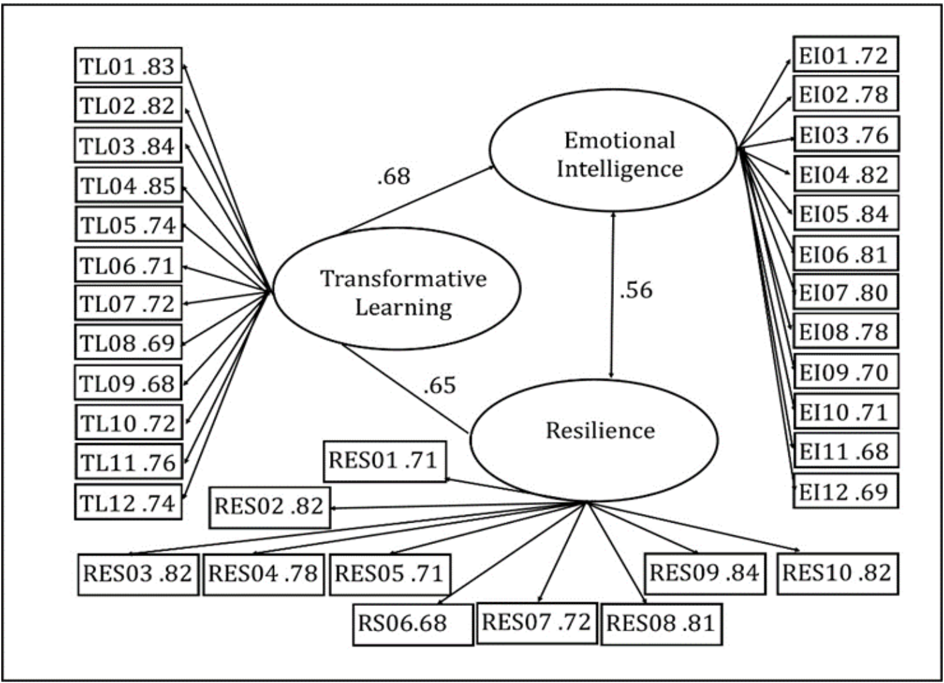
- CFA supported the three-factor measurement model (CFI = .94, TLI = .93, RMSEA = .048, SRMR = .041), with standardized loadings from .68 to .85, composite reliability .88–.92, and AVE .54–.63.
- Bivariate correlations were positive and significant: transformative learning–emotional intelligence r = .58, transformative learning–resilience r = .65, emotional intelligence–resilience r = .56 (all p < .001). Cronbach’s alphas ranged from .86 to .88.
- Multi-group invariance analyses supported equivalent measurement and structural relations across gender at configural, metric, scalar, and structural levels (ΔCFI ≤ .01; ΔRMSEA ≤ .015).
Methods
- Cross-sectional, theory-driven quantitative online survey of 742 undergraduate students at a private university in East Africa; participants were aged 18–27 (M = 21.4, SD = 2.8), 52% female and 48% male, from business (35.0%), social sciences (28.3%), technology-related programs (25.6%), and other fields (11.1%). Eligibility required full-time undergraduate enrollment and age 18 or older.
- Measures included a study-specific 12-item Transformative Learning Scale for the Innovation Mindset short form (TLSIM-12; α = .88), the 10-item Connor-Davidson Resilience Scale (CD-RISC-10; α = .86), and a 12-item self-report Emotional Intelligence Scale (EI-12; α = .87) aligned with the four-branch ability model but interpreted as perceived emotional competence.
- Analysis used SPSS for descriptives and correlations, AMOS for CFA and SEM, bootstrapping with 5,000 resamples and 95% bias-corrected confidence intervals for indirect effects, and multi-group invariance testing across gender.
Limitations
- The paper states that the cross-sectional, same-time self-report design prevents causal inference or empirical confirmation of temporal ordering; the single private-university East African setting and lack of a verifiable invitation denominator limit generalization and precise response-rate reporting; the emotional intelligence measure is a self-report proxy rather than a performance-based ability test; and same-source measurement may have inflated some associations.
- Evident from the text: the TLSIM-12 is described as an analytically reduced, study-specific short form rather than a previously established standalone instrument; the EI-12 was constructed for this study; and the ethics approval body/reference placeholder remains unfilled in the manuscript.
Model-written summary. Check it against the paper before relying on it.
Integrity signals
Registry
Cites
Statistics
Figures
Verification
Claims the paper makes
0 Valid · 0 Not valid · 9 Not checked · 56 Own results and interpretations
A result the paper reports from its own data — it cites no other source for it, so there is none to check. The quote shows it is in the paper.
In the paper
“while emotional intelligence was also positively associated with resilience (β = .34,p < .001).”
§ Transformative Learning, Emotional Intelligence, and Resilience: Testing an Integrative Structural Model among University Students > Abstract
plainstates an association- Asserted: passes — The authors put it forward as true.
- Checkable: passes — It can be checked against evidence.
- Load-bearing: passes — The paper’s conclusions depend on it.
- Based: passes — The paper gives a reason why it holds.
A result the paper reports from its own data — it cites no other source for it, so there is none to check. The quote shows it is in the paper.
In the paper
“Confirmatory Factor Analysis supported the adequacy of the three latent constructs.”
§ Transformative Learning, Emotional Intelligence, and Resilience: Testing an Integrative Structural Model among University Students > Abstract
plain- Asserted: passes — The authors put it forward as true.
- Checkable: passes — It can be checked against evidence.
- Load-bearing: passes — The paper’s conclusions depend on it.
- Based: passes — The paper gives a reason why it holds.
A result the paper reports from its own data — it cites no other source for it, so there is none to check. The quote shows it is in the paper.
In the paper
“Transformative learning was positively associated with emotional intelligence (β = .58,p < .001)”
§ Transformative Learning, Emotional Intelligence, and Resilience: Testing an Integrative Structural Model among University Students > Abstract
plainstates an association- Asserted: passes — The authors put it forward as true.
- Checkable: passes — It can be checked against evidence.
- Load-bearing: passes — The paper’s conclusions depend on it.
- Based: passes — The paper gives a reason why it holds.
A result the paper reports from its own data — it cites no other source for it, so there is none to check. The quote shows it is in the paper.
In the paper
“Transformative learning was positively associated with emotional intelligence (β = .58,p < .001)and resilience (β = .42,p < .001)”
§ Transformative Learning, Emotional Intelligence, and Resilience: Testing an Integrative Structural Model among University Students > Abstract
plainstates an association- Asserted: passes — The authors put it forward as true.
- Checkable: passes — It can be checked against evidence.
- Load-bearing: passes — The paper’s conclusions depend on it.
- Based: passes — The paper gives a reason why it holds.
A result the paper reports from its own data — it cites no other source for it, so there is none to check. The quote shows it is in the paper.
In the paper
“Structural Equation Modeling demonstrated satisfactory model fit (CFI = .93,TLI = .92,RMSEA = .051,SRMR = .044).”
§ Transformative Learning, Emotional Intelligence, and Resilience: Testing an Integrative Structural Model among University Students > Abstract
boosted- Asserted: passes — The authors put it forward as true.
- Checkable: passes — It can be checked against evidence.
- Load-bearing: passes — The paper’s conclusions depend on it.
- Based: passes — The paper gives a reason why it holds.
33 more claims
Create a free account to see all 65 claims and to verify the 11 references still open.
- Probably not a substantial claim. 10
- It may state two separate claims as one. 19
- The quote only partly states this claim. 1
Self-check
Percentages, sums and reported differences re-computed from the paper’s own numbers.
Each contradiction between two passages listed here was confirmed by an independent check.
Rated major: it would touch a result — a value a result rests on, reported and recomputed p-values on opposite sides of the significance level, two passages that conflict with no sign which is right, or a cited work retracted before this paper was published.
In the paper
§ Transformative Learning, Emotional Intelligence, and Resilience: Testing an Integrative Structural Model among University Students > 4.4 Structural Model
“The structural model accounted for 34% of the variance in emotional intelligence and 49% of the variance in resilience.”
§ Transformative Learning, Emotional Intelligence, and Resilience: Testing an Integrative Structural Model among University Students > 4.4 Structural Model
“Within this model, transformative learning was positively associated with emotional intelligence (β = .58,p < .001)and resilience (β = .42,p < .001),and emotional intelligence was positively associated with resilience (β = .34,p < .001).”
Citations
Cites
Development of a new resilience scale: The Connor-Davidson Resilience Scale (CD-RISC)
Connor, K. M., & Davidson, J. R. T. (2003) · Depression and Anxiety · doi:10.1002/da.10113 · Cited by 11,793
Campbell‐Sills, L., & Stein, M. B. (2007) · Journal of Traumatic Stress · doi:10.1002/jts.20271 · Cited by 3,575
Bond, M., Buntins, K., Bedenlier, S., Zawacki-Richter, O., & Kerres, M. (2020) · International Journal of Educational Technology in Higher Education · doi:10.1186/s41239-019-0176-8 · Cited by 1,097
Components of Education 4.0 in 21st Century Skills Frameworks: Systematic Review
González-Pérez, L. I., & Ramírez-Montoya, M. S. (2022) · Sustainability · doi:10.3390/su14031493 · Cited by 752
Reflective Learning in Higher Education: Active Methodologies for Transformative Practices
Colomer, J., Serra, T., Cañabate, D., & Bubnys, R. (2020) · Sustainability · doi:10.3390/su12093827 · Cited by 186
Essential Validation Criteria for Rigorous Covariance‐Based Structural Equation Modelling
Gaskin, J. E., Lowry, P. B., Rosengren, W., & Fife, P. C. (2025) · Information Systems Journal · doi:10.1111/isj.12598 · Cited by 136
Resilience in educational system: A systematic review and directions for future research
Borazon, E. Q., & Chuang, H.-H. (2023) · International Journal of Educational Development · doi:10.1016/j.ijedudev.2023.102761 · Cited by 58
Transformative learning: An emotional (r)evolution
Carter, P. L., & Nicolaides, A. (2023) · New Directions for Adult and Continuing Education · doi:10.1002/ace.20476 · Cited by 36
Azpiazu, L., Fernández‐Zabala, A., Fernández, A. R., & Ramos-Díaz, E. (2022) · Current Psychology · doi:10.1007/s12144-022-04128-1 · Cited by 28
Understanding transformative learning through metatheory
Hoggan, C., & Higgins, K. (2023) · New Directions for Adult and Continuing Education · doi:10.1002/ace.20475 · Cited by 13
Metadata
- Authors
- Nkurunziza, D. A., Sangwa, D. S., & Dushimimana, D. F.
- Venue
- Open Journal of Transformative Education & Lifelong Learning (ISSN: 3105-305X)
- Publisher
- Center for Faith and Work
- Published
- 2026-04-15
- Volume
- 2
- Issue
- 1
- ISSN
- 3105-305X (ISSN-L)
- OpenAlex
- W7154457909
- Cited by
- 0
- References
- 9
- FWCI
- 0.00
- Type
- journal article
- Language
- en
- Open access
- hybrid
- doi.org
- Locations
- Open Journal of Transformative Education & Lifelong Learning (publishedVersion, cc-by)
- Topics
- Social Sciences › Education › Adult and Continuing Education Topics
- Social Sciences › Psychology › Social Psychology › Emotional Intelligence and Performance
- Social Sciences › Education › Social Skills and Education
- Keywords
- transformative learning, emotional intelligence, psychological resilience, university students, ability model of emotional intelligence, resilience theory, transformative pedagogy, emotional competence, gender invariance, holistic student development
About these checks
Registry, retraction, Cites and statistics results are computed, not judged, with one exception: a printed reference that no index lists is read once by a model before it counts as a citation error. Claims are extracted by a model and kept only when their quote appears verbatim in the text; each cited source is then checked, with a model’s help, for whether it says what the claim relies on. Those verdicts can be wrong — read the claim’s quote and the cited source before relying on one.
A language model drew the claims from the paper on 2026-11-27, under version 3 of the claim definition (model deepseek-v4.1-flash, prompt extract-v3).
A second model labelled each claim on 2026-11-27 (model jev-1.13-20260917, definition revision gold-guideline-v0.2).
Statistics and arithmetic are recomputed, not judged.
Confidence bands are shown only for fields calibrated on our annotated test set. None is calibrated yet, so no band is shown.
What counts as a claim ›How we measure confidence ›How we check this ›
Are you an author, or do you see a problem with this page? Request a review
How to cite
Cite CoChat for the checks on this page, and the paper for its own findings.
- This page
- CoChat. (2026). Citation check: Transformative Learning, Emotional Intelligence, and Resilience: Testing an IntegrativeDevelopmental Model among University Students. https://app.cochat.ai/papers/10.65655/openchristianpress.2026.99
- The paper
- Nkurunziza, D. A., Sangwa, D. S., & Dushimimana, D. F. (2026). Transformative Learning, Emotional Intelligence, and Resilience: Testing an IntegrativeDevelopmental Model among University Students. Open Journal of Transformative Education & Lifelong Learning (ISSN: 3105-305X). https://doi.org/10.65655/openchristianpress.2026.99
Data sources
Bibliographic data: Semantic Scholar, OpenAlex, Crossref.
Contains information from the Semantic Scholar Academic Graph Datasets, made available under the ODC Attribution License (ODC-BY 1.0).
Semantic Scholar’s data is described in: Kinney, R., et al. (2023). The Semantic Scholar Open Data Platform. arXiv:2301.10140.
