

Mineralization Rate in Vertebrate Fossilization Is Condition-Limited, Not Time-Limited
Open accessThe DOI matches its Crossref record; 16 of the 16 references it cites were found in a registry or an index; none of the 28 sources its claims cite is checked for support yet.
Abstract
Creationist treatments of fossilization frequently cite laboratory experiments that produce mineralization in days to years and present them, implicitly, as evidence that complete fossilization of vertebrate remains occurred over short timescales. Mainstream reviewers correctly object that demonstrating the initiation of mineralization is not the same as demonstrating the completion of fossilization, and that early-stage experiments cannot be linearly extrapolated to a finished fossil. This paper accepts that objection and advances a narrower, falsifiable thesis: that the rate-limiting variable in early diagenetic mineralization is geochemical condition, phosphate and silica availability, pH, fluid chemistry, diffusion through the enclosing sediment, and microbial mediation, rather than the mere passage of time. Here I compile peer-reviewed experimental and field studies on bone alteration, soft-tissue phosphatization, wood silicification, and concretion growth, and for each I document what was actually measured and what may legitimately be inferred. Where a study provides sufficient time-series data (wood silicification), I fit a decelerating kinetic continuation rather than a linear one, and find an extrapolated practical-completion time consistent with the original authors’ published estimate of tens to hundreds of years, well within the prior prediction I made of a 2,000 year maximum tested here. I conclude that the experimental record removes ‘requires deep time’ as a necessary inference for extensive mineralization.
Overview
CoChat Summary
TL;DR
This review compiles peer-reviewed experimental and field studies on bone alteration, soft-tissue phosphatization, wood silicification, and concretion growth to argue that the rate-limiting variable in early diagenetic mineralization is geochemical condition (reactant supply, pH, diffusion, microbial mediation) rather than elapsed time. It concludes that the experimental record removes "requires deep time" as a necessary inference for extensive mineralization, while conceding that only wood silicification currently has enough time-series data to extrapolate to completion.
Key findings
- Bone alteration experiments show rapid, condition-driven change: elemental uptake into cortical bone within hours of exposure, and bioapatite recrystallization in alligator bone within days to weeks, attributed to fluid chemistry, phosphate supply, and a narrow pH "recrystallization window" rather than elapsed time [1][2][3].
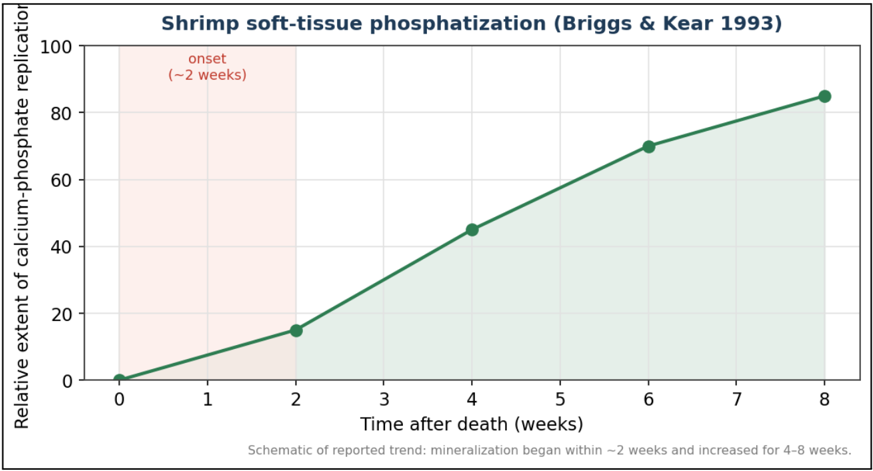
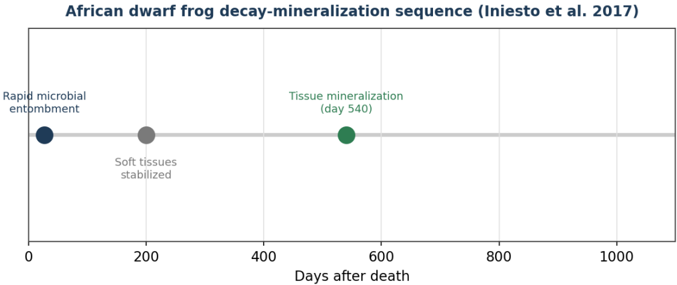
- Soft-tissue phosphatization begins within about two weeks and increases in extent over the following four to eight weeks in Briggs & Kear's shrimp experiments, replicating muscle texture; Iniesto et al. recorded tissue-selective mineralization by day 540 of a three-year experiment.
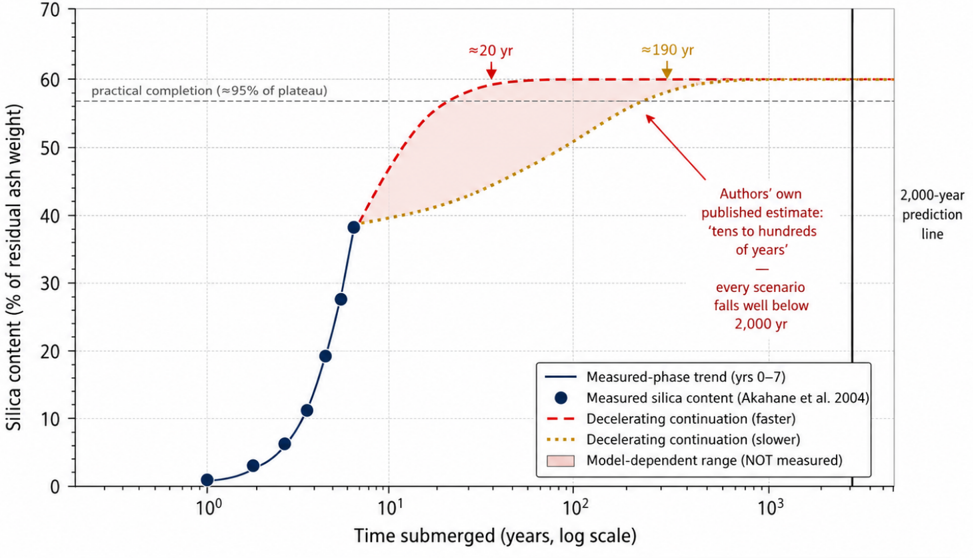
- Wood silicification provides the one quantitative completion estimate: silica content rose from about 0.7% at one year to 38.1% at seven years in hot-spring water, with the original authors concluding silicified wood can form in "tens to hundreds of years." The paper's decelerating kinetic continuations imply practical completion of roughly two decades to a few centuries, an order of magnitude or more below the 2,000-year prior prediction tested.
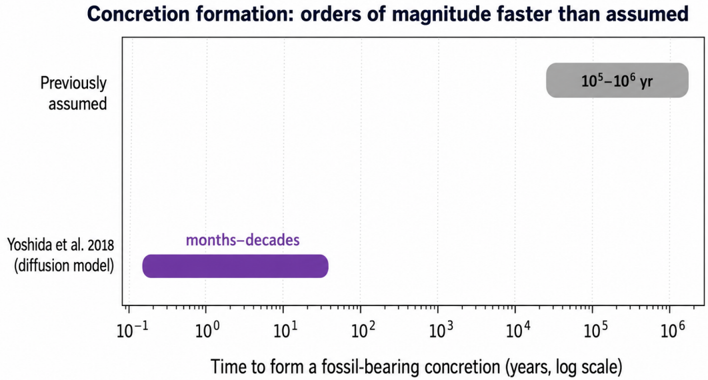
- Concretion growth modeled by Yoshida et al. from specimens in Japan, England, and New Zealand occurs over months to decades, rather than the 10⁵–10⁶ years previously assumed, with rate set by bicarbonate diffusion through fine, clay-rich sediment.
Methods
- Narrative compilation and re-analysis of published peer-reviewed studies across four systems (bone alteration, soft-tissue calcium phosphate, wood permineralization, carbonate concretions), separating for each study the quantity measured, the variable authors identify as rate-controlling, and what may legitimately be extrapolated.
- A stated falsifiable prior prediction (full mineralization sequence completable in under roughly 2,000 years) is declared before the survey.
- For the single system with sufficient time-series data (wood silicification), a decelerating kinetic continuation approaching a plateau is fitted rather than a linear extrapolation; the paper states this completion band is model-dependent and not a measurement.
Limitations
- Stated: onset is not completion — most experiments mineralize only part of a carcass within their duration, and extensive mineralization requires low decay rates to persist, a balance difficult to sustain in the laboratory.
- Stated: the completion estimate rests on an assumed decelerating kinetic form and assumed plateau; it is bounded and conservative but not a measurement.
- Stated: bone lacks a complete-mineralization clock — the bone experiments establish fast, condition-limited early stages but do not trace a measured curve to a finished fossil, so extending the wood result to bone is a hypothesis, not a result. The paper also excludes laboratory wood-to-SiC syntheses (~1,400 °C) as a cautionary non-example.
- Evident from the text: this is a review/argument paper presenting no new experimental data of its own; the closing racemization and radiocarbon discussion (Giem 2001; Baumgardner et al. 2003; Saitta et al. 2019, etc.) is appended and not integrated into the quantitative analysis; and the catastrophic-burial framework is offered as one interpretation of conditions the experiments are described as neutral toward.
Model-written summary. Check it against the paper before relying on it.
Integrity signals
Registry
Cites
Statistics
Figures
Verification
Claims the paper makes
0 Valid · 0 Not valid · 19 Not checked · 21 Own results and interpretations
A result the paper states — it cites no source for it, so there is none to check. The quote shows it is in the paper.
In the paper
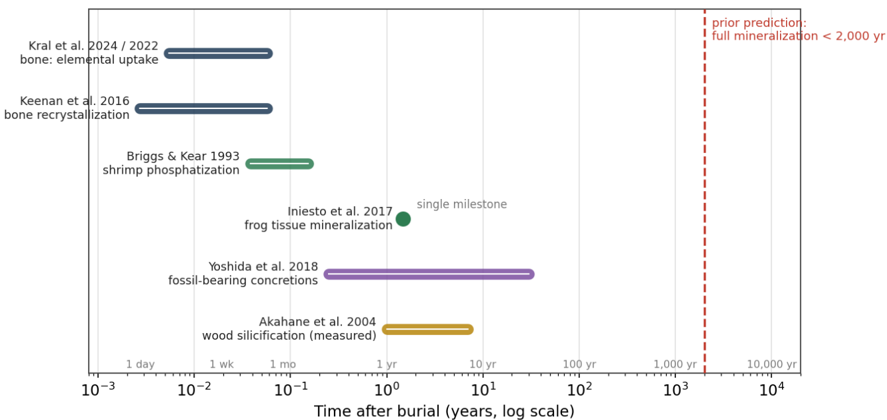
“every observed window of significant mineralization; bone, soft tissue, wood, and whole-carcass encasement all lie far to the left of the 2,000-year line.”
- Also stated in: § 8. Conclusion · plain
“all measured windows fall well below it.”
§ Mineralization Rate in Vertebrate Fossilization Is Condition-Limited, Not Time-Limited > 8. Conclusion
plain- Asserted: passes — The authors put it forward as true.
- Checkable: passes — It can be checked against evidence.
- Load-bearing: passes — The paper’s conclusions depend on it.
- Based: passes — The paper gives a reason why it holds.
- Also stated in: § 8. Conclusion · plain
A conclusion the paper draws from its own results — it cites no other source for it, so there is none to check. The quote shows it is in the paper.
In the paper
“This paper accepts that objection and advances a narrower, falsifiable thesis: that the rate-limiting variable in early diagenetic mineralization is geochemical condition, phosphate and silica availability, pH, fluid chemistry, diffusion through the enclosing sediment, and microbial mediation, rather than the mere passage of time.”
- Also stated in: § 1. Introduction · plain
“the bottleneck in early diagenetic mineralization is the chemistry of the burial environment, not elapsed time.”
- Also stated in: § 5. The rate-limiting step is geochemical condition, not elapsed time · plain
“Mineralization accelerates or stalls according to the availability of reactants and the local physicochemistry, not according to how much time has passed.”
§ Mineralization Rate in Vertebrate Fossilization Is Condition-Limited, Not Time-Limited > Abstract
plainstates a cause- Asserted: passes — The authors put it forward as true.
- Checkable: passes — It can be checked against evidence.
- Load-bearing: passes — The paper’s conclusions depend on it.
- Based: passes — The paper gives a reason why it holds.
- Also stated in: § 1. Introduction · plain
A conclusion the paper draws from its own results — it cites no other source for it, so there is none to check. The quote shows it is in the paper.
In the paper
“The catastrophic-burial scenarios invoked in flood geology; rapid sediment loading, anoxia, fine-grained sealing muds, and abundant phosphate and silica liberated by mass mortality and volcanic or sedimentary input-are, notably, the very conditions the experiments identify as rate-maximizing.”
§ Mineralization Rate in Vertebrate Fossilization Is Condition-Limited, Not Time-Limited > 5. The rate-limiting step is geochemical condition, not elapsed time
plainstates a cause- Asserted: passes — The authors put it forward as true.
- Checkable: passes — It can be checked against evidence.
- Load-bearing: passes — The paper’s conclusions depend on it.
- Based: passes — The paper gives a reason why it holds.
None of the sources cited for this claim could be matched to a paper, so there is nothing to check it against.
In the paper
“In every case the authors attribute the speed to fluid chemistry, phosphate supply, and a narrow pH 'recrystallization window,' not to elapsed time.”
§ Mineralization Rate in Vertebrate Fossilization Is Condition-Limited, Not Time-Limited > 4. Experimental and field evidence 4.1 Bone: elemental uptake and recrystallization within days
What the sources say
- Not matchedcites [1]
The reference list we hold has no entry [1].
- Not matchedcites [2]
The reference list we hold has no entry [2].
- Not matchedcites [3]
The reference list we hold has no entry [3].
plainstates a cause- Asserted: passes — The authors put it forward as true.
- Checkable: passes — It can be checked against evidence.
- Load-bearing: passes — The paper’s conclusions depend on it.
- Based: passes — The paper gives a reason why it holds.
- Not matched
In the paper
“Yoshida and colleagues modeled spherical carbonate concretions, which frequently contain exceptionally preserved fossils at their cores and showed, from diffusion-growth analysis of specimens from Japan, England, and New Zealand, that they grow over months to decades rather than the 10 5 -10 6 years previously assumed [7].”
§ Mineralization Rate in Vertebrate Fossilization Is Condition-Limited, Not Time-Limited > 4.4 Whole-fossil encasement: concretions in months to decades
What the sources say
- Not matchedcites [7]
The reference list we hold has no entry [7].
plain- Asserted: passes — The authors put it forward as true.
- Checkable: passes — It can be checked against evidence.
- Load-bearing: passes — The paper’s conclusions depend on it.
- Based: passes — The paper gives a reason why it holds.
- Not matched
5 more claims
Create a free account to see all 40 claims and every source verdict.
- It may state two separate claims as one. 28
- Probably not a substantial claim. 7
Self-check
Percentages, sums and reported differences re-computed from the paper’s own numbers.
Each contradiction between two passages listed here was confirmed by an independent check.
Rated minor: it would not touch a result — a value no result rests on, a p-value that stays on the same side of the significance level, or a conflict that is clerical, resolved elsewhere in the paper, or outside its own findings.
In the paper
§ Mineralization Rate in Vertebrate Fossilization Is Condition-Limited, Not Time-Limited > 4.2 Soft-tissue calcium phosphate: onset in weeks, extent over weeks
“Iniesto and colleagues followed African dwarf frogs decaying within microbial mats and recorded selective mineralization of certain tissues by day 540 of a three-year experiment [5].”
§ Mineralization Rate in Vertebrate Fossilization Is Condition-Limited, Not Time-Limited > References
“5. also Briggs, Kear, Martill & Wilby (1993), Journal of the Geological Society, 150, 1035-1038.”
Rated minor: it would not touch a result — a value no result rests on, a p-value that stays on the same side of the significance level, or a conflict that is clerical, resolved elsewhere in the paper, or outside its own findings.
In the paper
§ Mineralization Rate in Vertebrate Fossilization Is Condition-Limited, Not Time-Limited > 6. Limitations and scope (what this paper does not claim)
“As Briggs has emphasized, extensive mineralization requires that low decay rates persist long enough for precipitation to proceed, a balance difficult to sustain in the laboratory [8].”
§ Mineralization Rate in Vertebrate Fossilization Is Condition-Limited, Not Time-Limited > References
“8. Yoshida, H., Yamamoto, K., Minami, M., Katsuta, N., Sin-ichi, S., & Metcalfe, R. (2018). Generalized conditions of spherical carbonate concretion formation around decaying organic matter in early diagenesis. Scientific Reports, 8, 6308.”
Rated minor: it would not touch a result — a value no result rests on, a p-value that stays on the same side of the significance level, or a conflict that is clerical, resolved elsewhere in the paper, or outside its own findings.
In the paper
§ Mineralization Rate in Vertebrate Fossilization Is Condition-Limited, Not Time-Limited > 4.3 Permineralization of wood: a quantitative completion estimate
“Figure 2 plots the measured uptake and two decelerating continuations beyond the seven-year dataset.”
§ Mineralization Rate in Vertebrate Fossilization Is Condition-Limited, Not Time-Limited > 8. Conclusion
“Figure 2. Decay-mineralization sequence for the African dwarf frog (Iniesto et al. 2017): rapid microbial entombment within ~1 month, soft-tissue stabilization, and tissue-selective mineralization by day 540.”
Rated minor: it would not touch a result — a value no result rests on, a p-value that stays on the same side of the significance level, or a conflict that is clerical, resolved elsewhere in the paper, or outside its own findings.
In the paper
§ Mineralization Rate in Vertebrate Fossilization Is Condition-Limited, Not Time-Limited > 8. Conclusion
“Figure 1.Schematic of the reported trend in Briggs & Kear (1993): calcium-phosphate replication of shrimp soft tissue began within ~2 weeks and increased over 4-8 weeks.Curve is illustrative of the described trend, not a digitized dataset.”
§ Mineralization Rate in Vertebrate Fossilization Is Condition-Limited, Not Time-Limited > 8. Conclusion
“Figure 1.Observed windows of significant mineralization across the compiled studies, on a logarithmic time axis.The dashed line marks the 2,000-year prior prediction; all measured windows fall well below it.”
Rated minor: it would not touch a result — a value no result rests on, a p-value that stays on the same side of the significance level, or a conflict that is clerical, resolved elsewhere in the paper, or outside its own findings.
In the paper
§ Mineralization Rate in Vertebrate Fossilization Is Condition-Limited, Not Time-Limited > 4.4 Whole-fossil encasement: concretions in months to decades
“Yoshida and colleagues modeled spherical carbonate concretions, which frequently contain exceptionally preserved fossils at their cores and showed, from diffusion-growth analysis of specimens from Japan, England, and New Zealand, that they grow over months to decades rather than the 10 5 -10 6 years previously assumed [7].”
§ Mineralization Rate in Vertebrate Fossilization Is Condition-Limited, Not Time-Limited > References
“7. Akahane, H., Furuno, T., Miyajima, H., Yoshikawa, T., & Yamamoto, S. (2004). Rapid wood silicification in hot spring water: an explanation of silicification of wood during the Earth's history. Sedimentary Geology, 169(3-4), 219-228.”
1 more finding
Create a free account to see every finding of this check.
Citations
Cites
Protein Sequences from Mastodon and Tyrannosaurus Rex Revealed by Mass Spectrometry
Asara, J. M., Schweitzer, M. H., Freimark, L. M., Phillips, M., & Cantley, L. C. (2007) · Science · doi:10.1126/science.1137614 · Cited by 268
Fossilization of Soft Tissue in the Laboratory
Briggs, D. E. G., & Kear, A. J. (1993) · Science · doi:10.1126/science.259.5100.1439 · Cited by 268
Biomolecular Characterization and Protein Sequences of the Campanian Hadrosaur B. canadensis
Schweitzer, M. H., Zheng, W., Organ, C. L., Avci, R., Suo, Z., Freimark, L. M., Lebleu, V. S., Duncan, M. B., Vander Heiden, M. G., Neveu, J. M., et al. (2009) · Science · doi:10.1126/science.1165069 · Cited by 238
Phosphatization of soft-tissue in experiments and fossils
BRIGGS, D. E. G., KEAR, A. J., MARTILL, D. M., & WILBY, P. R. (1993) · Journal of the Geological Society · doi:10.1144/gsjgs.150.6.1035 · Cited by 218
Soft-Tissue Vessels and Cellular Preservation in Tyrannosaurus rex
Schweitzer, M. H., Wittmeyer, J. L., Horner, J. R., & Toporski, J. K. (2005) · Science · doi:10.1126/science.1108397 · Cited by 160
The role of experiments in investigating the taphonomy of exceptional preservation
Briggs, D. E. G., & McMahon, S. (2016) · Palaeontology · doi:10.1111/pala.12219 · Cited by 120
Fibres and cellular structures preserved in 75-million–year-old dinosaur specimens
Bertazzo, S., Maidment, S. C. R., Kallepitis, C., Fearn, S., Stevens, M. M., & Xie, H.-N. (2015) · Nature Communications · doi:10.1038/ncomms8352 · Cited by 97
Early diagenesis and recrystallization of bone
Keenan, S. W., & Engel, A. S. (2017) · Geochimica et Cosmochimica Acta · doi:10.1016/j.gca.2016.09.033 · Cited by 95
Schroeter, E. R., DeHart, C. J., Cleland, T. P., Zheng, W., Thomas, P. M., Kelleher, N. L., Bern, M., & Schweitzer, M. H. (2017) · Journal of Proteome Research · doi:10.1021/acs.jproteome.6b00873 · Cited by 94
Yoshida, H., Yamamoto, K., Minami, M., Katsuta, N., Sin-ichi, S., & Metcalfe, R. (2018) · Scientific Reports · doi:10.1038/s41598-018-24205-5 · Cited by 72
Research works printed but not linked: 6
- also Briggs, Kear, Martill & Wilby (1993), Journal of the Geological Society, 150, 1035-1038.
- Baumgardner, J. R., Snelling, A. A., Humphreys, D. R., & Austin, S. A. (2003). Measurable ¹⁴C in fossilized organic materials: Confirming the young earth creation-flood model. In R. L. Ivey Jr. (Ed.), Proceedings of the Fifth International Conference on Creationism (pp. 127-142). Creation Science Fellowship.
- Baumgardner, J. R. (2005). ¹⁴C evidence for a recent global flood and a young earth. In L. Vardiman, A. A. Snelling, & E. F. Chaffin (Eds.), Radioisotopes and the age of the earth: Results of a young-earth creationist research initiative (Vol. 2, pp. 587-630). Institute for Creation Research & Creation Research Society.
- Snelling, A. A. (2008). Radiocarbon ages for fossil ammonites and wood in Cretaceous strata near Redding, California. Answers Research Journal, 1, 123-144.
- Thomas, B., & Nelson, V. (2015). Radiocarbon in dinosaur and other fossils. Creation Research Society Quarterly, 51(4), 299-311.
- Saitta, E. T., Liang, R., Lau, M. C. Y., Brown, C. M., Longrich, N. R., Kaye, T. G., Novak, B. J., Salzberg, S. L., Norell, M. A., Abbott, G. D., Dickinson, M. R., Vinther, J., Bull, I. D., Brooker, R. A., Martin, P., Donohoe, P., Knowles, T. D., Penkman, K. E. H., & Onstott, T. C. (2019). Cretaceous dinosaur bone contains recent organic material and provides an environment conducive to microbial communities. eLife, 8, e46205. https://doi.org/10.7554/eLife.46205 · DOI · Paper page
Cited by
Still being checked.
Metadata
- Authors
- Nailor, M.
- Corresponding author
- Matt Nailor
- ORCID
- Matt Nailor
- Venue
- Truth in Research
- Publisher
- Truth in Research
- Published
- 2026-07-07
- Volume
- 1
- Issue
- 3
- ISSN
- 3155-6302 (ISSN-L)
- OpenAlex
- W7171532381
- Cited by
- 0
- References
- 16
- FWCI
- 0.00
- Type
- journal article
- Language
- en
- Open access
- hybrid
- doi.org
- Locations
- Truth in Research (publishedVersion, cc-by)
- Topics
- Physical Sciences › Earth and Planetary Sciences › Paleontology › Paleontology and Stratigraphy of Fossils
- Physical Sciences › Earth and Planetary Sciences › Paleontology › Paleontology and Evolutionary Biology
- Physical Sciences › Earth and Planetary Sciences › Paleontology › Evolution and Paleontology Studies
- Keywords
- fossilization, mineralization rate, fossil vertebrates, early diagenesis, phosphate availability, bone changes, creationism
About these checks
Registry, retraction, Cites and statistics results are computed, not judged, with one exception: a printed reference that no index lists is read once by a model before it counts as a citation error. Claims are extracted by a model and kept only when their quote appears verbatim in the text; each cited source is then checked, with a model’s help, for whether it says what the claim relies on. Those verdicts can be wrong — read the claim’s quote and the cited source before relying on one.
A language model drew the claims from the paper on 2026-11-24, under version 3 of the claim definition (model deepseek-v4.1-flash, prompt extract-v3).
A second model labelled each claim on 2026-11-24 (model jev-1.13-20260917, definition revision gold-guideline-v0.2).
Statistics and arithmetic are recomputed, not judged.
Confidence bands are shown only for fields calibrated on our annotated test set. None is calibrated yet, so no band is shown.
What counts as a claim ›How we measure confidence ›How we check this ›
Are you an author, or do you see a problem with this page? Request a review
Data sources
Bibliographic data: Semantic Scholar, OpenAlex, Crossref.
Contains information from the Semantic Scholar Academic Graph Datasets, made available under the ODC Attribution License (ODC-BY 1.0).
Semantic Scholar’s data is described in: Kinney, R., et al. (2023). The Semantic Scholar Open Data Platform. arXiv:2301.10140.
