

No Ice Age but Melt Age after the Flood: Subglacial water flows during the recessive stage of the Flood
Open accessThe DOI matches its Crossref record; 13 of the 13 references it cites were found in a registry or an index; none of the 35 sources its claims cite is checked for support yet.
Abstract
Conventional geology interprets Pleistocene deposits, erosional landforms, transported erratics, buried tunnel valleys, and megafaunal remains within a framework of repeated glacial–interglacial cycles. Most modern young-earth creationist models instead place a single Ice Age after the Genesis Flood, commonly proposing approximately 500 years of ice-sheet growth followed by 200 years of melting. However, these post-Flood models face difficulties explaining how sufficient snowfall could accumulate over continental interiors while the continents remained warm and precipitation from heated oceans tended to fall as rain. This paper proposes an alternative model in which major ice sheets formed during the Flood itself and subsequently underwent a comparatively rapid post-Flood “Melt Age.” In this model, explosive release from the fountains of the great deep, volcanic activity, high atmospheric moisture, reduced solar heating beneath extensive cloud cover, and hail formation within towering storm systems produced rapid atmospheric cooling and floating polar ice caps during the inundatory stage of the Flood. Meanwhile, thick deposits of warm sediment and widespread igneous activity maintained elevated temperatures within the continental crust. During the recessive stage, differential vertical tectonics raised the continents toward the floating ice masses, grounding them and forcing pressurized Floodwater and sediment-laden subglacial flows across the emerging land surfaces. These catastrophic flows are proposed to account for deeply incised tunnel valleys, channelized erosion, transported megalithic erratics, and the removal of large volumes of Pleistocene sediment into offshore basins such as the Gulf of Mexico. Long-distance rock transport traditionally attributed to slow glacial creep is instead interpreted as the result of rapid subglacial debris flows. Pleistocene megafauna and Paleolithic human remains are interpreted as Flood-buried pre-Flood organisms rather than inhabitants of a prolonged post-Flood Ice Age. Following the grounding of the ice caps, residual continental heat drove rapid melting, filling subglacial channels and completing a short-lived Melt Age. This model places Pleistocene glaciation, erosion, sedimentation, and mass extinction within the final stages of a single catastrophic Flood year.
Overview
CoChat Summary
TL;DR
Heerema proposes that the major Pleistocene ice sheets formed during the Genesis Flood itself rather than in a post-Flood Ice Age, with floating polar ice caps grounded by differential vertical tectonics during the recessive stage. The subsequent rapid melting of residual continental heat — a "Melt Age" — and catastrophic subglacial debris flows are offered as explanations for tunnel valleys, channelized erosion, and transported erratics.
Key findings
- The paper argues that a post-Flood Ice Age model requiring ~500 years of ice growth and ~200 years of melt (citing Oard) struggles because precipitation from warm oceans falls as rain rather than snow over continental interiors.
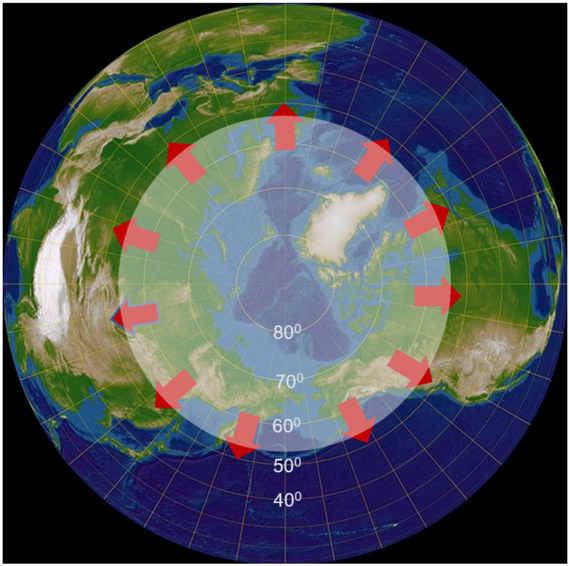
- It proposes ice caps formed during the Flood via hail formation in towering storm clouds (with a lapse rate of 6.5 °C/km and hail returning at temperatures as low as −50 °C) plus reduced solar heating under cloud cover during the first 150 days.
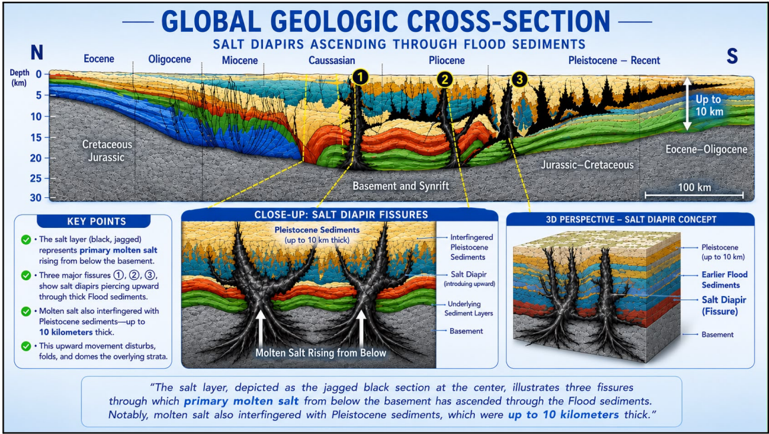
- Continental crust is said to have remained hot beneath warm sediment deposits up to 20 km thick, with Pleistocene sediments up to 10 km thick, and molten salt interfingering with them.
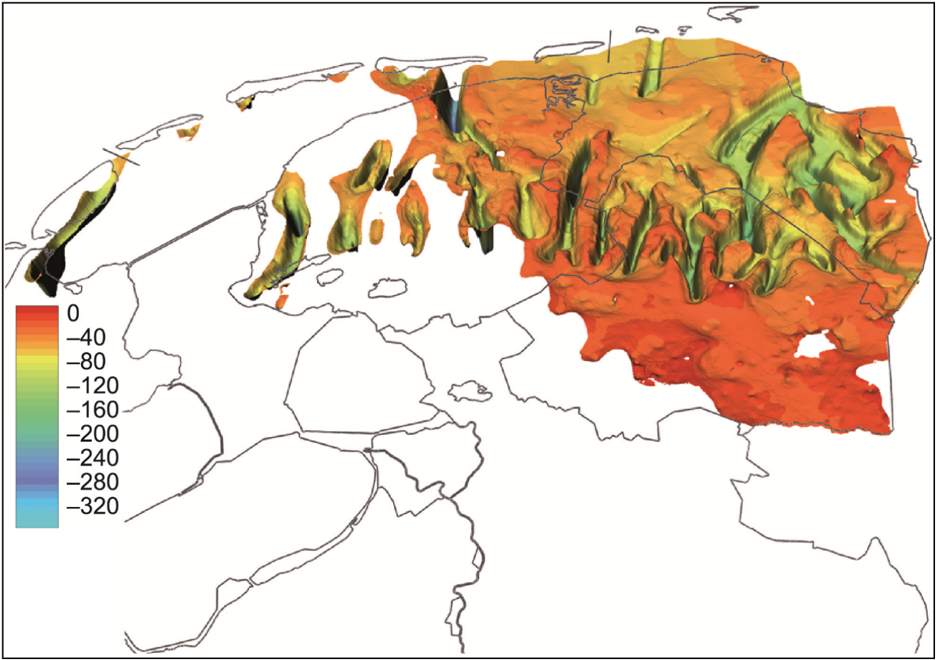
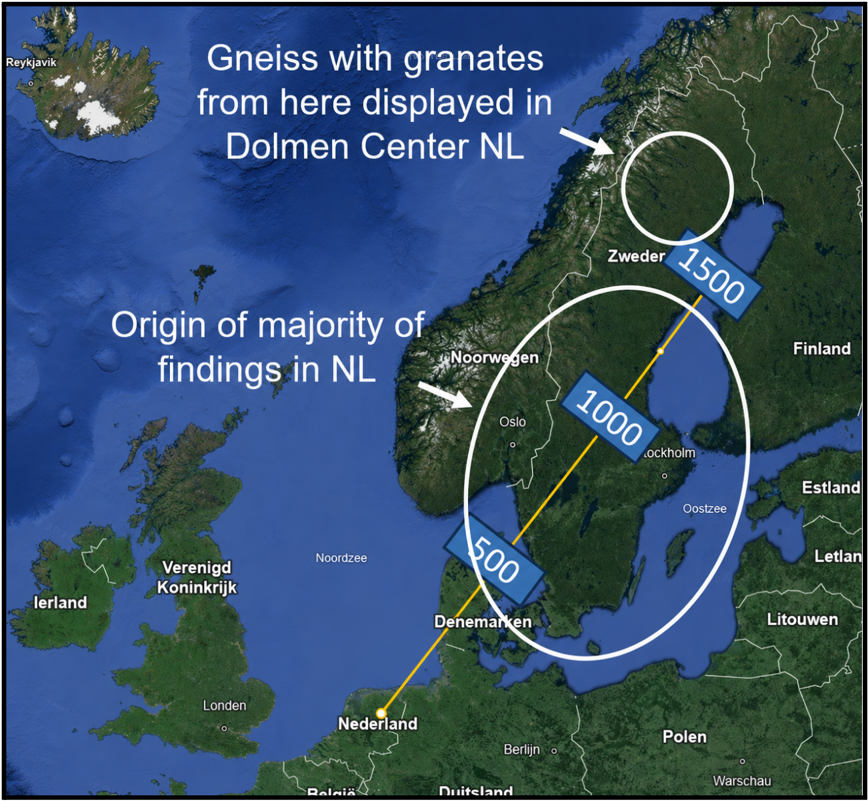
- Subglacial flows are credited with incising individual valleys up to 100 km long, 4 km wide, and 400 m deep, with buried valleys identified up to 700 m below the North Sea bed; the largest rock in The Netherlands (150,000 kg, from Uppsala, Sweden) is cited as evidence of transport over more than 1,500 km by debris flow rather than ice creep.
- Pleistocene megafauna and Paleolithic human remains are reinterpreted as Flood-buried pre-Flood organisms; the end-Pleistocene extinction (megafauna over 44 kg) is placed just before Noah left the Ark, with Genesis 8:13–15 giving 57 days for re-colonization.
Methods
- Conceptual/interpretive model paper: no new data collection or formal analysis is described. The argument is built by synthesizing previously published creationist and mainstream geological literature with the author's own prior work on salt magma.
- Evidence cited includes a north–south transect of the Gulf of Mexico (Figure 1), buried valleys in the northern Netherlands from TNO–Geological Survey of the Netherlands (Figure 3), and Pleistocene erratic provenance (Figure 4).
- Reasoning is largely qualitative and hydraulic/mechanical in character — e.g., erosion related to bed shear force proportional to the fourth power of velocity — rather than quantitative simulation.
Limitations
- Stated: the paper acknowledges that "glaciologists often cite a lack of sufficient water sources" for subglacial flows, and that the bedrock under loose deposits may also be incised, which it treats as unresolved context rather than a refuted objection.
- Evident from the text: no numerical model, sensitivity test, or quantitative reconstruction is presented for the proposed cooling, ice-cap formation, grounding, or melt chronology; the timeline is asserted rather than simulated.
- Evident from the text: key claims (e.g., elephants floating and freezing into Pleistocene permafrost, megafauna as pre-Flood fauna) rest on inference and cited secondary sources rather than presented primary evidence, and the paper is published in a venue whose peer-review status is not described in the text.
Model-written summary. Check it against the paper before relying on it.
Integrity signals
Registry
Cites
Statistics
Figures

Verification
Claims the paper makes
0 Valid · 4 Not valid · 19 Not checked · 36 Own results and interpretations
A conclusion the paper draws from its own results — it cites no other source for it, so there is none to check. The quote shows it is in the paper.
In the paper
“During the recessive stage, differential vertical tectonics raised the continents toward the floating ice masses, grounding them and forcing pressurized Floodwater and sediment-laden subglacial flows across the emerging land surfaces.”
§ No Ice Age but Melt Age after the Flood Subglacial waterflows during the recessive stage of the flood > Abstract
plainstates a cause- Asserted: passes — The authors put it forward as true.
- Checkable: passes — It can be checked against evidence.
- Load-bearing: passes — The paper’s conclusions depend on it.
- Based: unclear — It is unclear why the paper says it holds.
A conclusion the paper draws from its own results — it cites no other source for it, so there is none to check. The quote shows it is in the paper.
In the paper
“This gorge-forming catastrophic event with worldwide erosional effects cannot be dated differently from late-Flood.”
§ No Ice Age but Melt Age after the Flood Subglacial waterflows during the recessive stage of the flood > Subglacial waterflows during the recessive stage of the Flood
plain- Asserted: passes — The authors put it forward as true.
- Checkable: passes — It can be checked against evidence.
- Load-bearing: passes — The paper’s conclusions depend on it.
- Based: passes — The paper gives a reason why it holds.
A conclusion the paper draws from its own results — it cites no other source for it, so there is none to check. The quote shows it is in the paper.
In the paper
“Furthermore, the clouds that blanketed the Earth during the first 150 days of the Flood reflected solar heat, contributing to a further drop in temperatures.”
§ No Ice Age but Melt Age after the Flood Subglacial waterflows during the recessive stage of the flood > Formation of ice sheets during the Flood
plainstates a cause- Asserted: passes — The authors put it forward as true.
- Checkable: passes — It can be checked against evidence.
- Load-bearing: passes — The paper’s conclusions depend on it.
- Based: unclear — It is unclear why the paper says it holds.
- Rests on an assumption not shown here.
A conclusion the paper draws from its own results — it cites no other source for it, so there is none to check. The quote shows it is in the paper.
In the paper
“During the recessive stage, differential vertical tectonics raised the continents toward the floating ice masses, grounding them and forcing pressurized Floodwater and sediment-laden subglacial flows across the emerging land surfaces.”
§ No Ice Age but Melt Age after the Flood Subglacial waterflows during the recessive stage of the flood > Abstract
plainstates a cause- Asserted: passes — The authors put it forward as true.
- Checkable: passes — It can be checked against evidence.
- Load-bearing: passes — The paper’s conclusions depend on it.
- Based: unclear — It is unclear why the paper says it holds.
None of the sources cited for this claim could be matched to a paper, so there is nothing to check it against.
In the paper
“Differential vertical tectonics was the mechanism for draining Floodwaters and exposing continents (20,21,22,23,24,25) .”
§ No Ice Age but Melt Age after the Flood Subglacial waterflows during the recessive stage of the flood > Subglacial waterflows during the recessive stage of the Flood
What the sources say
- Not matchedcites [20]
The reference list we hold has no entry [20].
- Not matchedcites [21]
The reference list we hold has no entry [21].
- Not matchedcites [22]
The reference list we hold has no entry [22].
- Not matchedcites [23]
The reference list we hold has no entry [23].
- Not matchedcites [24]
The reference list we hold has no entry [24].
- Not matchedcites [25]
The reference list we hold has no entry [25].
plainstates a cause- Asserted: passes — The authors put it forward as true.
- Checkable: passes — It can be checked against evidence.
- Load-bearing: passes — The paper’s conclusions depend on it.
- Based: passes — The paper gives a reason why it holds.
- Not matched
25 more claims
Create a free account to see all 59 claims and every source verdict.
- It may state two separate claims as one. 17
- Probably not a substantial claim. 17
Self-check
Percentages, sums and reported differences re-computed from the paper’s own numbers.
Each contradiction between two passages listed here was confirmed by an independent check.
Rated minor: it would not touch a result — a value no result rests on, a p-value that stays on the same side of the significance level, or a conflict that is clerical, resolved elsewhere in the paper, or outside its own findings.
In the paper
§ No Ice Age but Melt Age after the Flood Subglacial waterflows during the recessive stage of the flood > Conclusion
“even in regions far from the icy poles such as Australia, which was among the most severely affected (38)”
§ No Ice Age but Melt Age after the Flood Subglacial waterflows during the recessive stage of the flood > References
“38. Heerema, S.J., Not all life died before Day 150 of the Flood, J. Creation 38(3):56-61, 2024.”
Rated minor: it would not touch a result — a value no result rests on, a p-value that stays on the same side of the significance level, or a conflict that is clerical, resolved elsewhere in the paper, or outside its own findings.
In the paper
§ No Ice Age but Melt Age after the Flood Subglacial waterflows during the recessive stage of the flood > Ice movement over large distances is impossible
“Matthews highlights the impracticality of geological overthrusts, stating: "The concept of overthrusting has been defined by secular motives rather than physics."(36)”
§ No Ice Age but Melt Age after the Flood Subglacial waterflows during the recessive stage of the flood > References
“36. Uppsala granite in Rotstergaast North NL; this stone is broken into pieces for all kinds of uses, but 40,000 kg remains.”
Citations
Cites
Sediment Transport: Theory and Practice
Yang, C. T. (1995) · Cited by 643
The meltwater hypothesis for subglacial bedforms
Shaw, J. (2002) · Quaternary International · doi:10.1016/s1040-6182(01)00089-1 · Cited by 145
Stewart, M., Lonergan, L., & Hampson, G. J. (2013) · Quaternary Science Reviews · doi:10.1016/j.quascirev.2013.03.016 · Cited by 97
Baker, V. R. (2013) · Elsevier eBooks · doi:10.1016/b978-0-12-374739-6.00252-9 · Cited by 50
Kinematics of regional salt flow in the northern Gulf of Mexico
Fort, X., & Brun, J.-P. (2012) · Geological Society London Special Publications · doi:10.1144/sp363.12 · Cited by 46
An Early Pleistocene grounded ice sheet in the Central North Sea
Buckley, F. A. (2012) · Geological Society London Special Publications · doi:10.1144/sp368.8 · Cited by 29
Hydraulic modelling of subglacial tunnel channels, south-east Alberta, Canada
Beaney, C. L., & Hicks, F. (2000) · Hydrological Processes · doi:10.1002/1099-1085(20001015)14:14<2545::aid-hyp113>3.0.co;2-u · Cited by 23
Deep and extensive meltwater system beneath the former Eurasian Ice Sheet in the Kara Sea
Montelli, A., Dowdeswell, J. A., Pirogova, A. S., Terekhina, Y. E., Tokarev, M. Y., Rybin, N. A., Martyn, A. A. A., & Khoshtariya, V. N. (2019) · Geology · doi:10.1130/g46968.1 · Cited by 20
Surficial continental erosion places the Flood/post-Flood boundary in the late Cenozoic
Oard, M. J. (2013) · Cited by 5
Effect of aerosol distributions on precipitation patterns needed for a rapid Ice Age
Gollmer, S. (2018) · The Proceedings of the International Conference on Creationism · doi:10.15385/jpicc.2018.8.1.47 · Cited by 1
Research works printed but not linked: 22
- Oard, M.J., The unique post-Flood Ice Age, Creation 41(4):44-47, 2019;
- Whitmore, J.H. (Ed.), Proceedings of the Eighth International Conference on Creationism, Pittsburgh, Pennsylvania, Creation Science Fellowship, pp. 695-706, 2018.
- Cox, D.E., Problems in the glacial theory, Creation Research Society Quarterly 13(1):25-34, 1976.
- Cox, D.E., Kames, eskers, and the deluge, Creation Research Society Quarterly 14(1):47-52, 1977.
- Cox, D.E., Controversy about ice ages, Creation Research Society Quarterly 16(1):21-28, 1979.
- Heerema, S.J., and van Heugten, G.J., The igneous origin of salt deposits and structures; countering critics, Journal of Creation 36(2):58-60, 2022.
- Heerema, S.J. and Matthews, J.D., Letter to the editor-Regarding the Paper on the Dolomite Problem, Creation Research Society Quarterly 59(4):252-253, 2023.
- Cox, D., A diluvial origin for drumlins, Creation Research Society Quarterly 16(3):154-162, 1979.
- Oard, M.J., Two more late Ice Age megafloods discovered, J. Creation 25(1):4-6, 2011.
- Oard, M.J., Ice Age megafloods provide insight into Flood sedimentation, J. Creation 29(1):9-11, 2015.
- Radford, B.V., Here today, J. Creation 29(1):12-14, 2015.
- Ollier, C. and Pain, C., The Origin of Mountains, Routledge, New York, 2000.
- Oard, M.J., Flood processes into the late Cenozoic: Part 4-Tectonic evidence, J. Creation 31(1):58-65, 2017.
- Oard, M.J., Flood processes into the late Cenozoic: Part 7-Critique of a post-Flood Cenozoic, J. Creation 33(2):99-106, 2019.
- McGuire, M., Plate tectonics-inconsistencies in the model, J. Creation 28(2):104-115, 2014; p. 112.
- Heerema, S.J., and van Heugten, G.J., Salt magma and sediments interfingered. Journal of Creation 32(2):118-123, 2018.
- Oard, M.J., The Flood/post-Flood boundary along the Arctic coast of North America, J. Creation 32(3):78, 2018.
- Oard, M.J., Tunnel valleys can be formed in one ice age by catastrophic flow, J. Creation 32(2):5-7, 2018.
- Oard, M.J., Tremendous erosion of continents during the Recessive Stage of the Flood, J. Creation 31(3):74-81, 2017.
- Matthews, J.D., The overthrusting paradox: a challenge to uniformitarian geology and evolution, J. Creation 30(2):83-91, 2016.
- Heerema, S.J., Not all life died before Day 150 of the Flood, J. Creation 38(3):56-61, 2024.
- Oard, M.J., How did 90% of large Australian Ice Age animals go extinct? J. Creation 22(1):17-19, 2008.
Cited by
Still being checked.
Metadata
- Authors
- Heerema, S. J.
- Corresponding author
- Stef J. Heerema
- Venue
- Truth in Research
- Publisher
- Truth in Research
- Published
- 2026-07-26
- Volume
- 1
- Issue
- 1
- ISSN
- 3155-6302 (ISSN-L)
- OpenAlex
- W7171537376
- Semantic Scholar
- 129e89e250609afd398826cdc98ef8d952209f43
- Cited by
- 0
- References
- 13
- FWCI
- 0.00
- Type
- journal article
- Language
- en
- Open access
- hybrid
- doi.org
- Locations
- Truth in Research (publishedVersion, cc-by)
- Topics
- Physical Sciences › Earth and Planetary Sciences › Atmospheric Science › Geology and Paleoclimatology Research
- Physical Sciences › Earth and Planetary Sciences › Earth-Surface Processes › Geological formations and processes
- Social Sciences › Anthropology › Pleistocene-Era Hominins and Archaeology
- Keywords
- Noah's flood, young-earth creationism, Quaternary glaciation, ice sheet melting, tunnel valleys, erratics, mass extinction, continental tectonics
About these checks
Registry, retraction, Cites and statistics results are computed, not judged, with one exception: a printed reference that no index lists is read once by a model before it counts as a citation error. Claims are extracted by a model and kept only when their quote appears verbatim in the text; each cited source is then checked, with a model’s help, for whether it says what the claim relies on. Those verdicts can be wrong — read the claim’s quote and the cited source before relying on one.
A language model drew the claims from the paper on 2026-11-24, under version 3 of the claim definition (model deepseek-v4.1-flash, prompt extract-v3).
A second model labelled each claim on 2026-11-24 (model jev-1.13-20260917, definition revision gold-guideline-v0.2).
Statistics and arithmetic are recomputed, not judged.
Confidence bands are shown only for fields calibrated on our annotated test set. None is calibrated yet, so no band is shown.
What counts as a claim ›How we measure confidence ›How we check this ›
Are you an author, or do you see a problem with this page? Request a review
Data sources
Bibliographic data: Semantic Scholar, OpenAlex, Crossref.
Contains information from the Semantic Scholar Academic Graph Datasets, made available under the ODC Attribution License (ODC-BY 1.0).
Semantic Scholar’s data is described in: Kinney, R., et al. (2023). The Semantic Scholar Open Data Platform. arXiv:2301.10140.
