

The DOI matches its Crossref record; 27 of the 27 references it cites were found in a registry or an index.
A Novel Chaos-Based Encryption Technique with Parallel Processing Using CUDA for Mobile Powerful GPU Control Center
Open accessAbstract
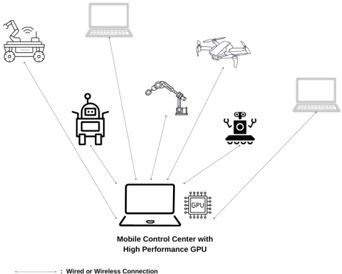
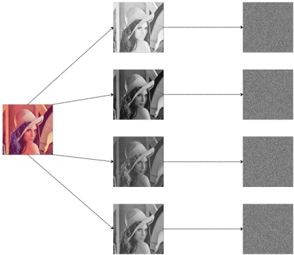
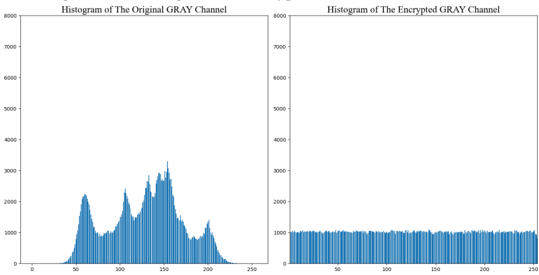
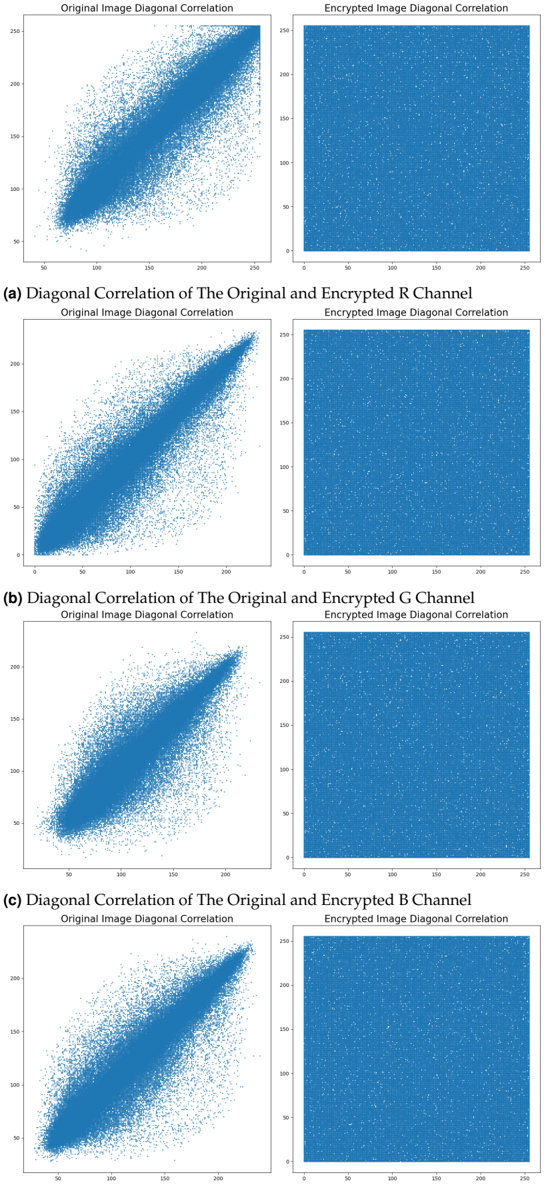
Chaotic systems possess unique properties that can be leveraged for cybersecurity. These properties stem from the complex and unpredictable nature of images, which makes it challenging for systems to interpret them. When combined with CUDA, chaotic systems benefit from high-efficiency parallel processing capabilities, allowing for the rapid and secure handling of large data sets. Therefore, chaotic systems can be effectively used to securely store and conceal images. In this study, a CUDA-supported chaos-based parallel processing encryption mechanism for mobile control centers is developed. Encryption processes leverage the powerful GPU of the control center. This allows for the fast encryption and decryption of image data received from multiple devices connected to the control center via wired or wireless connections. For encryption, the Logistic Map is used to generate random numbers. Using this map, image data is subjected to XOR operations, encrypting the R, G, B, and Gray Scale channels of the images. Initially, an analysis of the numbers generated from this map is conducted, followed by a detailed explanation of the encryption technique. The technique is then applied to image data, and image analyses are performed. Finally, the performance of the encryption technique is compared with other studies, and encryption speeds are examined. The results show that the new encryption technique provides significantly fast encryption and security levels comparable to other studies. The key discovery of this research is that the devised mechanism is well-suited for parallel processing, allowing for rapid image encryption using the proposed method. For encrypting large IoT files, random number generation is initially performed, followed by statistical tests. Subsequently, encryption is executed using the developed algorithm, and security analyses are conducted. The performance of the proposed mechanism is compared with other studies in the literature, and the results from image analysis and encryption performance demonstrate that the developed mechanism can be effectively used with high security for IoT applications.
Overview
CoChat Summary
## TL;DR
The paper proposes a CUDA-supported chaos-based encryption mechanism for mobile control centers, using the Logistic Map and XOR operations to encrypt image channels. It claims fast encryption with security comparable to other studies and suitability for IoT image/file encryption.
## Key findings
- The method uses the Logistic Map to generate random numbers and applies XOR encryption to the R, G, B, and Gray Scale channels of images.
- The paper reports that the proposed technique provides “significantly fast encryption” with security levels comparable to other studies.
- It states that the mechanism is well-suited for parallel processing, enabling rapid image encryption using the control center’s GPU.
- For large IoT files, the paper says it performs random number generation, statistical tests, encryption, and security analyses, and concludes the mechanism can be used effectively with high security for IoT applications.
## Methods
- Design: A CUDA-supported chaos-based parallel processing encryption mechanism for mobile control centers; encryption and decryption are performed using the control center’s GPU.
- Data/sample: The text says the technique is applied to image data and separately to large IoT files, but does not state a specific dataset, image count, or file sample size.
- Main analysis: The study first analyzes the numbers generated by the Logistic Map, then performs image analyses and security analyses, and compares encryption performance with other studies in the literature.
## Limitations
- The paper states comparison with other studies, but does not provide the specific benchmark names, dataset details, or numeric performance results in the provided text.
- The text makes evident that the summary is incomplete because the excerpt ends mid-sentence and does not include the full results section; this limits what can be verified from the provided text.
Model-written summary. Check it against the paper before relying on it.
Integrity signals
Registry
Cites
Statistics
Figures




Verification
Claims the paper makes
0 Valid · 0 Not valid · 0 Not checked · 7 Own results and interpretations
A result the paper reports from its own data — it cites no other source for it, so there is none to check. The quote shows it is in the paper.
In the paper
“The results show that the new encryption technique provides significantly fast encryption and security levels comparable to other studies.”
plain- Asserted: passes — The authors put it forward as true.
- Checkable: passes — It can be checked against evidence.
- Load-bearing: passes — The paper’s conclusions depend on it.
- Based: passes — The paper gives a reason why it holds.
A result the paper reports from its own data — it cites no other source for it, so there is none to check. The quote shows it is in the paper.
In the paper
“The results show that the new encryption technique provides significantly fast encryption and security levels comparable to other studies.”
boostedstates a cause- Asserted: passes — The authors put it forward as true.
- Checkable: passes — It can be checked against evidence.
- Load-bearing: passes — The paper’s conclusions depend on it.
- Based: passes — The paper gives a reason why it holds.
A result the paper states — it cites no source for it, so there is none to check. The quote shows it is in the paper.
In the paper
“The key discovery of this research is that the devised mechanism is well-suited for parallel processing, allowing for rapid image encryption using the proposed method.”
boosted- Asserted: passes — The authors put it forward as true.
- Checkable: passes — It can be checked against evidence.
- Load-bearing: passes — The paper’s conclusions depend on it.
- Based: passes — The paper gives a reason why it holds.
A conclusion the paper draws from its own results — it cites no other source for it, so there is none to check. The quote shows it is in the paper.
In the paper
“the results from image analysis and encryption performance demonstrate that the developed mechanism can be effectively used with high security for IoT applications.”
boosted- Asserted: passes — The authors put it forward as true.
- Checkable: passes — It can be checked against evidence.
- Load-bearing: passes — The paper’s conclusions depend on it.
- Based: passes — The paper gives a reason why it holds.
- Rests on an assumption not shown here.
A conclusion the paper draws from its own results — it cites no other source for it, so there is none to check. The quote shows it is in the paper.
In the paper
“The key discovery of this research is that the devised mechanism is well-suited for parallel processing, allowing for rapid image encryption using the proposed method.”
boostedstates a cause- Asserted: passes — The authors put it forward as true.
- Checkable: passes — It can be checked against evidence.
- Load-bearing: passes — The paper’s conclusions depend on it.
- Based: passes — The paper gives a reason why it holds.
1 more claim
Create a free account to see all 7 claims and every source verdict.
- Probably not a substantial claim. 1
Citations
Cites
Kashyap, P. K., Kumar, S., Jaiswal, A., Prasad, M., & Gandomi, A. H. (2021) · IEEE Sensors Journal · doi:10.1109/jsen.2021.3069266 · Cited by 271
A Review on Applications of Chaotic Maps in Pseudo-Random Number Generators and Encryption
Naik, R. B., & Singh, U. (2024) · Annals of Data Science · doi:10.1007/s40745-021-00364-7 · Cited by 190
Adaptive chaotic maps and their application to pseudo-random numbers generation
Tutueva, A. V., Nepomuceno, E. G., Karimov, A. I., Andreev, V. S., & Butusov, D. N. (2020) · Chaos, Solitons & Fractals · doi:10.1016/j.chaos.2020.109615 · Cited by 164
Internet of Robotic Things in Smart Domains: Applications and Challenges
Romeo, L., Petitti, A., Marani, R., & Milella, A. (2020) · Sensors · doi:10.3390/s20123355 · Cited by 161
Singh, R., Gehlot, A., Akram, S. V., Gupta, L. R., Jena, M. K., Prakash, C., Singh, S., & Kumar, R. (2021) · Sustainability · doi:10.3390/su13137327 · Cited by 158
A lightweight chaos-based encryption scheme for IoT healthcare systems
Clemente-López, D., Rangel‐Magdaleno, J., & Munoz-Pacheco, J. M. (2023) · Internet of Things · doi:10.1016/j.iot.2023.101032 · Cited by 88
A new parallel image cryptosystem based on 5D hyper-chaotic system
Yuan, H.-M., Liu, Y., Lin, T., Hu, T., & Gong, L.-H. (2017) · Signal Processing Image Communication · doi:10.1016/j.image.2017.01.002 · Cited by 76
Pseudo-random bit generator based on multi-modal maps
García-Martínez, M., & Campos-Cantón, E. (2015) · Nonlinear Dynamics · doi:10.1007/s11071-015-2303-y · Cited by 67
Application Experiences Using IoT Devices in Education
Francisti, J., Balogh, Z., Reichel, J., Magdin, M., Koprda, Š., & Molnár, G. (2020) · Applied Sciences · doi:10.3390/app10207286 · Cited by 53
Man, Z., Li, J., Di, X., Liu, X., Zhou, J., Jia, W., & Zhang, X. (2021) · Multimedia Tools and Applications · doi:10.1007/s11042-021-10979-w · Cited by 51
Research works printed but not linked: 1
- Koyuncu, İ., 2014 Kriptolojik uygulamalar için FPGA tabanlı yeni kaotik osilatörlerin ve gerçek rasgele sayı üreteçlerinin tasarımı ve gerçekleştirilmesi. Ph.D. thesis, Sakarya Universitesi (Turkey).
Cited by
Wang, Y., Yin, K., Jin, J., et al. (2026) · Integration · doi:10.1016/j.vlsi.2026.102731 · Cited by 19
The Time Series Classification of Discrete-Time Chaotic Systems Using Deep Learning Approaches
Akmeşe, Ö. F., Emin, B., Alaca, Y., Karaca, Y., & Akgül, A. (2024) · Mathematics · doi:10.3390/math12193052 · Cited by 9
Zhou, Y., Guo, Y., Zhang, W., & Zhao, P. (2025) · Nonlinear Dynamics · doi:10.1007/s11071-025-11673-4 · Cited by 9
“Consequently, chaotic systems are employed in image encryption applications to securely encrypt and decrypt image data [31–33].”
Lightweight Hybrid Chaotic Image Encryption With Spiral Shuffling and S‐Box Diffusion
Dey, D., Bhunia, P., Jana, D. K., Diyasi, S., & Maity, S. (2025) · Security and Privacy · doi:10.1002/spy2.70123 · Cited by 5
Design and analysis of a fractional-order based chaotic map with application in image encryption
Kumar, S., & Sharma, D. (2026) · Franklin Open · doi:10.1016/j.fraope.2026.100580 · Cited by 7
Metadata
- Authors
- Kıran, H. E.
- Affiliations
- Hitit Üniversitesi (TR)
- Corresponding author
- Kıran, Harun Emre
- ORCID
- Kıran, Harun Emre
- Venue
- Chaos and Fractals
- Published
- 2024-07-31
- Volume
- 1
- Issue
- 1
- Pages
- 6-18
- ISSN
- 3023-8951 (ISSN-L)
- OpenAlex
- W4401179011
- Semantic Scholar
- 07e9d13f500a9b34c3d332f795039fcea9b5af68
- Cited by
- 25
- References
- 27
- Citations by year
- 2026: 10 · 2025: 14 · 2024: 1
- FWCI
- 3.52
- Type
- journal article
- Language
- en
- Open access
- diamond
- doi.org
- Licence
- Locations
- Chaos and fractals. (publishedVersion, cc-by-nc)
- DOAJ (DOAJ: Directory of Open Access Journals) (submittedVersion, cc-by-sa)
- Topics
- Physical Sciences › Computer Science › Computer Vision and Pattern Recognition › Chaos-based Image/Signal Encryption
- Physical Sciences › Computer Science › Artificial Intelligence › Computer Science and Engineering
- Physical Sciences › Computer Science › Computer Vision and Pattern Recognition › Advanced Steganography and Watermarking Techniques
- Keywords
- chaos-based image encryption, logistic map, GPU parallel processing, CUDA, XOR encryption, random number generation, Internet of Things security, encryption performance, randomness testing
About these checks
Registry, retraction, Cites and statistics results are computed, not judged, with one exception: a printed reference that no index lists is read once by a model before it counts as a citation error. Claims are extracted by a model and kept only when their quote appears verbatim in the text; each cited source is then checked, with a model’s help, for whether it says what the claim relies on. Those verdicts can be wrong — read the claim’s quote and the cited source before relying on one.
A language model drew the claims from the paper on 2026-09-30, under version 3 of the claim definition (model deepseek-v4.1-flash, prompt extract-v3).
A second model labelled each claim on 2026-09-30 (model jev-1.13-20260917, definition revision gold-guideline-v0.2).
Statistics and arithmetic are recomputed, not judged.
Confidence bands are shown only for fields calibrated on our annotated test set. None is calibrated yet, so no band is shown.
What counts as a claim ›How we measure confidence ›How we check this ›
Are you an author, or do you see a problem with this page? Request a review
How to cite
Cite CoChat for the checks on this page, and the paper for its own findings.
- This page
- CoChat. (2026). Citation check: A Novel Chaos-Based Encryption Technique with Parallel Processing Using CUDA for Mobile Powerful GPU Control Center. https://app.cochat.ai/papers/10.69882/adba.chf.2024072
- The paper
- Kıran, H. E. (2024). A Novel Chaos-Based Encryption Technique with Parallel Processing Using CUDA for Mobile Powerful GPU Control Center. Chaos and Fractals. https://doi.org/10.69882/adba.chf.2024072
Data sources
Bibliographic data: Semantic Scholar, OpenAlex, Crossref.
Contains information from the Semantic Scholar Academic Graph Datasets, made available under the ODC Attribution License (ODC-BY 1.0).
Semantic Scholar’s data is described in: Kinney, R., et al. (2023). The Semantic Scholar Open Data Platform. arXiv:2301.10140.
