

The DOI matches its Crossref record; 36 of the 40 references it cites were found in a registry or an index, and 4 are not checked yet; none of the 46 sources its claims cite is checked for support yet.
Sleep, Dietary Patterns, and Energy Availability Status in Adolescent Female Artistic Gymnasts
Open accessAbstract
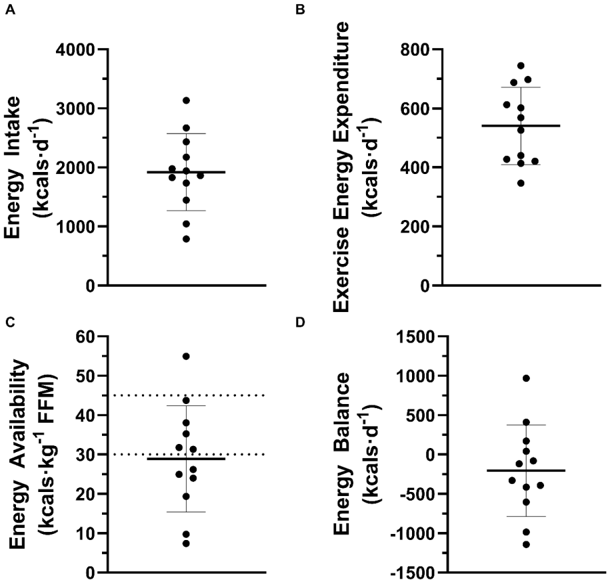
Low energy availability (LEA), which represents inadequate energy intake relative to exercise energy expenditure (EEE), is associated with adverse physiological and performance outcomes, yet limited data quantifying LEA prevalence in women's artistic gymnasts exists.This study assessed LEA prevalence in adolescent female artistic gymnasts and compared diet and sleep characteristics between those with and without LEA.Twelve female gymnasts (15 ± 1 y; 160.6 ± 5.5 cm; 55.8 ± 4.6 kg; 14.9 ± 6.4% body fat; 47.4 ± 4.3 kg FFM) completed body composition testing, questionnaires, and a three-day observation of activity and dietary patterns.Mean EA was 28.9 ± 13.5 kcal•kg⁻¹ FFM, with six athletes classified as having LEA (≤ 30 kcal•kg⁻¹ FFM).Compared with athletes without LEA, those with LEA consumed less calories (1451 ± 447 vs 2388 ± 458 kcal; p = 0.005), protein (0.8 ± 0.2 vs 1.5 ± 0.4 g•kg⁻¹; p = 0.007), and carbohydrate (3.1 ± 0.8 vs 4.8 ± 0.8 g•kg⁻¹; p = 0.004), while exercise energy expenditure did not differ.Athletes with LEA spent less time in bed (389.8 ± 55.7 vs 498.2 ± 35.2 min; p = 0.002) and had lower total sleep time (345.8± 57.2 vs 439.3 ± 32.8 min; p = 0.006), despite experiencing fewer awakenings (17 ± 6 vs 24 ± 4; p = 0.035).Most gymnasts experienced sleep impairments and failed to meet recommended intakes for protein and carbohydrate, underscoring the need for targeted nutritional interventions and education in this population.
Checked 2026-11-14 · 4 references not checked yet
Overview
CoChat Summary
TL;DR
In 12 adolescent female artistic gymnasts, mean energy availability (EA) was 28.9 ± 13.5 kcal·kg⁻¹ FFM, with 6/12 (50%) classified as having low energy availability (LEA, ≤30 kcal·kg⁻¹ FFM) and another 5/12 (41.6%) in a suboptimal EA state. Gymnasts with LEA consumed less energy, protein, and carbohydrate and had less time in bed and total sleep time than those without LEA, while exercise energy expenditure did not differ.
Key findings
- LEA prevalence was 50% (6/12), and all but one gymnast had low or suboptimal EA; mean energy balance was −206 ± 582 kcal·d⁻¹, with mean EI 1920 ± 653 kcal·d⁻¹ and EEE 540 ± 131 kcal·d⁻¹.
- Compared with no-LEA gymnasts, those with LEA had lower energy intake (1451 ± 447 vs 2388 ± 458 kcal; p = 0.005), relative protein (0.8 ± 0.2 vs 1.5 ± 0.4 g·kg⁻¹; p = 0.007), and relative carbohydrate (3.1 ± 0.8 vs 4.8 ± 0.8 g·kg⁻¹; p = 0.004), with no difference in EEE (559 ± 140 vs 522 ± 132 kcal·d⁻¹; p = 0.655).
- Sleep differed by EA status: LEA vs no LEA had less time in bed (389.8 ± 55.7 vs 498.2 ± 35.2 min; p = 0.002), lower total sleep time (345.8 ± 57.2 vs 439.3 ± 32.8 min; p = 0.006), and fewer awakenings (17 ± 6 vs 24 ± 4; p = 0.035); only one gymnast met the National Sleep Foundation recommendation of 8–10 h.
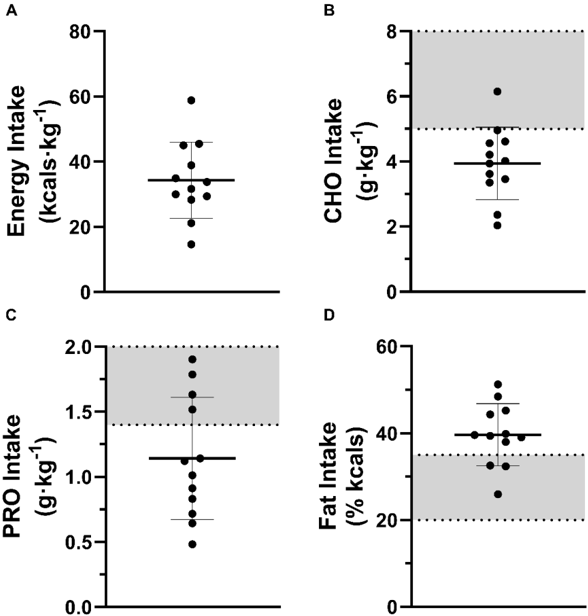
- Most gymnasts did not meet sports-nutrition recommendations: 8.3% met carbohydrate recommendations (5–8 g·kg⁻¹), 33.3% met protein recommendations (1.4–2.0 g·kg⁻¹), and 100% met or exceeded fat recommendations (20–35% kcal); LEA gymnasts consumed fewer calories at breakfast (299 ± 99 vs 597 ± 238 kcal; p = 0.018).
Methods
- Observational, free-living study with one laboratory visit followed by three continuous days of dietary and activity/sleep assessment; 13 adolescent female artistic gymnasts were recruited from local clubs during the off-season in Summer 2024, and 12 completed the study (15.1 ± 0.9 y; 160.6 ± 5.5 cm; 55.8 ± 4.6 kg) after one exclusion for incomplete dietary records.
- Body composition was assessed by air displacement plethysmography (Bod Pod) using the Lohman equation; participants completed the LEAF-Q, PSQI, and ASBQ; EI was assessed over three days using the NIH ASA24; EEE and sleep were assessed via hip- and wrist-worn triaxial accelerometers (ActiGraph GT3X-BT), with EEE from the Freedson VM3 Combination equation and sleep from the Sadeh algorithm; resting metabolic rate was estimated with the Cunningham equation.
- EA was categorized as optimal (≥45 kcal·kg⁻¹ FFM), suboptimal (30–45 kcal·kg⁻¹ FFM), or LEA (≤30 kcal·kg⁻¹ FFM); analyses used SPSS v29, descriptive statistics, independent-samples t-tests or Mann-Whitney U tests when normality was violated, Cohen’s d, and Pearson or Spearman correlations, with significance at p < 0.05.
Limitations
- Stated by the authors: self-reported dietary intake is prone to misreporting, especially in adolescents; accelerometers may overestimate EEE at lower exercise intensities and underestimate it during higher-intensity or sport-specific movements; the convenience sample from local clubs was small, so exploratory LEA vs no-LEA comparisons may be underpowered; and the 3-day observation period may not capture long-term EA patterns or seasonal training-load variations.
- Also stated in the Methods: no control group was included, and no a priori power analysis was performed due to the observational design.
- Evident from the text: the study is a single-site, off-season sample of 12 gymnasts, and the small sample plus multiple exploratory comparisons limit generalizability and precision; the authors call for larger or multi-site designs and assessment across training phases.
Model-written summary. Check it against the paper before relying on it.
Integrity signals
Registry
Cites
Statistics
Figures
Verification
Claims the paper makes
0 Valid · 0 Not valid · 39 Not checked · 62 Own results and interpretations
A result the paper reports from its own data — it cites no other source for it, so there is none to check. The quote shows it is in the paper.
In the paper
“Notably, concordance between LEAF-Q classification and EA status was limited.”
§ Sleep, Dietary Patterns, and Energy Availability Status in Adolescent Female Artistic Gymnasts > Int J Exerc Sci 19(2) 2018, 2026
plain- Asserted: passes — The authors put it forward as true.
- Checkable: passes — It can be checked against evidence.
- Load-bearing: passes — The paper’s conclusions depend on it.
- Based: passes — The paper gives a reason why it holds.
A result the paper reports from its own data — it cites no other source for it, so there is none to check. The quote shows it is in the paper.
In the paper
“However, only three gymnasts who presented in an LEA state scored ≥ 8 on the LEAF-Q.”
§ Sleep, Dietary Patterns, and Energy Availability Status in Adolescent Female Artistic Gymnasts > Energy Availability
plain- Asserted: passes — The authors put it forward as true.
- Checkable: passes — It can be checked against evidence.
- Load-bearing: unclear — It is unclear whether the paper’s conclusions depend on it.
- Based: passes — The paper gives a reason why it holds.
A result the paper reports from its own data — it cites no other source for it, so there is none to check. The quote shows it is in the paper.
In the paper
“Relative to the ISSN recommendations, 8.3% met intake recommendations for CHO (5-8 g•kg -1 ), 33.3% met intake recommendations for PRO (1.4-2.0 g•kg -1 ), and 100% met or exceeded intake recommendations for fat (20-35% kcals).”
§ Sleep, Dietary Patterns, and Energy Availability Status in Adolescent Female Artistic Gymnasts > Dietary Habits
plain- Asserted: passes — The authors put it forward as true.
- Checkable: passes — It can be checked against evidence.
- Load-bearing: unclear — It is unclear whether the paper’s conclusions depend on it.
- Based: passes — The paper gives a reason why it holds.
A result the paper reports from its own data — it cites no other source for it, so there is none to check. The quote shows it is in the paper.
In the paper
“Compared with athletes without LEA, those with LEA consumed less calories (1451 ± 447 vs 2388 ± 458 kcal; p = 0.005), protein (0.8 ± 0.2 vs 1.5 ± 0.4 g•kg⁻¹; p = 0.007), and carbohydrate (3.1 ± 0.8 vs 4.8 ± 0.8 g•kg⁻¹; p = 0.004), while exercise energy expenditure did not differ.”
- Also stated in: § Dietary Habits · plain
“Those with LEA consumed significantly fewer calories (absolute and relative, p < 0.05), protein (absolute and relative; p < 0.05), and CHO (absolute and relative; p < 0.05) compared to those without.”
§ Sleep, Dietary Patterns, and Energy Availability Status in Adolescent Female Artistic Gymnasts > Abstract
plainstates an association- Asserted: passes — The authors put it forward as true.
- Checkable: passes — It can be checked against evidence.
- Load-bearing: passes — The paper’s conclusions depend on it.
- Based: passes — The paper gives a reason why it holds.
- Also stated in: § Dietary Habits · plain
A result the paper reports from its own data — it cites no other source for it, so there is none to check. The quote shows it is in the paper.
In the paper
“On average, gymnasts consumed 34.3 ± 11.7 kcal•kg⁻¹, with macronutrient intakes of 3.9 ± 1.1 g•kg⁻¹ CHO, 1.1 ± 0.5 g•kg⁻¹ PRO, and 39.7 ± 7.1% of total calories from fat.”
§ Sleep, Dietary Patterns, and Energy Availability Status in Adolescent Female Artistic Gymnasts > Dietary Habits
plain- Asserted: passes — The authors put it forward as true.
- Checkable: passes — It can be checked against evidence.
- Load-bearing: unclear — It is unclear whether the paper’s conclusions depend on it.
- Based: passes — The paper gives a reason why it holds.
50 more claims
Create a free account to see all 101 claims and every source verdict.
- It may state two separate claims as one. 31
- Probably not a substantial claim. 26
Self-check
Percentages, sums and reported differences re-computed from the paper’s own numbers.
Each contradiction between two passages listed here was confirmed by an independent check.
Rated major: it would touch a result — a value a result rests on, reported and recomputed p-values on opposite sides of the significance level, two passages that conflict with no sign which is right, or a cited work retracted before this paper was published.
In the paper
§ Sleep, Dietary Patterns, and Energy Availability Status in Adolescent Female Artistic Gymnasts > Energy Availability
“Mean LEAF-Q scores were 7.3 ± 3.6, with 6 of 12 gymnasts at risk for LEA.”
§ Sleep, Dietary Patterns, and Energy Availability Status in Adolescent Female Artistic Gymnasts > Int J Exerc Sci 19(2) 2018, 2026
“In the present study, the mean LEAF-Q score was 7.5 ± 4.6, with 50% of gymnasts scoring ≥ 8, the established threshold for LEA risk.”
Rated minor: it would not touch a result — a value no result rests on, a p-value that stays on the same side of the significance level, or a conflict that is clerical, resolved elsewhere in the paper, or outside its own findings.
In the paper
“Predicted RMR (kcals•d -1 ) 1394 ± 92 1392 ± 134 1395 ± 27 0.958 0.03 EEE (kcals•d -1 ) 540 ± 131 559 ± 140 522 ± 132 0.655 0.27 TEF (kcals•d -1 ) 192 ± 65 145 ± 45 239 ± 46** 0.005 2.07 Total energy expenditure (kcals•d -1 ) 2126 ± 156 2147 ± 218 2104 ± 71 0.661 0.26”
§ Sleep, Dietary Patterns, and Energy Availability Status in Adolescent Female Artistic Gymnasts > Energy Availability
Reported 2104 · recomputed 2156
Rated minor: it would not touch a result — a value no result rests on, a p-value that stays on the same side of the significance level, or a conflict that is clerical, resolved elsewhere in the paper, or outside its own findings.
In the paper
§ Sleep, Dietary Patterns, and Energy Availability Status in Adolescent Female Artistic Gymnasts > Int J Exerc Sci 19(2) 2018, 2026
“the artistic gymnasts in the present investigation (1451 ± 445 kcals•d -1 )”
§ Sleep, Dietary Patterns, and Energy Availability Status in Adolescent Female Artistic Gymnasts > Energy Availability
“Energy intake (kcals•d -1 ) 1920 ± 653 1451 ± 447 2388 ± 458** 0.005 2.07”
Rated minor: it would not touch a result — a value no result rests on, a p-value that stays on the same side of the significance level, or a conflict that is clerical, resolved elsewhere in the paper, or outside its own findings.
In the paper
“Predicted RMR (kcals•d -1 ) 1394 ± 92 1392 ± 134 1395 ± 27 0.958 0.03 EEE (kcals•d -1 ) 540 ± 131 559 ± 140 522 ± 132 0.655 0.27 TEF (kcals•d -1 ) 192 ± 65 145 ± 45 239 ± 46** 0.005 2.07 Total energy expenditure (kcals•d -1 ) 2126 ± 156 2147 ± 218 2104 ± 71 0.661 0.26”
§ Sleep, Dietary Patterns, and Energy Availability Status in Adolescent Female Artistic Gymnasts > Energy Availability
Reported 2147 · recomputed 2096
Citations
Cites
Statistical Power Analysis for the Behavioral Sciences
Cohen, J. (2013) · doi:10.4324/9780203771587 · Cited by 25,373
National Sleep Foundation’s updated sleep duration recommendations: final report
Hirshkowitz, M., Whiton, K., Albert, S. M., Alessi, C., Bruni, O., DonCarlos, L., Hazen, N., Herman, J., Adams Hillard, P. J., Katz, E. S., et al. (2015) · Sleep Health · doi:10.1016/j.sleh.2015.10.004 · Cited by 2,348
Activity-Based Sleep-Wake Identification: An Empirical Test of Methodological Issues
Sadeh, A., Sharkey, M., & Carskadon, M. A. (1994) · Sleep · doi:10.1093/sleep/17.3.201 · Cited by 1,487
Validation and comparison of ActiGraph activity monitors
Sasaki, J. E., John, D., & Freedson, P. S. (2011) · Journal of Science and Medicine in Sport · doi:10.1016/j.jsams.2011.04.003 · Cited by 1,317
Mountjoy, M., Ackerman, K. E., Bailey, D. M., Burke, L. M., Constantini, N., Hackney, A. C., Heikura, I. A., Melin, A., Pensgaard, A. M., Stellingwerff, T., et al. (2023) · British Journal of Sports Medicine · doi:10.1136/bjsports-2023-106994 · Cited by 974
ISSN exercise & sports nutrition review update: research & recommendations
Kerksick, C. M., Wilborn, C. D., Roberts, M. D., Smith-Ryan, A., Kleiner, S. M., Jäger, R., Collins, R., Cooke, M., Davis, J. N., Galvan, E., et al. (2018) · Journal of the International Society of Sports Nutrition · doi:10.1186/s12970-018-0242-y · Cited by 945
International Society of Sports Nutrition Position Stand: protein and exercise
Jäger, R., Kerksick, C. M., Campbell, B. I., Cribb, P. J., Wells, S. D., Skwiat, T. M., Purpura, M., Ziegenfuss, T. N., Ferrando, A. A., Arent, S. M., et al. (2017) · Journal of the International Society of Sports Nutrition · doi:10.1186/s12970-017-0177-8 · Cited by 873
Paruthi, S., Brooks, L. J., D'Ambrosio, C., Hall, W. A., Kotagal, S., Lloyd, R. M., Malow, B. A., Maski, K., Nichols, C., Quan, S. F., et al. (2016) · Journal of Clinical Sleep Medicine · doi:10.5664/jcsm.6288 · Cited by 837
Loucks, A. B., & Thuma, J. R. (2003) · The Journal of Clinical Endocrinology & Metabolism · doi:10.1210/jc.2002-020369 · Cited by 760
Ethical Issues Relating to Scientific Discovery in Exercise Science
Navalta, J. W., & Stone, W. J. (2019) · International Journal of Exercise Science · doi:10.70252/eycd6235 · Cited by 679
Cunningham, J. (1991) · The American Journal of Clinical Nutrition · doi:10.1093/ajcn/54.6.963 · Cited by 607
Dose-Response Relationships Between Energy Availability and Bone Turnover in Young Exercising Women
Ihle, R., & Loucks, A. B. (2004) · Journal of Bone and Mineral Research · doi:10.1359/jbmr.040410 · Cited by 523
Melin, A., Tornberg, Å. B., Skouby, S., Faber, J., Ritz, C., Sjödin, A., & Sundgot-Borgen, J. (2014) · British Journal of Sports Medicine · doi:10.1136/bjsports-2013-093240 · Cited by 435
Bailey, R. L. (2021) · Current Opinion in Biotechnology · doi:10.1016/j.copbio.2021.02.007 · Cited by 431
Heikura, I. A., Uusitalo, A. L. T., Stellingwerff, T., Bergland, D., Mero, A. A., & Burke, L. M. (2018) · International Journal of Sport Nutrition and Exercise Metabolism · doi:10.1123/ijsnem.2017-0313 · Cited by 318
Estimating Activity and Sedentary Behavior from an Accelerometer on the Hip or Wrist
Rosenberger, M. E., Haskell, W. L., Albinali, F., Mota, S., Nawyn, J., & Intille, S. S. (2013) · Medicine & Science in Sports & Exercise · doi:10.1249/mss.0b013e31827f0d9c · Cited by 261
Energy Availability in Athletics: Health, Performance, and Physique
Melin, A. K., Heikura, I. A., Tenforde, A., & Mountjoy, M. (2019) · International Journal of Sport Nutrition and Exercise Metabolism · doi:10.1123/ijsnem.2018-0201 · Cited by 258
The Pittsburgh Sleep Quality Index: Validity and factor structure in young people.
de la Vega, R., Tomé-Pires, C., Solé, E., Racine, M., Castarlenas, E., Jensen, M. P., & Miró, J. (2015) · Psychological Assessment · doi:10.1037/pas0000128 · Cited by 217
Areta, J. L., Taylor, H. L., & Koehler, K. (2021) · European Journal of Applied Physiology · doi:10.1007/s00421-020-04516-0 · Cited by 214
Full, K. M., Kerr, J., Grandner, M. A., Malhotra, A., Moran, K., Godoble, S., Natarajan, L., & Soler, X. (2018) · Sleep Health · doi:10.1016/j.sleh.2017.12.007 · Cited by 136
Jagim, A. R., Fields, J., Magee, M. K., Kerksick, C. M., & Jones, M. T. (2022) · Nutrients · doi:10.3390/nu14050986 · Cited by 74
Low energy availability and low body fat of female gymnasts before an international competition
Silva, M. ‐. G., & Paiva, T. (2015) · European Journal of Sport Science · doi:10.1080/17461391.2014.969323 · Cited by 72
Trabelsi, K., Saif, Z., Driller, M. W., Vitiello, M. V., & Jahrami, H. (2024) · BMC Sports Science Medicine and Rehabilitation · doi:10.1186/s13102-023-00787-0 · Cited by 54
Sleep, Nutrition, and Injury Risk in Adolescent Athletes: A Narrative Review
Mason, L., Connolly, J., Devenney, L. E., Lacey, K., O’Donovan, J., & Doherty, R. (2023) · Nutrients · doi:10.3390/nu15245101 · Cited by 50
Gastin, P. B., Cayzer, C., Dwyer, D., & Robertson, S. J. (2017) · Journal of science and medicine in sport · doi:10.1016/j.jsams.2017.07.022 · Cited by 48
Comparison Between Wrist-Worn and Waist-Worn Accelerometry
Loprinzi, P. D., & Smith, B. (2017) · Journal of Physical Activity and Health · doi:10.1123/jpah.2016-0211 · Cited by 43
Current risks factors and emerging biomarkers for bone stress injuries in military personnel
Greeves, J. P., Beck, B. R., Nindl, B. C., & O’Leary, T. J. (2023) · Journal of science and medicine in sport · doi:10.1016/j.jsams.2023.04.006 · Cited by 41
Jones, L., Ness, A., & Emmett, P. M. (2021) · Frontiers in Nutrition · doi:10.3389/fnut.2021.749007 · Cited by 41
Everett, S. (2025) · Nutrients · doi:10.3390/nu17172792 · Cited by 37
Choice, E., Tufano, J. J., Jagger, K. L., Hooker, K., & Cochrane-Snyman, K. C. (2022) · Sports · doi:10.3390/sports10100141 · Cited by 20
Association between Low Energy Availability (LEA) and Impaired Sleep Quality in Young Rugby Players
Saidi, O., Souabni, M., Del Sordo, G. C., Maviel, C., Peyrel, P., Maso, F., Vercruyssen, F., & Duché, P. (2024) · Nutrients · doi:10.3390/nu16050609 · Cited by 18
Assessment of Relative Energy Deficiency in Sport (REDs) Risk among Adolescent Acrobatic Gymnasts
Besor, O., Redlich, N., Constantini, N., Weiler‐Sagie, M., Ornan, E. M., Lieberman, S., Bentur, L., & Bar‐Yoseph, R. (2024) · Journal of Personalized Medicine · doi:10.3390/jpm14040363 · Cited by 15
Puscheck, L. J., Kennel, J. A., & Sáenz, C. (2025) · Journal of Eating Disorders · doi:10.1186/s40337-025-01218-w · Cited by 14
Energy Availability, Mental Health, and Sleep Patterns of Athletic Trainers
Torres-McGehee, T. M., Emerson, D. M., Flanscha, A. N., Uriegas, N. A., Moore, E. M., & Smith, A. B. (2023) · Journal of Athletic Training · doi:10.4085/1062-6050-0547.22 · Cited by 10
Dietary intake, energy availability, and power in men collegiate gymnasts
Kuhlman, N. M., Jones, M. T., Jagim, A. R., Magee, M. K., Wilcox, L., & Fields, J. B. (2024) · Frontiers in Sports and Active Living · doi:10.3389/fspor.2024.1448197 · Cited by 10
Energy Availability in Female Collegiate Beach Volleyball Athletes
Willingham, B. D., Daou, M., VanArsdale, J., Thomas, M., & Saracino, P. G. (2024) · The Journal of Strength and Conditioning Research · doi:10.1519/jsc.0000000000004884 · Cited by 8
Evang, L. P., Lewis, J. E., & Nicanord, E. J. (2025) · American Journal of Lifestyle Medicine · doi:10.1177/15598276251388632 · Cited by 6
Smulligan, K. L., Brna, M. L., Hogg-Cornejo, V., Petersen, S., Sweeney, E. A., Meyers, R. N., Howell, D. R., & Armento, A. M. (2025) · Physical Therapy in Sport · doi:10.1016/j.ptsp.2025.09.011 · Cited by 5
Low Energy Availability Prevalence, Dietary Habits, and Sleep in Female Army ROTC Cadets
Eberhardt, H. K., Willingham, B. D., Brisebois, M. F., & Saracino, P. G. (2025) · International journal of exercise science · doi:10.70252/vrdk5031 · Cited by 4
Grompanopoulou, A., Kypraiou, A., Milosis, D. C., Chourdakis, M. G., & Petridou, A. (2026) · Nutrients · doi:10.3390/nu18030519 · Cited by 3
Cited by
Still being checked.
Metadata
- Authors
- K. Eberhardt, H., J. Ormsbee, M., & G. Saracino, P.
- Venue
- International Journal of Exercise Science
- Published
- 2026
- Volume
- 19
- Issue
- 2
- ISSN
- 1939-795X (ISSN-L)
- OpenAlex
- W7206165766
- Semantic Scholar
- e3c5fc8e7727d5c46ffea61e9b9d46da53d43062
- Cited by
- 0
- References
- 36
- FWCI
- 0.00
- Type
- journal article
- Language
- en
- Open access
- diamond
- doi.org
- Licence
- cc-by-nd
- Locations
- International journal of exercise science (publishedVersion, cc-by-nd)
- Topics
- Social Sciences › Psychology › Clinical Psychology › Eating Disorders and Behaviors
- Health Sciences › Nursing › Nutrition and Dietetics › Nutrition, Health and Food Behavior
- Health Sciences › Medicine › Orthopedics and Sports Medicine › Sports Performance and Training
- Keywords
- low energy availability, artistic gymnasts, adolescent female athletes, sleep duration, dietary intake, protein intake, carbohydrate intake, exercise energy expenditure, sleep disorders, body composition
About these checks
Registry, retraction, Cites and statistics results are computed, not judged, with one exception: a printed reference that no index lists is read once by a model before it counts as a citation error. Claims are extracted by a model and kept only when their quote appears verbatim in the text; each cited source is then checked, with a model’s help, for whether it says what the claim relies on. Those verdicts can be wrong — read the claim’s quote and the cited source before relying on one.
A language model drew the claims from the paper on 2026-11-14, under version 3 of the claim definition (model deepseek-v4.1-flash, prompt extract-v3).
A second model labelled each claim on 2026-11-14 (model jev-1.13-20260917, definition revision gold-guideline-v0.2).
Statistics and arithmetic are recomputed, not judged.
Confidence bands are shown only for fields calibrated on our annotated test set. None is calibrated yet, so no band is shown.
What counts as a claim ›How we measure confidence ›How we check this ›
Are you an author, or do you see a problem with this page? Request a review
Data sources
Bibliographic data: Semantic Scholar, OpenAlex, Crossref.
Contains information from the Semantic Scholar Academic Graph Datasets, made available under the ODC Attribution License (ODC-BY 1.0).
Semantic Scholar’s data is described in: Kinney, R., et al. (2023). The Semantic Scholar Open Data Platform. arXiv:2301.10140.
