

The DOI matches its Crossref record.
Carving Out Spaces of Possibility. An Interview with Ayana Omilade Flewellen
Open accessAbstract
Carving Out Spaces of Possibility. An Interview with Ayana Omilade Flewellen
Overview
AI snapshot
Written from the paper’s full text.
TL;DR
This is an interview with archaeologist Ayana Omilade Flewellen about the Estate Little Princess Archaeology Project on St. Croix and her research on dress and adornment among African-descended people in the former Danish West Indies. She discusses community-engaged excavation of an eighteenth-century Danish plantation's enslaved village, the limits of archival and archaeological sources, and the ethical problem of "thingification" in studying enslaved people.
Key findings
- The Estate Little Princess Archaeology Project was founded in 2016, with first excavations in summer 2017; the eighteenth-century Danish plantation cultivated sugar and operated a rum distillery, and at its height housed about 147 enslaved individuals, with historical documentation indicating roughly 15–25 coral structures built to house the enslaved labor force.
- Excavations focus on the enslaved village area, asking how domestic and shared spaces were used, where people cooked, what they ate, and what craft production and ceramic goods they had access to; the team has recovered a mix of European ceramics and Afro-Caribbean ware, plus bone buttons and what they think is a hand-carved stone bead, though "we haven't recovered a lot of adornment materials."
- Artifacts belong to the landowner, The Nature Conservancy; under a signed agreement they are removed for analysis, currently hosted at the University of Tulsa by Alicia Odewale, with hopes of moving to UC Riverside in 2021–2022 and eventual return to St. Croix once an adequate on-island facility exists.
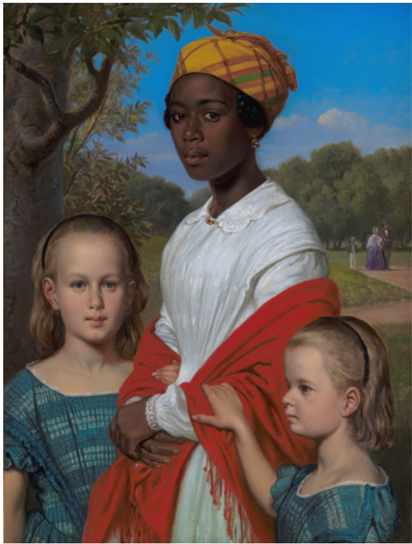
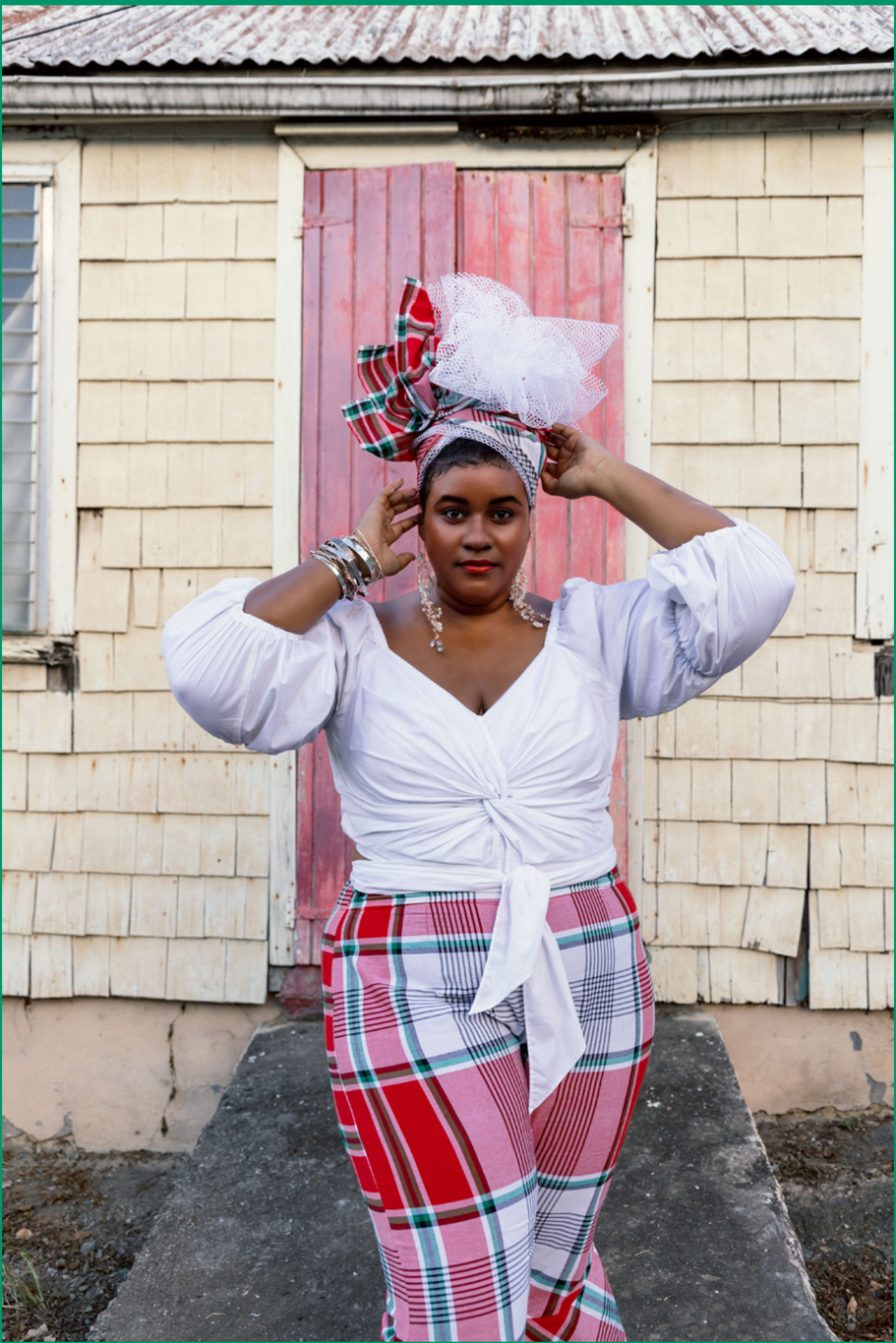
- Flewellen argues dress was central to identity formation under enslavement, citing sumptuary laws in the former Danish West Indies that sought to limit how people could dress, and reading fugitive-slave advertisements as evidence of everyday harm and of the language used to classify Black bodies over time.
Methods
- Interview format: Nina Cramer poses questions and Flewellen responds, covering the project's founding, collaborators, research questions, artifact ownership, and analytical frameworks.
- Flewellen describes combining archaeological artifacts, vernacular photography, print culture (newspapers and runaway advertisements), and other written archival material to study dress practices pre- and post-emancipation (1848), grounded in Black feminist theory and Saidiya Hartman's methodologies for approaching archival limits.
- Archaeological practice described: classifying artifact attributes into a database, generating distribution and cluster maps, dating colonial sites primarily through ceramics (and glass after the twentieth century), with planned laser ablation on low-fired earthenware in collaboration with the Digital Archaeological Archive of Comparative Slavery to source clay.
Limitations
- Stated: the paper's data sources are limited, and "the final leap of knowing the interior lives of these historical people is often still not within our grasp"; adornment materials are scarce because work has prioritized a large-scale survey of the enslaved village rather than the interiors of domestic structures where such items would ordinarily be found; zooarchaeological questions about diet remain unanswered; and no adequate on-island facility currently exists to host the artifacts.
- Evident from the text: this is a conversational interview rather than a peer-reviewed study, so claims about the site and its findings are presented without systematic data, citations to results, or quantified analysis beyond the figures Flewellen states.
Model-written summary. Check it against the paper before relying on it.
Integrity signals
Registry
Cites
Statistics
Figures
Verification
Claims the paper makes
No claims could be anchored to a verbatim quote in the text.
Citations
Cites
Still being checked.
Cited by
Sorted by citations
Dirckinck-Holmfeld, K. (2022) · The Nordic Journal of Aesthetics · doi:10.7146/nja.v31i64.134220 · Cited by 3
Metadata
- Authors
- Cramer, N.
- Affiliations
- University of California, Riverside (US)
- Corresponding author
- Cramer, Nina
- Venue
- Periskop – Forum for kunsthistorisk debat
- Published
- 2021-08-24
- Issue
- 25
- Pages
- 46-59
- ISSN
- 0908-6919 (ISSN-L)
- 2596-4283
- OpenAlex
- W4312988741
- Cited by
- 1
- References
- 0
- Citations by year
- 2022: 1
- FWCI
- 2.20
- Type
- journal article
- Language
- en
- Open access
- diamond
- doi.org
- Locations
- Periskop – Forum for kunsthistorisk debat (publishedVersion, cc-by)
- Research at the University of Copenhagen (University of Copenhagen) (submittedVersion, cc-by)
- DOAJ (DOAJ: Directory of Open Access Journals) (submittedVersion)
- Periskop – Forum for kunsthistorisk debat (cc-by)
- Topics
- Social Sciences › Arts and Humanities › Visual Arts and Performing Arts › Art, Politics, and Modernism
- Social Sciences › Sociology and Political Science › Race, History, and American Society
- Social Sciences › Arts and Humanities › Visual Arts and Performing Arts › Visual Culture and Art Theory
- Keywords
- contemporary art, African diaspora art, Black women artists, artistic practice
About these checks
Registry, retraction, Cites and statistics results are computed, not judged, with one exception: a printed reference that no index lists is read once by a model before it counts as a citation error. Claims are extracted by a model and kept only when their quote appears verbatim in the text; each cited source is then checked, with a model’s help, for whether it says what the claim relies on. Those verdicts can be wrong — read the claim’s quote and the cited source before relying on one.
A language model drew the claims from the paper on 2026-11-08 (model deepseek-v4.1-flash, prompt extract-v3).
Statistics and arithmetic are recomputed, not judged.
Confidence bands are shown only for fields calibrated on our annotated test set. None is calibrated yet, so no band is shown.
What counts as a claim ›How we measure confidence ›How we check this ›
Are you an author, or do you see a problem with this page? Request a review
How to cite
Cite CoChat for the checks on this page, and the paper for its own findings.
- This page
- CoChat. (2026). Citation check: Carving Out Spaces of Possibility. An Interview with Ayana Omilade Flewellen. https://app.cochat.ai/papers/10.7146/periskop.v2021i25.128296
- The paper
- Cramer, N. (2021). Carving Out Spaces of Possibility. An Interview with Ayana Omilade Flewellen. Periskop – Forum for kunsthistorisk debat. https://doi.org/10.7146/periskop.v2021i25.128296
