

Two Sides of the Same Coin: A Randomized Clinical Trial of the Unified Protocol for Addressing Depression and Anxiety in People With Multiple Sclerosis.
Open accessThe DOI matches its Crossref record; 9 of the 9 references it cites were found in a registry or an index; 1 of the 47 sources its claims cite were checked for support.
Abstract
BACKGROUND: Depression and anxiety are common in people with multiple sclerosis (MS) and significantly impact disease symptomatology, coping, quality of life (QOL), and psychological well-being (PWB). Effective treatment of both is warranted and may be accomplished using a transdiagnostic intervention such as the Unified Protocol (UP). The purpose of this study was to conduct a pilot randomized controlled trial (Clinical Trials # NCT05953519) to determine the effectiveness of the UP in reducing depression and anxiety and the subsequent impact on MS symptomatology, coping, QOL, and PWB. METHODS: Thir ty people with MS and depression and/or anxiety were randomly assigned to a UP intervention (n = 12) or a control group (n = 18). Individuals in the intervention group completed a 12-week group virtual intervention. All completed baseline, posttreatment, and 3-month follow-up assessments. All study procedures were approved by the Kessler Foundation Institutional Review Board. RESULTS: Following the intervention, significant reductions in depression, experiential avoidance, and fatigue were observed. Participants also demonstrated improvements in self-efficacy, coping (eg, benefit finding, social support), QOL (eg, flourishing), and PWB (eg, acceptance). These effects were maintained at the 3-month follow-up. CONCLUSIONS: The UP intervention holds great promise in reducing mood symptoms in people with MS, as well as fatigue, one of the most detrimental symptoms associated with MS. The impact on coping, QOL, and PWB also suggests greater, long-standing effects on perspective, reframing, and coping, which are likely to have a greater impact overall for individuals with MS.
Overview
CoChat Summary
## TL;DR
This pilot randomized controlled trial found that a 12-week virtual Unified Protocol intervention for people with multiple sclerosis was associated with significant reductions in depression, experiential avoidance, and fatigue, with several gains in coping, quality of life, and psychological well-being maintained at 3 months. The trial did not find a significant effect on anxiety.
## Key findings
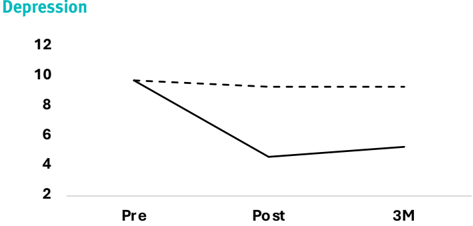
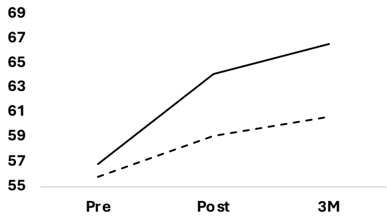
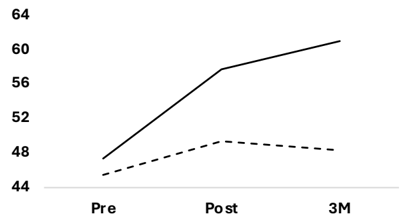
- Thirty people with MS were randomized to the Unified Protocol intervention (n = 12) or control/treatment as usual (n = 18); the treatment group showed significant reductions in depression and experiential avoidance immediately after the 12-week intervention and at 3-month follow-up.
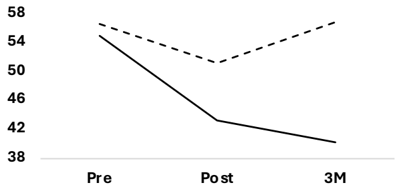
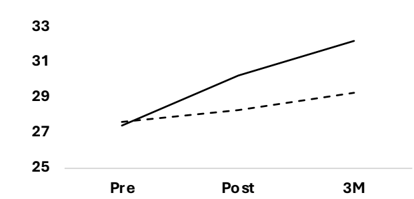
- Significant improvements were also observed in fatigue, general self-efficacy, environmental mastery, coping (benefit finding and instrumental social support), QOL (flourishing), and psychological well-being (positive relationships with others and self-acceptance).
- The paper reports no significant effects for anxiety, positive or negative affect, sleep disturbance, pain, or MS self-efficacy.
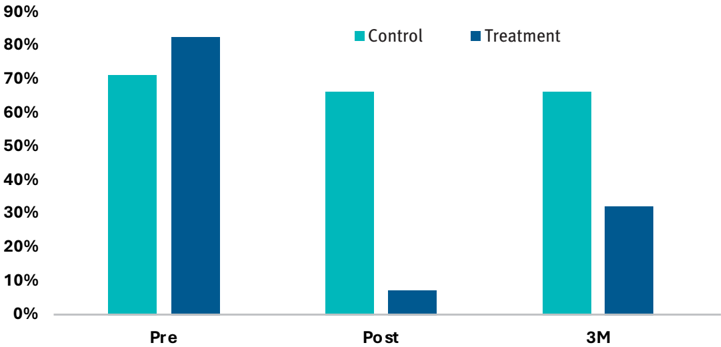
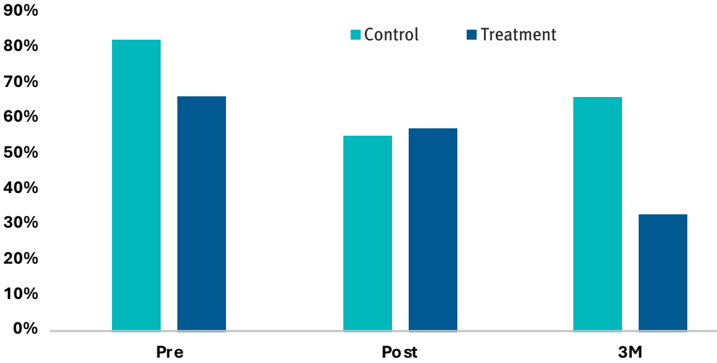
- Clinically elevated depression in the treatment group dropped from 83% at baseline to 8% immediately post-treatment and 33% at 3 months; clinically elevated anxiety dropped from 67% at baseline to 58% post-treatment and 33% at 3 months.
## Methods
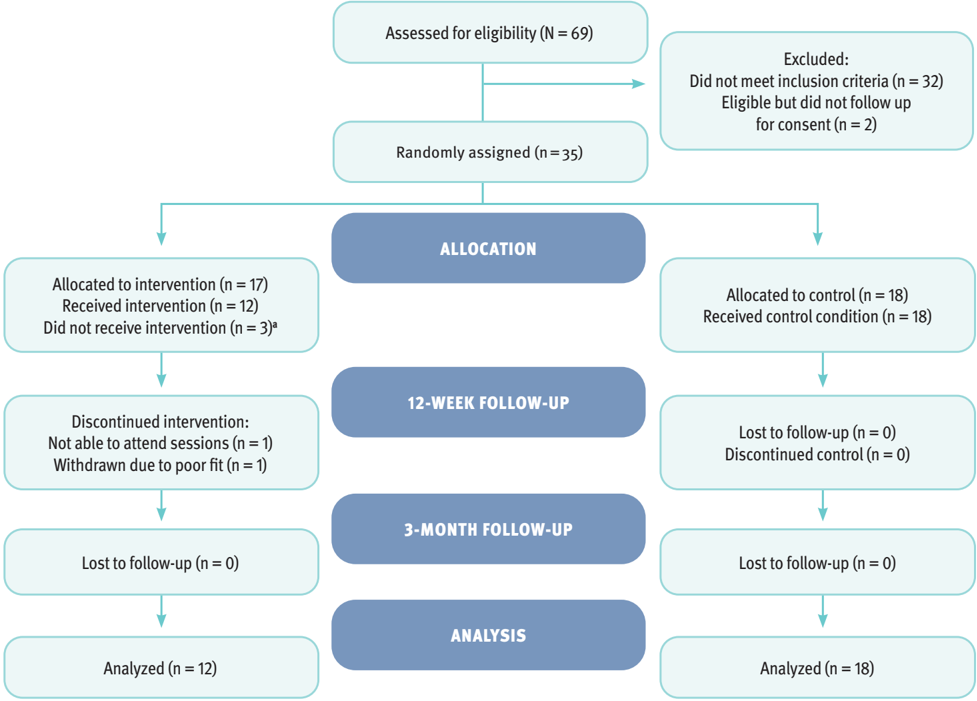
- Single-blind, parallel pilot RCT conducted over 3 cohorts from May 2023 to August 2024; assessors were blinded and participants were randomized by computer-generated sequence.
- Sample: 69 screened, 35 met inclusion criteria, and 30 people with MS and depression and/or anxiety were randomized; eligibility required, among other criteria, MS diagnosis, age 18+, English fluency, internet access, and elevated depression and/or anxiety scores.
- Intervention group received a 12-week virtual group Unified Protocol delivered via Zoom Health; control group received treatment as usual. Outcomes were assessed at baseline, posttreatment, and 3-month follow-up, with repeated-measures ANOVAs used for between-group comparisons and η² reported.
## Limitations
- The paper explicitly states the trial was single-blind, the control group received no active intervention, α inflation was not corrected because this was a pilot study, and the small number of groups and facilitators prevented examination of nested-level effects.
- The authors also state that more within-treatment assessments would have provided better information on timing and nature of change.
- Evident from the text: the sample was small and imbalanced (12 intervention vs 18 control), and the study was limited to people with access to the internet and able to attend virtual sessions.
Model-written summary. Check it against the paper before relying on it.
Integrity signals
Registry
Cites
Statistics
Figures
Verification
Claims the paper makes
1 Valid · 0 Not valid · 26 Not checked · 46 Own results and interpretations
A result the paper reports from its own data — it cites no other source for it, so there is none to check. The quote shows it is in the paper.
In the paper
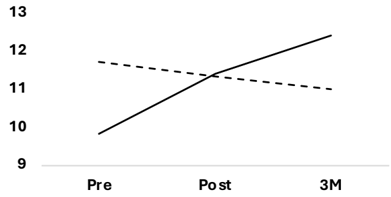
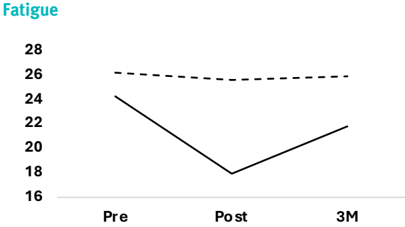
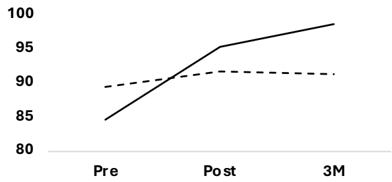
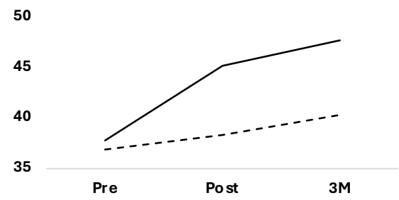
“Significant reductions in fatigue and improvements in general self-efficacy , environmental mastery, coping (ie, benefit finding and instrumental social support), QOL (ie, flourishing), and psychological well-being (PWB; ie, positive relationships with others and self-acceptance) were also observed ( TABLE S1, FIGURE 2 ).”
plain- Asserted: passes — The authors put it forward as true.
- Checkable: passes — It can be checked against evidence.
- Load-bearing: passes — The paper’s conclusions depend on it.
- Based: passes — The paper gives a reason why it holds.
A result the paper reports from its own data — it cites no other source for it, so there is none to check. The quote shows it is in the paper.
In the paper
“Significant reductions in fatigue and improvements in general self-efficacy , environmental mastery, coping (ie, benefit finding and instrumental social support), QOL (ie, flourishing), and psychological well-being (PWB; ie, positive relationships with others and self-acceptance) were also observed ( TABLE S1, FIGURE 2 ).”
plainstates a cause- Asserted: passes — The authors put it forward as true.
- Checkable: passes — It can be checked against evidence.
- Load-bearing: unclear — It is unclear whether the paper’s conclusions depend on it.
- Based: passes — The paper gives a reason why it holds.
A result the paper reports from its own data — it cites no other source for it, so there is none to check. The quote shows it is in the paper.
In the paper
“No significant effects were found for anxiety, positive or negative affect, sleep disturbance, pain, or MS self-efficacy .”
plain- Asserted: passes — The authors put it forward as true.
- Checkable: passes — It can be checked against evidence.
- Load-bearing: passes — The paper’s conclusions depend on it.
- Based: passes — The paper gives a reason why it holds.
A result the paper reports from its own data — it cites no other source for it, so there is none to check. The quote shows it is in the paper.
In the paper
“The treatment group experienced significant reductions in depression and experiential avoidance immediately following the 12-week intervention and at the 3-month follow-up.”
plainstates a cause- Asserted: passes — The authors put it forward as true.
- Checkable: passes — It can be checked against evidence.
- Load-bearing: passes — The paper’s conclusions depend on it.
- Based: passes — The paper gives a reason why it holds.
A result the paper reports from its own data — it cites no other source for it, so there is none to check. The quote shows it is in the paper.
In the paper
“The rates of clinically significant depression and anxiety were more significantly reduced in the treatment group than in the control group.”
plainstates a cause- Asserted: passes — The authors put it forward as true.
- Checkable: passes — It can be checked against evidence.
- Load-bearing: passes — The paper’s conclusions depend on it.
- Based: passes — The paper gives a reason why it holds.
31 more claims
Create a free account to see all 73 claims and every source verdict.
- Probably not a substantial claim. 23
- It may state two separate claims as one. 18
Statistics that don’t add up
Each reported p-value recomputed from its test statistic and degrees of freedom, each partial η² from its F, and each ratio, mean difference or B printed with a p checked against its own confidence interval.
Rated minor: it would not touch a result — a value no result rests on, a p-value that stays on the same side of the significance level, or a conflict that is clerical, resolved elsewhere in the paper, or outside its own findings.
In the paper
“F (2,56) = 1.45, P = .644”
Reported p = .644 · recomputed p = .243
Statistics recomputed
Every reported test result, recomputed from its test statistic and degrees of freedom. A result shows as not adding up only once an independent check has confirmed it.
- Doesn’t add upF(2, 56) = 1.45reported p = .644 · recomputed p = .243
“F (2,56) = 1.45, p = .644”
- Not confirmedF(1.45, 56) = 1.55reported p = .226 · recomputed p = .223
“F (1.45,56) = 1.55, p = .226”
- Not confirmedF(1.46, 56) = 4.68reported p = .024 · recomputed p = .022
“F (1.46,56) = 4.68, p = .024”
- Not confirmedF(1.69, 56) = 1.15reported p = .319 · recomputed p = .317
“F (1.69,56) = 1.15, p = .319”
- Not confirmedF(1.49, 56) = 4.47reported p = .027 · recomputed p = .025
“F (1.49,56) = 4.47, p = .027”
22 more recomputed tests
Create a free account to see every test the Stats check recomputed.
Self-check
Percentages, sums and reported differences re-computed from the paper’s own numbers.
Self-check results appear here once an independent check has confirmed them.
Citations
Cites
The publisher hasn’t deposited this paper’s reference list.
Research works printed but not linked: 1
- [1]1. Marrie RA, Walld R, Bolton JM, et al; CIHR Team in Defining the Burden and Managing the Effects of Psychiatric Comorbidity in Chronic Immunoinflammatory Disease. Estimating annual prevalence of depression and anxiety disorder in multiple sclerosis using administrative data. BMC Res Notes . 2017;10(1):619. doi:10.1186/s13104-017 -2958-1 · doi:10.1186/s13104-017
Metadata
- Authors
- Strober, L. B., Arbelaez, O., Vitale, L., & Boswell, J. F.
- Affiliations
- Rutgers, The State University of New Jersey (US)
- Kessler Foundation (US)
- State University of New York (US)
- Venue
- International Journal of MS Care
- Published
- 2026-03-23
- Volume
- 28
- Issue
- 2
- Pages
- 89
- ISSN
- 1537-2073 (ISSN-L)
- PMC
- PMC13694035
- OpenAlex
- W7140122442
- Semantic Scholar
- 23b8e1788ab997fe9fc686f518078dbabac117ae
- Cited by
- 0
- References
- 0
- FWCI
- 0.00
- Type
- journal article
- Language
- en
- Open access
- diamond
- doi.org
- Locations
- International Journal of MS Care (publishedVersion)
- PubMed Central (publishedVersion)
- PubMed (publishedVersion)
- Funders
- Kessler Foundation
- Topics
- Health Sciences › Medicine › Clinical Neurology › Multiple Sclerosis Research Studies
- Social Sciences › Psychology › Experimental and Cognitive Psychology › Anxiety, Depression, Psychometrics, Treatment, Cognitive Processes
- Social Sciences › Psychology › Clinical Psychology › Mindfulness and Compassion Interventions
- Keywords
- multiple sclerosis, depression, anxiety, Unified Protocol, transdiagnostic treatment, experiential avoidance, fatigue, coping, quality of life, psychological well-being, virtual group intervention, self-efficacy, eudaimonia, acceptance
About these checks
Registry, retraction, Cites and statistics results are computed, not judged, with one exception: a printed reference that no index lists is read once by a model before it counts as a citation error. Claims are extracted by a model and kept only when their quote appears verbatim in the text; each cited source is then checked, with a model’s help, for whether it says what the claim relies on. Those verdicts can be wrong — read the claim’s quote and the cited source before relying on one.
A language model drew the claims from the paper on 2026-10-11, under version 3 of the claim definition (model deepseek-v4.1-flash, prompt extract-v3).
A second model labelled each claim on 2026-10-11 (model jev-1.13-20260917, definition revision gold-guideline-v0.2).
Statistics and arithmetic are recomputed, not judged.
Confidence bands are shown only for fields calibrated on our annotated test set. None is calibrated yet, so no band is shown.
What counts as a claim ›How we measure confidence ›How we check this ›
Are you an author, or do you see a problem with this page? Request a review
Data sources
Bibliographic data: Semantic Scholar, OpenAlex, Crossref.
Contains information from the Semantic Scholar Academic Graph Datasets, made available under the ODC Attribution License (ODC-BY 1.0).
Semantic Scholar’s data is described in: Kinney, R., et al. (2023). The Semantic Scholar Open Data Platform. arXiv:2301.10140.
