

The DOI matches its Crossref record.
The role of peripheral arterial occlusive disease in the healing of venous ulcers
Open accessAbstract
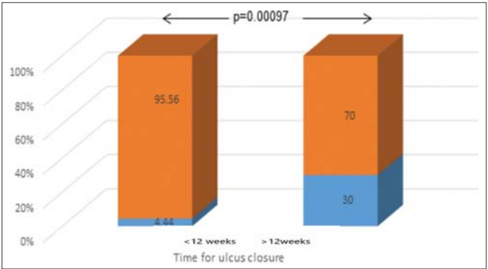
Background: The biggest challenge in patients with chronic venous insufficiency is venous ulcers that occur in stage 6 of the CEAP classification. In general, acute ulcers have a 71–80% chance of healing, while chronic ulcers only have a 22% chance of healing. Our clinical practice has shown that patients diagnosed with peripheral arterial occlusive disease have a much longer duration of the disease and a more difficult treatment of venous ulcers than patients with normal arterial circulation. Materials and Methods: The study included 105 patients with CVI and a developed leg ulcer. Among these, twenty patients were diagnosed with peripheral arterial occlusive disease. All patients were followed for more than twelve weeks. Results: Peripheral arterial occlusive disease was significantly more common in patients with delayed healing than in patients with normal venous ulcer healing: 18 (30%) vs. 2 (4.4%). for twelve weeks or longer, and it was statistically significant for p = 0.00097. Conclusion: Peripheral arterial occlusive disease has been shown to be an important indicator of venous epithelial wound healing. The establishment of good arterial circulation is closely related to the course of treatment of chronic venous ulcers.
Overview
AI snapshot
Written from the paper’s full text.
TL;DR
In 105 patients with chronic venous insufficiency and leg ulcers, peripheral arterial occlusive disease (PAOD) was strongly associated with delayed venous ulcer healing. PAOD was present in 18 (30%) of patients with delayed healing versus 2 (4.4%) of those with normal healing.
Key findings
- PAOD was significantly more common in delayed healing than normal healing: 18 (30%) vs. 2 (4.4%), p = 0.00097.
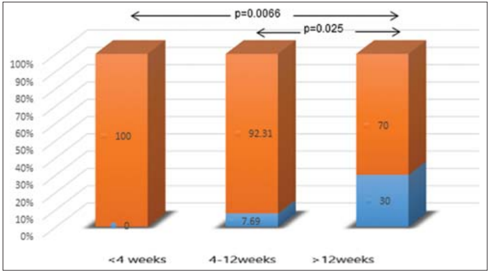
- Among patients with PAOD, ulcer closure took 4–12 weeks in 2 (7.7%) and ≥12 weeks in 18 (30%); no patient with closure <4 weeks had PAOD.
- The distribution difference was statistically significant between rapid and delayed healing (p = 0.0066) and between normal and delayed healing (p = 0.025).
- The authors conclude PAOD is an important indicator/predictive factor for venous ulcer healing and that good arterial circulation is closely related to treatment course.
Methods
- Study included 105 patients with CVI and a developed leg ulcer; 20 were diagnosed with PAOD. All were followed for more than twelve weeks.
- Patients were divided by ulcer duration: normal closure up to twelve weeks versus longer than twelve weeks; a secondary table also reports rapid (<4 weeks), normal (4–12 weeks), and delayed (>12 weeks) healing.
- All received wound dressing and venotonics, with compression therapy given only to patients not diagnosed with PAOD. Analysis used Pearson chi-square tests.
Limitations
- The paper does not state limitations.
- Evident from the text: the PAOD subgroup was small (n = 20), and compression therapy was withheld from PAOD patients, so treatment differed between groups.
Model-written summary. Check it against the paper before relying on it.
Integrity signals
Registry
Cites
Statistics
Figures
Verification
Claims the paper makes
6 Own result · 3 Own interpretation
A result the paper reports from its own data — it cites no other source for it, so there is none to check. The quote shows it is in the paper.
In the paper
“Patients with ulcer closure shorter than four weeks did not have peripheral arterial occlusive disease.”
- Also stated in: § DISCUSSION · p. 2 · plain
“No patients diagnosed with peripheral arterial occlusive disease were observed in the group of rapidly closing ulcers up to four weeks after the beginning of treatment.”
plain- Asserted: passes — The authors put it forward as true.
- Checkable: passes — It can be checked against evidence.
- Load-bearing: passes — The paper’s conclusions depend on it.
- Based: passes — The paper gives a reason why it holds.
- Also stated in: § DISCUSSION · p. 2 · plain
A result the paper reports from its own data — it cites no other source for it, so there is none to check. The quote shows it is in the paper.
In the paper
“The test difference in the distribution of the patients with and without peripheral arterial occlusive disease was confirmed as statistically significant between the groups with rapidly delayed venous ulcer healing (p = 0.0066) and between the groups with normal and delayed healing (p = 0.025).”
boostedcorrelational- Asserted: passes — The authors put it forward as true.
- Checkable: passes — It can be checked against evidence.
- Load-bearing: passes — The paper’s conclusions depend on it.
- Based: passes — The paper gives a reason why it holds.
A result the paper reports from its own data — it cites no other source for it, so there is none to check. The quote shows it is in the paper.
In the paper
“The patients with delayed venous ulcer healing were significantly more likely to have peripheral arterial occlusive disease when compared to patients with rapid and normal healing.”
plaincorrelational- Asserted: passes — The authors put it forward as true.
- Checkable: passes — It can be checked against evidence.
- Load-bearing: passes — The paper’s conclusions depend on it.
- Based: passes — The paper gives a reason why it holds.
A result the paper reports from its own data — it cites no other source for it, so there is none to check. The quote shows it is in the paper.
In the paper
“Peripheral arterial occlusive disease was significantly more common in patients with delayed healing than in patients with normal venous ulcer healing - 18 (30%) vs 2 (4.4%). of 12 weeks or 12 weeks and longer, and it was statistically significant for p = 0.00097 (Table 1); (Fig. 1).”
- Also stated in: § ABSTRACT · p. 1 · plain
“Peripheral arterial occlusive disease was significantly more common in patients with delayed healing than in patients with normal venous ulcer healing: 18 (30%) vs. 2 (4.4%). for twelve weeks or longer, and it was statistically significant for p = 0.00097.”
plaincorrelationaln = 105 ·- Asserted: passes — The authors put it forward as true.
- Checkable: passes — It can be checked against evidence.
- Load-bearing: passes — The paper’s conclusions depend on it.
- Based: passes — The paper gives a reason why it holds.
- Also stated in: § ABSTRACT · p. 1 · plain
A result the paper reports from its own data — it cites no other source for it, so there is none to check. The quote shows it is in the paper.
In the paper
“The test difference in the distribution of the patients with and without peripheral arterial occlusive disease was confirmed as statistically significant between the groups with rapidly delayed venous ulcer healing (p = 0.0066) and between the groups with normal and delayed healing (p = 0.025).”
boostedcorrelational- Asserted: passes — The authors put it forward as true.
- Checkable: passes — It can be checked against evidence.
- Load-bearing: passes — The paper’s conclusions depend on it.
- Based: passes — The paper gives a reason why it holds.
A conclusion the paper draws from its own results — it cites no other source for it, so there is none to check. The quote shows it is in the paper.
In the paper
“Peripheral arterial occlusive disease has been shown to be an important predictive factor in the duration of venous ulcers.”
boostedcorrelational- Asserted: passes — The authors put it forward as true.
- Checkable: passes — It can be checked against evidence.
- Load-bearing: passes — The paper’s conclusions depend on it.
- Based: passes — The paper gives a reason why it holds.
A conclusion the paper draws from its own results — it cites no other source for it, so there is none to check. The quote shows it is in the paper.
In the paper
“Peripheral arterial occlusive disease has been shown to be an important indicator of venous epithelial wound healing.”
- Also stated in: § CONCLUSION · p. 3 · boosted
“Peripheral arterial occlusive disease has been shown to be an important indicator of venous epithelial wound healing.”
boostedcorrelationaln = 105- Asserted: passes — The authors put it forward as true.
- Checkable: passes — It can be checked against evidence.
- Load-bearing: passes — The paper’s conclusions depend on it.
- Based: passes — The paper gives a reason why it holds.
- Also stated in: § CONCLUSION · p. 3 · boosted
A conclusion the paper draws from its own results — it cites no other source for it, so there is none to check. The quote shows it is in the paper.
In the paper
“The establishment of good arterial circulation is closely related to the course of treatment of chronic venous ulcers.”
- Also stated in: § CONCLUSION · p. 3 · plain
“The establishment of good arterial circulation is closely related to the course of treatment of chronic venous ulcers.”
plaincorrelationaln = 105- Asserted: passes — The authors put it forward as true.
- Checkable: passes — It can be checked against evidence.
- Load-bearing: passes — The paper’s conclusions depend on it.
- Based: passes — The paper gives a reason why it holds.
- Also stated in: § CONCLUSION · p. 3 · plain
- It may state two separate claims as one. 1
A result the paper reports from its own data — it cites no other source for it, so there is none to check. The quote shows it is in the paper.
In the paper
“With peripheral arterial occlusive disease, ulcer closure took between four to twelve weeks in two (7.7%) patients and twelve weeks or more in eighteen (30%) patients.”
plain- Asserted: passes — The authors put it forward as true.
- Checkable: passes — It can be checked against evidence.
- Load-bearing: passes — The paper’s conclusions depend on it.
- Based: passes — The paper gives a reason why it holds.
It may state two separate claims as one.
The paper relies on this without support.
Patients diagnosed with peripheral arterial occlusive disease have a much longer duration of the disease and a more difficult treatment of venous ulcers than patients with normal arterial circulation.
“Our clinical practice has shown that patients diagnosed with peripheral arterial occlusive disease have a much longer duration of the disease and a more difficult treatment of venous ulcers than patients with normal arterial circulation.”
“Our clinical practice has shown that patients diagnosed with peripheral arterial occlusive disease have a much longer duration of the disease and a more difficult treatment of venous ulcers than patients with normal arterial circulation.”
Self-check
Percentages, sums and reported differences re-computed from the paper’s own numbers.
Each contradiction between two passages listed here was confirmed by an independent check.
Rated minor: it would not touch a result — a value no result rests on, a p-value that stays on the same side of the significance level, or a conflict that is clerical, resolved elsewhere in the paper, or outside its own findings.
In the paper
§ RESULTS · p. 2
“X 2 (Pearson Chi-square) ***p<0.0001”
§ RESULTS · p. 2
“X 2 =10.89 ***p=0.00097 sig”
Citations
Cites
Still being checked.
Research works printed but not linked: 11
- [1]1. Recek C. Calf pump activity infl uencing venous hemodynamics in the lower extremity. Int J Angiol. 2013;22:23-30.
- [2]2. Franz A, Berndt F, Raabe J, Harmsen JF, Zilkens C, Behringer M. Invasive assessment of hemodynamic, metabolic and ionic consequences during blood fl ow restriction training. Front Physiol. 2020;11:617668.
- [3]3. Youn YJ, Lee J. Chronic venous insuffi ciency and varicose veins of the lower extremities. Korean J Intern Med. 2019;34:269-83.
- [4]4. Lohr JM, Bush RL. Venous disease in women: Epidemiology, manifestations, and treatment. J Vasc Surg. 2013;57:37S-45S.
- [5]5. Kirsten N, Mohr N, Gensel F, Alhumam A, Bruning G, Augustin M. Population-based epidemiologic study in venous diseases in Germany: Prevalence, comorbidity, and medical needs in a cohort of 19,104 workers. Vasc Health Risk Manag. 2021;17:679-87.
- [7]7. Raffetto JD. Pathophysiology of wound healing and alterations in venous leg ulcers-review. Phlebology. 2016;31:56-62.
- [8]8. Mansilha A, Sousa J. Pathophysiological mechanisms of chronic venous disease and implications for venoactive drug therapy. Int J Mol Sci. 2018;19:1669.
- [9]9. Szewczyk MT, Mo ś cicka P, Jawie ń A, Cwajda-Bia ł asik J, Cierzniakowska K, Ś lusarz R, et al. Quality of life in patients with leg ulcers or skin lesions: A pilot study. Postepy Dermatol Alergol. 2015;32:465-9.
- [10]10. Vishwanath V. Quality of life: Venous leg ulcers. Indian Dermatol Online J. 2014;5:397-9.
- [12]12. Raffetto JD, Ligi D, Maniscalco R, Khalil RA, Mannello F. Why venous leg ulcers have difficulty healing: Overview on pathophysiology, clinical consequences, and treatment. J Clin Med. 2020;10:29.
- [13]13. Manna B, Nahirniak P, Morrison CA. Wound Debridement. 2021 Sep 6. In: StatPearls [Internet]. Treasure Island (FL): StatPearls Publishing; 2022. PMID: 29939659.
Cited by
Sorted by citations
Comorbidities as prognostic factors in the healing of venous ulcers
Vasileva, M., Brishkoska-Boshkovski, V., & Sersemova, E. D. (2023) · Our Dermatology Online · doi:10.7241/ourd.20232.10 · Cited by 4
Self-citation
Metadata
- Authors
- Vasilev, B., Vasileva, M., & Vasileva, S.
- ORCID
- Vasileva, Mirela
- Venue
- Our Dermatology Online
- Publisher
- Our Dermatology Online
- Published
- 2022-07-01
- Volume
- 13
- Issue
- 3
- Pages
- 280-282
- ISSN
- 2081-9390 (ISSN-L)
- OpenAlex
- W4283643434
- Cited by
- 1
- References
- 0
- Citations by year
- 2023: 1
- FWCI
- 0.21
- Type
- journal article
- Language
- en
- Open access
- diamond
- doi.org
- Locations
- Our Dermatology Online (publishedVersion)
- Topics
- Health Sciences › Medicine › Surgery › Diagnosis and Treatment of Venous Diseases
- Health Sciences › Medicine › Surgery › Wound Healing and Treatments
- Health Sciences › Medicine › Surgery › Peripheral Artery Disease Management
- Keywords
- peripheral arterial disease, venous ulcers, chronic venous insufficiency, wound healing, leg ulcers, CEAP classification, arterial circulation, delayed healing
About these checks
Registry, retraction, Cites and statistics results are computed, not judged, with one exception: a printed reference that no index lists is read once by a model before it counts as a citation error. Claims are extracted by a model and kept only when their quote appears verbatim in the text; each cited source is then checked, with a model’s help, for whether it says what the claim relies on. Those verdicts can be wrong — read the claim’s quote and the cited source before relying on one.
A language model drew the claims from the paper on 2026-11-11, under version 3 of the claim definition (model deepseek-v4.1-flash, prompt extract-v3).
A second model labelled each claim on 2026-11-11 (model jev-1.13-20260917, definition revision gold-guideline-v0.2).
Statistics and arithmetic are recomputed, not judged.
Confidence bands are shown only for fields calibrated on our annotated test set. None is calibrated yet, so no band is shown.
What counts as a claim ›How we measure confidence ›How we check this ›
Are you an author, or do you see a problem with this page? Request a review
