

The DOI matches its Crossref record; 23 of the 63 references it cites were found in a registry or an index, and 4 are not checked yet; none of the 49 sources its claims cite is checked for support yet.
Political Economy and Knowledge Production in the Making of the Viceroyalty of New Granada
Open accessAbstract
Objective/Context: During the eighteenth century, officials from different colonial powers attempted to turn the viceroyalty of the New Kingdom of Granada—present-day Colombia, Ecuador, Venezuela, and Panama—into an economically viable territory. The Spanish Crown embraced its most radical jurisdictional reform in centuries to exercise effective state control, extract more revenue, and defend the colonies from foreign incursions. This article explores the particularities of New Granada’s economic governance and argues that colonial officials produced local discourses of political economy to turn unfamiliar spaces into familiar places for economic, political, and military ends. In doing so, producing knowledge about the land and its resources became a key bureaucratic practice that shaped the imagining of a paradoxical territoriality in Northern South America. First, I detail the impact of political economy frameworks on imperial governance and bureaucratic practices. I then showcase how administrative narratives, mapping projects, and fiscal networks reveal the workings of Bourbon economic governance and the search for regional integration. Methodology: This article is built from an analysis of archival documents consisting of a selection of evidence from chorographic texts about New Granada and its provinces produced between 1720 and 1808. Originality: Reflecting on the ways in which the pursuit of knowledge for wealth creation affected the creation of territorialities contributes to uncovering how the imperial political economy was never a top-down imposition. Local officials negotiated it vis-à-vis singular geographical realities and knowledge production practices. Conclusions: Chorographic texts were central devices of imperial reform. The search for wealth production and territorial integration occurred in colonial outposts, not in intellectual treatises in Europe. In forging New Granada as an integrated, potentially rich place, bureaucrats’ experience of moving across the territory and inscribing the landscape on paper shaped perceptions of cohesion and difference, economic dependence, and regional fragmentation.
Checked 2026-11-10 · 4 references not checked yet
Overview
AI snapshot
Written from the paper’s full text.
TL;DR
This article argues that eighteenth-century Spanish imperial reform in the Viceroyalty of New Granada was driven less by European intellectual treatises than by colonial bureaucrats producing "chorographic" knowledge—maps, reports, natural histories, and geographic descriptions—that rendered unfamiliar territory legible for taxation, defense, and wealth extraction. It shows that this knowledge production forged a paradoxical territoriality: an imagined cohesive, resource-rich viceroyalty that was in practice regionally fragmented and contested.
Key findings
- The Bourbon Crown established the viceroyalty of the New Kingdom of Granada between 1717 and 1723, extinguished it in 1723, and restored it in 1739; the Real Cédula of August 20, 1739, defined its jurisdiction as including "Choco, Popayan, the kingdom of de Quito and Guayaquil, the province of Antioquia, Cartagena, Santa Marta, Rio del Hacha, Maracaibo, Caracas, Cumana, Guayana, Islands of Trinidad and Margarita, and Orinoco River, provinces of Panama, Portobelo, Veragua and Darién."
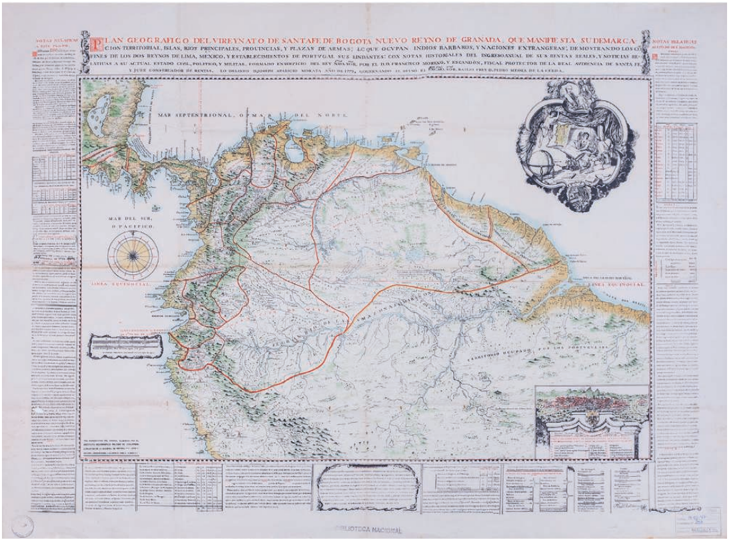
- Francisco Antonio Moreno y Escandón's 1772 *Plan Geográfico del Virreinato de Santafé de Bogotá* depicted the viceroyalty as a single bounded unit separated by a thick line from Peru and New Spain, while its margins carried statistical charts on the Royal Treasury, salaries, cities, towns, missions, and tributary populations—making the map a fiscal-administrative instrument rather than a neutral representation.
- Fiscal interdependence ran contrary to the imagined cohesion: Meisel's analysis of Cartagena's incomes from 1751 to 1808 shows the *situado* (intra-imperial money transfers) "became the vital sustenance of the public finances and economy of Cartagena," funded by surpluses from Andean treasuries such as Honda and Mompox and remittances from Quito and Santa Fe.
- Jurisdictional reform generated inter-colonial conflict: Peruvian authorities and merchants protested the separation of Panama and Guayaquil, and a royal decree in 1803 ordered Guayaquil's annexation to the Viceroyalty of Peru, a dispute that persisted into the independence struggles.
Methods
- Archival analysis of a selection of chorographic texts about New Granada and its provinces produced between 1720 and 1808, including maps, economic improvement projects, administrative reports and petitions, geographic descriptions, and natural histories.
- Sources drawn from the Archivo General de Indias (Seville), the Biblioteca Nacional de Colombia, and published primary sources such as Campillo y Cossío's *Nuevo sistema de gobierno económico para la América* (1743), Gumilla's *El Orinoco Ilustrado* (1741), and Moreno y Escandón's "Estado del Virreinato de Santafé."
- Qualitative historical analysis organized around three themes: imperial reform and political economy, wealth creation and cartography, and Andean–Caribbean fiscal and commercial relations.
Limitations
- The paper states no explicit limitations section.
- Evident from the text: the author notes that "it is unclear how many local officials submitted chorographic reports," so the representativeness of the surviving reports cannot be established.
- Evident from the text: the analysis rests on a "selection of evidence," and the author repeatedly relies on secondary scholarship (Eissa-Barroso, Paquette, Meisel, Múnera, Grafe) for key claims about fiscal flows and merchant conflict rather than on primary quantification.
Model-written summary. Check it against the paper before relying on it.
Integrity signals
Registry
Cites
Statistics
Figures
Verification
Claims the paper makes
97 Own interpretation · 70 No basis given · 46 Sources not found · 4 Own result · 3 Not checked yet · 2 No full text of the sources
None of the sources cited for this claim have been checked yet.
In the paper
“The Jesuit priest Joseph Gumilla highlighted the agricultural and commercial potential of the Orinoco basin in the northern South American kingdom of New Granada in his widely read 1741 book El Orinoco Ilustrado.”
§ Political Economy and Knowledge Production in the Making of the Viceroyalty of New Granada • > Introduction
plain- Asserted: passes — The authors put it forward as true.
- Checkable: passes — It can be checked against evidence.
- Load-bearing: unclear — It is unclear whether the paper’s conclusions depend on it.
- Based: passes — The paper gives a reason why it holds.
The paper states this without a source or data behind it here, so there is nothing to check it against. The quote shows it is in the paper.
In the paper
“Gumilla, determined to raise awareness of the region's natural riches, encouraged Spaniards to settle in the fertile lowlands of the Orinoco River and establish villages and cattle ranches.”
§ Political Economy and Knowledge Production in the Making of the Viceroyalty of New Granada • > Introduction
plaindirect- Asserted: passes — The authors put it forward as true.
- Checkable: passes — It can be checked against evidence.
- Load-bearing: unclear — It is unclear whether the paper’s conclusions depend on it.
- Based: passes — The paper gives a reason why it holds.
The paper states this without a source or data behind it here, so there is nothing to check it against. The quote shows it is in the paper.
In the paper
“Local administrators responded to the petition.”
§ Political Economy and Knowledge Production in the Making of the Viceroyalty of New Granada • > 3. Wealth Creation, Cartography, and the Search for Legibility
plaindirect- Asserted: passes — The authors put it forward as true.
- Checkable: passes — It can be checked against evidence.
- Load-bearing: unclear — It is unclear whether the paper’s conclusions depend on it.
- Based: passes — The paper gives a reason why it holds.
The paper states this without a source or data behind it here, so there is nothing to check it against. The quote shows it is in the paper.
In the paper
“Spanish reformers considered the possibility of partially integrating independent indigenous groups into colonial society through trade.”
§ Political Economy and Knowledge Production in the Making of the Viceroyalty of New Granada • > 3. Wealth Creation, Cartography, and the Search for Legibility
plain- Asserted: passes — The authors put it forward as true.
- Checkable: passes — It can be checked against evidence.
- Load-bearing: unclear — It is unclear whether the paper’s conclusions depend on it.
- Based: passes — The paper gives a reason why it holds.
In the paper
“Later on, a royal decree in 1803 ordered the annexation of Guayaquil to the Viceroyalty of Peru.”
§ Political Economy and Knowledge Production in the Making of the Viceroyalty of New Granada • > 2. The Economic Government of America and the Viceroyalty of New Granada
What the sources say
- Not matchedcites [47]
Couldn’t be matched to a paper in Crossref, so it can’t be checked.
plain- Asserted: passes — The authors put it forward as true.
- Checkable: passes — It can be checked against evidence.
- Load-bearing: unclear — It is unclear whether the paper’s conclusions depend on it.
- Based: passes — The paper gives a reason why it holds.
- Not matched
The paper states this without a source or data behind it here, so there is nothing to check it against. The quote shows it is in the paper.
In the paper
“The effort was supported by a network of royal bureaucrats from the fiscal, military, and ecclesiastical administrations.”
§ Political Economy and Knowledge Production in the Making of the Viceroyalty of New Granada • > 3. Wealth Creation, Cartography, and the Search for Legibility
plaindirect- Asserted: passes — The authors put it forward as true.
- Checkable: passes — It can be checked against evidence.
- Load-bearing: unclear — It is unclear whether the paper’s conclusions depend on it.
- Based: passes — The paper gives a reason why it holds.
The paper states this without a source or data behind it here, so there is nothing to check it against. The quote shows it is in the paper.
In the paper
“Bureaucrats in Santa Fe readily worked towards inscribing the space of the viceroyalty in chorographic texts.”
§ Political Economy and Knowledge Production in the Making of the Viceroyalty of New Granada • > 2. The Economic Government of America and the Viceroyalty of New Granada
plain- Asserted: passes — The authors put it forward as true.
- Checkable: passes — It can be checked against evidence.
- Load-bearing: passes — The paper’s conclusions depend on it.
- Based: passes — The paper gives a reason why it holds.
In the paper
“Decades later, in 1779, the controversy was still current as José García de León y Pizarro, President of Quito's Audiencia, revisited the issue to attempt to segregate Guayaquil from the newly created viceroyalty.46”
§ Political Economy and Knowledge Production in the Making of the Viceroyalty of New Granada • > 2. The Economic Government of America and the Viceroyalty of New Granada
What the sources say
- Not matchedcites [46]
Couldn’t be matched to a paper in Crossref, so it can’t be checked.
plain- Asserted: passes — The authors put it forward as true.
- Checkable: passes — It can be checked against evidence.
- Load-bearing: unclear — It is unclear whether the paper’s conclusions depend on it.
- Based: passes — The paper gives a reason why it holds.
- Not matched
The paper states this without a source or data behind it here, so there is nothing to check it against. The quote shows it is in the paper.
In the paper
“In December 1770, Viceroy Pedro Messía de la Cerda requested local officials throughout the kingdom to produce reports on the territories under their command.”
§ Political Economy and Knowledge Production in the Making of the Viceroyalty of New Granada • > 3. Wealth Creation, Cartography, and the Search for Legibility
plain- Asserted: passes — The authors put it forward as true.
- Checkable: passes — It can be checked against evidence.
- Load-bearing: passes — The paper’s conclusions depend on it.
- Based: passes — The paper gives a reason why it holds.
The paper states this without a source or data behind it here, so there is nothing to check it against. The quote shows it is in the paper.
In the paper
“Few local governments had access to trained surveyors or cartographers.”
§ Political Economy and Knowledge Production in the Making of the Viceroyalty of New Granada • > 3. Wealth Creation, Cartography, and the Search for Legibility
plain- Asserted: passes — The authors put it forward as true.
- Checkable: passes — It can be checked against evidence.
- Load-bearing: unclear — It is unclear whether the paper’s conclusions depend on it.
- Based: unclear — It is unclear why the paper says it holds.
In the paper
“Along with the report, he ordered the creation of a map of the viceroyalty, entitled Plan Geográfico del Virreynato de Santafe de Bogotá, Nuevo Reyno de Granada in 1772.50”
§ Political Economy and Knowledge Production in the Making of the Viceroyalty of New Granada • > 3. Wealth Creation, Cartography, and the Search for Legibility
What the sources say
- Not matchedcites [50]
Couldn’t be matched to a paper in Crossref, so it can’t be checked.
plain- Asserted: passes — The authors put it forward as true.
- Checkable: passes — It can be checked against evidence.
- Load-bearing: unclear — It is unclear whether the paper’s conclusions depend on it.
- Based: passes — The paper gives a reason why it holds.
- Not matched
The paper states this without a source or data behind it here, so there is nothing to check it against. The quote shows it is in the paper.
In the paper
“In a set of letters directed to royal officials in Madrid, Peruvian authorities and merchants protested the separation of Panama and Guayaquil from Perú.”
§ Political Economy and Knowledge Production in the Making of the Viceroyalty of New Granada • > 2. The Economic Government of America and the Viceroyalty of New Granada
plain- Asserted: passes — The authors put it forward as true.
- Checkable: passes — It can be checked against evidence.
- Load-bearing: unclear — It is unclear whether the paper’s conclusions depend on it.
- Based: passes — The paper gives a reason why it holds.
The paper states this without a source or data behind it here, so there is nothing to check it against. The quote shows it is in the paper.
In the paper
“For example, the change in jurisdiction impacted Peruvian mercantile interests.”
§ Political Economy and Knowledge Production in the Making of the Viceroyalty of New Granada • > 2. The Economic Government of America and the Viceroyalty of New Granada
plaindirect- Asserted: passes — The authors put it forward as true.
- Checkable: passes — It can be checked against evidence.
- Load-bearing: unclear — It is unclear whether the paper’s conclusions depend on it.
- Based: passes — The paper gives a reason why it holds.
In the paper
“For instance, from the viceroyalty's creation until the early 1800s, the expansion of imperial structures and policies of land redistribution led to an increase in the number of provinces or governorships.”
§ Political Economy and Knowledge Production in the Making of the Viceroyalty of New Granada • > 2. The Economic Government of America and the Viceroyalty of New Granada
What the sources say
- Not matchedcites [41]
Couldn’t be matched to a paper in Crossref, so it can’t be checked.
plaindirect- Asserted: passes — The authors put it forward as true.
- Checkable: passes — It can be checked against evidence.
- Load-bearing: unclear — It is unclear whether the paper’s conclusions depend on it.
- Based: passes — The paper gives a reason why it holds.
- Not matched
The paper states this without a source or data behind it here, so there is nothing to check it against. The quote shows it is in the paper.
In the paper
“Viceroy Messía de la Cerda attempted to craft his relación de mando (government report), relying on information provided by local administrators.”
§ Political Economy and Knowledge Production in the Making of the Viceroyalty of New Granada • > 3. Wealth Creation, Cartography, and the Search for Legibility
plaindirect- Asserted: passes — The authors put it forward as true.
- Checkable: passes — It can be checked against evidence.
- Load-bearing: unclear — It is unclear whether the paper’s conclusions depend on it.
- Based: passes — The paper gives a reason why it holds.
In the paper
“Within the provinces, new parishes and towns were created.41”
§ Political Economy and Knowledge Production in the Making of the Viceroyalty of New Granada • > 2. The Economic Government of America and the Viceroyalty of New Granada
What the sources say
- Not matchedcites [41]
Couldn’t be matched to a paper in Crossref, so it can’t be checked.
plain- Asserted: passes — The authors put it forward as true.
- Checkable: passes — It can be checked against evidence.
- Load-bearing: unclear — It is unclear whether the paper’s conclusions depend on it.
- Based: passes — The paper gives a reason why it holds.
- Not matched
The paper states this without a source or data behind it here, so there is nothing to check it against. The quote shows it is in the paper.
In the paper
“Local governors, fiscal administrators, and clergy members wrote their own reports.”
§ Political Economy and Knowledge Production in the Making of the Viceroyalty of New Granada • > 3. Wealth Creation, Cartography, and the Search for Legibility
plain- Asserted: passes — The authors put it forward as true.
- Checkable: passes — It can be checked against evidence.
- Load-bearing: passes — The paper’s conclusions depend on it.
- Based: passes — The paper gives a reason why it holds.
The paper states this without a source or data behind it here, so there is nothing to check it against. The quote shows it is in the paper.
In the paper
“Foreigners taught Neogranadian authorities about developing trade networks and English settlements on the Mosquito Coast.”
§ Political Economy and Knowledge Production in the Making of the Viceroyalty of New Granada • > 62
plaindirectSingle case- Asserted: passes — The authors put it forward as true.
- Checkable: passes — It can be checked against evidence.
- Load-bearing: unclear — It is unclear whether the paper’s conclusions depend on it.
- Based: passes — The paper gives a reason why it holds.
In the paper
“In the late eighteenth century, apprehensions regarding their territorial expansion into Calidonia and the Gulf of Darien escalated.63”
§ Political Economy and Knowledge Production in the Making of the Viceroyalty of New Granada • > 62
What the sources say
- Not matchedcites [63]
Couldn’t be matched to a paper in Crossref, so it can’t be checked.
plain- Asserted: passes — The authors put it forward as true.
- Checkable: passes — It can be checked against evidence.
- Load-bearing: passes — The paper’s conclusions depend on it.
- Based: passes — The paper gives a reason why it holds.
- Not matched
The paper states this without a source or data behind it here, so there is nothing to check it against. The quote shows it is in the paper.
In the paper
“Escandón's Plan barely depicts New Granada's viceroyalty economic connections with the Greater Caribbean region.”
§ Political Economy and Knowledge Production in the Making of the Viceroyalty of New Granada • > 4. The Paradoxes of Andean-Caribbean Relationships
plain- Asserted: passes — The authors put it forward as true.
- Checkable: passes — It can be checked against evidence.
- Load-bearing: passes — The paper’s conclusions depend on it.
- Based: passes — The paper gives a reason why it holds.
In the paper
“Moreno y Escandón proposed an education curriculum reform, which replaced theological philosophy with Enlightenment natural philosophy.68”
§ Political Economy and Knowledge Production in the Making of the Viceroyalty of New Granada • > 4. The Paradoxes of Andean-Caribbean Relationships
What the sources say
- Not matchedcites [68]
Couldn’t be matched to a paper in Crossref, so it can’t be checked.
plaindirect- Asserted: passes — The authors put it forward as true.
- Checkable: passes — It can be checked against evidence.
- Load-bearing: unclear — It is unclear whether the paper’s conclusions depend on it.
- Based: passes — The paper gives a reason why it holds.
- Not matched
In the paper
“Creole intellectuals in the capital led the expansion of the public sphere and the circulation of public discourse on political economy.69”
§ Political Economy and Knowledge Production in the Making of the Viceroyalty of New Granada • > 4. The Paradoxes of Andean-Caribbean Relationships
What the sources say
- Not matchedcites [69]
Couldn’t be matched to a paper in Crossref, so it can’t be checked.
plaindirect- Asserted: passes — The authors put it forward as true.
- Checkable: passes — It can be checked against evidence.
- Load-bearing: unclear — It is unclear whether the paper’s conclusions depend on it.
- Based: passes — The paper gives a reason why it holds.
- Not matched
In the paper
“In contrast to Escandón's portrayal of New Granada, Manuel de Anguiano's geographic-military description of Cartagena in 1805 emphasized the city's significance as a component of the viceroyalty's economic governance.”
§ Political Economy and Knowledge Production in the Making of the Viceroyalty of New Granada • > 4. The Paradoxes of Andean-Caribbean Relationships
What the sources say
- Not matchedcites [70]
Couldn’t be matched to a paper in Crossref, so it can’t be checked.
plainSingle case- Asserted: passes — The authors put it forward as true.
- Checkable: passes — It can be checked against evidence.
- Load-bearing: unclear — It is unclear whether the paper’s conclusions depend on it.
- Based: passes — The paper gives a reason why it holds.
- Not matched
The paper states this without a source or data behind it here, so there is nothing to check it against. The quote shows it is in the paper.
In the paper
“Anguiano's interpretation of the landscape of the viceroyalty of New Granada extended the defensive responsibilities of the province of Cartagena to include the protection of the region that connected the Caribbean and Pacific regions of the viceregal territory.”
§ Political Economy and Knowledge Production in the Making of the Viceroyalty of New Granada • > 70
plaindirect- Asserted: passes — The authors put it forward as true.
- Checkable: passes — It can be checked against evidence.
- Load-bearing: unclear — It is unclear whether the paper’s conclusions depend on it.
- Based: passes — The paper gives a reason why it holds.
The paper states this without a source or data behind it here, so there is nothing to check it against. The quote shows it is in the paper.
In the paper
“However, the king appointed Cartagena as the facilitator of the internal transportation routes and economic growth of the viceroyalty.”
§ Political Economy and Knowledge Production in the Making of the Viceroyalty of New Granada • > 72
plaindirect- Asserted: passes — The authors put it forward as true.
- Checkable: passes — It can be checked against evidence.
- Load-bearing: unclear — It is unclear whether the paper’s conclusions depend on it.
- Based: passes — The paper gives a reason why it holds.
In the paper
“Following the British capture of Portobello in 1739 and the attacks to the city in the following years, Cartagena experienced a golden age in the development of military fortifications that persisted for the entirety of the century.”
§ Political Economy and Knowledge Production in the Making of the Viceroyalty of New Granada • > 70
What the sources say
- Not matchedcites [72]
Couldn’t be matched to a paper in Crossref, so it can’t be checked.
plaindirect- Asserted: passes — The authors put it forward as true.
- Checkable: passes — It can be checked against evidence.
- Load-bearing: unclear — It is unclear whether the paper’s conclusions depend on it.
- Based: passes — The paper gives a reason why it holds.
- Not matched
The paper states this without a source or data behind it here, so there is nothing to check it against. The quote shows it is in the paper.
In the paper
“The construction of transportation routes to the coast was deemed a priority by Santa Fe's Consulado during periods of flour scarcity, to ease the movement of their products.”
§ Political Economy and Knowledge Production in the Making of the Viceroyalty of New Granada • > 72
plaindirect- Asserted: passes — The authors put it forward as true.
- Checkable: passes — It can be checked against evidence.
- Load-bearing: unclear — It is unclear whether the paper’s conclusions depend on it.
- Based: passes — The paper gives a reason why it holds.
The paper states this without a source or data behind it here, so there is nothing to check it against. The quote shows it is in the paper.
In the paper
“Anguiano provided an interpretation of the landscape in relation to Cartagena's role in defending Neogranadian resources.”
§ Political Economy and Knowledge Production in the Making of the Viceroyalty of New Granada • > 70
plaincorrelational- Asserted: passes — The authors put it forward as true.
- Checkable: passes — It can be checked against evidence.
- Load-bearing: unclear — It is unclear whether the paper’s conclusions depend on it.
- Based: passes — The paper gives a reason why it holds.
The paper states this without a source or data behind it here, so there is nothing to check it against. The quote shows it is in the paper.
In the paper
“Through the publication of several newspapers, such as the Papel Periódico de la Ciudad de Santa Fe (1791-1797), the Correo Curioso Erudito, Económico y Mercantil (Feb-Dec.1801), and the Semanario del Nuevo Reyno de Granada (1808-1809) knowledge of political economy and geography, climate, and population of the viceroyalty of New Granada circulated in a nascent public sphere.”
§ Political Economy and Knowledge Production in the Making of the Viceroyalty of New Granada • > Primary Sources
plaindirect- Asserted: passes — The authors put it forward as true.
- Checkable: passes — It can be checked against evidence.
- Load-bearing: passes — The paper’s conclusions depend on it.
- Based: passes — The paper gives a reason why it holds.
In the paper
“In the 1710s, Spanish reformers started to suggest that the nature of royal authority was not simply to provide order and justice but that the king had to promote the material welfare, common good, and economic and cultural progress of his subjects.17”
§ Political Economy and Knowledge Production in the Making of the Viceroyalty of New Granada • > 1. Imperial Reform, Political Economy, and Knowledge Production
What the sources say
- Not matchedcites [17]
Couldn’t be matched to a paper in Crossref, so it can’t be checked.
plain- Asserted: passes — The authors put it forward as true.
- Checkable: passes — It can be checked against evidence.
- Load-bearing: passes — The paper’s conclusions depend on it.
- Based: passes — The paper gives a reason why it holds.
- Not matched
A conclusion the paper draws from its own results — it cites no other source for it, so there is none to check. The quote shows it is in the paper.
In the paper
“Moreover, while territorial integration and wealth generation were difficult to achieve on the ground and were full of tensions among provinces within the viceroyalty, bureaucratic fiscal networks enabled it to function as an administrative whole that linked coastal and Andean areas, as well as the colony, to the Greater Caribbean and Europe.”
§ Political Economy and Knowledge Production in the Making of the Viceroyalty of New Granada • > Introduction
plaindirect- Asserted: passes — The authors put it forward as true.
- Checkable: passes — It can be checked against evidence.
- Load-bearing: passes — The paper’s conclusions depend on it.
- Based: passes — The paper gives a reason why it holds.
A conclusion the paper draws from its own results — it cites no other source for it, so there is none to check. The quote shows it is in the paper.
In the paper
“Their territorial descriptions and maps gave Spanish bureaucrats a spatial sense for establishing Bourbon economic governance in the eighteenth century.”
§ Political Economy and Knowledge Production in the Making of the Viceroyalty of New Granada • > Introduction
plaindirect- Asserted: passes — The authors put it forward as true.
- Checkable: passes — It can be checked against evidence.
- Load-bearing: passes — The paper’s conclusions depend on it.
- Based: passes — The paper gives a reason why it holds.
A conclusion the paper draws from its own results — it cites no other source for it, so there is none to check. The quote shows it is in the paper.
In the paper
“Local officials negotiated it vis-à-vis singular geographical realities and knowledge production practices.”
§ Political Economy and Knowledge Production in the Making of the Viceroyalty of New Granada • > Abstract
plaincorrelational- Asserted: passes — The authors put it forward as true.
- Checkable: passes — It can be checked against evidence.
- Load-bearing: passes — The paper’s conclusions depend on it.
- Based: passes — The paper gives a reason why it holds.
- Rests on an assumption: The selected chorographic texts are representative of broader bureaucratic knowledge production in New Granada.
In the paper
“In this reform agenda, one of the central problems of colonial state-building was making space legible.21”
§ Political Economy and Knowledge Production in the Making of the Viceroyalty of New Granada • > 1. Imperial Reform, Political Economy, and Knowledge Production
What the sources say
- Not matchedcites [21]
Couldn’t be matched to a paper in Crossref, so it can’t be checked.
plain- Asserted: passes — The authors put it forward as true.
- Checkable: passes — It can be checked against evidence.
- Load-bearing: passes — The paper’s conclusions depend on it.
- Based: passes — The paper gives a reason why it holds.
- Not matched
A conclusion the paper draws from its own results — it cites no other source for it, so there is none to check. The quote shows it is in the paper.
In the paper
“Colonial officials created political economy discourses that rendered conflicting territorialities in northern South America: a cohesive colony that was regionally differentiated.”
§ Political Economy and Knowledge Production in the Making of the Viceroyalty of New Granada • > Introduction
plaindirect- Asserted: passes — The authors put it forward as true.
- Checkable: passes — It can be checked against evidence.
- Load-bearing: passes — The paper’s conclusions depend on it.
- Based: unclear — It is unclear why the paper says it holds.
A conclusion the paper draws from its own results — it cites no other source for it, so there is none to check. The quote shows it is in the paper.
In the paper
“Colonial bureaucrats on the Orinoco's outskirts portrayed the region in their writings to make it visible to reformers in Madrid.”
§ Political Economy and Knowledge Production in the Making of the Viceroyalty of New Granada • > Introduction
plaindirect- Asserted: passes — The authors put it forward as true.
- Checkable: passes — It can be checked against evidence.
- Load-bearing: passes — The paper’s conclusions depend on it.
- Based: passes — The paper gives a reason why it holds.
In the paper
“In contrast to the first two hundred years of colonial rule, during the eighteenth century, the collection of knowledge began to coincide fully with a reform program formulated to exploit it.18”
§ Political Economy and Knowledge Production in the Making of the Viceroyalty of New Granada • > 1. Imperial Reform, Political Economy, and Knowledge Production
What the sources say
- Not matchedcites [18]
Couldn’t be matched to a paper in Crossref, so it can’t be checked.
plaincorrelational- Asserted: passes — The authors put it forward as true.
- Checkable: passes — It can be checked against evidence.
- Load-bearing: passes — The paper’s conclusions depend on it.
- Based: passes — The paper gives a reason why it holds.
- Not matched
A conclusion the paper draws from its own results — it cites no other source for it, so there is none to check. The quote shows it is in the paper.
In the paper
“In forging New Granada as an integrated, potentially rich place, bureaucrats' experience of moving across the territory and inscribing the landscape on paper shaped perceptions of cohesion and difference, economic dependence, and regional fragmentation.”
§ Political Economy and Knowledge Production in the Making of the Viceroyalty of New Granada • > Abstract
plaindirect- Asserted: passes — The authors put it forward as true.
- Checkable: passes — It can be checked against evidence.
- Load-bearing: passes — The paper’s conclusions depend on it.
- Based: passes — The paper gives a reason why it holds.
- Rests on an assumption: The selected chorographic texts are representative of broader bureaucratic knowledge production in New Granada.
A conclusion the paper draws from its own results — it cites no other source for it, so there is none to check. The quote shows it is in the paper.
In the paper
“Imperial governance and its main objective of increasing wealth needed the constant production and flow of documents from peripheral areas of the empire to main colonial cities and then to the metropolis.”
§ Political Economy and Knowledge Production in the Making of the Viceroyalty of New Granada • > 1. Imperial Reform, Political Economy, and Knowledge Production
plaindirect- Asserted: passes — The authors put it forward as true.
- Checkable: passes — It can be checked against evidence.
- Load-bearing: passes — The paper’s conclusions depend on it.
- Based: passes — The paper gives a reason why it holds.
A conclusion the paper draws from its own results — it cites no other source for it, so there is none to check. The quote shows it is in the paper.
In the paper
“In a context of inter-imperial competition, they applied the framework of political economy to figure out how to transform the natural riches of their territories into wealth for the Spanish Crown.”
§ Political Economy and Knowledge Production in the Making of the Viceroyalty of New Granada • > Introduction
plaindirect- Asserted: passes — The authors put it forward as true.
- Checkable: passes — It can be checked against evidence.
- Load-bearing: passes — The paper’s conclusions depend on it.
- Based: passes — The paper gives a reason why it holds.
A conclusion the paper draws from its own results — it cites no other source for it, so there is none to check. The quote shows it is in the paper.
In the paper
“Reflecting on the ways in which the pursuit of knowledge for wealth creation affected the creation of territorialities contributes to uncovering how the imperial political economy was never a top-down imposition.”
§ Political Economy and Knowledge Production in the Making of the Viceroyalty of New Granada • > Abstract
plain- Asserted: passes — The authors put it forward as true.
- Checkable: passes — It can be checked against evidence.
- Load-bearing: passes — The paper’s conclusions depend on it.
- Based: passes — The paper gives a reason why it holds.
- Rests on an assumption: The selected chorographic texts are representative of broader bureaucratic knowledge production in New Granada.
In the paper
“As a result, the new monarchy sought to create a uniform juridical framework for the Spanish Empire and its colonies to recover from the perception that the empire was failing.26”
§ Political Economy and Knowledge Production in the Making of the Viceroyalty of New Granada • > 2. The Economic Government of America and the Viceroyalty of New Granada
What the sources say
- Not matchedcites [26]
Couldn’t be matched to a paper in Crossref, so it can’t be checked.
plaindirect- Asserted: passes — The authors put it forward as true.
- Checkable: passes — It can be checked against evidence.
- Load-bearing: unclear — It is unclear whether the paper’s conclusions depend on it.
- Based: passes — The paper gives a reason why it holds.
- Not matched
A conclusion the paper draws from its own results — it cites no other source for it, so there is none to check. The quote shows it is in the paper.
In the paper
“Ideology, geopolitics, and knowledge practices influenced the Spanish reformation program in the colonial peripheries.”
§ Political Economy and Knowledge Production in the Making of the Viceroyalty of New Granada • > 1. Imperial Reform, Political Economy, and Knowledge Production
plaindirect- Asserted: passes — The authors put it forward as true.
- Checkable: passes — It can be checked against evidence.
- Load-bearing: passes — The paper’s conclusions depend on it.
- Based: passes — The paper gives a reason why it holds.
A conclusion the paper draws from its own results — it cites no other source for it, so there is none to check. The quote shows it is in the paper.
In the paper
“The paper technologies of empire-making were vital components of the social history of knowledge, colonial place-making, and political economy embedded in Spanish colonialism.”
§ Political Economy and Knowledge Production in the Making of the Viceroyalty of New Granada • > 1. Imperial Reform, Political Economy, and Knowledge Production
plaindirect- Asserted: passes — The authors put it forward as true.
- Checkable: passes — It can be checked against evidence.
- Load-bearing: passes — The paper’s conclusions depend on it.
- Based: passes — The paper gives a reason why it holds.
A conclusion the paper draws from its own results — it cites no other source for it, so there is none to check. The quote shows it is in the paper.
In the paper
“They studied and wrote about the landscape searching to turn it into a natural resource.”
§ Political Economy and Knowledge Production in the Making of the Viceroyalty of New Granada • > Introduction
plaindirect- Asserted: passes — The authors put it forward as true.
- Checkable: passes — It can be checked against evidence.
- Load-bearing: passes — The paper’s conclusions depend on it.
- Based: passes — The paper gives a reason why it holds.
A conclusion the paper draws from its own results — it cites no other source for it, so there is none to check. The quote shows it is in the paper.
In the paper
“The attempts to imagine and consolidate a viceroyalty in northern South America can be traced in a set of bureaucratic documents such as maps, economic improvement projects, administrative reports and petitions, geographic descriptions, and natural histories.”
§ Political Economy and Knowledge Production in the Making of the Viceroyalty of New Granada • > 1. Imperial Reform, Political Economy, and Knowledge Production
plaincorrelational- Asserted: passes — The authors put it forward as true.
- Checkable: passes — It can be checked against evidence.
- Load-bearing: passes — The paper’s conclusions depend on it.
- Based: passes — The paper gives a reason why it holds.
A conclusion the paper draws from its own results — it cites no other source for it, so there is none to check. The quote shows it is in the paper.
In the paper
“They worked to represent and transform New Granada into a territorial, economic, and administrative unit with a long-term vision of integration and wealth creation.”
§ Political Economy and Knowledge Production in the Making of the Viceroyalty of New Granada • > 1. Imperial Reform, Political Economy, and Knowledge Production
plaindirect- Asserted: passes — The authors put it forward as true.
- Checkable: passes — It can be checked against evidence.
- Load-bearing: passes — The paper’s conclusions depend on it.
- Based: passes — The paper gives a reason why it holds.
A conclusion the paper draws from its own results — it cites no other source for it, so there is none to check. The quote shows it is in the paper.
In the paper
“The search for wealth production and territorial integration occurred in colonial outposts, not in intellectual treatises in Europe.”
§ Political Economy and Knowledge Production in the Making of the Viceroyalty of New Granada • > Abstract
plain- Asserted: passes — The authors put it forward as true.
- Checkable: passes — It can be checked against evidence.
- Load-bearing: passes — The paper’s conclusions depend on it.
- Based: passes — The paper gives a reason why it holds.
- Rests on an assumption: The selected chorographic texts are representative of broader bureaucratic knowledge production in New Granada.
In the paper
“Through these devices, the Crown requested information to control space occupancy, taxation, and population distribution.15”
§ Political Economy and Knowledge Production in the Making of the Viceroyalty of New Granada • > 1. Imperial Reform, Political Economy, and Knowledge Production
What the sources say
- Not matchedcites [15]
Couldn’t be matched to a paper in Crossref, so it can’t be checked.
plaindirect- Asserted: passes — The authors put it forward as true.
- Checkable: passes — It can be checked against evidence.
- Load-bearing: unclear — It is unclear whether the paper’s conclusions depend on it.
- Based: passes — The paper gives a reason why it holds.
- Not matched
In the paper
“The production of relaciones geográficas consisting of questionnaires to gather information about the land and its people, was a Spanish policy since the sixteenth century.14”
§ Political Economy and Knowledge Production in the Making of the Viceroyalty of New Granada • > 1. Imperial Reform, Political Economy, and Knowledge Production
What the sources say
- Not matchedcites [14]
Couldn’t be matched to a paper in Crossref, so it can’t be checked.
plain- Asserted: passes — The authors put it forward as true.
- Checkable: passes — It can be checked against evidence.
- Load-bearing: unclear — It is unclear whether the paper’s conclusions depend on it.
- Based: passes — The paper gives a reason why it holds.
- Not matched
The paper states this without a source or data behind it here, so there is nothing to check it against. The quote shows it is in the paper.
In the paper
“This consisted of ordering the population and the landscape to help simplify state functions such as taxation, security, and wealth creation.”
§ Political Economy and Knowledge Production in the Making of the Viceroyalty of New Granada • > 1. Imperial Reform, Political Economy, and Knowledge Production
plaindirect- Asserted: passes — The authors put it forward as true.
- Checkable: passes — It can be checked against evidence.
- Load-bearing: passes — The paper’s conclusions depend on it.
- Based: passes — The paper gives a reason why it holds.
A conclusion the paper draws from its own results — it cites no other source for it, so there is none to check. The quote shows it is in the paper.
In the paper
“Chorographic texts were central devices of imperial reform.”
§ Political Economy and Knowledge Production in the Making of the Viceroyalty of New Granada • > Abstract
plaindirect- Asserted: passes — The authors put it forward as true.
- Checkable: passes — It can be checked against evidence.
- Load-bearing: passes — The paper’s conclusions depend on it.
- Based: passes — The paper gives a reason why it holds.
- Rests on an assumption: The selected chorographic texts are representative of broader bureaucratic knowledge production in New Granada.
A conclusion the paper draws from its own results — it cites no other source for it, so there is none to check. The quote shows it is in the paper.
In the paper
“In doing so, producing knowledge about the land and its resources became a key bureaucratic practice that shaped the imagining of a paradoxical territoriality in Northern South America.”
§ Political Economy and Knowledge Production in the Making of the Viceroyalty of New Granada • > Abstract
plaindirect- Asserted: passes — The authors put it forward as true.
- Checkable: passes — It can be checked against evidence.
- Load-bearing: passes — The paper’s conclusions depend on it.
- Based: passes — The paper gives a reason why it holds.
- Rests on an assumption: The selected chorographic texts are representative of broader bureaucratic knowledge production in New Granada.
A conclusion the paper draws from its own results — it cites no other source for it, so there is none to check. The quote shows it is in the paper.
In the paper
“This article explores the particularities of New Granada's economic governance and argues that colonial officials produced local discourses of political economy to turn unfamiliar spaces into familiar places for economic, political, and military ends.”
§ Political Economy and Knowledge Production in the Making of the Viceroyalty of New Granada • > Abstract
plaindirect- Asserted: passes — The authors put it forward as true.
- Checkable: passes — It can be checked against evidence.
- Load-bearing: passes — The paper’s conclusions depend on it.
- Based: passes — The paper gives a reason why it holds.
- Rests on an assumption: The selected chorographic texts are representative of broader bureaucratic knowledge production in New Granada.
A conclusion the paper draws from its own results — it cites no other source for it, so there is none to check. The quote shows it is in the paper.
In the paper
“Therefore, most of the local chorographic texts presented descriptive information about local territories gathered through the experience and observations of local administrators.”
§ Political Economy and Knowledge Production in the Making of the Viceroyalty of New Granada • > 3. Wealth Creation, Cartography, and the Search for Legibility
plain- Asserted: passes — The authors put it forward as true.
- Checkable: passes — It can be checked against evidence.
- Load-bearing: unclear — It is unclear whether the paper’s conclusions depend on it.
- Based: passes — The paper gives a reason why it holds.
A conclusion the paper draws from its own results — it cites no other source for it, so there is none to check. The quote shows it is in the paper.
In the paper
“By the early 1770s, colonial reformers sought to depict the viceroyalty as a cohesive administrative and geographic space, distinguished from Perú.”
§ Political Economy and Knowledge Production in the Making of the Viceroyalty of New Granada • > 2. The Economic Government of America and the Viceroyalty of New Granada
plain- Asserted: passes — The authors put it forward as true.
- Checkable: passes — It can be checked against evidence.
- Load-bearing: passes — The paper’s conclusions depend on it.
- Based: passes — The paper gives a reason why it holds.
A conclusion the paper draws from its own results — it cites no other source for it, so there is none to check. The quote shows it is in the paper.
In the paper
“This reflects royal concerns about the viceroyalty's vulnerability compared to the strength of other empires in alliance with independent indigenous groups.”
§ Political Economy and Knowledge Production in the Making of the Viceroyalty of New Granada • > 3. Wealth Creation, Cartography, and the Search for Legibility
plaindirect- Asserted: passes — The authors put it forward as true.
- Checkable: passes — It can be checked against evidence.
- Load-bearing: unclear — It is unclear whether the paper’s conclusions depend on it.
- Based: passes — The paper gives a reason why it holds.
A conclusion the paper draws from its own results — it cites no other source for it, so there is none to check. The quote shows it is in the paper.
In the paper
“The proposal for a new viceroyalty included a knowledge-gathering strategy.”
§ Political Economy and Knowledge Production in the Making of the Viceroyalty of New Granada • > 2. The Economic Government of America and the Viceroyalty of New Granada
plain- Asserted: passes — The authors put it forward as true.
- Checkable: passes — It can be checked against evidence.
- Load-bearing: passes — The paper’s conclusions depend on it.
- Based: passes — The paper gives a reason why it holds.
A conclusion the paper draws from its own results — it cites no other source for it, so there is none to check. The quote shows it is in the paper.
In the paper
“Despite detaching the territories of Venezuela, Neogranadian territorialization advanced significantly throughout the century.”
§ Political Economy and Knowledge Production in the Making of the Viceroyalty of New Granada • > 2. The Economic Government of America and the Viceroyalty of New Granada
plain- Asserted: passes — The authors put it forward as true.
- Checkable: passes — It can be checked against evidence.
- Load-bearing: unclear — It is unclear whether the paper’s conclusions depend on it.
- Based: passes — The paper gives a reason why it holds.
In the paper
“The Council of the Indies sent petitions to America regularly, requesting that royal officials map, evaluate, and control potential sources of wealth for the empire.38”
§ Political Economy and Knowledge Production in the Making of the Viceroyalty of New Granada • > 2. The Economic Government of America and the Viceroyalty of New Granada
What the sources say
- Not matchedcites [38]
Couldn’t be matched to a paper in Crossref, so it can’t be checked.
plain- Asserted: passes — The authors put it forward as true.
- Checkable: passes — It can be checked against evidence.
- Load-bearing: unclear — It is unclear whether the paper’s conclusions depend on it.
- Based: passes — The paper gives a reason why it holds.
- Not matched
A conclusion the paper draws from its own results — it cites no other source for it, so there is none to check. The quote shows it is in the paper.
In the paper
“They sought to advance commercial and territorial visions of the provinces to improve the newly created viceroyalty's position within the empire.”
§ Political Economy and Knowledge Production in the Making of the Viceroyalty of New Granada • > 2. The Economic Government of America and the Viceroyalty of New Granada
plaindirect- Asserted: passes — The authors put it forward as true.
- Checkable: passes — It can be checked against evidence.
- Load-bearing: unclear — It is unclear whether the paper’s conclusions depend on it.
- Based: passes — The paper gives a reason why it holds.
A conclusion the paper draws from its own results — it cites no other source for it, so there is none to check. The quote shows it is in the paper.
In the paper
“In tandem with foreign incursions-such as the British attack on Portobelo in 1739-Bourbon territorial reform unleashed inter-colonial geopolitical and economic conflicts with long-lasting consequences in South America.”
§ Political Economy and Knowledge Production in the Making of the Viceroyalty of New Granada • > 2. The Economic Government of America and the Viceroyalty of New Granada
plaindirect- Asserted: passes — The authors put it forward as true.
- Checkable: passes — It can be checked against evidence.
- Load-bearing: unclear — It is unclear whether the paper’s conclusions depend on it.
- Based: passes — The paper gives a reason why it holds.
A conclusion the paper draws from its own results — it cites no other source for it, so there is none to check. The quote shows it is in the paper.
In the paper
“For this exercise in spatial imagination to succeed, emulation of French political economy proved crucial.”
§ Political Economy and Knowledge Production in the Making of the Viceroyalty of New Granada • > 2. The Economic Government of America and the Viceroyalty of New Granada
plaindirect- Asserted: passes — The authors put it forward as true.
- Checkable: passes — It can be checked against evidence.
- Load-bearing: passes — The paper’s conclusions depend on it.
- Based: passes — The paper gives a reason why it holds.
In the paper
“Over a decade later, the upsurge of tensions between Spain and Britain, stemming from the Treaty of Utrecht, led to the restoration of the viceroyalty in 1739.34”
§ Political Economy and Knowledge Production in the Making of the Viceroyalty of New Granada • > 2. The Economic Government of America and the Viceroyalty of New Granada
What the sources say
- Not matchedcites [34]
Couldn’t be matched to a paper in Crossref, so it can’t be checked.
plaindirect- Asserted: passes — The authors put it forward as true.
- Checkable: passes — It can be checked against evidence.
- Load-bearing: unclear — It is unclear whether the paper’s conclusions depend on it.
- Based: passes — The paper gives a reason why it holds.
- Not matched
A conclusion the paper draws from its own results — it cites no other source for it, so there is none to check. The quote shows it is in the paper.
In the paper
“To this end, the conjunction of bureaucratic practice and mapping projects contributed to shaping New Granada's conceptual and imagined territory within South America and the entire empire.”
§ Political Economy and Knowledge Production in the Making of the Viceroyalty of New Granada • > 2. The Economic Government of America and the Viceroyalty of New Granada
plaindirect- Asserted: passes — The authors put it forward as true.
- Checkable: passes — It can be checked against evidence.
- Load-bearing: passes — The paper’s conclusions depend on it.
- Based: passes — The paper gives a reason why it holds.
A conclusion the paper draws from its own results — it cites no other source for it, so there is none to check. The quote shows it is in the paper.
In the paper
“Transforming these territories into an agricultural and trade hub, a revenue-producing colony, and integrating them into the Spanish commercial empire became a priority of the Spanish crown during the second half of the eighteenth century.”
§ Political Economy and Knowledge Production in the Making of the Viceroyalty of New Granada • > 2. The Economic Government of America and the Viceroyalty of New Granada
plain- Asserted: passes — The authors put it forward as true.
- Checkable: passes — It can be checked against evidence.
- Load-bearing: unclear — It is unclear whether the paper’s conclusions depend on it.
- Based: passes — The paper gives a reason why it holds.
A conclusion the paper draws from its own results — it cites no other source for it, so there is none to check. The quote shows it is in the paper.
In the paper
“Furthermore, these texts show that colonial officials negotiated political economy ideas vis-à-vis specific colonial geographic and geopolitical realities.”
§ Political Economy and Knowledge Production in the Making of the Viceroyalty of New Granada • > 2. The Economic Government of America and the Viceroyalty of New Granada
plaincorrelational- Asserted: passes — The authors put it forward as true.
- Checkable: passes — It can be checked against evidence.
- Load-bearing: passes — The paper’s conclusions depend on it.
- Based: passes — The paper gives a reason why it holds.
In the paper
“Local bureaucrats were part of the network of chorographic knowledge that circulated from the colony's outskirts to Santa Fe de Bogotá, the administrative center.49”
§ Political Economy and Knowledge Production in the Making of the Viceroyalty of New Granada • > 3. Wealth Creation, Cartography, and the Search for Legibility
What the sources say
- Not matchedcites [49]
Couldn’t be matched to a paper in Crossref, so it can’t be checked.
plaincorrelational- Asserted: passes — The authors put it forward as true.
- Checkable: passes — It can be checked against evidence.
- Load-bearing: passes — The paper’s conclusions depend on it.
- Based: passes — The paper gives a reason why it holds.
- Not matched
In the paper
“was linked to the Atlantic context.58”
§ Political Economy and Knowledge Production in the Making of the Viceroyalty of New Granada • > 3. Wealth Creation, Cartography, and the Search for Legibility
What the sources say
- Not matchedcites [58]
Couldn’t be matched to a paper in Crossref, so it can’t be checked.
plaincorrelational- Asserted: passes — The authors put it forward as true.
- Checkable: passes — It can be checked against evidence.
- Load-bearing: unclear — It is unclear whether the paper’s conclusions depend on it.
- Based: passes — The paper gives a reason why it holds.
- Not matched
A conclusion the paper draws from its own results — it cites no other source for it, so there is none to check. The quote shows it is in the paper.
In the paper
“Making the Viceroyalty of New Granada into a revenue-generating colony, like Peru and New Spain, began with representing its material conditions.”
§ Political Economy and Knowledge Production in the Making of the Viceroyalty of New Granada • > 3. Wealth Creation, Cartography, and the Search for Legibility
plaindirect- Asserted: passes — The authors put it forward as true.
- Checkable: passes — It can be checked against evidence.
- Load-bearing: passes — The paper’s conclusions depend on it.
- Based: passes — The paper gives a reason why it holds.
The paper states this without a source or data behind it here, so there is nothing to check it against. The quote shows it is in the paper.
In the paper
“The new bureaucratic apparatus was expected to harness fiscal revenues more effectively by subordinating local and provincial officials to the authority of a viceroy-the image of the king in America.”
§ Political Economy and Knowledge Production in the Making of the Viceroyalty of New Granada • > 2. The Economic Government of America and the Viceroyalty of New Granada
plainconditional- Asserted: passes — The authors put it forward as true.
- Checkable: passes — It can be checked against evidence.
- Load-bearing: passes — The paper’s conclusions depend on it.
- Based: passes — The paper gives a reason why it holds.
A conclusion the paper draws from its own results — it cites no other source for it, so there is none to check. The quote shows it is in the paper.
In the paper
“In the short term, the authorities of Santa Fe responded and directed their efforts to legitimize the existence of the new viceregal territoriality.”
§ Political Economy and Knowledge Production in the Making of the Viceroyalty of New Granada • > 2. The Economic Government of America and the Viceroyalty of New Granada
plain- Asserted: passes — The authors put it forward as true.
- Checkable: passes — It can be checked against evidence.
- Load-bearing: unclear — It is unclear whether the paper’s conclusions depend on it.
- Based: passes — The paper gives a reason why it holds.
In the paper
“The territorial reform included fiscal rearrangements that attempted to centralize the administration of the Royal Treasury in the hands of the viceroy, who resided in the capital city of Santa Fe de Bogotá.40”
§ Political Economy and Knowledge Production in the Making of the Viceroyalty of New Granada • > 2. The Economic Government of America and the Viceroyalty of New Granada
What the sources say
- Not matchedcites [40]
Couldn’t be matched to a paper in Crossref, so it can’t be checked.
plaindirect- Asserted: passes — The authors put it forward as true.
- Checkable: passes — It can be checked against evidence.
- Load-bearing: unclear — It is unclear whether the paper’s conclusions depend on it.
- Based: passes — The paper gives a reason why it holds.
- Not matched
A conclusion the paper draws from its own results — it cites no other source for it, so there is none to check. The quote shows it is in the paper.
In the paper
“Knowledge about the territory was useful but limited in promoting the idea of the viceroyalty of New Granada as a unified administrative, economic, and geographical unit among bureaucrats and merchants.”
§ Political Economy and Knowledge Production in the Making of the Viceroyalty of New Granada • > 4. The Paradoxes of Andean-Caribbean Relationships
plainconditional- Asserted: passes — The authors put it forward as true.
- Checkable: passes — It can be checked against evidence.
- Load-bearing: passes — The paper’s conclusions depend on it.
- Based: passes — The paper gives a reason why it holds.
A conclusion the paper draws from its own results — it cites no other source for it, so there is none to check. The quote shows it is in the paper.
In the paper
“His limited attention to coastal trans-imperial commercial flows resulted from his interest in conveying a vision of territoriality and viceregal power that is centripetal.”
§ Political Economy and Knowledge Production in the Making of the Viceroyalty of New Granada • > 4. The Paradoxes of Andean-Caribbean Relationships
plaindirect- Asserted: passes — The authors put it forward as true.
- Checkable: passes — It can be checked against evidence.
- Load-bearing: passes — The paper’s conclusions depend on it.
- Based: passes — The paper gives a reason why it holds.
A conclusion the paper draws from its own results — it cites no other source for it, so there is none to check. The quote shows it is in the paper.
In the paper
“Throughout the century, the Andean and Caribbean regions of the viceroyalty developed a complex interdependent relationship that allowed for a somehow integrated domestic market.”
§ Political Economy and Knowledge Production in the Making of the Viceroyalty of New Granada • > 72
hedgeddirect- Asserted: passes — The authors put it forward as true.
- Checkable: passes — It can be checked against evidence.
- Load-bearing: passes — The paper’s conclusions depend on it.
- Based: passes — The paper gives a reason why it holds.
A conclusion the paper draws from its own results — it cites no other source for it, so there is none to check. The quote shows it is in the paper.
In the paper
“The portrayal of New Granada's provinces aided in the design and imagination of entire landscapes in which the viceroyalty emerged as a potentially rich, integrated, yet regionally fragmented space.”
§ Political Economy and Knowledge Production in the Making of the Viceroyalty of New Granada • > Conclusion
plaindirect- Asserted: passes — The authors put it forward as true.
- Checkable: passes — It can be checked against evidence.
- Load-bearing: passes — The paper’s conclusions depend on it.
- Based: passes — The paper gives a reason why it holds.
A conclusion the paper draws from its own results — it cites no other source for it, so there is none to check. The quote shows it is in the paper.
In the paper
“Interdependence between the Andean and coastal regions was limited by competing commercial interests.”
§ Political Economy and Knowledge Production in the Making of the Viceroyalty of New Granada • > 72
plaindirect- Asserted: passes — The authors put it forward as true.
- Checkable: passes — It can be checked against evidence.
- Load-bearing: passes — The paper’s conclusions depend on it.
- Based: passes — The paper gives a reason why it holds.
A conclusion the paper draws from its own results — it cites no other source for it, so there is none to check. The quote shows it is in the paper.
In the paper
“Despite the conflicting portrayals of the respective roles of Santa Fe and Cartagena in the viceroyalty, and the competition between their commercial elites for trade dominance, fiscal territoriality under the viceregal system established a reciprocal interdependence between the Andean cities and Cartagena.”
§ Political Economy and Knowledge Production in the Making of the Viceroyalty of New Granada • > 72
plaindirect- Asserted: passes — The authors put it forward as true.
- Checkable: passes — It can be checked against evidence.
- Load-bearing: passes — The paper’s conclusions depend on it.
- Based: passes — The paper gives a reason why it holds.
A conclusion the paper draws from its own results — it cites no other source for it, so there is none to check. The quote shows it is in the paper.
In the paper
“Cartagena was designated as a military jurisdiction due to policies aimed at assigning the strategically positioned city with the responsibility of safeguarding the viceroyalty against external threats.”
§ Political Economy and Knowledge Production in the Making of the Viceroyalty of New Granada • > 70
plaindirect- Asserted: passes — The authors put it forward as true.
- Checkable: passes — It can be checked against evidence.
- Load-bearing: unclear — It is unclear whether the paper’s conclusions depend on it.
- Based: passes — The paper gives a reason why it holds.
A conclusion the paper draws from its own results — it cites no other source for it, so there is none to check. The quote shows it is in the paper.
In the paper
“Paradoxically, the challenge of safeguarding the northern gateway to the kingdom against autonomous indigenous groups and external invasions played a role in Cartagena's fiscal reliance on the interior provinces of the viceroyalty.”
§ Political Economy and Knowledge Production in the Making of the Viceroyalty of New Granada • > 72
plaindirect- Asserted: passes — The authors put it forward as true.
- Checkable: passes — It can be checked against evidence.
- Load-bearing: unclear — It is unclear whether the paper’s conclusions depend on it.
- Based: passes — The paper gives a reason why it holds.
A conclusion the paper draws from its own results — it cites no other source for it, so there is none to check. The quote shows it is in the paper.
In the paper
“Despite the controversy that resurfaced during the independence process, Andean cities continued to depend on Cartagena's pivotal role as a commercial and defensive stronghold.”
§ Political Economy and Knowledge Production in the Making of the Viceroyalty of New Granada • > 72
plaincorrelational- Asserted: passes — The authors put it forward as true.
- Checkable: passes — It can be checked against evidence.
- Load-bearing: passes — The paper’s conclusions depend on it.
- Based: passes — The paper gives a reason why it holds.
A conclusion the paper draws from its own results — it cites no other source for it, so there is none to check. The quote shows it is in the paper.
In the paper
“In this process, the representations of the viceroyalty made it a legible, resource-producing colony not only for the Spanish but also for other European empires.”
§ Political Economy and Knowledge Production in the Making of the Viceroyalty of New Granada • > Conclusion
plaindirect- Asserted: passes — The authors put it forward as true.
- Checkable: passes — It can be checked against evidence.
- Load-bearing: passes — The paper’s conclusions depend on it.
- Based: passes — The paper gives a reason why it holds.
A conclusion the paper draws from its own results — it cites no other source for it, so there is none to check. The quote shows it is in the paper.
In the paper
“The significance of Cartagena as a defensive entrepôt and commercial center of the kingdom was amplified during the reorganization of jurisdictions and the establishment of the Consulado de Comercio in 1795.”
§ Political Economy and Knowledge Production in the Making of the Viceroyalty of New Granada • > 72
plaindirect- Asserted: passes — The authors put it forward as true.
- Checkable: passes — It can be checked against evidence.
- Load-bearing: unclear — It is unclear whether the paper’s conclusions depend on it.
- Based: passes — The paper gives a reason why it holds.
A conclusion the paper draws from its own results — it cites no other source for it, so there is none to check. The quote shows it is in the paper.
In the paper
“A spatial history of the creation of the Viceroyalty of New Granada thus reveals how language and mapmaking rhetorically served to transform space into place.”
§ Political Economy and Knowledge Production in the Making of the Viceroyalty of New Granada • > Conclusion
plaindirect- Asserted: passes — The authors put it forward as true.
- Checkable: passes — It can be checked against evidence.
- Load-bearing: passes — The paper’s conclusions depend on it.
- Based: passes — The paper gives a reason why it holds.
A conclusion the paper draws from its own results — it cites no other source for it, so there is none to check. The quote shows it is in the paper.
In the paper
“The reorganization of New Granada resulted in the establishment of a new territorial hierarchy that pertained to both war and trade matters.”
§ Political Economy and Knowledge Production in the Making of the Viceroyalty of New Granada • > 72
plaindirect- Asserted: passes — The authors put it forward as true.
- Checkable: passes — It can be checked against evidence.
- Load-bearing: passes — The paper’s conclusions depend on it.
- Based: passes — The paper gives a reason why it holds.
A conclusion the paper draws from its own results — it cites no other source for it, so there is none to check. The quote shows it is in the paper.
In the paper
“In contrast, Cartagena turned on the fiscal surpluses generated by Andean cities.”
§ Political Economy and Knowledge Production in the Making of the Viceroyalty of New Granada • > 72
plaindirect- Asserted: passes — The authors put it forward as true.
- Checkable: passes — It can be checked against evidence.
- Load-bearing: passes — The paper’s conclusions depend on it.
- Based: passes — The paper gives a reason why it holds.
A conclusion the paper draws from its own results — it cites no other source for it, so there is none to check. The quote shows it is in the paper.
In the paper
“Chorographic political economies were central devices of imperial reform, and the search for colonial wealth that laid the foundation of production and territorial integration occurred in colonial outposts, not in intellectual treatises in Europe.”
§ Political Economy and Knowledge Production in the Making of the Viceroyalty of New Granada • > Conclusion
plain- Asserted: passes — The authors put it forward as true.
- Checkable: passes — It can be checked against evidence.
- Load-bearing: passes — The paper’s conclusions depend on it.
- Based: passes — The paper gives a reason why it holds.
A conclusion the paper draws from its own results — it cites no other source for it, so there is none to check. The quote shows it is in the paper.
In the paper
“Chorographic political economies were central devices of imperial reform, and the search for colonial wealth that laid the foundation of production and territorial integration occurred in colonial outposts, not in intellectual treatises in Europe.”
§ Political Economy and Knowledge Production in the Making of the Viceroyalty of New Granada • > Conclusion
plaindirect- Asserted: passes — The authors put it forward as true.
- Checkable: passes — It can be checked against evidence.
- Load-bearing: passes — The paper’s conclusions depend on it.
- Based: passes — The paper gives a reason why it holds.
A conclusion the paper draws from its own results — it cites no other source for it, so there is none to check. The quote shows it is in the paper.
In the paper
“This, coupled with the crisis of flour supply, posed a significant challenge to the efforts of making wheat the foundation for agricultural advancement in the viceroyalty.”
§ Political Economy and Knowledge Production in the Making of the Viceroyalty of New Granada • > 72
plaindirect- Asserted: passes — The authors put it forward as true.
- Checkable: passes — It can be checked against evidence.
- Load-bearing: unclear — It is unclear whether the paper’s conclusions depend on it.
- Based: passes — The paper gives a reason why it holds.
A conclusion the paper draws from its own results — it cites no other source for it, so there is none to check. The quote shows it is in the paper.
In the paper
“In the eighteenth century, gathering information about the territory, its topography, natural resources, and potential economic prosperity became fundamental to bureaucratic practice and economic governance.”
§ Political Economy and Knowledge Production in the Making of the Viceroyalty of New Granada • > Conclusion
plain- Asserted: passes — The authors put it forward as true.
- Checkable: passes — It can be checked against evidence.
- Load-bearing: passes — The paper’s conclusions depend on it.
- Based: passes — The paper gives a reason why it holds.
A conclusion the paper draws from its own results — it cites no other source for it, so there is none to check. The quote shows it is in the paper.
In the paper
“The fiscal network that facilitated economic transactions between the Andean hinterlands and the Caribbean coast served as a conduit for the exchange of not only monetary resources but also other valuable commodities.”
§ Political Economy and Knowledge Production in the Making of the Viceroyalty of New Granada • > 72
plaindirect- Asserted: passes — The authors put it forward as true.
- Checkable: passes — It can be checked against evidence.
- Load-bearing: unclear — It is unclear whether the paper’s conclusions depend on it.
- Based: passes — The paper gives a reason why it holds.
A conclusion the paper draws from its own results — it cites no other source for it, so there is none to check. The quote shows it is in the paper.
In the paper
“As this article has shown, the production of knowledge in the form of chorographic texts tailored by bureaucrats was inextricably linked to the creation of wealth in Spanish overseas colonies and Europe.”
§ Political Economy and Knowledge Production in the Making of the Viceroyalty of New Granada • > Conclusion
boostedcorrelational- Asserted: passes — The authors put it forward as true.
- Checkable: passes — It can be checked against evidence.
- Load-bearing: passes — The paper’s conclusions depend on it.
- Based: passes — The paper gives a reason why it holds.
A conclusion the paper draws from its own results — it cites no other source for it, so there is none to check. The quote shows it is in the paper.
In the paper
“Although bureaucratic, fiscal, and military networks enabled the viceroyalty to function as an administrative whole that linked coastal and Andean regions, the tensions between the main cities of Cartagena and Santa Fe illustrate paradoxes in the making of an integrated and harmonious viceregal territoriality in the dawn of the Spanish Empire.”
§ Political Economy and Knowledge Production in the Making of the Viceroyalty of New Granada • > Conclusion
plaindirect- Asserted: passes — The authors put it forward as true.
- Checkable: passes — It can be checked against evidence.
- Load-bearing: passes — The paper’s conclusions depend on it.
- Based: passes — The paper gives a reason why it holds.
A conclusion the paper draws from its own results — it cites no other source for it, so there is none to check. The quote shows it is in the paper.
In the paper
“Although bureaucratic, fiscal, and military networks enabled the viceroyalty to function as an administrative whole that linked coastal and Andean regions, the tensions between the main cities of Cartagena and Santa Fe illustrate paradoxes in the making of an integrated and harmonious viceregal territoriality in the dawn of the Spanish Empire.”
§ Political Economy and Knowledge Production in the Making of the Viceroyalty of New Granada • > Conclusion
plaincorrelational- Asserted: passes — The authors put it forward as true.
- Checkable: passes — It can be checked against evidence.
- Load-bearing: passes — The paper’s conclusions depend on it.
- Based: passes — The paper gives a reason why it holds.
A conclusion the paper draws from its own results — it cites no other source for it, so there is none to check. The quote shows it is in the paper.
In the paper
“While local political economies set out to advance the possibilities of connecting a city or town with certain rivers or sea outlets, larger conceptions of the Viceroyalty of New Granada as a territorial unit proved difficult to render a sense of territorial cohesiveness.”
§ Political Economy and Knowledge Production in the Making of the Viceroyalty of New Granada • > Conclusion
plain- Asserted: passes — The authors put it forward as true.
- Checkable: passes — It can be checked against evidence.
- Load-bearing: passes — The paper’s conclusions depend on it.
- Based: passes — The paper gives a reason why it holds.
- Rests on an assumption: Insurmountable topographical obstacles impeded fluid communication among the provinces of New Granada.
A conclusion the paper draws from its own results — it cites no other source for it, so there is none to check. The quote shows it is in the paper.
In the paper
“Reporting back to Santa Fe or Spain, governors, clerics, oidores, military men and viceroys themselves sought to convey a spatial understanding of particular regions within the empire.”
§ Political Economy and Knowledge Production in the Making of the Viceroyalty of New Granada • > Conclusion
plain- Asserted: passes — The authors put it forward as true.
- Checkable: passes — It can be checked against evidence.
- Load-bearing: passes — The paper’s conclusions depend on it.
- Based: passes — The paper gives a reason why it holds.
A conclusion the paper draws from its own results — it cites no other source for it, so there is none to check. The quote shows it is in the paper.
In the paper
“The written narrative in the charts, along with the cartographic representation of the viceroyalty, contributed to the containment and order of the colony's space.”
§ Political Economy and Knowledge Production in the Making of the Viceroyalty of New Granada • > Additional information
plaindirectSingle case- Asserted: passes — The authors put it forward as true.
- Checkable: passes — It can be checked against evidence.
- Load-bearing: passes — The paper’s conclusions depend on it.
- Based: passes — The paper gives a reason why it holds.
- Probably not a substantial claim. 100
- It may state two separate claims as one. 56
The paper states this without a source or data behind it here, so there is nothing to check it against. The quote shows it is in the paper.
In the paper
“He felt that his report lacked detail.”
§ Political Economy and Knowledge Production in the Making of the Viceroyalty of New Granada • > 3. Wealth Creation, Cartography, and the Search for Legibility
plain- Asserted: passes — The authors put it forward as true.
- Checkable: passes — It can be checked against evidence.
- Load-bearing: fails — The paper’s conclusions may not depend on it.
- Based: passes — The paper gives a reason why it holds.
Probably not a substantial claim. The paper’s conclusions may not depend on it.
The paper states this without a source or data behind it here, so there is nothing to check it against. The quote shows it is in the paper.
In the paper
“He charted urban and rural spaces as a record-keeping bureaucrat and translated them into fiscally relevant numbers along a narrative of potential wealth.”
§ Political Economy and Knowledge Production in the Making of the Viceroyalty of New Granada • > 3. Wealth Creation, Cartography, and the Search for Legibility
plaindirect- Asserted: passes — The authors put it forward as true.
- Checkable: passes — It can be checked against evidence.
- Load-bearing: passes — The paper’s conclusions depend on it.
- Based: passes — The paper gives a reason why it holds.
Probably not a substantial claim. It may state two separate claims as one.
The paper states this without a source or data behind it here, so there is nothing to check it against. The quote shows it is in the paper.
In the paper
“Although it is unclear how many local officials submitted chorographic reports, evidence of report-gathering processes within specific provinces exists.”
§ Political Economy and Knowledge Production in the Making of the Viceroyalty of New Granada • > 3. Wealth Creation, Cartography, and the Search for Legibility
hedged- Asserted: passes — The authors put it forward as true.
- Checkable: passes — It can be checked against evidence.
- Load-bearing: unclear — It is unclear whether the paper’s conclusions depend on it.
- Based: passes — The paper gives a reason why it holds.
It may state two separate claims as one.
The paper states this without a source or data behind it here, so there is nothing to check it against. The quote shows it is in the paper.
In the paper
“Moreno spent some time gathering information for his report and faced difficulty compiling reliable information on distant provinces.”
§ Political Economy and Knowledge Production in the Making of the Viceroyalty of New Granada • > 3. Wealth Creation, Cartography, and the Search for Legibility
plainSingle case- Asserted: passes — The authors put it forward as true.
- Checkable: passes — It can be checked against evidence.
- Load-bearing: fails — The paper’s conclusions may not depend on it.
- Based: passes — The paper gives a reason why it holds.
Probably not a substantial claim. The paper’s conclusions may not depend on it. It may state two separate claims as one.
The paper states this without a source or data behind it here, so there is nothing to check it against. The quote shows it is in the paper.
In the paper
“In the framework of the Bourbon reforms, efforts were made to establish territorial cohesion in New Granada and the rest of the colonies.”
§ Political Economy and Knowledge Production in the Making of the Viceroyalty of New Granada • > 2. The Economic Government of America and the Viceroyalty of New Granada
plain- Asserted: passes — The authors put it forward as true.
- Checkable: passes — It can be checked against evidence.
- Load-bearing: passes — The paper’s conclusions depend on it.
- Based: passes — The paper gives a reason why it holds.
Probably not a substantial claim.
The paper states this without a source or data behind it here, so there is nothing to check it against. The quote shows it is in the paper.
In the paper
“On January 31, 1771, the Governor of Popayán, Joseph Ignacio Ortega, redirected the viceroy's petition to provincial officials.”
§ Political Economy and Knowledge Production in the Making of the Viceroyalty of New Granada • > 3. Wealth Creation, Cartography, and the Search for Legibility
plain- Asserted: passes — The authors put it forward as true.
- Checkable: passes — It can be checked against evidence.
- Load-bearing: fails — The paper’s conclusions may not depend on it.
- Based: passes — The paper gives a reason why it holds.
Probably not a substantial claim. The paper’s conclusions may not depend on it.
In the paper
“The rationale for this decision was distance and the interest in facilitating control of fiscal revenues and sending defensive support from Lima to Guayaquil, as opposed to Santa Fe. 47”
§ Political Economy and Knowledge Production in the Making of the Viceroyalty of New Granada • > 2. The Economic Government of America and the Viceroyalty of New Granada
What the sources say
- Not matchedcites [47]
Couldn’t be matched to a paper in Crossref, so it can’t be checked.
plaindirect- Asserted: passes — The authors put it forward as true.
- Checkable: passes — It can be checked against evidence.
- Load-bearing: passes — The paper’s conclusions depend on it.
- Based: passes — The paper gives a reason why it holds.
It may state two separate claims as one.
- Not matched
In the paper
“Mendoza Caamaño also noted that due to the distances and broken terrain between Santa Fe and Portobelo, the resources and governmental ordinances from Santa Fe would arrive late, to the detriment of Spanish trade.45”
§ Political Economy and Knowledge Production in the Making of the Viceroyalty of New Granada • > 2. The Economic Government of America and the Viceroyalty of New Granada
What the sources say
- Not matchedcites [45]
Couldn’t be matched to a paper in Crossref, so it can’t be checked.
hedgeddirect- Asserted: passes — The authors put it forward as true.
- Checkable: passes — It can be checked against evidence.
- Load-bearing: fails — The paper’s conclusions may not depend on it.
- Based: passes — The paper gives a reason why it holds.
Probably not a substantial claim. The paper’s conclusions may not depend on it.
- Not matched
The paper states this without a source or data behind it here, so there is nothing to check it against. The quote shows it is in the paper.
In the paper
“The map appears to show fixed viceregal frontiers and a stabilized colonial space but it also includes areas of potential or ongoing conflict and weakening imperial control.”
§ Political Economy and Knowledge Production in the Making of the Viceroyalty of New Granada • > 3. Wealth Creation, Cartography, and the Search for Legibility
hedged- Asserted: passes — The authors put it forward as true.
- Checkable: passes — It can be checked against evidence.
- Load-bearing: passes — The paper’s conclusions depend on it.
- Based: passes — The paper gives a reason why it holds.
It may state two separate claims as one.
The paper states this without a source or data behind it here, so there is nothing to check it against. The quote shows it is in the paper.
In the paper
“Although cartographic representations typically aim to present physical space in an economical manner, Moreno y Escandón included a significant amount of text on the map.”
§ Political Economy and Knowledge Production in the Making of the Viceroyalty of New Granada • > 3. Wealth Creation, Cartography, and the Search for Legibility
plainSingle case- Asserted: passes — The authors put it forward as true.
- Checkable: passes — It can be checked against evidence.
- Load-bearing: fails — The paper’s conclusions may not depend on it.
- Based: passes — The paper gives a reason why it holds.
Probably not a substantial claim. The paper’s conclusions may not depend on it. It may state two separate claims as one.
The paper states this without a source or data behind it here, so there is nothing to check it against. The quote shows it is in the paper.
In the paper
“His textual additions mapped the viceroyalty's administrative structure.”
§ Political Economy and Knowledge Production in the Making of the Viceroyalty of New Granada • > 3. Wealth Creation, Cartography, and the Search for Legibility
plaindirect- Asserted: passes — The authors put it forward as true.
- Checkable: passes — It can be checked against evidence.
- Load-bearing: fails — The paper’s conclusions may not depend on it.
- Based: passes — The paper gives a reason why it holds.
Probably not a substantial claim. The paper’s conclusions may not depend on it.
In the paper
“The map depicted the viceroyalty as a single unit, with a thick line clearly separating it from Peru and New Spain.56”
§ Political Economy and Knowledge Production in the Making of the Viceroyalty of New Granada • > 3. Wealth Creation, Cartography, and the Search for Legibility
What the sources say
- Not matchedcites [56]
Couldn’t be matched to a paper in Crossref, so it can’t be checked.
boosted- Asserted: passes — The authors put it forward as true.
- Checkable: passes — It can be checked against evidence.
- Load-bearing: fails — The paper’s conclusions may not depend on it.
- Based: passes — The paper gives a reason why it holds.
Probably not a substantial claim. The paper’s conclusions may not depend on it. It may state two separate claims as one.
- Not matched
In the paper
“Moreno y Escandón emphasized in his more extended report the hindrance posed by indigenous uprisings to the viceroyalty's progress, and the perils associated to English alliances with indigenous communities residing on the Mosquito coast.60”
§ Political Economy and Knowledge Production in the Making of the Viceroyalty of New Granada • > 3. Wealth Creation, Cartography, and the Search for Legibility
What the sources say
- Not matchedcites [60]
Couldn’t be matched to a paper in Crossref, so it can’t be checked.
plaindirect- Asserted: passes — The authors put it forward as true.
- Checkable: passes — It can be checked against evidence.
- Load-bearing: fails — The paper’s conclusions may not depend on it.
- Based: passes — The paper gives a reason why it holds.
Probably not a substantial claim. The paper’s conclusions may not depend on it. It may state two separate claims as one.
- Not matched
The paper states this without a source or data behind it here, so there is nothing to check it against. The quote shows it is in the paper.
In the paper
“For this reason, he commissioned the Crown Attorney, Protector of Indians, Judge, and Preserver of royal incomes (fiscal protector de Indios, juez y conservador de rentas reales) of the Real Audiencia of Santa Fe, D. Francisco Antonio Moreno y Escandón, to compose yet another general compendium of the state of the Viceroyalty regarding civil, political, economic, and military matters.”
§ Political Economy and Knowledge Production in the Making of the Viceroyalty of New Granada • > 3. Wealth Creation, Cartography, and the Search for Legibility
plaindirect- Asserted: passes — The authors put it forward as true.
- Checkable: passes — It can be checked against evidence.
- Load-bearing: fails — The paper’s conclusions may not depend on it.
- Based: passes — The paper gives a reason why it holds.
Probably not a substantial claim. The paper’s conclusions may not depend on it.
The paper states this without a source or data behind it here, so there is nothing to check it against. The quote shows it is in the paper.
In the paper
“According to royal administrators, the scarcity of accurate information led to failures in political decision-making and hampered economic governance.”
§ Political Economy and Knowledge Production in the Making of the Viceroyalty of New Granada • > 3. Wealth Creation, Cartography, and the Search for Legibility
plaindirect- Asserted: passes — The authors put it forward as true.
- Checkable: passes — It can be checked against evidence.
- Load-bearing: passes — The paper’s conclusions depend on it.
- Based: passes — The paper gives a reason why it holds.
Probably not a substantial claim. It may state two separate claims as one.
The paper states this without a source or data behind it here, so there is nothing to check it against. The quote shows it is in the paper.
In the paper
“Ortega distributed the request to royal officials of the cities and places within his governorship.”
§ Political Economy and Knowledge Production in the Making of the Viceroyalty of New Granada • > 3. Wealth Creation, Cartography, and the Search for Legibility
plain- Asserted: passes — The authors put it forward as true.
- Checkable: passes — It can be checked against evidence.
- Load-bearing: fails — The paper’s conclusions may not depend on it.
- Based: passes — The paper gives a reason why it holds.
Probably not a substantial claim. The paper’s conclusions may not depend on it.
The paper states this without a source or data behind it here, so there is nothing to check it against. The quote shows it is in the paper.
In the paper
“In addition, moving across the New Kingdom of Granada was a costly and challenging endeavor.”
§ Political Economy and Knowledge Production in the Making of the Viceroyalty of New Granada • > 3. Wealth Creation, Cartography, and the Search for Legibility
plain- Asserted: passes — The authors put it forward as true.
- Checkable: passes — It can be checked against evidence.
- Load-bearing: passes — The paper’s conclusions depend on it.
- Based: fails — The paper may give no reason why it holds.
Probably not a substantial claim. The paper may give no reason why it holds.
A result the paper reports from its own data — it cites no other source for it, so there is none to check. The quote shows it is in the paper.
In the paper
“The request asked colonial officials to describe their pueblos (villages), cities, villas (towns), and places within their jurisdiction, as well as any borders differ due to ecclesiastical and spiritual jurisdictions.”
§ Political Economy and Knowledge Production in the Making of the Viceroyalty of New Granada • > 3. Wealth Creation, Cartography, and the Search for Legibility
plain- Asserted: passes — The authors put it forward as true.
- Checkable: passes — It can be checked against evidence.
- Load-bearing: fails — The paper’s conclusions may not depend on it.
- Based: passes — The paper gives a reason why it holds.
Probably not a substantial claim. The paper’s conclusions may not depend on it.
A result the paper reports from its own data — it cites no other source for it, so there is none to check. The quote shows it is in the paper.
In the paper
“The central legend at the bottom of the map states that its goal is to present the viceroyalty's current state and potential to determine the most appropriate measures for its improvement.”
§ Political Economy and Knowledge Production in the Making of the Viceroyalty of New Granada • > 3. Wealth Creation, Cartography, and the Search for Legibility
plain- Asserted: passes — The authors put it forward as true.
- Checkable: passes — It can be checked against evidence.
- Load-bearing: fails — The paper’s conclusions may not depend on it.
- Based: passes — The paper gives a reason why it holds.
Probably not a substantial claim. The paper’s conclusions may not depend on it.
The paper states this without a source or data behind it here, so there is nothing to check it against. The quote shows it is in the paper.
In the paper
“The viceroy complained because Peru's trade primarily flowed through Guayaquil and Panama, which would now belong to the newly created viceroyalty.”
§ Political Economy and Knowledge Production in the Making of the Viceroyalty of New Granada • > 2. The Economic Government of America and the Viceroyalty of New Granada
plaindirect- Asserted: passes — The authors put it forward as true.
- Checkable: passes — It can be checked against evidence.
- Load-bearing: fails — The paper’s conclusions may not depend on it.
- Based: passes — The paper gives a reason why it holds.
Probably not a substantial claim. The paper’s conclusions may not depend on it.
The paper states this without a source or data behind it here, so there is nothing to check it against. The quote shows it is in the paper.
In the paper
“The same request was sent from different cities to Quiebralomo's mining centers (reales de minas), where the priest (cura doctrinero) responded.”
§ Political Economy and Knowledge Production in the Making of the Viceroyalty of New Granada • > 3. Wealth Creation, Cartography, and the Search for Legibility
plain- Asserted: passes — The authors put it forward as true.
- Checkable: passes — It can be checked against evidence.
- Load-bearing: fails — The paper’s conclusions may not depend on it.
- Based: passes — The paper gives a reason why it holds.
Probably not a substantial claim. The paper’s conclusions may not depend on it.
The paper states this without a source or data behind it here, so there is nothing to check it against. The quote shows it is in the paper.
In the paper
“The map focuses on fiscal and demographic data, as well as the potential for future wealth in the space occupied by the viceroyalty.”
§ Political Economy and Knowledge Production in the Making of the Viceroyalty of New Granada • > 3. Wealth Creation, Cartography, and the Search for Legibility
plain- Asserted: passes — The authors put it forward as true.
- Checkable: passes — It can be checked against evidence.
- Load-bearing: fails — The paper’s conclusions may not depend on it.
- Based: passes — The paper gives a reason why it holds.
Probably not a substantial claim. The paper’s conclusions may not depend on it. It may state two separate claims as one.
The paper states this without a source or data behind it here, so there is nothing to check it against. The quote shows it is in the paper.
In the paper
“The chart and chorographic texts described its natural wealth as subject to human intervention.”
§ Political Economy and Knowledge Production in the Making of the Viceroyalty of New Granada • > 3. Wealth Creation, Cartography, and the Search for Legibility
plain- Asserted: passes — The authors put it forward as true.
- Checkable: passes — It can be checked against evidence.
- Load-bearing: fails — The paper’s conclusions may not depend on it.
- Based: passes — The paper gives a reason why it holds.
Probably not a substantial claim. The paper’s conclusions may not depend on it.
The paper states this without a source or data behind it here, so there is nothing to check it against. The quote shows it is in the paper.
In the paper
“The Englishman had used the false Spanish name Alejandro Velasco.”
§ Political Economy and Knowledge Production in the Making of the Viceroyalty of New Granada • > 62
plain- Asserted: passes — The authors put it forward as true.
- Checkable: passes — It can be checked against evidence.
- Load-bearing: fails — The paper’s conclusions may not depend on it.
- Based: passes — The paper gives a reason why it holds.
Probably not a substantial claim. The paper’s conclusions may not depend on it.
The paper states this without a source or data behind it here, so there is nothing to check it against. The quote shows it is in the paper.
In the paper
“Moreno y Escandón believed that Englishmen, in alliance with autonomous indigenous groups, could easily invade the gold-producing provinces of Chocó and Antioquia from the aforementioned area.”
§ Political Economy and Knowledge Production in the Making of the Viceroyalty of New Granada • > 62
hedged- Asserted: passes — The authors put it forward as true.
- Checkable: passes — It can be checked against evidence.
- Load-bearing: fails — The paper’s conclusions may not depend on it.
- Based: passes — The paper gives a reason why it holds.
Probably not a substantial claim. The paper’s conclusions may not depend on it.
The paper states this without a source or data behind it here, so there is nothing to check it against. The quote shows it is in the paper.
In the paper
“The report includes a citation of information provided to Spanish authorities by an Englishman apprehended near Cartagena on the Caribbean coast.”
§ Political Economy and Knowledge Production in the Making of the Viceroyalty of New Granada • > 62
plainSingle case- Asserted: passes — The authors put it forward as true.
- Checkable: passes — It can be checked against evidence.
- Load-bearing: fails — The paper’s conclusions may not depend on it.
- Based: passes — The paper gives a reason why it holds.
Probably not a substantial claim. The paper’s conclusions may not depend on it.
The paper states this without a source or data behind it here, so there is nothing to check it against. The quote shows it is in the paper.
In the paper
“Moreover, he added, indigenous populations could assist enslaved mining laborers in their quest for emancipation.”
§ Political Economy and Knowledge Production in the Making of the Viceroyalty of New Granada • > 62
hedgedconditional- Asserted: fails — The authors may not put it forward as true.
- Checkable: passes — It can be checked against evidence.
- Load-bearing: fails — The paper’s conclusions may not depend on it.
- Based: passes — The paper gives a reason why it holds.
Probably not a substantial claim. The authors may not put it forward as true. The paper’s conclusions may not depend on it.
The paper states this without a source or data behind it here, so there is nothing to check it against. The quote shows it is in the paper.
In the paper
“According to royal officials, the viceroyalty had the potential to stimulate both internal and external trade, prevent infiltration of agents from other empires, and connect coastal territories with Andean hinterlands.”
§ Political Economy and Knowledge Production in the Making of the Viceroyalty of New Granada • > 62
plainconditional- Asserted: passes — The authors put it forward as true.
- Checkable: passes — It can be checked against evidence.
- Load-bearing: fails — The paper’s conclusions may not depend on it.
- Based: passes — The paper gives a reason why it holds.
Probably not a substantial claim. The paper’s conclusions may not depend on it. It may state two separate claims as one.
The paper states this without a source or data behind it here, so there is nothing to check it against. The quote shows it is in the paper.
In the paper
“He also mentioned that the navigation of the Atrato River in this area had been forbidden for Spaniards since 1730, further exposing the region to vulnerability, compounded by the absence of fortifications.”
§ Political Economy and Knowledge Production in the Making of the Viceroyalty of New Granada • > 62
plaindirect- Asserted: passes — The authors put it forward as true.
- Checkable: passes — It can be checked against evidence.
- Load-bearing: passes — The paper’s conclusions depend on it.
- Based: passes — The paper gives a reason why it holds.
Probably not a substantial claim. It may state two separate claims as one.
In the paper
“The report stated that the viceroyalty had minimal trade activity and only produced few agricultural products, such as cacao.67”
§ Political Economy and Knowledge Production in the Making of the Viceroyalty of New Granada • > 4. The Paradoxes of Andean-Caribbean Relationships
What the sources say
- Not matchedcites [67]
Couldn’t be matched to a paper in Crossref, so it can’t be checked.
plain- Asserted: passes — The authors put it forward as true.
- Checkable: passes — It can be checked against evidence.
- Load-bearing: passes — The paper’s conclusions depend on it.
- Based: passes — The paper gives a reason why it holds.
Probably not a substantial claim. It may state two separate claims as one.
- Not matched
The paper states this without a source or data behind it here, so there is nothing to check it against. The quote shows it is in the paper.
In the paper
“He emphasized the creation of an integrated internal market and the symbolic and bureaucratic core of the viceroyalty in the city of Santa Fe de Bogotá.”
§ Political Economy and Knowledge Production in the Making of the Viceroyalty of New Granada • > 4. The Paradoxes of Andean-Caribbean Relationships
plain- Asserted: passes — The authors put it forward as true.
- Checkable: passes — It can be checked against evidence.
- Load-bearing: passes — The paper’s conclusions depend on it.
- Based: passes — The paper gives a reason why it holds.
Probably not a substantial claim. It may state two separate claims as one.
The paper states this without a source or data behind it here, so there is nothing to check it against. The quote shows it is in the paper.
In the paper
“The map and text do not reference the illegal trade's impact on colonial wealth and harm to the Royal Treasury.”
§ Political Economy and Knowledge Production in the Making of the Viceroyalty of New Granada • > 4. The Paradoxes of Andean-Caribbean Relationships
plain- Asserted: passes — The authors put it forward as true.
- Checkable: passes — It can be checked against evidence.
- Load-bearing: fails — The paper’s conclusions may not depend on it.
- Based: passes — The paper gives a reason why it holds.
Probably not a substantial claim. The paper’s conclusions may not depend on it. It may state two separate claims as one.
The paper states this without a source or data behind it here, so there is nothing to check it against. The quote shows it is in the paper.
In the paper
“In the view we see a valley of organized houses and buildings with the Cordillera in the back.”
§ Political Economy and Knowledge Production in the Making of the Viceroyalty of New Granada • > 4. The Paradoxes of Andean-Caribbean Relationships
plain- Asserted: passes — The authors put it forward as true.
- Checkable: passes — It can be checked against evidence.
- Load-bearing: fails — The paper’s conclusions may not depend on it.
- Based: passes — The paper gives a reason why it holds.
Probably not a substantial claim. The paper’s conclusions may not depend on it.
The paper states this without a source or data behind it here, so there is nothing to check it against. The quote shows it is in the paper.
In the paper
“The map includes a panoramic view of the urban center of Santa Fe in the lower right section.”
§ Political Economy and Knowledge Production in the Making of the Viceroyalty of New Granada • > 4. The Paradoxes of Andean-Caribbean Relationships
plain- Asserted: passes — The authors put it forward as true.
- Checkable: passes — It can be checked against evidence.
- Load-bearing: fails — The paper’s conclusions may not depend on it.
- Based: passes — The paper gives a reason why it holds.
Probably not a substantial claim. The paper’s conclusions may not depend on it.
The paper states this without a source or data behind it here, so there is nothing to check it against. The quote shows it is in the paper.
In the paper
“The city led the way in incorporating Newtonian sciences into education and housed the Royal Botanical Expedition (1783-1808) and the first Astronomical Observatory in the Americas, built in 1803.”
§ Political Economy and Knowledge Production in the Making of the Viceroyalty of New Granada • > 4. The Paradoxes of Andean-Caribbean Relationships
plain- Asserted: passes — The authors put it forward as true.
- Checkable: passes — It can be checked against evidence.
- Load-bearing: fails — The paper’s conclusions may not depend on it.
- Based: fails — The paper may give no reason why it holds.
Probably not a substantial claim. The paper’s conclusions may not depend on it. The paper may give no reason why it holds. It may state two separate claims as one.
The paper states this without a source or data behind it here, so there is nothing to check it against. The quote shows it is in the paper.
In the paper
“The Consulado in Santa Fe lodged a complaint, stating that Cartagena exhibited a lack of interest in the progress of the interior provinces.”
§ Political Economy and Knowledge Production in the Making of the Viceroyalty of New Granada • > 72
plain- Asserted: passes — The authors put it forward as true.
- Checkable: passes — It can be checked against evidence.
- Load-bearing: fails — The paper’s conclusions may not depend on it.
- Based: passes — The paper gives a reason why it holds.
Probably not a substantial claim. The paper’s conclusions may not depend on it.
The paper states this without a source or data behind it here, so there is nothing to check it against. The quote shows it is in the paper.
In the paper
“During the tenure of Viceroy Solis (1753-1761), the fiscal surpluses obtained from the treasuries of Honda and Mompox, in addition to the fiscal remittances received from Quito and Santa Fe, were utilized to improve the fortification system and to provide sustenance to the troops stationed in Cartagena.”
§ Political Economy and Knowledge Production in the Making of the Viceroyalty of New Granada • > 72
plaindirect- Asserted: passes — The authors put it forward as true.
- Checkable: passes — It can be checked against evidence.
- Load-bearing: unclear — It is unclear whether the paper’s conclusions depend on it.
- Based: unclear — It is unclear why the paper says it holds.
It may state two separate claims as one.
In the paper
“Before 1795, the transportation of royal safes from Quito to Cartagena was managed by merchants who engaged in the buying and selling of goods en route, thereby stimulating the local economies of the regions through which they passed.75”
§ Political Economy and Knowledge Production in the Making of the Viceroyalty of New Granada • > 72
What the sources say
- Not matchedcites [75]
Couldn’t be matched to a paper in Crossref, so it can’t be checked.
plaindirect- Asserted: passes — The authors put it forward as true.
- Checkable: passes — It can be checked against evidence.
- Load-bearing: unclear — It is unclear whether the paper’s conclusions depend on it.
- Based: passes — The paper gives a reason why it holds.
It may state two separate claims as one.
- Not matched
The paper states this without a source or data behind it here, so there is nothing to check it against. The quote shows it is in the paper.
In the paper
“The Spanish government implemented a fiscal system that directed the surpluses of local provincial economies in the Andean region towards supporting the crucial military defense infrastructure along the Caribbean coast.”
§ Political Economy and Knowledge Production in the Making of the Viceroyalty of New Granada • > 72
plaindirect- Asserted: passes — The authors put it forward as true.
- Checkable: passes — It can be checked against evidence.
- Load-bearing: passes — The paper’s conclusions depend on it.
- Based: passes — The paper gives a reason why it holds.
Probably not a substantial claim.
The paper states this without a source or data behind it here, so there is nothing to check it against. The quote shows it is in the paper.
In the paper
“A number of fortification initiatives within the city were granted substantial financial support from the monarchy.”
§ Political Economy and Knowledge Production in the Making of the Viceroyalty of New Granada • > 72
plain- Asserted: passes — The authors put it forward as true.
- Checkable: passes — It can be checked against evidence.
- Load-bearing: fails — The paper’s conclusions may not depend on it.
- Based: fails — The paper may give no reason why it holds.
Probably not a substantial claim. The paper’s conclusions may not depend on it. The paper may give no reason why it holds.
The paper states this without a source or data behind it here, so there is nothing to check it against. The quote shows it is in the paper.
In the paper
“As a part of the reform, a politico-military division was established, which had already been included in the decree that established the viceroyalty in 1739.”
§ Political Economy and Knowledge Production in the Making of the Viceroyalty of New Granada • > 72
plain- Asserted: passes — The authors put it forward as true.
- Checkable: passes — It can be checked against evidence.
- Load-bearing: fails — The paper’s conclusions may not depend on it.
- Based: passes — The paper gives a reason why it holds.
Probably not a substantial claim. The paper’s conclusions may not depend on it.
The paper states this without a source or data behind it here, so there is nothing to check it against. The quote shows it is in the paper.
In the paper
“The city of Cartagena played a significant role as a mercantile hub and a primary center for the distribution of slaves, with the customs office serving as the focal point of these activities.”
§ Political Economy and Knowledge Production in the Making of the Viceroyalty of New Granada • > 70
plaincorrelational- Asserted: passes — The authors put it forward as true.
- Checkable: passes — It can be checked against evidence.
- Load-bearing: fails — The paper’s conclusions may not depend on it.
- Based: passes — The paper gives a reason why it holds.
Probably not a substantial claim. The paper’s conclusions may not depend on it. It may state two separate claims as one.
The paper states this without a source or data behind it here, so there is nothing to check it against. The quote shows it is in the paper.
In the paper
“The Cajas Reales were responsible for collecting revenues not only for local improvement projects, but also for larger imperial needs such as wars in Europe, limits' expeditions, fortifications and military sustenance.”
§ Political Economy and Knowledge Production in the Making of the Viceroyalty of New Granada • > 72
plaindirect- Asserted: passes — The authors put it forward as true.
- Checkable: passes — It can be checked against evidence.
- Load-bearing: fails — The paper’s conclusions may not depend on it.
- Based: fails — The paper may give no reason why it holds.
Probably not a substantial claim. The paper’s conclusions may not depend on it. The paper may give no reason why it holds. It may state two separate claims as one.
In the paper
“The port city housed a state customs house and a merchant's guild later in the century (Consulado).71”
§ Political Economy and Knowledge Production in the Making of the Viceroyalty of New Granada • > 70
What the sources say
- Not matchedcites [71]
Couldn’t be matched to a paper in Crossref, so it can’t be checked.
plain- Asserted: passes — The authors put it forward as true.
- Checkable: passes — It can be checked against evidence.
- Load-bearing: fails — The paper’s conclusions may not depend on it.
- Based: passes — The paper gives a reason why it holds.
Probably not a substantial claim. The paper’s conclusions may not depend on it. It may state two separate claims as one.
- Not matched
The paper states this without a source or data behind it here, so there is nothing to check it against. The quote shows it is in the paper.
In the paper
“This interpretation was based on a historical context of recurrent Dutch and British incursions in the gold-rich province of Chocó.”
§ Political Economy and Knowledge Production in the Making of the Viceroyalty of New Granada • > 70
plaindirect- Asserted: passes — The authors put it forward as true.
- Checkable: passes — It can be checked against evidence.
- Load-bearing: fails — The paper’s conclusions may not depend on it.
- Based: passes — The paper gives a reason why it holds.
Probably not a substantial claim. The paper’s conclusions may not depend on it.
The paper states this without a source or data behind it here, so there is nothing to check it against. The quote shows it is in the paper.
In the paper
“The general commanders of Caracas, Cartagena, and Panama were appointed as the governors of this division.”
§ Political Economy and Knowledge Production in the Making of the Viceroyalty of New Granada • > 72
plain- Asserted: passes — The authors put it forward as true.
- Checkable: passes — It can be checked against evidence.
- Load-bearing: fails — The paper’s conclusions may not depend on it.
- Based: passes — The paper gives a reason why it holds.
Probably not a substantial claim. The paper’s conclusions may not depend on it.
The paper states this without a source or data behind it here, so there is nothing to check it against. The quote shows it is in the paper.
In the paper
“A network of bureaucrats linked towns to regional revenue collection centers by transporting fiscal remittances from Andean cities to the defense outpost of Cartagena.”
§ Political Economy and Knowledge Production in the Making of the Viceroyalty of New Granada • > 72
plaincorrelational- Asserted: passes — The authors put it forward as true.
- Checkable: passes — It can be checked against evidence.
- Load-bearing: fails — The paper’s conclusions may not depend on it.
- Based: fails — The paper may give no reason why it holds.
Probably not a substantial claim. The paper’s conclusions may not depend on it. The paper may give no reason why it holds.
In the paper
“The Consulado represented the regional interests of the city's commercial elite but encountered significant opposition from the merchants of Santa Fe. 73”
§ Political Economy and Knowledge Production in the Making of the Viceroyalty of New Granada • > 72
What the sources say
- Not matchedcites [73]
Couldn’t be matched to a paper in Crossref, so it can’t be checked.
plaincorrelational- Asserted: passes — The authors put it forward as true.
- Checkable: passes — It can be checked against evidence.
- Load-bearing: unclear — It is unclear whether the paper’s conclusions depend on it.
- Based: passes — The paper gives a reason why it holds.
It may state two separate claims as one.
- Not matched
The paper states this without a source or data behind it here, so there is nothing to check it against. The quote shows it is in the paper.
In the paper
“The learned elite of the kingdom also founded the Economic Society of Friends of the Country (Sociedad Económica de Amigos del País) in 1802.”
§ Political Economy and Knowledge Production in the Making of the Viceroyalty of New Granada • > Primary Sources
plain- Asserted: passes — The authors put it forward as true.
- Checkable: passes — It can be checked against evidence.
- Load-bearing: fails — The paper’s conclusions may not depend on it.
- Based: passes — The paper gives a reason why it holds.
Probably not a substantial claim. The paper’s conclusions may not depend on it.
A result the paper reports from its own data — it cites no other source for it, so there is none to check. The quote shows it is in the paper.
In the paper
“A series of statistical charts, which framed the map, displayed the viceroyalty's territorial divisions, revealing the imposed administrative order.”
§ Political Economy and Knowledge Production in the Making of the Viceroyalty of New Granada • > Additional information
plaindirect- Asserted: passes — The authors put it forward as true.
- Checkable: passes — It can be checked against evidence.
- Load-bearing: fails — The paper’s conclusions may not depend on it.
- Based: passes — The paper gives a reason why it holds.
Probably not a substantial claim. The paper’s conclusions may not depend on it.
The paper states this without a source or data behind it here, so there is nothing to check it against. The quote shows it is in the paper.
In the paper
“It also counted the number of cities, villages, towns, places, and indigenous towns.”
§ Political Economy and Knowledge Production in the Making of the Viceroyalty of New Granada • > Additional information
plain- Asserted: passes — The authors put it forward as true.
- Checkable: passes — It can be checked against evidence.
- Load-bearing: fails — The paper’s conclusions may not depend on it.
- Based: passes — The paper gives a reason why it holds.
Probably not a substantial claim. The paper’s conclusions may not depend on it.
The paper states this without a source or data behind it here, so there is nothing to check it against. The quote shows it is in the paper.
In the paper
“The chart for military governments included calculations of salaries assigned to each military jurisdiction.”
§ Political Economy and Knowledge Production in the Making of the Viceroyalty of New Granada • > Additional information
plain- Asserted: passes — The authors put it forward as true.
- Checkable: passes — It can be checked against evidence.
- Load-bearing: fails — The paper’s conclusions may not depend on it.
- Based: passes — The paper gives a reason why it holds.
Probably not a substantial claim. The paper’s conclusions may not depend on it.
A result the paper reports from its own data — it cites no other source for it, so there is none to check. The quote shows it is in the paper.
In the paper
“The section also collects information on missions, including the religious orders in charge, the number of towns, missionaries, and indigenous peoples, and the cost of maintaining them.”
§ Political Economy and Knowledge Production in the Making of the Viceroyalty of New Granada • > Additional information
plain- Asserted: passes — The authors put it forward as true.
- Checkable: passes — It can be checked against evidence.
- Load-bearing: fails — The paper’s conclusions may not depend on it.
- Based: passes — The paper gives a reason why it holds.
Probably not a substantial claim. The paper’s conclusions may not depend on it.
The paper states this without a source or data behind it here, so there is nothing to check it against. The quote shows it is in the paper.
In the paper
“Finally, the chart shows the number of tributary indigenous peoples from each jurisdiction and its urban populations (vecinos).”
§ Political Economy and Knowledge Production in the Making of the Viceroyalty of New Granada • > Additional information
plain- Asserted: passes — The authors put it forward as true.
- Checkable: passes — It can be checked against evidence.
- Load-bearing: fails — The paper’s conclusions may not depend on it.
- Based: passes — The paper gives a reason why it holds.
Probably not a substantial claim. The paper’s conclusions may not depend on it.
The paper states this without a source or data behind it here, so there is nothing to check it against. The quote shows it is in the paper.
In the paper
“The same information, such as salaries and the number of cities and towns, is displayed on the map for each political government within the Audiencias of Santa Fe and Quito.”
§ Political Economy and Knowledge Production in the Making of the Viceroyalty of New Granada • > Additional information
plain- Asserted: passes — The authors put it forward as true.
- Checkable: passes — It can be checked against evidence.
- Load-bearing: fails — The paper’s conclusions may not depend on it.
- Based: passes — The paper gives a reason why it holds.
Probably not a substantial claim. The paper’s conclusions may not depend on it.
The paper states this without a source or data behind it here, so there is nothing to check it against. The quote shows it is in the paper.
In the paper
“In his efforts to systematically organize the viceroyalty's accounting information geospatially, the map included in its margins “Notes relative to the state of the Royal Treasury” (Notas relativas al estado de la Real Hacienda).”
§ Political Economy and Knowledge Production in the Making of the Viceroyalty of New Granada • > Additional information
plain- Asserted: passes — The authors put it forward as true.
- Checkable: passes — It can be checked against evidence.
- Load-bearing: fails — The paper’s conclusions may not depend on it.
- Based: passes — The paper gives a reason why it holds.
Probably not a substantial claim. The paper’s conclusions may not depend on it.
A conclusion the paper draws from its own results — it cites no other source for it, so there is none to check. The quote shows it is in the paper.
In the paper
“In fact, an essential component of Spain's effort to govern, demarcate, and extract wealth from its vast transatlantic dominion consisted in gathering information about the land and its resources.”
§ Political Economy and Knowledge Production in the Making of the Viceroyalty of New Granada • > 1. Imperial Reform, Political Economy, and Knowledge Production
plaindirect- Asserted: passes — The authors put it forward as true.
- Checkable: passes — It can be checked against evidence.
- Load-bearing: passes — The paper’s conclusions depend on it.
- Based: passes — The paper gives a reason why it holds.
Probably not a substantial claim.
In the paper
“The reform aimed to increase territorial control over northern South America and the Caribbean, increase revenue, and protect the overall territorial integrity of the American colonies.”
§ Political Economy and Knowledge Production in the Making of the Viceroyalty of New Granada • > Introduction
What the sources say
- Not matchedcites [4]
Couldn’t be matched to a paper in Crossref, so it can’t be checked.
plaindirect- Asserted: passes — The authors put it forward as true.
- Checkable: passes — It can be checked against evidence.
- Load-bearing: unclear — It is unclear whether the paper’s conclusions depend on it.
- Based: passes — The paper gives a reason why it holds.
It may state two separate claims as one.
- Not matched
In the paper
“Spain also ceded the asiento de negros, the monopoly over the slave trade, to Great Britain in 1713.24”
§ Political Economy and Knowledge Production in the Making of the Viceroyalty of New Granada • > 2. The Economic Government of America and the Viceroyalty of New Granada
What the sources say
- Not matchedcites [24]
Couldn’t be matched to a paper in Crossref, so it can’t be checked.
plain- Asserted: passes — The authors put it forward as true.
- Checkable: passes — It can be checked against evidence.
- Load-bearing: fails — The paper’s conclusions may not depend on it.
- Based: passes — The paper gives a reason why it holds.
Probably not a substantial claim. The paper’s conclusions may not depend on it.
- Not matched
A conclusion the paper draws from its own results — it cites no other source for it, so there is none to check. The quote shows it is in the paper.
In the paper
“Over the century, colonial officials devised numerous of plans to order the territory and achieve cohesion as a condition for wealth production.”
§ Political Economy and Knowledge Production in the Making of the Viceroyalty of New Granada • > Introduction
plaindirect- Asserted: passes — The authors put it forward as true.
- Checkable: passes — It can be checked against evidence.
- Load-bearing: passes — The paper’s conclusions depend on it.
- Based: fails — The paper may give no reason why it holds.
Probably not a substantial claim. The paper may give no reason why it holds.
In the paper
“The Treaty also consolidated the international recognition of the Bourbon monarchy, which attempted to dismantle the previous two centuries of Habsburg rule, based on federal autonomous provinces.25”
§ Political Economy and Knowledge Production in the Making of the Viceroyalty of New Granada • > 2. The Economic Government of America and the Viceroyalty of New Granada
What the sources say
- Not matchedcites [25]
Couldn’t be matched to a paper in Crossref, so it can’t be checked.
plaindirect- Asserted: passes — The authors put it forward as true.
- Checkable: passes — It can be checked against evidence.
- Load-bearing: unclear — It is unclear whether the paper’s conclusions depend on it.
- Based: passes — The paper gives a reason why it holds.
It may state two separate claims as one.
- Not matched
A conclusion the paper draws from its own results — it cites no other source for it, so there is none to check. The quote shows it is in the paper.
In the paper
“Bureaucrats aimed to forge a connected, wealth-producing colony in northern South America in response to the challenges that foreign incursions imposed on Spain's territorial control and wealth production.”
§ Political Economy and Knowledge Production in the Making of the Viceroyalty of New Granada • > Introduction
plaindirect- Asserted: passes — The authors put it forward as true.
- Checkable: passes — It can be checked against evidence.
- Load-bearing: passes — The paper’s conclusions depend on it.
- Based: fails — The paper may give no reason why it holds.
Probably not a substantial claim. The paper may give no reason why it holds.
A conclusion the paper draws from its own results — it cites no other source for it, so there is none to check. The quote shows it is in the paper.
In the paper
“The construction of the territory of the viceroyalty of New Granada during the Bourbon era unfolded as part of Spain's tense relationship with other empires, shifts in colonial policy, and situated practices of political economy knowledge production.”
§ Political Economy and Knowledge Production in the Making of the Viceroyalty of New Granada • > 1. Imperial Reform, Political Economy, and Knowledge Production
plaincorrelational- Asserted: passes — The authors put it forward as true.
- Checkable: passes — It can be checked against evidence.
- Load-bearing: passes — The paper’s conclusions depend on it.
- Based: passes — The paper gives a reason why it holds.
Probably not a substantial claim. It may state two separate claims as one.
A conclusion the paper draws from its own results — it cites no other source for it, so there is none to check. The quote shows it is in the paper.
In the paper
“These documents are chorographic in nature.”
§ Political Economy and Knowledge Production in the Making of the Viceroyalty of New Granada • > 1. Imperial Reform, Political Economy, and Knowledge Production
plain- Asserted: passes — The authors put it forward as true.
- Checkable: passes — It can be checked against evidence.
- Load-bearing: passes — The paper’s conclusions depend on it.
- Based: passes — The paper gives a reason why it holds.
Probably not a substantial claim.
The paper states this without a source or data behind it here, so there is nothing to check it against. The quote shows it is in the paper.
In the paper
“The Treaty of Utrecht, which concluded the War of Spanish Succession, resulted in several territorial and economic rearrangements.”
§ Political Economy and Knowledge Production in the Making of the Viceroyalty of New Granada • > 2. The Economic Government of America and the Viceroyalty of New Granada
plaindirect- Asserted: passes — The authors put it forward as true.
- Checkable: passes — It can be checked against evidence.
- Load-bearing: fails — The paper’s conclusions may not depend on it.
- Based: passes — The paper gives a reason why it holds.
Probably not a substantial claim. The paper’s conclusions may not depend on it.
A conclusion the paper draws from its own results — it cites no other source for it, so there is none to check. The quote shows it is in the paper.
In the paper
“The idea for a new viceroyalty came from the metropolis, but the creation of the administrative muscle to make it possible was the work of hundreds of colonial bureaucrats.”
§ Political Economy and Knowledge Production in the Making of the Viceroyalty of New Granada • > 1. Imperial Reform, Political Economy, and Knowledge Production
plaindirect- Asserted: passes — The authors put it forward as true.
- Checkable: passes — It can be checked against evidence.
- Load-bearing: passes — The paper’s conclusions depend on it.
- Based: unclear — It is unclear why the paper says it holds.
It may state two separate claims as one.
A conclusion the paper draws from its own results — it cites no other source for it, so there is none to check. The quote shows it is in the paper.
In the paper
“In Gumilla's image of agrarian riches and the Orinoco River, we find a discourse that envisioned the newly created viceroyalty as a hub of agriculture and trade.”
§ Political Economy and Knowledge Production in the Making of the Viceroyalty of New Granada • > Introduction
plain- Asserted: passes — The authors put it forward as true.
- Checkable: passes — It can be checked against evidence.
- Load-bearing: fails — The paper’s conclusions may not depend on it.
- Based: passes — The paper gives a reason why it holds.
Probably not a substantial claim. The paper’s conclusions may not depend on it.
A conclusion the paper draws from its own results — it cites no other source for it, so there is none to check. The quote shows it is in the paper.
In the paper
“Imperial reform and its negotiation across colonial outposts forged bureaucratic practices based on the production of knowledge about the territory, which impacted wealth production, geographical imaginaries, and territorial disputes.”
§ Political Economy and Knowledge Production in the Making of the Viceroyalty of New Granada • > Introduction
plaindirect- Asserted: passes — The authors put it forward as true.
- Checkable: passes — It can be checked against evidence.
- Load-bearing: passes — The paper’s conclusions depend on it.
- Based: unclear — It is unclear why the paper says it holds.
It may state two separate claims as one.
A conclusion the paper draws from its own results — it cites no other source for it, so there is none to check. The quote shows it is in the paper.
In the paper
“The case of the Orinoco region exemplifies a more extensive history of administrative, economic, and territorial reform in northern South America during the eighteenth century.”
§ Political Economy and Knowledge Production in the Making of the Viceroyalty of New Granada • > Introduction
plainSingle case- Asserted: passes — The authors put it forward as true.
- Checkable: passes — It can be checked against evidence.
- Load-bearing: fails — The paper’s conclusions may not depend on it.
- Based: fails — The paper may give no reason why it holds.
Probably not a substantial claim. The paper’s conclusions may not depend on it. The paper may give no reason why it holds.
A conclusion the paper draws from its own results — it cites no other source for it, so there is none to check. The quote shows it is in the paper.
In the paper
“Gumilla's utopia attempted to persuade the Spanish crown of the value of the Orinoco region's natural resources to gain additional missionary, economic and military support.”
§ Political Economy and Knowledge Production in the Making of the Viceroyalty of New Granada • > Introduction
plaindirect- Asserted: passes — The authors put it forward as true.
- Checkable: passes — It can be checked against evidence.
- Load-bearing: fails — The paper’s conclusions may not depend on it.
- Based: passes — The paper gives a reason why it holds.
Probably not a substantial claim. The paper’s conclusions may not depend on it.
A conclusion the paper draws from its own results — it cites no other source for it, so there is none to check. The quote shows it is in the paper.
In the paper
“Chorography is then a non-neutral endeavor in which royal officials use descriptions as part of a process of turning unfamiliar spaces into familiar places for economic, political, and military ends.”
§ Political Economy and Knowledge Production in the Making of the Viceroyalty of New Granada • > 1. Imperial Reform, Political Economy, and Knowledge Production
plaindirect- Asserted: passes — The authors put it forward as true.
- Checkable: passes — It can be checked against evidence.
- Load-bearing: passes — The paper’s conclusions depend on it.
- Based: passes — The paper gives a reason why it holds.
Probably not a substantial claim.
A conclusion the paper draws from its own results — it cites no other source for it, so there is none to check. The quote shows it is in the paper.
In the paper
“Establishing the viceroyalty of New Granada was just the beginning of an era of territorial rearrangements that emerged as byproducts of the science of political economy.”
§ Political Economy and Knowledge Production in the Making of the Viceroyalty of New Granada • > 1. Imperial Reform, Political Economy, and Knowledge Production
plaindirect- Asserted: passes — The authors put it forward as true.
- Checkable: passes — It can be checked against evidence.
- Load-bearing: passes — The paper’s conclusions depend on it.
- Based: fails — The paper may give no reason why it holds.
Probably not a substantial claim. The paper may give no reason why it holds.
A conclusion the paper draws from its own results — it cites no other source for it, so there is none to check. The quote shows it is in the paper.
In the paper
“An era of territorial organization guided by the precepts of political economy led to the establishment of the viceroyalty of New Granada.”
§ Political Economy and Knowledge Production in the Making of the Viceroyalty of New Granada • > Introduction
plaindirect- Asserted: passes — The authors put it forward as true.
- Checkable: passes — It can be checked against evidence.
- Load-bearing: passes — The paper’s conclusions depend on it.
- Based: fails — The paper may give no reason why it holds.
Probably not a substantial claim. The paper may give no reason why it holds.
In the paper
“The Bourbon crown laid out a renewed plan for imperial reform in what then were the northernmost reaches of the viceroyalty of Peru with the establishment of the new viceroyalty of the New Kingdom of Granada between 1717 and 1723 and then again in 1739.4”
§ Political Economy and Knowledge Production in the Making of the Viceroyalty of New Granada • > Introduction
What the sources say
- Not matchedcites [4]
Couldn’t be matched to a paper in Crossref, so it can’t be checked.
plain- Asserted: passes — The authors put it forward as true.
- Checkable: passes — It can be checked against evidence.
- Load-bearing: unclear — It is unclear whether the paper’s conclusions depend on it.
- Based: passes — The paper gives a reason why it holds.
It may state two separate claims as one.
- Not matched
A conclusion the paper draws from its own results — it cites no other source for it, so there is none to check. The quote shows it is in the paper.
In the paper
“The principal aim of royal officials in the peripheries of the empire was to energize domestic trade, hinder foreign incursions, and strengthen the region's participation in Spain's commercial empire.”
§ Political Economy and Knowledge Production in the Making of the Viceroyalty of New Granada • > Introduction
plain- Asserted: passes — The authors put it forward as true.
- Checkable: passes — It can be checked against evidence.
- Load-bearing: passes — The paper’s conclusions depend on it.
- Based: passes — The paper gives a reason why it holds.
Probably not a substantial claim. It may state two separate claims as one.
A conclusion the paper draws from its own results — it cites no other source for it, so there is none to check. The quote shows it is in the paper.
In the paper
“This principle of partitioning the urban landscape into numbered individual registries simplified the work of officials in charge of ensuring tax collection in the quest for legibility.”
§ Political Economy and Knowledge Production in the Making of the Viceroyalty of New Granada • > 3. Wealth Creation, Cartography, and the Search for Legibility
plaindirect- Asserted: passes — The authors put it forward as true.
- Checkable: passes — It can be checked against evidence.
- Load-bearing: fails — The paper’s conclusions may not depend on it.
- Based: fails — The paper may give no reason why it holds.
Probably not a substantial claim. The paper’s conclusions may not depend on it. The paper may give no reason why it holds.
A conclusion the paper draws from its own results — it cites no other source for it, so there is none to check. The quote shows it is in the paper.
In the paper
“This information was required by Messía de la Cerda to assess the kingdom's situation, first in its smaller territorial units and then as a whole.”
§ Political Economy and Knowledge Production in the Making of the Viceroyalty of New Granada • > 3. Wealth Creation, Cartography, and the Search for Legibility
plaindirect- Asserted: passes — The authors put it forward as true.
- Checkable: passes — It can be checked against evidence.
- Load-bearing: fails — The paper’s conclusions may not depend on it.
- Based: passes — The paper gives a reason why it holds.
Probably not a substantial claim. The paper’s conclusions may not depend on it.
A conclusion the paper draws from its own results — it cites no other source for it, so there is none to check. The quote shows it is in the paper.
In the paper
“In doing so, the map assessed the causes and origins of the viceroyalty's backwardness.”
§ Political Economy and Knowledge Production in the Making of the Viceroyalty of New Granada • > 3. Wealth Creation, Cartography, and the Search for Legibility
plain- Asserted: passes — The authors put it forward as true.
- Checkable: passes — It can be checked against evidence.
- Load-bearing: fails — The paper’s conclusions may not depend on it.
- Based: passes — The paper gives a reason why it holds.
Probably not a substantial claim. The paper’s conclusions may not depend on it.
None of the sources cited for this claim could be matched to a paper in Crossref, so there is nothing to check it against.
In the paper
“In the case of the Viceroyalty of New Granada, a rural agricultural economy in which gold mining played an important role in shaping the colonial economy, 32 reformers considered jumpstarting mining, promoting trade, and combatting smuggling.33”
§ Political Economy and Knowledge Production in the Making of the Viceroyalty of New Granada • > 2. The Economic Government of America and the Viceroyalty of New Granada
What the sources say
- Not matchedcites [32]
Couldn’t be matched to a paper in Crossref, so it can’t be checked.
- Not matchedcites [33]
Couldn’t be matched to a paper in Crossref, so it can’t be checked.
plain- Asserted: passes — The authors put it forward as true.
- Checkable: passes — It can be checked against evidence.
- Load-bearing: unclear — It is unclear whether the paper’s conclusions depend on it.
- Based: passes — The paper gives a reason why it holds.
It may state two separate claims as one.
- Not matched
The paper states this without a source or data behind it here, so there is nothing to check it against. The quote shows it is in the paper.
In the paper
“In addition, responding to inter-imperial rivalry, the reform of military jurisdictions in coastal locations led first to the separation of the province of Venezuela from Santo Domingo and later from the Viceroyalty of New Granada.”
§ Political Economy and Knowledge Production in the Making of the Viceroyalty of New Granada • > 2. The Economic Government of America and the Viceroyalty of New Granada
plaindirect- Asserted: passes — The authors put it forward as true.
- Checkable: passes — It can be checked against evidence.
- Load-bearing: fails — The paper’s conclusions may not depend on it.
- Based: fails — The paper may give no reason why it holds.
Probably not a substantial claim. The paper’s conclusions may not depend on it. The paper may give no reason why it holds. It may state two separate claims as one.
A conclusion the paper draws from its own results — it cites no other source for it, so there is none to check. The quote shows it is in the paper.
In the paper
“They unleashed a knowledge-gathering campaign guided by the spirit of the Enlightenment and the tenets of the economic government of America.”
§ Political Economy and Knowledge Production in the Making of the Viceroyalty of New Granada • > 2. The Economic Government of America and the Viceroyalty of New Granada
plaindirect- Asserted: passes — The authors put it forward as true.
- Checkable: passes — It can be checked against evidence.
- Load-bearing: fails — The paper’s conclusions may not depend on it.
- Based: passes — The paper gives a reason why it holds.
Probably not a substantial claim. The paper’s conclusions may not depend on it.
In the paper
“Campillo y Cossío's text characterized Spanish political economy: his plan was pragmatic, addressed local concerns, and took into account successful foreign economic practices.29”
§ Political Economy and Knowledge Production in the Making of the Viceroyalty of New Granada • > 2. The Economic Government of America and the Viceroyalty of New Granada
What the sources say
- Not matchedcites [29]
Couldn’t be matched to a paper in Crossref, so it can’t be checked.
plain- Asserted: passes — The authors put it forward as true.
- Checkable: passes — It can be checked against evidence.
- Load-bearing: fails — The paper’s conclusions may not depend on it.
- Based: passes — The paper gives a reason why it holds.
Probably not a substantial claim. The paper’s conclusions may not depend on it. It may state two separate claims as one.
- Not matched
The paper states this without a source or data behind it here, so there is nothing to check it against. The quote shows it is in the paper.
In the paper
“The strategic plan for the Economic Government of America written in 1743 by the Minister of the Secretaries of Treasury, the Navy, War, and the Indies, José Campillo y Cossío, contained the basic tenets of the reforms.”
§ Political Economy and Knowledge Production in the Making of the Viceroyalty of New Granada • > 2. The Economic Government of America and the Viceroyalty of New Granada
plain- Asserted: passes — The authors put it forward as true.
- Checkable: passes — It can be checked against evidence.
- Load-bearing: fails — The paper’s conclusions may not depend on it.
- Based: passes — The paper gives a reason why it holds.
Probably not a substantial claim. The paper’s conclusions may not depend on it.
A conclusion the paper draws from its own results — it cites no other source for it, so there is none to check. The quote shows it is in the paper.
In the paper
“The dispersion and small-scale settlements, the difficulties of internal transportation, and the scattered nature of the colony's mining all hampered the viceroyalty's economic growth.”
§ Political Economy and Knowledge Production in the Making of the Viceroyalty of New Granada • > 2. The Economic Government of America and the Viceroyalty of New Granada
plaindirect- Asserted: passes — The authors put it forward as true.
- Checkable: passes — It can be checked against evidence.
- Load-bearing: unclear — It is unclear whether the paper’s conclusions depend on it.
- Based: passes — The paper gives a reason why it holds.
It may state two separate claims as one.
A conclusion the paper draws from its own results — it cites no other source for it, so there is none to check. The quote shows it is in the paper.
In the paper
“On the eve of the eighteenth century, the New Kingdom of Granada epitomized the weaknesses of the Spanish Empire.”
§ Political Economy and Knowledge Production in the Making of the Viceroyalty of New Granada • > 2. The Economic Government of America and the Viceroyalty of New Granada
plain- Asserted: passes — The authors put it forward as true.
- Checkable: passes — It can be checked against evidence.
- Load-bearing: fails — The paper’s conclusions may not depend on it.
- Based: passes — The paper gives a reason why it holds.
Probably not a substantial claim. The paper’s conclusions may not depend on it.
A conclusion the paper draws from its own results — it cites no other source for it, so there is none to check. The quote shows it is in the paper.
In the paper
“These documents reflect the imperial state's search for supreme authority within the empire's periphery.”
§ Political Economy and Knowledge Production in the Making of the Viceroyalty of New Granada • > 2. The Economic Government of America and the Viceroyalty of New Granada
plaincorrelational- Asserted: passes — The authors put it forward as true.
- Checkable: fails — It may be too vague to check against evidence.
- Load-bearing: fails — The paper’s conclusions may not depend on it.
- Based: fails — The paper may give no reason why it holds.
Probably not a substantial claim. It may be too vague to check against evidence. The paper’s conclusions may not depend on it. The paper may give no reason why it holds.
A conclusion the paper draws from its own results — it cites no other source for it, so there is none to check. The quote shows it is in the paper.
In the paper
“Territorial reform affected inter-imperial political economies, revealing the contested nature of colonial jurisdictional change and igniting a long-standing conflict over the southwestern border of the viceroyalty.”
§ Political Economy and Knowledge Production in the Making of the Viceroyalty of New Granada • > 2. The Economic Government of America and the Viceroyalty of New Granada
plaindirect- Asserted: passes — The authors put it forward as true.
- Checkable: passes — It can be checked against evidence.
- Load-bearing: passes — The paper’s conclusions depend on it.
- Based: fails — The paper may give no reason why it holds.
Probably not a substantial claim. The paper may give no reason why it holds. It may state two separate claims as one.
In the paper
“Alberoni's reform was multifaceted and, in some aspects, mimicked French political economy, which started in France under Jean-Baptiste Colbert, often regarded as the leading figure of French mercantilism.”
§ Political Economy and Knowledge Production in the Making of the Viceroyalty of New Granada • > 2. The Economic Government of America and the Viceroyalty of New Granada
What the sources say
- Not matchedcites [36]
Couldn’t be matched to a paper in Crossref, so it can’t be checked.
plaincorrelational- Asserted: passes — The authors put it forward as true.
- Checkable: passes — It can be checked against evidence.
- Load-bearing: passes — The paper’s conclusions depend on it.
- Based: passes — The paper gives a reason why it holds.
It may state two separate claims as one.
- Not matched
The paper states this without a source or data behind it here, so there is nothing to check it against. The quote shows it is in the paper.
In the paper
“Unlike early Spanish colonialism, which emphasized incorporating its subject population into its vision of Catholic Christianity, the Bourbons highlighted the economic government of America.”
§ Political Economy and Knowledge Production in the Making of the Viceroyalty of New Granada • > 2. The Economic Government of America and the Viceroyalty of New Granada
plain- Asserted: passes — The authors put it forward as true.
- Checkable: passes — It can be checked against evidence.
- Load-bearing: passes — The paper’s conclusions depend on it.
- Based: fails — The paper may give no reason why it holds.
Probably not a substantial claim. The paper may give no reason why it holds. It may state two separate claims as one.
A conclusion the paper draws from its own results — it cites no other source for it, so there is none to check. The quote shows it is in the paper.
In the paper
“This brought about the creation of cartographic representations, as well as a comprehensive reformation of the fiscal administration.”
§ Political Economy and Knowledge Production in the Making of the Viceroyalty of New Granada • > 2. The Economic Government of America and the Viceroyalty of New Granada
plaindirect- Asserted: passes — The authors put it forward as true.
- Checkable: passes — It can be checked against evidence.
- Load-bearing: fails — The paper’s conclusions may not depend on it.
- Based: passes — The paper gives a reason why it holds.
Probably not a substantial claim. The paper’s conclusions may not depend on it. It may state two separate claims as one.
In the paper
“The creation of the viceroyalty in 1717 came with a series of reforms introduced by the Italian priest Giulio Alberoni, the Italian cardinal and statesman in the service of King Phillip V since 1715, which significantly altered the form of government of the Indies.36”
§ Political Economy and Knowledge Production in the Making of the Viceroyalty of New Granada • > 2. The Economic Government of America and the Viceroyalty of New Granada
What the sources say
- Not matchedcites [36]
Couldn’t be matched to a paper in Crossref, so it can’t be checked.
plaindirect- Asserted: passes — The authors put it forward as true.
- Checkable: passes — It can be checked against evidence.
- Load-bearing: passes — The paper’s conclusions depend on it.
- Based: passes — The paper gives a reason why it holds.
It may state two separate claims as one.
- Not matched
In the paper
“Competition, however, also emerged at the inter-colonial scale, and jurisdictional conflicts were a common feature in the Spanish polycentric monarchy.42”
§ Political Economy and Knowledge Production in the Making of the Viceroyalty of New Granada • > 2. The Economic Government of America and the Viceroyalty of New Granada
What the sources say
- Not matchedcites [42]
Couldn’t be matched to a paper in Crossref, so it can’t be checked.
plain- Asserted: passes — The authors put it forward as true.
- Checkable: passes — It can be checked against evidence.
- Load-bearing: unclear — It is unclear whether the paper’s conclusions depend on it.
- Based: passes — The paper gives a reason why it holds.
It may state two separate claims as one.
- Not matched
A conclusion the paper draws from its own results — it cites no other source for it, so there is none to check. The quote shows it is in the paper.
In the paper
“This territorial reform stemmed from renewed visions of Spanish colonialism that sought to counteract the growing influence of the British and make Spain rich and powerful again.”
§ Political Economy and Knowledge Production in the Making of the Viceroyalty of New Granada • > 2. The Economic Government of America and the Viceroyalty of New Granada
plaindirect- Asserted: passes — The authors put it forward as true.
- Checkable: passes — It can be checked against evidence.
- Load-bearing: fails — The paper’s conclusions may not depend on it.
- Based: fails — The paper may give no reason why it holds.
Probably not a substantial claim. The paper’s conclusions may not depend on it. The paper may give no reason why it holds. It may state two separate claims as one.
The paper states this without a source or data behind it here, so there is nothing to check it against. The quote shows it is in the paper.
In the paper
“The rivalry between Britain, France, and Spain necessitated the use of resources and abilities that the colonies provided.”
§ Political Economy and Knowledge Production in the Making of the Viceroyalty of New Granada • > 3. Wealth Creation, Cartography, and the Search for Legibility
plaindirect- Asserted: passes — The authors put it forward as true.
- Checkable: passes — It can be checked against evidence.
- Load-bearing: fails — The paper’s conclusions may not depend on it.
- Based: passes — The paper gives a reason why it holds.
Probably not a substantial claim. The paper’s conclusions may not depend on it.
A conclusion the paper draws from its own results — it cites no other source for it, so there is none to check. The quote shows it is in the paper.
In the paper
“The map's thick, well-marked borders created the illusion of a bounded space, one claimed by Spain but constantly threatened by foreign incursions.”
§ Political Economy and Knowledge Production in the Making of the Viceroyalty of New Granada • > 3. Wealth Creation, Cartography, and the Search for Legibility
plaindirect- Asserted: passes — The authors put it forward as true.
- Checkable: passes — It can be checked against evidence.
- Load-bearing: passes — The paper’s conclusions depend on it.
- Based: passes — The paper gives a reason why it holds.
It may state two separate claims as one.
A conclusion the paper draws from its own results — it cites no other source for it, so there is none to check. The quote shows it is in the paper.
In the paper
“Creating a unified domestic market while competing with other empires in was a major focus for royal administrators and a crucial aspect of the local political economy.”
§ Political Economy and Knowledge Production in the Making of the Viceroyalty of New Granada • > 4. The Paradoxes of Andean-Caribbean Relationships
plain- Asserted: passes — The authors put it forward as true.
- Checkable: passes — It can be checked against evidence.
- Load-bearing: passes — The paper’s conclusions depend on it.
- Based: passes — The paper gives a reason why it holds.
It may state two separate claims as one.
A conclusion the paper draws from its own results — it cites no other source for it, so there is none to check. The quote shows it is in the paper.
In the paper
“In brief, the persistence of sovereign indigenous polities, their coalitions with foreigners, and the closure of the Atrato River constituted a threat to gold extraction.”
§ Political Economy and Knowledge Production in the Making of the Viceroyalty of New Granada • > 62
plaindirect- Asserted: passes — The authors put it forward as true.
- Checkable: passes — It can be checked against evidence.
- Load-bearing: passes — The paper’s conclusions depend on it.
- Based: passes — The paper gives a reason why it holds.
Probably not a substantial claim. It may state two separate claims as one.
A conclusion the paper draws from its own results — it cites no other source for it, so there is none to check. The quote shows it is in the paper.
In the paper
“The maritime borders with the British, French, and Dutch empires in the Caribbean significantly impacted its economic culture.”
§ Political Economy and Knowledge Production in the Making of the Viceroyalty of New Granada • > 4. The Paradoxes of Andean-Caribbean Relationships
plaindirect- Asserted: passes — The authors put it forward as true.
- Checkable: passes — It can be checked against evidence.
- Load-bearing: passes — The paper’s conclusions depend on it.
- Based: fails — The paper may give no reason why it holds.
Probably not a substantial claim. The paper may give no reason why it holds.
In the paper
“Grafe explains that Heckscher viewed mercantilism as a set of ideas and practices aimed at state formation and the creation of an integrated domestic market, rather than solely focused on international competition.66”
§ Political Economy and Knowledge Production in the Making of the Viceroyalty of New Granada • > 4. The Paradoxes of Andean-Caribbean Relationships
What the sources say
- Not matchedcites [66]
Couldn’t be matched to a paper in Crossref, so it can’t be checked.
plain- Asserted: passes — The authors put it forward as true.
- Checkable: passes — It can be checked against evidence.
- Load-bearing: passes — The paper’s conclusions depend on it.
- Based: passes — The paper gives a reason why it holds.
Probably not a substantial claim.
- Not matched
A conclusion the paper draws from its own results — it cites no other source for it, so there is none to check. The quote shows it is in the paper.
In the paper
“This portrayal of Santa Fe as an administrative, commercial, and learning center, as well as an ideal European-like landscape, demonstrates its position as an administrative and learning core.”
§ Political Economy and Knowledge Production in the Making of the Viceroyalty of New Granada • > 4. The Paradoxes of Andean-Caribbean Relationships
boosteddirect- Asserted: passes — The authors put it forward as true.
- Checkable: passes — It can be checked against evidence.
- Load-bearing: fails — The paper’s conclusions may not depend on it.
- Based: passes — The paper gives a reason why it holds.
Probably not a substantial claim. The paper’s conclusions may not depend on it.
In the paper
“As demonstrated by Alfonso Múnera, merchants hailing from Santa Fe presented arguments that their economic interests were in conflict with those of Cartagena and held divergent perspectives on the viceroyalty's development.76”
§ Political Economy and Knowledge Production in the Making of the Viceroyalty of New Granada • > 72
What the sources say
- Not matchedcites [76]
Couldn’t be matched to a paper in Crossref, so it can’t be checked.
boostedcorrelational- Asserted: passes — The authors put it forward as true.
- Checkable: passes — It can be checked against evidence.
- Load-bearing: passes — The paper’s conclusions depend on it.
- Based: passes — The paper gives a reason why it holds.
It may state two separate claims as one.
- Not matched
A conclusion the paper draws from its own results — it cites no other source for it, so there is none to check. The quote shows it is in the paper.
In the paper
“Bureaucrats, military men, cartographers, and missionaries drew maps and wrote about the landscape and its resources in a non-neutral endeavor that involved debating the boundaries and integration of territorial units and how to generate wealth for the empire.”
§ Political Economy and Knowledge Production in the Making of the Viceroyalty of New Granada • > Conclusion
plaincorrelational- Asserted: passes — The authors put it forward as true.
- Checkable: passes — It can be checked against evidence.
- Load-bearing: passes — The paper’s conclusions depend on it.
- Based: passes — The paper gives a reason why it holds.
It may state two separate claims as one.
A conclusion the paper draws from its own results — it cites no other source for it, so there is none to check. The quote shows it is in the paper.
In the paper
“On the other hand, this type of mapping gave a definitive purpose to ongoing governance, commercial networks, imperial and creole aspirations, and longstanding visions of territoriality, which were often quite fragile illusions in practice.”
§ Political Economy and Knowledge Production in the Making of the Viceroyalty of New Granada • > Conclusion
plaindirect- Asserted: passes — The authors put it forward as true.
- Checkable: fails — It may be too vague to check against evidence.
- Load-bearing: passes — The paper’s conclusions depend on it.
- Based: passes — The paper gives a reason why it holds.
Probably not a substantial claim. It may be too vague to check against evidence.
A conclusion the paper draws from its own results — it cites no other source for it, so there is none to check. The quote shows it is in the paper.
In the paper
“Despite Cartagena's significant role as the protector of The viceroyalty of the New Kingdom of Granada and its strong connections to the broader Caribbean area, both in terms of spatial imagination and administrative functioning, it continued to be financially reliant on the hinterland provinces and therefore remained closely linked to Andean urban centers.”
§ Political Economy and Knowledge Production in the Making of the Viceroyalty of New Granada • > 72
plaincorrelational- Asserted: passes — The authors put it forward as true.
- Checkable: passes — It can be checked against evidence.
- Load-bearing: passes — The paper’s conclusions depend on it.
- Based: passes — The paper gives a reason why it holds.
It may state two separate claims as one.
In the paper
“Meisel notes that the situado, which involved a series of intra-imperial money transfers, was regularly utilized to support strategic military outposts such as Cartagena, Santa Marta, and Guayana.”
§ Political Economy and Knowledge Production in the Making of the Viceroyalty of New Granada • > 72
What the sources say
- Not matchedcites [74]
Couldn’t be matched to a paper in Crossref, so it can’t be checked.
plaindirect- Asserted: passes — The authors put it forward as true.
- Checkable: passes — It can be checked against evidence.
- Load-bearing: fails — The paper’s conclusions may not depend on it.
- Based: passes — The paper gives a reason why it holds.
Probably not a substantial claim. The paper’s conclusions may not depend on it.
- Not matched
A conclusion the paper draws from its own results — it cites no other source for it, so there is none to check. The quote shows it is in the paper.
In the paper
“Coastal regions, especially in the Caribbean, aimed to acquire not only commercial benefits but also royal currency.”
§ Political Economy and Knowledge Production in the Making of the Viceroyalty of New Granada • > 72
plain- Asserted: passes — The authors put it forward as true.
- Checkable: passes — It can be checked against evidence.
- Load-bearing: fails — The paper’s conclusions may not depend on it.
- Based: fails — The paper may give no reason why it holds.
Probably not a substantial claim. The paper’s conclusions may not depend on it. The paper may give no reason why it holds. It may state two separate claims as one.
In the paper
“This growth, based on regional specialization and commercialization, allowed consumers to access goods from Asia and Europe, thereby allowing the region to expand its markets.78”
§ Political Economy and Knowledge Production in the Making of the Viceroyalty of New Granada • > Conclusion
What the sources say
- Not matchedcites [78]
Couldn’t be matched to a paper in Crossref, so it can’t be checked.
plaindirect- Asserted: passes — The authors put it forward as true.
- Checkable: passes — It can be checked against evidence.
- Load-bearing: unclear — It is unclear whether the paper’s conclusions depend on it.
- Based: passes — The paper gives a reason why it holds.
It may state two separate claims as one.
- Not matched
A conclusion the paper draws from its own results — it cites no other source for it, so there is none to check. The quote shows it is in the paper.
In the paper
“Throughout the century, the fiscal network had been reinforced by the introduction of new fiscal bureaucracy and the establishment of additional local fiscal institutions.”
§ Political Economy and Knowledge Production in the Making of the Viceroyalty of New Granada • > 72
plaindirect- Asserted: passes — The authors put it forward as true.
- Checkable: passes — It can be checked against evidence.
- Load-bearing: fails — The paper’s conclusions may not depend on it.
- Based: fails — The paper may give no reason why it holds.
Probably not a substantial claim. The paper’s conclusions may not depend on it. The paper may give no reason why it holds. It may state two separate claims as one.
A conclusion the paper draws from its own results — it cites no other source for it, so there is none to check. The quote shows it is in the paper.
In the paper
“The Royal Treasury faced significant challenges due to Spain's precarious authority over the borderlands of the viceroyalty.”
§ Political Economy and Knowledge Production in the Making of the Viceroyalty of New Granada • > 72
plaindirect- Asserted: passes — The authors put it forward as true.
- Checkable: passes — It can be checked against evidence.
- Load-bearing: fails — The paper’s conclusions may not depend on it.
- Based: fails — The paper may give no reason why it holds.
Probably not a substantial claim. The paper’s conclusions may not depend on it. The paper may give no reason why it holds.
A conclusion the paper draws from its own results — it cites no other source for it, so there is none to check. The quote shows it is in the paper.
In the paper
“In this sense, the discussion of knowledge production, colonialism, imperial reform, and political economy presented here became crucial for European capital accumulation.”
§ Political Economy and Knowledge Production in the Making of the Viceroyalty of New Granada • > Conclusion
plaindirect- Asserted: passes — The authors put it forward as true.
- Checkable: fails — It may be too vague to check against evidence.
- Load-bearing: passes — The paper’s conclusions depend on it.
- Based: fails — The paper may give no reason why it holds.
Probably not a substantial claim. It may be too vague to check against evidence. The paper may give no reason why it holds.
In the paper
“As Cardim et al. argue, the Iberian Monarchies were polycentric in the sense that “they allowed for the existence of many interlinked centers that interacted not only with the king but also among themselves, thus actively participating in forging the polity.””
§ Political Economy and Knowledge Production in the Making of the Viceroyalty of New Granada • > Conclusion
What the sources say
- Not matchedcites Cardim et al.
Couldn’t be matched to a paper in Crossref, so it can’t be checked.
plaindirect- Asserted: passes — The authors put it forward as true.
- Checkable: passes — It can be checked against evidence.
- Load-bearing: passes — The paper’s conclusions depend on it.
- Based: passes — The paper gives a reason why it holds.
Probably not a substantial claim. It may state two separate claims as one.
- Not matched
A conclusion the paper draws from its own results — it cites no other source for it, so there is none to check. The quote shows it is in the paper.
In the paper
“While this was a period of economic growth and global interconnection, many of the visions of territoriality and political economy projects never materialized as colonial officials had imagined them.”
§ Political Economy and Knowledge Production in the Making of the Viceroyalty of New Granada • > Conclusion
plain- Asserted: passes — The authors put it forward as true.
- Checkable: passes — It can be checked against evidence.
- Load-bearing: passes — The paper’s conclusions depend on it.
- Based: unclear — It is unclear why the paper says it holds.
It may state two separate claims as one.
In the paper
“New approaches have emphasized the role of various political communities-corporations, smugglers, and municipal leaders-in contesting mercantilist practices.”
§ Political Economy and Knowledge Production in the Making of the Viceroyalty of New Granada • > Primary Sources
What the sources say
- Not matchedcites Stern and Wennerlind, 2014
Couldn’t be matched to a paper in Crossref, so it can’t be checked.
plaincorrelational- Asserted: passes — The authors put it forward as true.
- Checkable: passes — It can be checked against evidence.
- Load-bearing: fails — The paper’s conclusions may not depend on it.
- Based: passes — The paper gives a reason why it holds.
Probably not a substantial claim. The paper’s conclusions may not depend on it.
- Not matched
A conclusion the paper draws from its own results — it cites no other source for it, so there is none to check. The quote shows it is in the paper.
In the paper
“Moreno y Escandón chose to represent a landscape ready for human intervention -one quantifiable in incomes, partitions, and people.”
§ Political Economy and Knowledge Production in the Making of the Viceroyalty of New Granada • > Additional information
plain- Asserted: passes — The authors put it forward as true.
- Checkable: passes — It can be checked against evidence.
- Load-bearing: passes — The paper’s conclusions depend on it.
- Based: passes — The paper gives a reason why it holds.
Probably not a substantial claim.
A conclusion the paper draws from its own results — it cites no other source for it, so there is none to check. The quote shows it is in the paper.
In the paper
“Furthermore, references to a few scientific expeditions and the use of prior geographic knowledge place the Plan within the context of Bourbon Enlightenment science.”
§ Political Economy and Knowledge Production in the Making of the Viceroyalty of New Granada • > Additional information
plaindirect- Asserted: passes — The authors put it forward as true.
- Checkable: passes — It can be checked against evidence.
- Load-bearing: fails — The paper’s conclusions may not depend on it.
- Based: fails — The paper may give no reason why it holds.
Probably not a substantial claim. The paper’s conclusions may not depend on it. The paper may give no reason why it holds.
The paper states this without a source or data behind it here, so there is nothing to check it against. The quote shows it is in the paper.
In the paper
“In 1723, due to poor results in containing foreign incursions and the high costs of maintaining a viceroyalty in a poor and unpopulated territory, the Spanish monarchy extinguished the viceroyalty.”
§ Political Economy and Knowledge Production in the Making of the Viceroyalty of New Granada • > Primary Sources
plaindirect- Asserted: passes — The authors put it forward as true.
- Checkable: passes — It can be checked against evidence.
- Load-bearing: fails — The paper’s conclusions may not depend on it.
- Based: passes — The paper gives a reason why it holds.
Probably not a substantial claim. The paper’s conclusions may not depend on it.
A conclusion the paper draws from its own results — it cites no other source for it, so there is none to check. The quote shows it is in the paper.
In the paper
“Royal bureaucrats used Enlightenment science to help the Spanish fiscal-military state by demarcating the viceroyalty's space.”
§ Political Economy and Knowledge Production in the Making of the Viceroyalty of New Granada • > Additional information
plaindirect- Asserted: passes — The authors put it forward as true.
- Checkable: passes — It can be checked against evidence.
- Load-bearing: passes — The paper’s conclusions depend on it.
- Based: fails — The paper may give no reason why it holds.
Probably not a substantial claim. The paper may give no reason why it holds.
A conclusion the paper draws from its own results — it cites no other source for it, so there is none to check. The quote shows it is in the paper.
In the paper
“Whether imagined or on the ground, the integration of the viceroyalty from the economic, defensive, and administrative points of view rendered discourses of regional difference, along with utopian representations of territorial integration and knowledge of political economy.”
§ Political Economy and Knowledge Production in the Making of the Viceroyalty of New Granada • > Conclusion
plaindirect- Asserted: passes — The authors put it forward as true.
- Checkable: passes — It can be checked against evidence.
- Load-bearing: passes — The paper’s conclusions depend on it.
- Based: passes — The paper gives a reason why it holds.
It may state two separate claims as one.
None of the sources cited for this claim have been checked yet.
In the paper
“Imperial reformers started to consider the colonies of the New World as an “integral territory of the Monarchy.””
§ Political Economy and Knowledge Production in the Making of the Viceroyalty of New Granada • > Primary Sources
plain- Asserted: passes — The authors put it forward as true.
- Checkable: passes — It can be checked against evidence.
- Load-bearing: fails — The paper’s conclusions may not depend on it.
- Based: passes — The paper gives a reason why it holds.
Probably not a substantial claim. The paper’s conclusions may not depend on it.
In the paper
“The merchant guild's function was three-fold: economic growth, efficient administration, and the eradication of contraband.”
§ Political Economy and Knowledge Production in the Making of the Viceroyalty of New Granada • > Primary Sources
What the sources say
- Not checked — no full text of the sourcecites Paquette, 2007 source
plaindirect- Asserted: passes — The authors put it forward as true.
- Checkable: passes — It can be checked against evidence.
- Load-bearing: fails — The paper’s conclusions may not depend on it.
- Based: passes — The paper gives a reason why it holds.
Probably not a substantial claim. The paper’s conclusions may not depend on it. It may state two separate claims as one.
None of the sources cited for this claim have been checked yet.
In the paper
“Thereafter, the Council of the Indies-the primary reformation organ of the Spanish Empire in the Americas after 1737-directed all its efforts to the economic recovery of overseas possessions.”
§ Political Economy and Knowledge Production in the Making of the Viceroyalty of New Granada • > Primary Sources
plaindirect- Asserted: passes — The authors put it forward as true.
- Checkable: passes — It can be checked against evidence.
- Load-bearing: fails — The paper’s conclusions may not depend on it.
- Based: passes — The paper gives a reason why it holds.
Probably not a substantial claim. The paper’s conclusions may not depend on it.
In the paper
“A growing literature on the emulation of political economy across European empires has demonstrated that royal officials and merchants thought about economics through this idea and formulated policies.”
§ Political Economy and Knowledge Production in the Making of the Viceroyalty of New Granada • > Primary Sources
What the sources say
- Not matchedcites Paquette, 2014
Couldn’t be matched to a paper in Crossref, so it can’t be checked.
boosteddirect- Asserted: passes — The authors put it forward as true.
- Checkable: passes — It can be checked against evidence.
- Load-bearing: fails — The paper’s conclusions may not depend on it.
- Based: passes — The paper gives a reason why it holds.
Probably not a substantial claim. The paper’s conclusions may not depend on it. It may state two separate claims as one.
- Not matched
In the paper
“Although this was the perception at the moment, Christopher Storrs has demonstrated that Carlos II's reign was not a period of decline and that by the end of the century, imperial governance was efficient.”
§ Political Economy and Knowledge Production in the Making of the Viceroyalty of New Granada • > Primary Sources
What the sources say
- Not matchedcites Storrs, 2009
Couldn’t be matched to a paper in Crossref, so it can’t be checked.
boosted- Asserted: passes — The authors put it forward as true.
- Checkable: passes — It can be checked against evidence.
- Load-bearing: fails — The paper’s conclusions may not depend on it.
- Based: passes — The paper gives a reason why it holds.
Probably not a substantial claim. The paper’s conclusions may not depend on it. It may state two separate claims as one.
- Not matched
In the paper
“The Captaincy General of The New Kingdom of Granada-created in 1564-was raised to the status of viceroyalty on March 27, 1717.”
§ Political Economy and Knowledge Production in the Making of the Viceroyalty of New Granada • > Primary Sources
What the sources say
- Not checked — no full text of the sourcecites Paquette, 2019 source
plain- Asserted: passes — The authors put it forward as true.
- Checkable: passes — It can be checked against evidence.
- Load-bearing: fails — The paper’s conclusions may not depend on it.
- Based: passes — The paper gives a reason why it holds.
Probably not a substantial claim. The paper’s conclusions may not depend on it. It may state two separate claims as one.
The paper relies on this without support.
The selected chorographic texts are representative of broader bureaucratic knowledge production in New Granada.
“This article is built from an analysis of archival documents consisting of a selection of evidence from chorographic texts about New Granada and its provinces produced between 1720 and 1808.”
The paper relies on this without support.
The period 1720–1808 is a coherent unit for analyzing the making of the viceroyalty of New Granada.
“produced between 1720 and 1808”
The paper relies on this without support.
The Viceroyalty of New Granada was internally topographically dislocated and permeated by foreign incursions.
“unique position, internally topographically dislocated and permeated by foreign incursions”
The paper relies on this without support.
Insurmountable topographical obstacles impeded fluid communication among the provinces of New Granada.
“The same was true on the ground visà-vis a reality of insurmountable topographical obstacles that impeded fluid communication among provinces.”
Self-check
Percentages, sums and reported differences re-computed from the paper’s own numbers.
Each contradiction between two passages listed here was confirmed by an independent check.
Rated minor: it would not touch a result — a value no result rests on, a p-value that stays on the same side of the significance level, or a conflict that is clerical, resolved elsewhere in the paper, or outside its own findings.
In the paper
§ Political Economy and Knowledge Production in the Making of the Viceroyalty of New Granada • > References
“in Entre líneas. Una historia de Colombia en mapas, edited by Sebastián Díaz Ángel, et al., (Bogotá: Editorial Crítica, Universidad de los Andes, 2023), 199-208.”
§ Political Economy and Knowledge Production in the Making of the Viceroyalty of New Granada • > References
“in Entre líneas. Una historia de Colombia en mapas, edited by Sebastián Díaz Ángel, Lucía Duque, Santiago Múñoz and Anthony Picón. Bogotá: Editorial Planeta, Universidad de los Andes, 2022, 199-208.”
Rated minor: it would not touch a result — a value no result rests on, a p-value that stays on the same side of the significance level, or a conflict that is clerical, resolved elsewhere in the paper, or outside its own findings.
In the paper
§ Political Economy and Knowledge Production in the Making of the Viceroyalty of New Granada • > 1. Imperial Reform, Political Economy, and Knowledge Production
“18 McFarlane, "The Bourbon Century", 36-37.”
§ Political Economy and Knowledge Production in the Making of the Viceroyalty of New Granada • > References
“McFarlane, Anthony. "The Bourbon Century", in Early Bourbon Spanish America: Politics and Society in a Forgotten Era, edited by Francisco A. Eissa-Barroso, Leiden: Brill, 2013: 184-198.”
Citations
Cites
McFarlane, A. (1993) · Cambridge University Press eBooks · doi:10.1017/cbo9780511529122 · Cited by 247
Soll, J. (2009) · University of Michigan Press eBooks · doi:10.3998/mpub.243021 · Cited by 198
Herzog, T. (2015) · Harvard University Press eBooks · doi:10.2307/j.ctt1287grm · Cited by 187
Reinert, S. A. (2011) · Harvard University Press eBooks · doi:10.4159/harvard.9780674063235 · Cited by 178
Bargaining for Absolutism: A Spanish Path to Nation-State and Empire Building
Irigoin, A., & Grafe, R. (2008) · Hispanic American Historical Review · doi:10.1215/00182168-2007-117 · Cited by 177
Lane, K. E. (2010) · Yale University Press eBooks · doi:10.12987/yale/9780300161311.001.0001 · Cited by 162
Grafe, R. (2013) · Oxford University Press eBooks · doi:10.1093/acprof:oso/9780199988532.001.0001 · Cited by 126
Frontiers of Possession: Spain and Portugal in Europe and the Americas
Herzog, T. (2015) · doi:10.4159/harvard.9780674735804 · Cited by 126
The Spanish Monarchy and the Creation of the Viceroyalty of New Granada (1717-1739)
Eissa‐Barroso, F. A. (2016) · BRILL eBooks · doi:10.1163/9789004308794 · Cited by 50
The Political Economy of Empire in the Early Modern World
Reinert, S. A., & Røge, P. (2013) · Palgrave Macmillan UK eBooks · doi:10.1057/9781137315557 · Cited by 46
Cited by
Sorted by citations
Bastos, C. A. (2024) · Procesos Revista ecuatoriana de historia · doi:10.29078/procesos.n60.2024.4777
Metadata
- Authors
- Afanador Llach, M. J.
- Venue
- Historia Crítica
- Publisher
- Universidad de los Andes
- Published
- 2023-07-04
- Issue
- 89
- ISSN
- 0121-1617 (ISSN-L)
- 1900-6152
- OpenAlex
- W4383065237
- Cited by
- 2
- References
- 60
- Citations by year
- 2026: 1 · 2024: 1
- FWCI
- 7.78
- Type
- journal article
- Language
- en
- Open access
- diamond
- doi.org
- Licence
- Locations
- Historia Crítica (publishedVersion, cc-by-nc-nd)
- Dialnet (Universidad de la Rioja) (submittedVersion)
- OpenEdition (OpenEdition) (submittedVersion, cc-by-nc-nd)
- DOAJ (DOAJ: Directory of Open Access Journals) (submittedVersion, cc-by-sa)
- Topics
- Social Sciences › Arts and Humanities › History › Historical Studies in Latin America
- Social Sciences › Arts and Humanities › History › History and Politics in Latin America
- Social Sciences › Arts and Humanities › History › Latin American history and culture
- Keywords
- Viceroyalty of New Granada, colonial political economy, Bourbon reforms, chorography, colonial cartography, knowledge production, territoriality, regional integration, colonial bureaucracy, New Kingdom of Granada
About these checks
Registry, retraction, Cites and statistics results are computed, not judged, with one exception: a printed reference that no index lists is read once by a model before it counts as a citation error. Claims are extracted by a model and kept only when their quote appears verbatim in the text; each cited source is then checked, with a model’s help, for whether it says what the claim relies on. Those verdicts can be wrong — read the claim’s quote and the cited source before relying on one.
A language model drew the claims from the paper on 2026-11-10, under version 3 of the claim definition (model deepseek-v4.1-flash, prompt extract-v3).
A second model labelled each claim on 2026-11-10 (model jev-1.13-20260917, definition revision gold-guideline-v0.2).
Statistics and arithmetic are recomputed, not judged.
Confidence bands are shown only for fields calibrated on our annotated test set. None is calibrated yet, so no band is shown.
What counts as a claim ›How we measure confidence ›How we check this ›
Are you an author, or do you see a problem with this page? Request a review
