Student or educator? Sign up with your school email and get 6 months of Pro free.
Cited by 1Vector-borne infectious diseasesTrypanosoma species research and implicationsMalaria Research and Control

The DOI matches its Crossref record; 56 of the 56 references it cites were found in a registry or an index.

Efficacy and mechanism of action of cipargamin as an antibabesial drug candidate

Open access
Li, Hang, Ji, Shengwei, Ariefta, Nanang R, Galon, Eloiza May S, El-Sayed, Shimaa AES, Do, Thom, Jia, Lijun, Sakaguchi, Miako, Asada, Masahito, Nishikawa, Yoshifumi, Qin, Xin, Liu, Mingming, Xuan, Xuenan·2025·eLife

Published version of a preprint

Abstract

Babesiosis is a disease brought on by intraerythrocytic parasites of the genus Babesia . Current chemotherapies are accompanied by side effects and parasite relapse. Therefore, it is crucial to develop highly effective drugs against Babesia . Cipargamin (CIP) has shown inhibition against apicomplexan parasites, mainly Plasmodium and Toxoplasma . This study evaluated the growth-inhibiting properties of CIP against Babesia spp. and investigated the mechanism of CIP on B. gibsoni . The half inhibitory concentration (IC 50 ) values of CIP against the in vitro growth of B. bovis and B. gibsoni were 20.2 ± 1.4 and 69.4 ± 2.2 nM, respectively. CIP significantly inhibited the growth of B. microti and B. rodhaini in vivo. Resistance was conferred by L921V and L921I mutations in BgATP4, which reduced the sensitivity to CIP by 6.1- and 12.8-fold. The inhibitory potency of CIP against BgATP4-associated ATPase activity was moderately reduced in mutant strains, with a 1.3- and 2.4-fold decrease in BgATP4 L921V and BgATP4 L921I , respectively, compared to that of BgATP4 WT . An in silico investigation revealed reductions in affinity for CIP binding to BgATP4 L921V and BgATP4 L921I compared to BgATP4 WT . Resistant strains showed no significant cross-resistance to atovaquone or tafenoquine succinate (TQ), with less than a onefold change in IC 50 values. Combining CIP with TQ effectively eliminated B. microti infection in SCID mice with no relapse, and parasite DNA was not detected by qPCR within 90 days post-infection. Our findings reveal the efficacy of CIP as an antibabesial agent, its limitations as a monotherapy due to resistance development, and the potential of combination therapy with TQ to overcome said resistance and achieve complete parasite clearance.

Overview

The claims and statistics of this paper haven’t been checked yet.

Run the check — free, no account needed. It reads the open-access text and checks the sources it cites.

A few free checks a day · papers already verified open instantly · results are public

Integrity signals

Registry

Crossref · 10.7554/elife.101128

Cites

56 of 56 references verified0 citation errors · 0 not checkable

Statistics

Figures

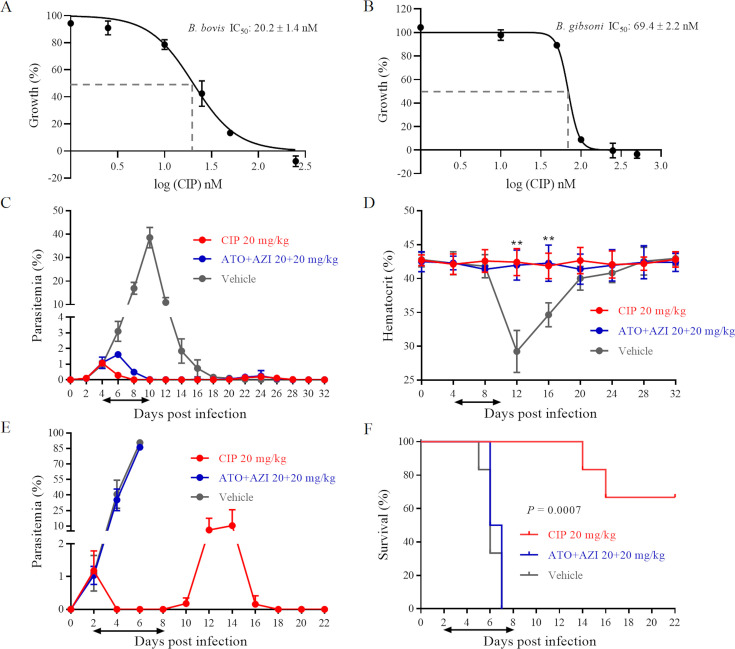
Figure 1. Cipargamin (CIP) demonstrates potent inhibition on Babesia spp. (A, B) Dose-dependent growth curve of CIP on B. bovis and B. gibsoni in vitro. IC50: the half maximal inhibitory concentration. (C) Inhibitory effects of CIP and atovaquone (ATO) plus azithromycin (AZI) on the proliferation of B. microti in BALB/c mice. (D) Hematocrit (HCT) values in mice treated with CIP or ATO plus AZI compared with vehicle-treated mice. (E) Inhibitory effects of CIP and ATO plus AZI on the proliferation of B. rodhaini in BALB/c mice. (F) Survival rates of CIP-treated, ATO plus AZI-treated, and vehicle-treated mice. The treatment time is shown by two-way arrows, and significant differences (p < 0.01) between the drug-treated groups (n = 6) and the vehicle-treated control group (n = 6) are indicated by asterisks. The data from one of three individual experiments are expressed as means ± SD. **p ˂ 0.01.
Figure 1. Cipargamin (CIP) demonstrates potent inhibition on Babesia spp. (A, B) Dose-dependent growth curve of CIP on B. bovis and B. gibsoni in vitro. IC50: the half maximal inhibitory concentration. (C) Inhibitory effects of CIP and atovaquone (ATO) plus azithromycin (AZI) on the proliferation of B. microti in BALB/c mice. (D) Hematocrit (HCT) values in mice treated with CIP or ATO plus AZI compared with vehicle-treated mice. (E) Inhibitory effects of CIP and ATO plus AZI on the proliferation of B. rodhaini in BALB/c mice. (F) Survival rates of CIP-treated, ATO plus AZI-treated, and vehicle-treated mice. The treatment time is shown by two-way arrows, and significant differences (p < 0.01) between the drug-treated groups (n = 6) and the vehicle-treated control group (n = 6) are indicated by asterisks. The data from one of three individual experiments are expressed as means ± SD. **p ˂ 0.01.CC BY · PubMed Central
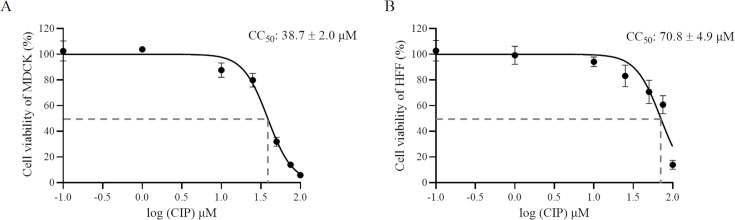
Figure 1—figure supplement 1. Cytotoxicity assay of CIP on (A) Madin-Darby canine kidney (MDCK) cells and (B) human foreskin fibroblast (HFF). The MTP-500 microplate reader was utilized to detect the absorbance at 450 nm. Each value represents the mean ± SD of three independent experiments carried out in triplicate. CC50: the 50% cytotoxic concentration.
Figure 1—figure supplement 1. Cytotoxicity assay of CIP on (A) Madin-Darby canine kidney (MDCK) cells and (B) human foreskin fibroblast (HFF). The MTP-500 microplate reader was utilized to detect the absorbance at 450 nm. Each value represents the mean ± SD of three independent experiments carried out in triplicate. CC50: the 50% cytotoxic concentration.CC BY · PubMed Central
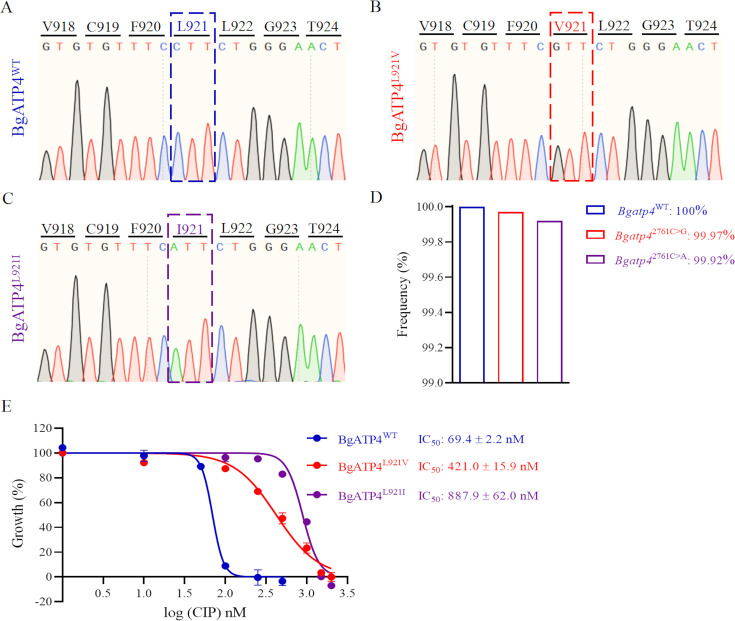
Figure 2. Mutations in BgATP4 mediate cipargamin (CIP) resistance. (A–C) Representative sequencing chromatogram of wild-type and resistant parasites from CIP-treated B. gibsoni. The resistant parasite genomic DNA is extracted from blood samples after a 60-day treatment. The BgATP4 gene was amplified and sequenced using the DNA. (D) Genes of high-frequency sequence variants detected by next-generation sequencing (NGS). (E) Dose-dependent growth curve of BgATP4WT, BgATP4L921V, and BgATP4L921I in vitro. The data from one of three individual experiments are expressed as means ± SD.
Figure 2. Mutations in BgATP4 mediate cipargamin (CIP) resistance. (A–C) Representative sequencing chromatogram of wild-type and resistant parasites from CIP-treated B. gibsoni. The resistant parasite genomic DNA is extracted from blood samples after a 60-day treatment. The BgATP4 gene was amplified and sequenced using the DNA. (D) Genes of high-frequency sequence variants detected by next-generation sequencing (NGS). (E) Dose-dependent growth curve of BgATP4WT, BgATP4L921V, and BgATP4L921I in vitro. The data from one of three individual experiments are expressed as means ± SD.CC BY · PubMed Central
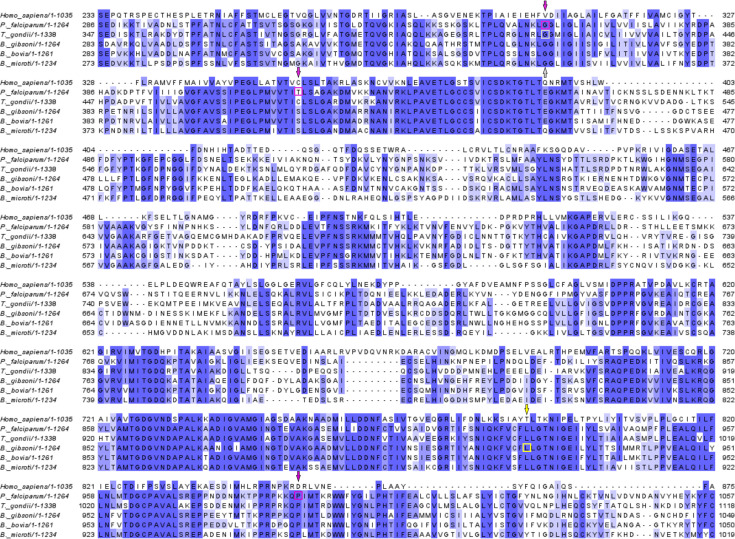
Figure 2—figure supplement 1. Multiple sequence alignment of ATP4 in different species. A yellow square and arrow denote the BgATP4 mutation site discovered in this investigation; purple squares and arrows represent sites linked to P. falciparum cipargamin (CIP) resistance, and a gray square and arrow represent sites associated with T. gondii.
Figure 2—figure supplement 1. Multiple sequence alignment of ATP4 in different species. A yellow square and arrow denote the BgATP4 mutation site discovered in this investigation; purple squares and arrows represent sites linked to P. falciparum cipargamin (CIP) resistance, and a gray square and arrow represent sites associated with T. gondii.CC BY · PubMed Central
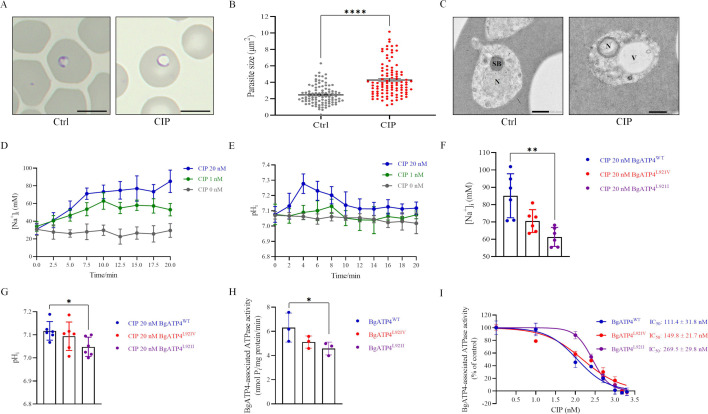
Figure 3. Mechanistic basis for resistance to cipargamin (CIP) conferred by the L921V and L921I mutations in BgATP4. (A) Untreated and CIP-treated parasite morphology after incubation for 72 hr. Scale bar: 5 µm. (B) Sizes of 100 parasites in two groups measured with ImageJ software in panel A. Statistically significant differences between the means of variables determined by t-test. ****p ˂ 0.0001. (C) Transmission electron microscopy (TEM) of untreated and CIP-treated parasite. N, nucleus; SB, spherical body; V, vacuole. Scale bar: 500 nm. (D) [Na+]i concentrations after the addition of CIP in the BgATP4WT line. Representative traces from the experiment that highlight the impact of adding 20 nM CIP (blue), 1 nM CIP (green), or 0 nM CIP (grey) on the concentration [Na+]i of the BgATP4WT line. (E) Alkalinization of pHi in BgATP4WT line upon addition of the ATP4 inhibitor. (F) Addition of 20 nM CIP to the wild-type and resistant parasite lines results in different [Na+]i concentrations. (G) Addition of 20 nM CIP to the wild-type and resistant parasite lines results in different pHi concentrations. (H) Data acquired in the low Na+ condition (containing only the 2 mM Na+ introduced upon the addition of 1 mM Na2ATP) was subtracted from data obtained in the high Na+ condition to determine the ATPase activity related to the BgATP4 proteins. (I) Dose-dependent BgATP4-associated ATPase activity curve of BgATP4WT, BgATP4L921V, and BgATP4L921I in vitro. ATPase activity was determined at pH 7.2 in the presence of 150 mM Na+ and 1 mM Na2ATP. Each value represents the mean ± SD derived from a minimum of three biological replicates. *p ˂ 0.05; **p ˂ 0.01.
Figure 3. Mechanistic basis for resistance to cipargamin (CIP) conferred by the L921V and L921I mutations in BgATP4. (A) Untreated and CIP-treated parasite morphology after incubation for 72 hr. Scale bar: 5 µm. (B) Sizes of 100 parasites in two groups measured with ImageJ software in panel A. Statistically significant differences between the means of variables determined by t-test. ****p ˂ 0.0001. (C) Transmission electron microscopy (TEM) of untreated and CIP-treated parasite. N, nucleus; SB, spherical body; V, vacuole. Scale bar: 500 nm. (D) [Na+]i concentrations after the addition of CIP in the BgATP4WT line. Representative traces from the experiment that highlight the impact of adding 20 nM CIP (blue), 1 nM CIP (green), or 0 nM CIP (grey) on the concentration [Na+]i of the BgATP4WT line. (E) Alkalinization of pHi in BgATP4WT line upon addition of the ATP4 inhibitor. (F) Addition of 20 nM CIP to the wild-type and resistant parasite lines results in different [Na+]i concentrations. (G) Addition of 20 nM CIP to the wild-type and resistant parasite lines results in different pHi concentrations. (H) Data acquired in the low Na+ condition (containing only the 2 mM Na+ introduced upon the addition of 1 mM Na2ATP) was subtracted from data obtained in the high Na+ condition to determine the ATPase activity related to the BgATP4 proteins. (I) Dose-dependent BgATP4-associated ATPase activity curve of BgATP4WT, BgATP4L921V, and BgATP4L921I in vitro. ATPase activity was determined at pH 7.2 in the presence of 150 mM Na+ and 1 mM Na2ATP. Each value represents the mean ± SD derived from a minimum of three biological replicates. *p ˂ 0.05; **p ˂ 0.01.CC BY · PubMed Central
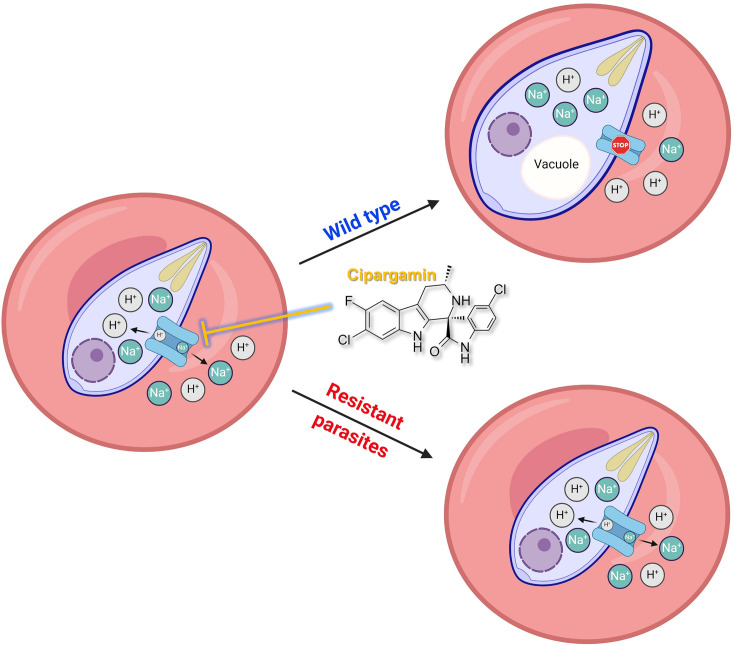
Figure 3—figure supplement 1. Proposed mechanism of inhibition of cipargamin (CIP) on wild-type and mutant parasite-infected erythrocytes. CIP disrupts the BgATP4 function of wild-type parasites, which causes a net influx of Na+ and efflux of H+ from the parasite. The osmotic load imposed on the influx of Na+ further brings about parasite swelling and internal alkalinization, which are the main factors in Babesia death. Mutations in ATP4 minimize the susceptibility to ATP4 inhibitors by recovering H+ and Na+ balance, as indicated by the dotted arrows.
Figure 3—figure supplement 1. Proposed mechanism of inhibition of cipargamin (CIP) on wild-type and mutant parasite-infected erythrocytes. CIP disrupts the BgATP4 function of wild-type parasites, which causes a net influx of Na+ and efflux of H+ from the parasite. The osmotic load imposed on the influx of Na+ further brings about parasite swelling and internal alkalinization, which are the main factors in Babesia death. Mutations in ATP4 minimize the susceptibility to ATP4 inhibitors by recovering H+ and Na+ balance, as indicated by the dotted arrows.CC BY · PubMed Central
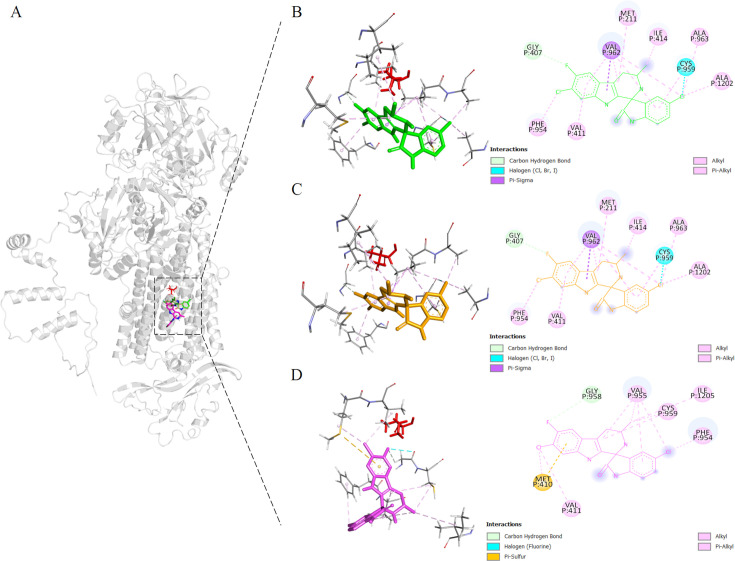
Figure 4. Binding sites proximal to BgATP4 residue 921 predicted by molecular docking. (A) The lowest energy poses for cipargamin (CIP) were located in reference to the whole protein structure, docking against the WT (green), L921V (yellow), and L921I (pink) mutant BgATP4. The side chain of L921 is also shown in a red stick at its position. (B–D) The zoomed views of the binding locations of CIP.
Figure 4. Binding sites proximal to BgATP4 residue 921 predicted by molecular docking. (A) The lowest energy poses for cipargamin (CIP) were located in reference to the whole protein structure, docking against the WT (green), L921V (yellow), and L921I (pink) mutant BgATP4. The side chain of L921 is also shown in a red stick at its position. (B–D) The zoomed views of the binding locations of CIP.CC BY · PubMed Central
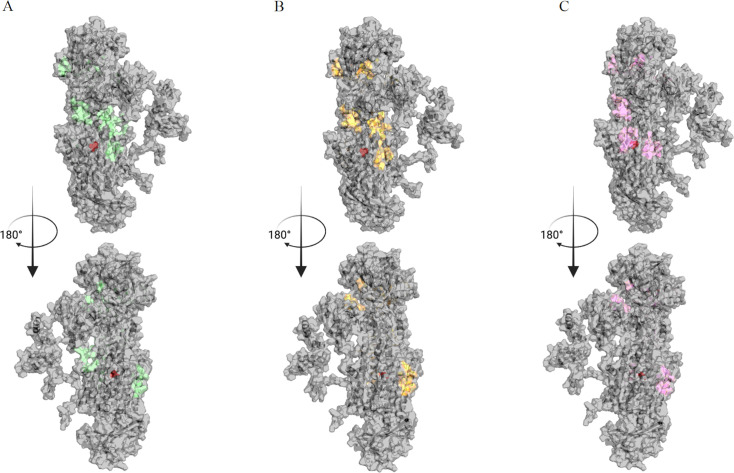
Figure 4—figure supplement 1. Binding sites for cipargamin (CIP) found by Gnina search across the entire surface of the protein. (A–C) The binding space of WT, L921V, and L921I mutants in BgATP4 are labeled in green, yellow, and pink, respectively.
Figure 4—figure supplement 1. Binding sites for cipargamin (CIP) found by Gnina search across the entire surface of the protein. (A–C) The binding space of WT, L921V, and L921I mutants in BgATP4 are labeled in green, yellow, and pink, respectively.CC BY · PubMed Central
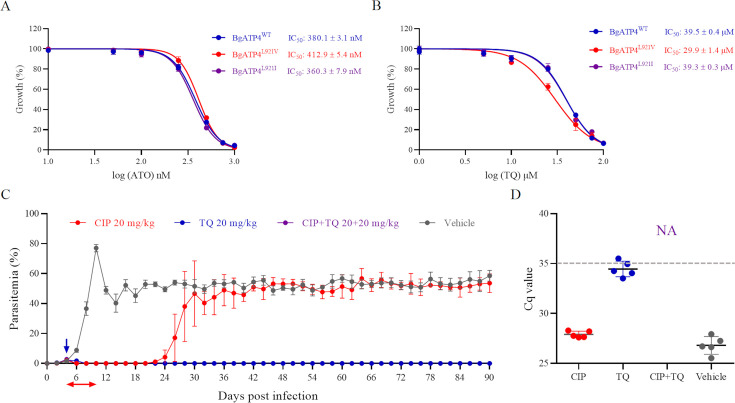
Figure 5. Cross-resistance between ATO and TQ in resistant parasites and combination therapy based on cipargamin (CIP) plus TQ. (A) Dose-dependent growth curve of BgATP4WT, BgATP4L921V, and BgATP4L921I by ATO treatment in vitro. (B) Dose-dependent growth curve of BgATP4WT, BgATP4L921V, and BgATP4L921I by TQ treatment in vitro. (C) Inhibitory effects of CIP plus TQ on the proliferation of B. microti in SCID mice (n = 5 per group). Treatment started at 4 DPI: CIP was given at 20 mg/kg once daily for 7 days, TQ was administered as a single 20 mg/kg dose, and the combination group received both treatments (CIP at 20 mg/kg once daily for 7 days plus a single dose of TQ at 20 mg/kg). (D) Parasite DNA was detected by qPCR on genomic DNA extracted from blood collected from untreated and treated SCID mice infected with B. microti at 90 DPI. A dotted gray line across the graph represents the average cut-off Cq value. Cut-off Cq ≤35 was considered positive, while Cq >35 or no amplification was considered negative. Each value represents the mean ± SD derived from a minimum of five biological replicates. NA indicates no amplification.
Figure 5. Cross-resistance between ATO and TQ in resistant parasites and combination therapy based on cipargamin (CIP) plus TQ. (A) Dose-dependent growth curve of BgATP4WT, BgATP4L921V, and BgATP4L921I by ATO treatment in vitro. (B) Dose-dependent growth curve of BgATP4WT, BgATP4L921V, and BgATP4L921I by TQ treatment in vitro. (C) Inhibitory effects of CIP plus TQ on the proliferation of B. microti in SCID mice (n = 5 per group). Treatment started at 4 DPI: CIP was given at 20 mg/kg once daily for 7 days, TQ was administered as a single 20 mg/kg dose, and the combination group received both treatments (CIP at 20 mg/kg once daily for 7 days plus a single dose of TQ at 20 mg/kg). (D) Parasite DNA was detected by qPCR on genomic DNA extracted from blood collected from untreated and treated SCID mice infected with B. microti at 90 DPI. A dotted gray line across the graph represents the average cut-off Cq value. Cut-off Cq ≤35 was considered positive, while Cq >35 or no amplification was considered negative. Each value represents the mean ± SD derived from a minimum of five biological replicates. NA indicates no amplification.CC BY · PubMed Central

Verification

Claims the paper makes

The claims and statistics of this paper haven’t been checked yet.

Run the check — free, no account needed. It reads the open-access text and checks the sources it cites.

A few free checks a day · papers already verified open instantly · results are public

Self-check

Percentages, sums and reported differences re-computed from the paper’s own numbers.

The self-check needs the paper’s full text.

Citations

Cites

Show all 56 references

Metadata

Authors
Li, H., Ji, S., Ariefta, N. R., Galon, E. M. S., El-Sayed, S. A., Do, T., Jia, L., Sakaguchi, M., Asada, M., Nishikawa, Y., Qin, X., Liu, M., & Xuan, X.
Affiliations
  • National Research Center for Protozoan Diseases, Obihiro University of Agriculture and Veterinary Medicine (JP)
  • Yanbian University (CN)
  • Cavite State University (PH)
  • Mansoura University (EG)
  • Hubei University of Arts and Science (CN)
Corresponding author
  • Liu, Mingming
  • Xuan, Xuenan
Venue
eLife
Published
2025-06-19
Volume
13
ISSN
2050-084X (ISSN-L)
OpenAlex
W4402438753
Cited by
1
References
56
Citations by year
2026: 1
Type
posted content
Language
en
Open access
Locations
  • eLife (publishedVersion, cc-by)
  • PubMed Central (publishedVersion, cc-by)
  • PubMed (publishedVersion)
  • DOAJ (DOAJ: Directory of Open Access Journals) (submittedVersion, cc-by-sa)
Funders
  • Ministry of Education, Culture, Sports, Science and Technology (22H0250906)
  • Ministry of Agriculture, Forestry and Fisheries (JPJ008837)
Topics
  • Life Sciences › Immunology and Microbiology › Parasitology › Vector-borne infectious diseases
  • Health Sciences › Medicine › Epidemiology › Trypanosoma species research and implications
  • Health Sciences › Medicine › Public Health, Environmental and Occupational Health › Malaria Research and Control
Keywords
cipargamin, Babesia, babesiosis, drug resistance, tafenoquine, combination therapy, Babesia microti, Babesia gibsoni, Babesia bovis, Babesia rodhaini, antiparasitic drug efficacy
MeSH terms
Animals, Antiprotozoal Agents, Babesia, Babesiosis, Drug Resistance, Inhibitory Concentration 50, Mice

About these checks

Registry, retraction, Cites and statistics results are computed, not judged, with one exception: a printed reference that no index lists is read once by a model before it counts as a citation error. Claims are extracted by a model and kept only when their quote appears verbatim in the text; each cited source is then checked, with a model’s help, for whether it says what the claim relies on. Those verdicts can be wrong — read the claim’s quote and the cited source before relying on one.

Statistics and arithmetic are recomputed, not judged.

Confidence bands are shown only for fields calibrated on our annotated test set. None is calibrated yet, so no band is shown.

What counts as a claim ›How we measure confidence ›How we check this ›

Are you an author, or do you see a problem with this page? Request a review

How to cite

Cite CoChat for the checks on this page, and the paper for its own findings.

This page
CoChat. (2026). Citation check: Efficacy and mechanism of action of cipargamin as an antibabesial drug candidate. https://app.cochat.ai/papers/10.7554/elife.101128
The paper
Li, H., Ji, S., Ariefta, N. R., Galon, E. M. S., El-Sayed, S. A., Do, T., Jia, L., Sakaguchi, M., Asada, M., Nishikawa, Y., Qin, X., Liu, M., & Xuan, X. (2025). Efficacy and mechanism of action of cipargamin as an antibabesial drug candidate. eLife. https://doi.org/10.7554/elife.101128

Data sources

Bibliographic data: Semantic Scholar, OpenAlex, Crossref.

Contains information from the Semantic Scholar Academic Graph Datasets, made available under the ODC Attribution License (ODC-BY 1.0).

Semantic Scholar’s data is described in: Kinney, R., et al. (2023). The Semantic Scholar Open Data Platform. arXiv:2301.10140.