

The DOI matches its Crossref record; 57 of the 57 references it cites were found in a registry or an index.
LC8 enhances 53BP1 foci through heterogeneous bridging of 53BP1 oligomers
Open accessPublished version of a preprint
Abstract
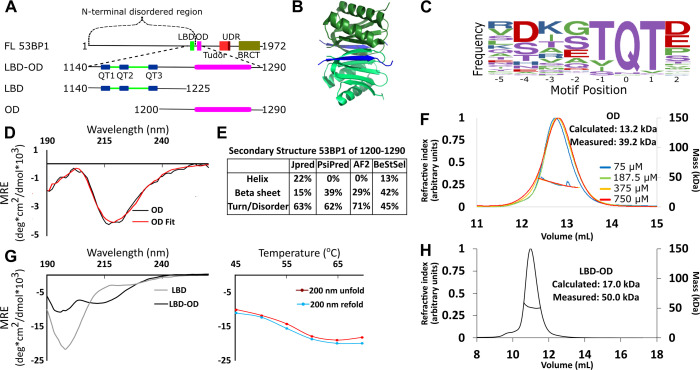
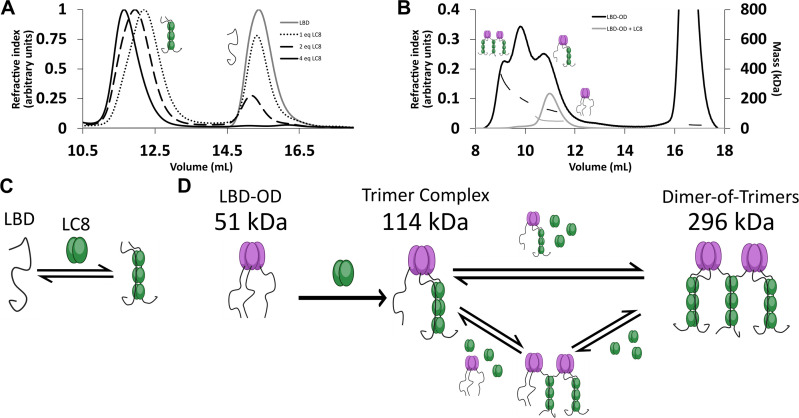
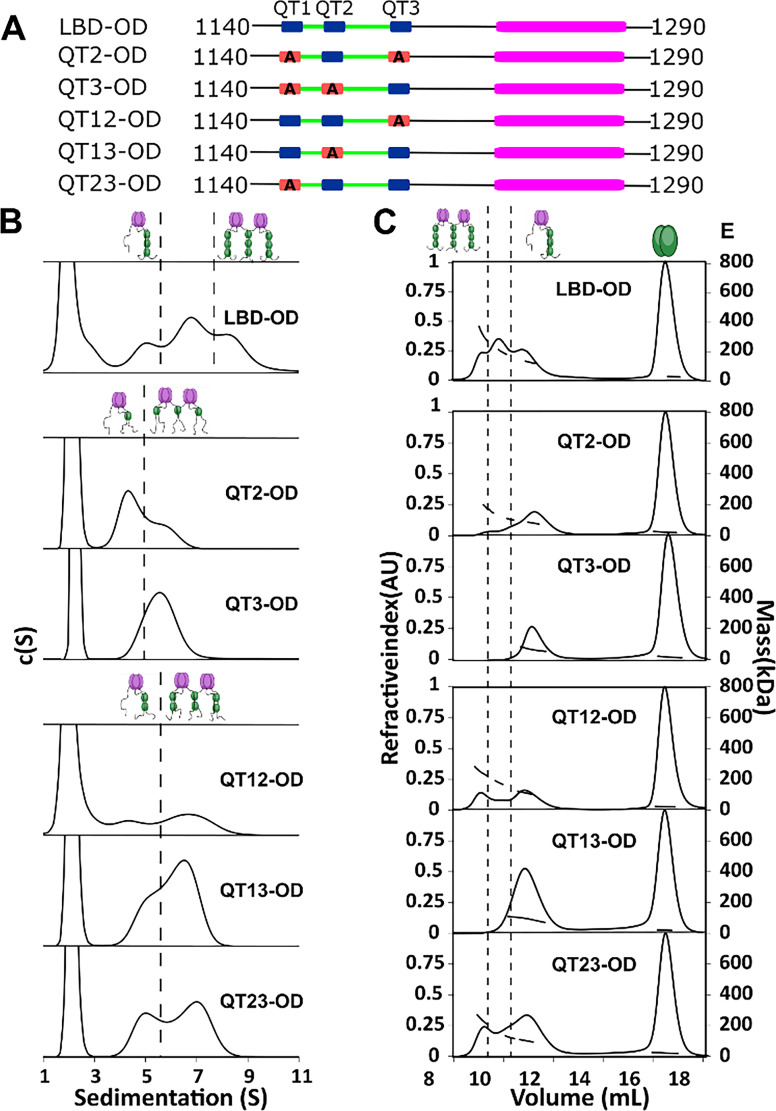
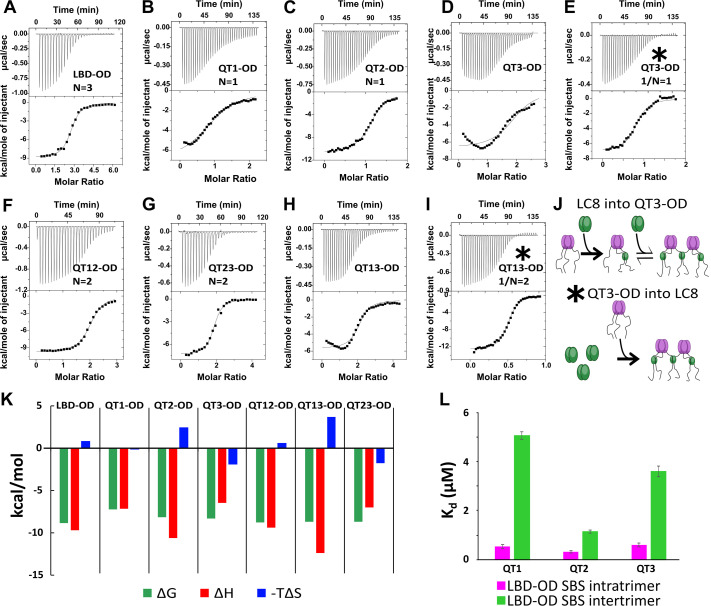
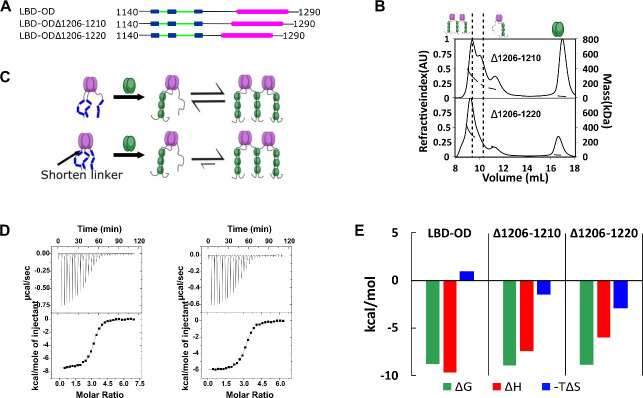
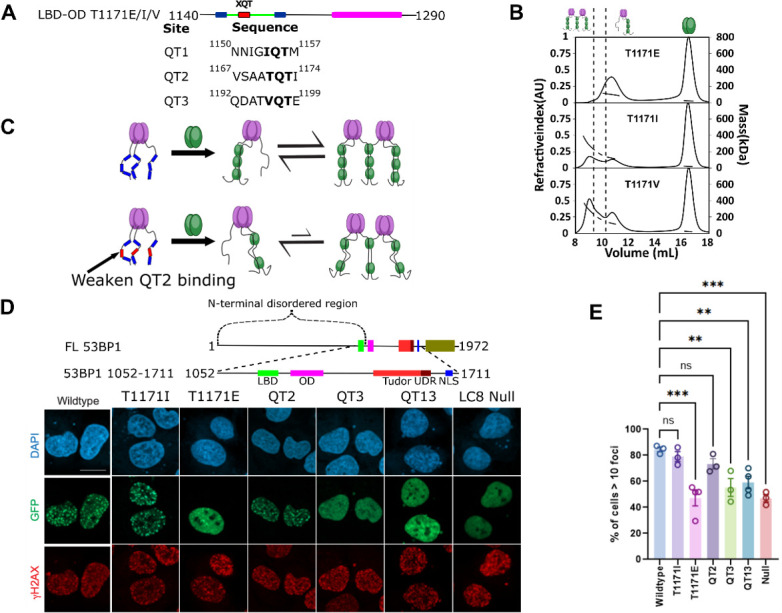
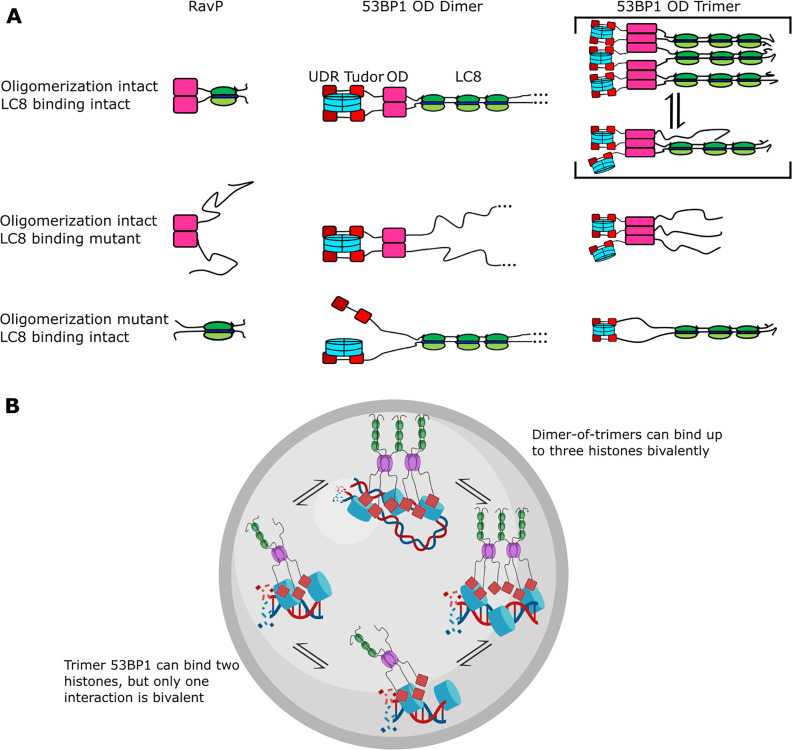
53BP1 is a key player in DNA repair and together with BRCA1 regulate selection of DNA double-strand break repair mechanisms. Localization of DNA repair factors to sites of DNA damage by 53BP1 is controlled by its oligomerization domain (OD) and binding to LC8, a hub protein that functions to dimerize >100 clients. Here, we show that 53BP1 OD is a trimer, an unusual finding for LC8 clients which are all dimers or tetramers. As a trimer, 53BP1 forms a heterogeneous mixture of complexes when bound to dimeric LC8, with the largest mass corresponding to a dimer-of-trimers bridged by 3 LC8 dimers. Analytical ultracentrifugation and isothermal titration calorimetry demonstrate that only the second of the three LC8 recognition motifs is necessary for a stable bridged complex. The stability of the bridged complex is tuned by multivalency, binding specificity of the second LC8 site, and the length of the linker separating the LC8 binding domain and OD. 53BP1 mutants deficient in bridged species fail to impact 53BP1 focus formation in human cell culture studies, suggesting that the primary role of LC8 is to bridge 53BP1 trimers, which in turn promotes recruitment of 53BP1 at sites of DNA damage. We propose that the formation of higher-order oligomers of 53BP1 explains how LC8 elicits an improvement in 53BP1 foci and affects the structure and functions of 53BP1.
Overview
The claims and statistics of this paper haven’t been checked yet.
Run the check — free, no account needed. It reads the open-access text and checks the sources it cites.
Integrity signals
Registry
Cites
Statistics
Figures
Verification
Claims the paper makes
The claims and statistics of this paper haven’t been checked yet.
Run the check — free, no account needed. It reads the open-access text and checks the sources it cites.
Self-check
Percentages, sums and reported differences re-computed from the paper’s own numbers.
The self-check needs the paper’s full text.
Citations
Cites
Highly accurate protein structure prediction with AlphaFold
Jumper, J., Evans, R., Pritzel, A., Green, T., Figurnov, M., Ronneberger, O., Tunyasuvunakool, K., Bates, R., Žídek, A., Potapenko, A., et al. (2021) · Nature · doi:10.1038/s41586-021-03819-2 · Cited by 43,764
NMRPipe: A multidimensional spectral processing system based on UNIX pipes
Delaglio, F., Grzesiek, S., Vuister, G., Zhu, G., Pfeifer, J., & Bax, A. (1995) · Journal of Biomolecular NMR · doi:10.1007/bf00197809 · Cited by 15,965
The PSIPRED protein structure prediction server
McGuffin, L. J., Bryson, K., & Jones, D. T. (2000) · Bioinformatics · doi:10.1093/bioinformatics/16.4.404 · Cited by 3,887
Farrow, N. A., Muhandiram, R., Singer, A. U., Pascal, S. M., Kay, C. M., Gish, G., Shoelson, S. E., Pawson, T., Forman-Kay, J. D., & Kay, L. E. (1994) · Biochemistry · doi:10.1021/bi00185a040 · Cited by 2,091
Accurate secondary structure prediction and fold recognition for circular dichroism spectroscopy
Micsonai, A., Wien, F., Kernya, L., Lee, Y., Goto, Y., Réfrégiers, M., & Kardos, J. (2015) · Proceedings of the National Academy of Sciences · doi:10.1073/pnas.1500851112 · Cited by 1,761
JPred4: a protein secondary structure prediction server
Drozdetskiy, A., Cole, C., Procter, J., & Barton, G. J. (2015) · Nucleic Acids Research · doi:10.1093/nar/gkv332 · Cited by 1,744
53BP1 Inhibits Homologous Recombination in Brca1-Deficient Cells by Blocking Resection of DNA Breaks
Bunting, S. F., Callén, E., Wong, N., Chen, H.-T., Polato, F., Gunn, A., Bothmer, A., Feldhahn, N., Fernandez-Capetillo, O., Cao, L., et al. (2010) · Cell · doi:10.1016/j.cell.2010.03.012 · Cited by 1,671
Using NMRView to Visualize and Analyze the NMR Spectra of Macromolecules
Johnson, B. A. (2004) · Humana Press eBooks · doi:10.1385/1-59259-809-9:313 · Cited by 1,039
Bouwman, P., Aly, A., Escandell, J. M., Pieterse, M., Bartkova, J., van der Gulden, H., Hiddingh, S., Thanasoula, M., Kulkarni, A., Yang, Q., et al. (2010) · Nature Structural & Molecular Biology · doi:10.1038/nsmb.1831 · Cited by 1,001
Schultz, L. B., Chehab, N. H., Malikzay, A., & Halazonetis, T. D. (2000) · The Journal of Cell Biology · doi:10.1083/jcb.151.7.1381 · Cited by 904
53BP1 is a reader of the DNA-damage-induced H2A Lys 15 ubiquitin mark
Fradet-Turcotte, A., Canny, M. D., Escribano-Díaz, C., Orthwein, A., Leung, C. C. Y., Huang, H., Landry, M.-C., Kitevski-LeBlanc, J., Noordermeer, S. M., Sicheri, F., et al. (2013) · Nature · doi:10.1038/nature12318 · Cited by 686
The shieldin complex mediates 53BP1-dependent DNA repair
Noordermeer, S. M., Adam, S., Setiaputra, D., Barazas, M., Pettitt, S. J., Ling, A. K., Olivieri, M., Álvarez-Quilón, A., Moatti, N., Zimmermann, M., et al. (2018) · Nature · doi:10.1038/s41586-018-0340-7 · Cited by 676
53BP1 Regulates DSB Repair Using Rif1 to Control 5′ End Resection
Zimmermann, M., Lottersberger, F., Buonomo, S. B. C., Sfeir, A. J., & de Lange, T. (2013) · Science · doi:10.1126/science.1231573 · Cited by 628
Erdős, G., Pajkos, M., & Dosztányi, Z. (2021) · Nucleic Acids Research · doi:10.1093/nar/gkab408 · Cited by 608
Sequence-Dependent Correction of Random Coil NMR Chemical Shifts
Schwarzinger, S., Kroon, G. J. A., Foss, T. R., Chung, J., Wright, P. E., & Dyson, H. J. (2001) · Journal of the American Chemical Society · doi:10.1021/ja003760i · Cited by 604
Tumor Suppressor P53 Binding Protein 1 (53bp1) Is Involved in DNA Damage–Signaling Pathways
Rappold, I., Iwabuchi, K., Date, T., & Chen, J. (2001) · The Journal of Cell Biology · doi:10.1083/jcb.153.3.613 · Cited by 487
An HMM model for coiled-coil domains and a comparison with PSSM-based predictions
Delorenzi, M., & Speed, T. (2002) · Bioinformatics · doi:10.1093/bioinformatics/18.4.617 · Cited by 479
Phase separation of 53 BP 1 determines liquid‐like behavior of DNA repair compartments
Kilic, S., Lezaja, A., Gatti, M., Bianco, E., Michelena, J., Imhof, R., & Altmeyer, M. (2019) · The EMBO Journal · doi:10.15252/embj.2018101379 · Cited by 444
Two cellular proteins that bind to wild-type but not mutant p53.
Iwabuchi, K., Bartel, P. L., Li, B., Marraccino, R., & Fields, S. (1994) · Proceedings of the National Academy of Sciences · doi:10.1073/pnas.91.13.6098 · Cited by 431
p53 Binding Protein 53BP1 Is Required for DNA Damage Responses and Tumor Suppression in Mice
Ward, I. M., Minn, K., van Deursen, J., & Chen, J. (2003) · Molecular and Cellular Biology · doi:10.1128/mcb.23.7.2556-2563.2003 · Cited by 413
Ying, J., Delaglio, F., Torchia, D. A., & Bax, A. (2017) · Journal of Biomolecular NMR · doi:10.1007/s10858-016-0072-7 · Cited by 331
53BP1 cooperation with the REV7–shieldin complex underpins DNA structure-specific NHEJ
Ghezraoui, H., Oliveira, C., Becker, J. R., Bilham, K., Moralli, D., Anzilotti, C., Fischer, R., Deobagkar-Lele, M., Sanchiz-Calvo, M., Fueyo-Marcos, E., et al. (2018) · Nature · doi:10.1038/s41586-018-0362-1 · Cited by 320
Random coil chemical shift for intrinsically disordered proteins: effects of temperature and pH
Kjaergaard, M., Brander, S., & Poulsen, F. M. (2011) · Journal of Biomolecular NMR · doi:10.1007/s10858-011-9472-x · Cited by 313
Kjaergaard, M., & Poulsen, F. M. (2011) · Journal of Biomolecular NMR · doi:10.1007/s10858-011-9508-2 · Cited by 297
Dynein Light Chain LC8 Is a Dimerization Hub Essential in Diverse Protein Networks
Barbar, E. J. (2007) · Biochemistry · doi:10.1021/bi701995m · Cited by 174
Self-citationRole of 53BP1 in the Regulation of DNA Double-Strand Break Repair Pathway Choice
Gupta, A. K. D., Hunt, C. R., Chakraborty, S., PANDITA, R. K., Yordy, J. S., Ramnarain, D. B., Horikoshi, N., & Pandita, T. K. (2013) · Radiation Research · doi:10.1667/rr13572.1 · Cited by 164
53BP1: A key player of DNA damage response with critical functions in cancer
Mirza‐Aghazadeh‐Attari, M., Mohammadzadeh, A., Yousefi, B., Mihanfar, A., Karimian, A., & Majidinia, M. (2018) · DNA repair · doi:10.1016/j.dnarep.2018.11.008 · Cited by 145
Harnessing the complexity of DNA-damage response pathways to improve cancer treatment outcomes
Al‐Ejeh, F., Kumar, R., Wiegmans, A. P., Lakhani, S. R., Brown, M. P., & Khanna, K. K. (2010) · Oncogene · doi:10.1038/onc.2010.407 · Cited by 142
An Oligomerized 53BP1 Tudor Domain Suffices for Recognition of DNA Double-Strand Breaks
Zgheib, O., Pataky, K. A., Brügger, J., & Halazonetis, T. D. (2008) · Molecular and Cellular Biology · doi:10.1128/mcb.01011-08 · Cited by 124
Lo, K. W. ‐., Kan, H.-M., Chan, L.-N., Xu, W., Wang, K., Wu, Z., Sheng, M., & Zhang, M. (2004) · Journal of Biological Chemistry · doi:10.1074/jbc.m411408200 · Cited by 114
Becker, J. R., Cuella-Martin, R., Barazas, M., Liu, R., Oliveira, C., Oliver, A. W., Bilham, K., Holt, A. B., Blackford, A. N., Heierhorst, J., et al. (2018) · Nature Communications · doi:10.1038/s41467-018-07855-x · Cited by 107
Zgheib, O., Huyen, Y., DiTullio, R. A., Snyder, A. R., Venere, M., Stavridi, E. S., & Halazonetis, T. D. (2005) · Radiotherapy and Oncology · doi:10.1016/j.radonc.2005.06.026 · Cited by 91
Benison, G., Karplus, P. A., & Barbar, E. J. (2007) · Journal of Molecular Biology · doi:10.1016/j.jmb.2007.05.046 · Cited by 88
Self-citationRole of 53BP1 oligomerization in regulating double-strand break repair
Lottersberger, F., Bothmer, A., Robbiani, D. F., Nussenzweig, M. C., & de Lange, T. (2013) · Proceedings of the National Academy of Sciences · doi:10.1073/pnas.1222617110 · Cited by 85
Characterisation of the sites of DNA damage-induced 53BP1 phosphorylation catalysed by ATM and ATR
Jowsey, P. A., Morrice, N. A., Hastie, C. J., McLauchlan, H., Toth, R. L., & Rouse, J. W. (2007) · DNA repair · doi:10.1016/j.dnarep.2007.04.011 · Cited by 82
Structural basis for assembly and function of the Nup82 complex in the nuclear pore scaffold
Gaik, M., Flemming, D., von Appen, A., Kastritis, P. L., Mücke, N., Fischer, J., Stelter, P., Ori, A., Bui, K. H., Baßler, J., et al. (2015) · The Journal of Cell Biology · doi:10.1083/jcb.201411003 · Cited by 72
Self-citationSpatiotemporal dynamics of 53BP1 dimer recruitment to a DNA double strand break
Lou, J., Priest, D. G., Solano, A. N., Kerjouan, A., & Hinde, E. (2020) · Nature Communications · doi:10.1038/s41467-020-19504-3 · Cited by 63
Multivalency regulates activity in an intrinsically disordered transcription factor
Clark, S. J., Myers, J. B., King, A., Fiala, R., Nováček, J., Pearce, F. G., Heierhorst, J., Reichow, S., & Barbar, E. J. (2018) · eLife · doi:10.7554/elife.36258 · Cited by 56
Self-citationPTIP Regulates 53BP1 and SMC1 at the DNA Damage Sites
Wu, J., Prindle, M. J., Dressler, G. R., & Yu, X. (2009) · Journal of Biological Chemistry · doi:10.1074/jbc.m109.002527 · Cited by 46
Benison, G., Karplus, P. A., & Barbar, E. J. (2008) · Journal of Molecular Biology · doi:10.1016/j.jmb.2008.09.083 · Cited by 44
Self-citationLC8/DYNLL1 is a 53BP1 effector and regulates checkpoint activation
West, K. L., Kelliher, J. L., Xu, Z., An, L., Reed, M. R., Eoff, R. L., Wang, J., Huen, M. S. Y., & Leung, J. W. C. (2019) · Nucleic Acids Research · doi:10.1093/nar/gkz263 · Cited by 44
Self-citationSystematic identification of recognition motifs for the hub protein LC8
Jespersen, N. E., Estelle, A. B., Waugh, N., Davey, N. E., Blikstad, C., Ammon, Y.-C., Akhmanova, A. S., Ivarsson, Y., Hendrix, D. A., & Barbar, E. J. (2019) · Life Science Alliance · doi:10.26508/lsa.201900366 · Cited by 43
Self-citationMultiple Recognition Motifs in Nucleoporin Nup159 Provide a Stable and Rigid Nup159-Dyn2 Assembly
Nyarko, A., Song, Y., Nováček, J., Žı́dek, L., & Barbar, E. J. (2012) · Journal of Biological Chemistry · doi:10.1074/jbc.m112.432831 · Cited by 40
Self-citationRapali, P., García‐Mayoral, M. F., Martínez‐Moreno, M., Tárnok, K., Schlett, K., Albar, J. P., Bruix, M., Nyitray, L., & Rodríguez‐Crespo, I. (2011) · Biochemical and Biophysical Research Communications · doi:10.1016/j.bbrc.2011.09.093 · Cited by 37
Polybivalency and disordered proteins in ordering macromolecular assemblies
Barbar, E. J., & Nyarko, A. (2014) · Seminars in Cell and Developmental Biology · doi:10.1016/j.semcdb.2014.09.016 · Cited by 35
Self-citationThe Anchored Flexibility Model in LC8 Motif Recognition: Insights from the Chica Complex
Clark, S. A., Nyarko, A., Löhr, F., Karplus, P. A., & Barbar, E. J. (2015) · Biochemistry · doi:10.1021/acs.biochem.5b01099 · Cited by 31
Self-citationErdős, G., Szaniszló, T., Pajkos, M., Hajdu-Soltész, B., Kiss, B., Pál, G., Nyitray, L., & Dosztányi, Z. (2017) · PLoS Computational Biology · doi:10.1371/journal.pcbi.1005885 · Cited by 31
Jespersen, N. E., Leyrat, C., Gérard, F. C. A., Bourhis, J., Blondel, D., Jamin, M., & Barbar, E. J. (2019) · Journal of Molecular Biology · doi:10.1016/j.jmb.2019.10.011 · Cited by 28
Self-citationReardon, P. N., Jara, K. A., Rolland, A. D., Smith, D. A., Hoang, H. T. M., Prell, J. S., & Barbar, E. J. (2020) · Journal of Biological Chemistry · doi:10.1074/jbc.ra119.011653 · Cited by 25
Self-citationStructural Features of LC8-Induced Self-Association of Swallow
Kidane, A. I., Song, Y., Nyarko, A., Hall, J., Hare, M. C., Löhr, F., & Barbar, E. J. (2013) · Biochemistry · doi:10.1021/bi400642u · Cited by 20
Self-citationNMR CHARACTERIZATION OF SELF-ASSOCIATION DOMAINS PROMOTED BY INTERACTIONS WITH LC8 HUB PROTEIN
Barbar, E. J., & Nyarko, A. (2014) · Computational and Structural Biotechnology Journal · doi:10.5936/csbj.201402003 · Cited by 15
Self-citationEvolved histone tail regulates 53BP1 recruitment at damaged chromatin
Kelliher, J. L., Folkerts, M. L., Shen, K. V., Song, W., Tengler, K., Stiefel, C. M., Lee, S.-O., Dray, E. V., Zhao, W., Koss, B. S., et al. (2024) · Nature Communications · doi:10.1038/s41467-024-49071-w · Cited by 15
Self-citationWalker, D. R., Jara, K. A., Rolland, A. D., Brooks, C., Hare, W., Swansiger, A. K., Reardon, P. N., Prell, J. S., & Barbar, E. J. (2023) · Biomolecules · doi:10.3390/biom13030404 · Cited by 13
Self-citationGalvan, J. R., Donner, B., Vesely, C. H., Reardon, P. N., Forsythe, H. M., Howe, J., Fujimura, G., & Barbar, E. J. (2021) · Biomolecules · doi:10.3390/biom11111603 · Cited by 9
Self-citationMultivalent binding of the hub protein LC8 at a newly discovered site in 53BP1
Howe, J., Weeks, A., Reardon, P. N., & Barbar, E. J. (2022) · Biophysical Journal · doi:10.1016/j.bpj.2022.11.006 · Cited by 7
Self-citationSzaniszló, T., Fülöp, M., Pajkos, M., Erdős, G., Kovács, R. Á., Vadászi, H., Kardos, J., & Dosztányi, Z. (2022) · Scientific Reports · doi:10.1038/s41598-022-19454-4 · Cited by 5
Benchmark analysis of coiled-coil prediction tools
Kollmar, M., & Simm, D. (2019) · Figshare · doi:10.6084/m9.figshare.9994706 · Cited by 1
Metadata
- Authors
- Howe, J., Walker, D., Tengler, K., Sonpatki, M., Reardon, P. N., Leung, J. W., & Barbar, E. J.
- Affiliations
- Oregon State University (US)
- The University of Texas at San Antonio Health Science Center (US)
- Corresponding author
- Barbar, Elisar J
- Venue
- eLife
- Publisher
- eLife Sciences Publications, Ltd
- Published
- 2025-04-29
- Volume
- 14
- ISSN
- 2050-084X (ISSN-L)
- PMC
- PMC12187134
- OpenAlex
- W4409947815
- Cited by
- 4
- References
- 57
- Citations by year
- 2026: 2 · 2025: 2
- FWCI
- 1.20
- Type
- journal article
- Language
- en
- Open access
- gold
- doi.org
- Licence
- cc-by
- creativecommons.org/licenses/by/4.0/ (vor)
- creativecommons.org/licenses/by/4.0/ (am)
- creativecommons.org/licenses/by/4.0/ (tdm)
- Locations
- eLife (publishedVersion, cc-by)
- bioRxiv (Cold Spring Harbor Laboratory) (acceptedVersion, cc-by)
- Europe PMC (PubMed Central) (publishedVersion, cc-by)
- PubMed Central (publishedVersion, cc-by)
- PubMed (publishedVersion)
- DOAJ (DOAJ: Directory of Open Access Journals) (submittedVersion, cc-by-sa)
- Funders
- National Institute of General Medical Sciences (R01GM141733, R35GM137798)
- National Cancer Institute (R01CA244261)
- American Cancer Society (10.53354/acs.rsg-20-131-01-dmc.pc.gr.142479, 10.53354/pc.gr.151537)
- ARCS Oregon Chapter (Graduate Student Fellowship)
- National Institutes of Health (1S10OD018518)
- MJ Murdock Charitable Trust (#2014162)
- University of Texas Health Science Center at San Antonio (STARs award)
- Topics
- Life Sciences › Biochemistry, Genetics and Molecular Biology › Molecular Biology › DNA Repair Mechanisms
- Life Sciences › Biochemistry, Genetics and Molecular Biology › Molecular Biology › DNA and Nucleic Acid Chemistry
- Life Sciences › Biochemistry, Genetics and Molecular Biology › Molecular Biology › Genomics and Chromatin Dynamics
- Keywords
- LC8, 53BP1, protein trimerization, DNA double-strand break repair, DNA damage foci, BRCA1, multivalency, protein oligomerization
- MeSH terms
- Tumor Suppressor p53-Binding Protein 1, DNA Damage, DNA Repair, Humans, Protein Binding, Protein Multimerization
About these checks
Registry, retraction, Cites and statistics results are computed, not judged, with one exception: a printed reference that no index lists is read once by a model before it counts as a citation error. Claims are extracted by a model and kept only when their quote appears verbatim in the text; each cited source is then checked, with a model’s help, for whether it says what the claim relies on. Those verdicts can be wrong — read the claim’s quote and the cited source before relying on one.
Statistics and arithmetic are recomputed, not judged.
Confidence bands are shown only for fields calibrated on our annotated test set. None is calibrated yet, so no band is shown.
What counts as a claim ›How we measure confidence ›How we check this ›
Are you an author, or do you see a problem with this page? Request a review
Data sources
Bibliographic data: Semantic Scholar, OpenAlex, Crossref.
Contains information from the Semantic Scholar Academic Graph Datasets, made available under the ODC Attribution License (ODC-BY 1.0).
Semantic Scholar’s data is described in: Kinney, R., et al. (2023). The Semantic Scholar Open Data Platform. arXiv:2301.10140.
