

The DOI matches its Crossref record; 21 of the 21 references it cites were found in a registry or an index.
Antibody-Drug Conjugates in Prostate Cancer: A Systematic Review
Abstract
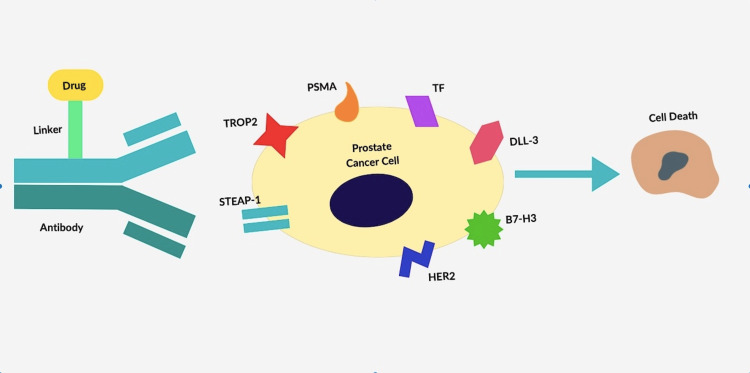
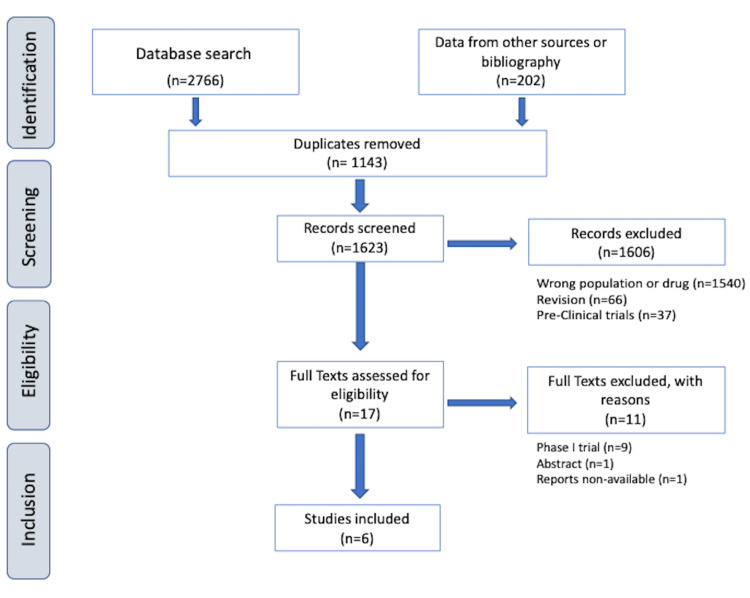
The prognosis in the setting of metastatic castration-resistant prostate cancer patients (mCRPC) remains limited. Therefore, novel treatment strategies remain an unmet need. Antibody-drug conjugates (ADC) emerged as a new drug concept with the potential to deliver a cytotoxic payload with limited off-target toxicity and potentially bystander effect. Following the success of ADCs in breast cancer and urothelial tumours, their activity in prostate cancer is now under investigation. Thus, the aim of this systematic review was to identify published and ongoing prospective clinical trials regarding ADC treatment in prostate cancer. A systematic search of PubMed, MEDLINE, and Web of Science was conducted as per PRISMA guidelines to identify prospective clinical trials of ADCin prostate cancer. Trials are currently ongoing on ClinicalTrials.gov and in the EU. The Clinical Trials Register was also identified. Abstracts, publications in languages other than English, review articles, retrospective analyses, and phase I trials were excluded. A total of six phase I/II prospective clinical trials already published were included. Seven ongoing trials were also identified. All studies were in the refractory/advanced tumour setting, and two included only mCRPC patients. The ADC targets were prostate-specific membrane antigen (PSMA), trophoblast cell surface antigen-2 (TROP-2), six-transmembrane epithelial antigen of prostate-1 (STEAP-1), tissue factor (TF), delta-like protein 3 (DLL-3), B7-H3 family of proteins (B7-H3), and human epidermal growth factor receptor 2 (HER2). Regarding the efficacy of PSMA ADC treatment in the second-line or beyond mCRPC setting, a PSA ≥ 50% decline rate in 14% of all treated patients was reported. One patient achieved a complete response with TROP-2 ADC. Overall, a wide range of safety issues were raised, particularly in connection with neuropathy and hematologic toxicity. Novel therapies have been changing the scope of treatment in mCRPC. ADCs seem to provide efficacy benefits, even with potential toxicity. The results of most prospective ongoing studies are still awaited, and a longer follow-up time is warranted to evaluate the real impact of ADCs in PCa.
Overview
The claims and statistics of this paper haven’t been checked yet.
Run the check — free, no account needed. It reads the open-access text and checks the sources it cites.
Integrity signals
Registry
Cites
Statistics
Figures
Verification
Claims the paper makes
The claims and statistics of this paper haven’t been checked yet.
Run the check — free, no account needed. It reads the open-access text and checks the sources it cites.
Self-check
Percentages, sums and reported differences re-computed from the paper’s own numbers.
The self-check needs the paper’s full text.
Citations
Cites
The PRISMA 2020 statement: An updated guideline for reporting systematic reviews
Page, M. J., McKenzie, J. E., Bossuyt, P. M., Boutron, I., Hoffmann, T. C., Mulrow, C. D., Shamseer, L., Tetzlaff, J. M., Akl, E. A., Brennan, S. E., et al. (2021) · BMJ · doi:10.1136/bmj.n71 · Cited by 108,283
Siegel, R. L., Miller, K. D., Fuchs, H. E., & Jemal, A. (2022) · CA: A Cancer Journal for Clinicians · doi:10.3322/caac.21708 · Cited by 17,196
The PRISMA 2020 statement: an updated guideline for reporting systematic reviews
Page, M. J., McKenzie, J. E., Bossuyt, P. M., Boutron, I., Hoffmann, T. C., Mulrow, C. D., Shamseer, L., Tetzlaff, J. M., Akl, E. A., Brennan, S. E., et al. (2021) · Systematic Reviews · doi:10.1186/s13643-021-01626-4 · Cited by 13,874
Docetaxel plus Prednisone or Mitoxantrone plus Prednisone for Advanced Prostate Cancer
Tannock, I. F., de Wit, R., Berry, W. R., Horti, J., Pluzanska, A., Chi, K. N., Oudard, S., Théodore, C., James, N. D., Turesson, I., et al. (2004) · New England Journal of Medicine · doi:10.1056/nejmoa040720 · Cited by 5,735
Increased Survival with Enzalutamide in Prostate Cancer after Chemotherapy
Scher, H. I., Fizazi, K., Saad, F., Taplin, M.-E., Sternberg, C. N., Miller, K., de Wit, R., Mulders, P., Chi, K. N., Shore, N. D., et al. (2012) · New England Journal of Medicine · doi:10.1056/nejmoa1207506 · Cited by 4,586
Abiraterone in Metastatic Prostate Cancer without Previous Chemotherapy
Ryan, C. J., Smith, M. R., de Bono, J. S., Molina, A., Logothetis, C. J., de Souza, P., Fizazi, K., Mainwaring, P., Piulats, J. M., Ng, S., et al. (2013) · New England Journal of Medicine · doi:10.1056/nejmoa1209096 · Cited by 2,796
Trastuzumab Emtansine for Residual Invasive HER2-Positive Breast Cancer
von Minckwitz, G., Huang, C.-S., Mano, M. S., Loibl, S., Mamounas, E. P., Untch, M., Wolmark, N., Rastogi, P., Schneeweiss, A., Redondo, A., et al. (2019) · New England Journal of Medicine · doi:10.1056/nejmoa1814017 · Cited by 2,625
Enfortumab Vedotin in Previously Treated Advanced Urothelial Carcinoma
Powles, T., Rosenberg, J. E., Sonpavde, G. P., Loriot, Y., Durán, I., Lee, J.-L., Matsubara, N., Vulsteke, C., Castellano, D., Wu, C., et al. (2021) · New England Journal of Medicine · doi:10.1056/nejmoa2035807 · Cited by 1,229
Trastuzumab Deruxtecan versus Trastuzumab Emtansine for Breast Cancer
Cortés, J., Kim, S.-B., Chung, W.-P., Im, S.-A., Park, Y. H., Hegg, R., Kim, M. H., Tseng, L.-M., Petry, V., Chung, C.-F., et al. (2022) · New England Journal of Medicine · doi:10.1056/nejmoa2115022 · Cited by 1,175
Prostate cancer: ESMO Clinical Practice Guidelines for diagnosis, treatment and follow-up
Parker, C., Castro, E., Fizazi, K., Heidenreich, A., Ost, P., Procopio, G., Tombal, B., & Gillessen, S. (2020) · Annals of Oncology · doi:10.1016/j.annonc.2020.06.011 · Cited by 977
Research works printed but not linked: 1
- EAU guidelines. Prostate cancer - epidemiology and aetiology. (2022). Accessed: October 7, 2022: https://uroweb.org/guidelines/prostate-cancer/chapter/epidemiology-and-aetiology.
Cited by
The evolving landscape of antibody-drug conjugates (ADCs) for treatment of prostate cancer
Lin, C., Hadfield, M. J., Santopietro, A., Lagos, G., Cheng, L., El-Deiry, W. S., Aggarwal, R., Mega, A., Hyams, E., & Carneiro, B. A. (2025) · npj Precision Oncology · doi:10.1038/s41698-025-01131-0 · Cited by 20
Metadata
- Authors
- Sardinha, M., Palma dos Reis, A. F., Barreira, J. V., Fontes Sousa, M., Pacey, S., & Luz, R.
- Venue
- Cureus
- Published
- 2023-02-01
- ISSN
- 2168-8184
- PMC
- PMC9983052
- Cited by
- 16
- References
- 21
- Language
- en
About these checks
Registry, retraction, Cites and statistics results are computed, not judged, with one exception: a printed reference that no index lists is read once by a model before it counts as a citation error. Claims are extracted by a model and kept only when their quote appears verbatim in the text; each cited source is then checked, with a model’s help, for whether it says what the claim relies on. Those verdicts can be wrong — read the claim’s quote and the cited source before relying on one.
Statistics and arithmetic are recomputed, not judged.
Confidence bands are shown only for fields calibrated on our annotated test set. None is calibrated yet, so no band is shown.
What counts as a claim ›How we measure confidence ›How we check this ›
Are you an author, or do you see a problem with this page? Request a review
Data sources
Bibliographic data: Semantic Scholar, OpenAlex, Crossref.
Contains information from the Semantic Scholar Academic Graph Datasets, made available under the ODC Attribution License (ODC-BY 1.0).
Semantic Scholar’s data is described in: Kinney, R., et al. (2023). The Semantic Scholar Open Data Platform. arXiv:2301.10140.
