

Homelessness and Emergency Department Use: Wait Time Disparities Across Triage Acuity Levels
Open accessThe DOI matches its Crossref record; 22 of the 22 references it cites were found in a registry or an index; none of the 29 sources its claims cite is checked for support yet.
Abstract
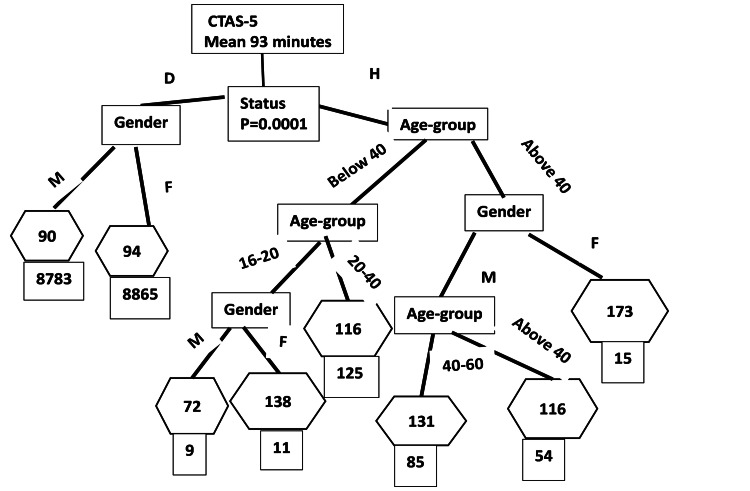
Introduction Certain patient groups perceive specific barriers to accessing primary care, resulting in increased emergency department (ED) use for non-emergency conditions. There is evidence coming from other countries that homeless people are treated differently in accessing emergency services. Examination of ED wait time by demographic characteristics provides pertinent information to identify subgroups that are more subject to the consequences or causes of access block and delayed treatment. Methods We analyzed five years of Emergency Department Information System (EDIS) visit records of the largest tertiary care center in Atlantic Canada. The wait time from triage to seeing a physician was the outcome, housing status was the main exposure, and age and gender were the predictors. Quantile regressions were carried out to identify the influence of homeless visits in meeting the Canadian Association of Emergency Physicians (CAEP) wait time benchmarks for each Canadian Triage and Acuity Scale (CTAS) level. The classification and regression tree method was used to quantify and classify the demographic subgroups contributing to wait time disparities across CTAS levels. Results Homeless visit median wait times that exceeded the three-hour CAEP benchmark were significantly longer for urgent (by 40 minutes, CI: 25-55), semi-urgent (by 31 minutes, CI: 17-45), and non-urgent (by 57 minutes, CI: 25-89) than acuity level-matched domiciled visit wait times. At the 50th percentile, one-hour benchmark homeless triaged as semi-urgent waited (median=20 minutes, CI: 12-28) longer, and no other triage-level differences were found at this benchmark. Homeless emergent-level visits that exceeded the three-hour benchmark were 28 minutes, on average, shorter than domiciled patients of the same acuity level. Homeless females above 40 stayed the longest for non-urgent care (mean=173 minutes), 82 minutes longer (p=0.0001) than age-gender-acuity level-matched domiciled patients. Homelessness was the most prominent ED wait time classifier for non-urgent, ED visits. Overall, homeless patients triaged as CTAS-5 waited 30 minutes longer (p=0.0001) than domiciled patients triaged as CTAS-5. Homeless male 16-20-year-olds waited the shortest time of 72 minutes. Conclusion Homelessness-related wait time disparities exist in the low acuity non-urgent-level ED visits more than in the other levels, supporting the theory that lack of primary care access is a driver of ED use in this group. Our acuity level analysis supports that homeless people of a certain age (older) and gender groups (female) wait longer than their age-gender-matched domiciled patients to be seen by a physician in low acuity level presentations. Given the pattern of the homeless being seen earlier or statistically similar in emergent-level visits compared to matched domiciled patients and that 16-20-year-old homeless males were seen on average within 72 minutes (the shortest mean wait time reported for the triage level CTAS-5), we decline the notion of discrimination at the study site ED. If homeless patients' non-urgent needs were met elsewhere, pressure on the ED to meet benchmarks might be reduced.
Overview
CoChat Summary
TL;DR
In five years of emergency department data from the largest tertiary care center in Atlantic Canada, homelessness-related wait time disparities were concentrated in low-acuity CTAS-4 and CTAS-5 visits, especially among homeless females over 40. The authors conclude that the pattern does not support discrimination against homeless patients at the study site and instead points to unmet primary care needs driving low-acuity ED use.
Key findings
- Among 350,111 visits from 2011–2015, 3,081 (0.9%) were homeless and 347,112 (99.1%) were domiciled; homeless visits were more often younger, male, and left without being seen (16% vs 2%, p<0.0001).
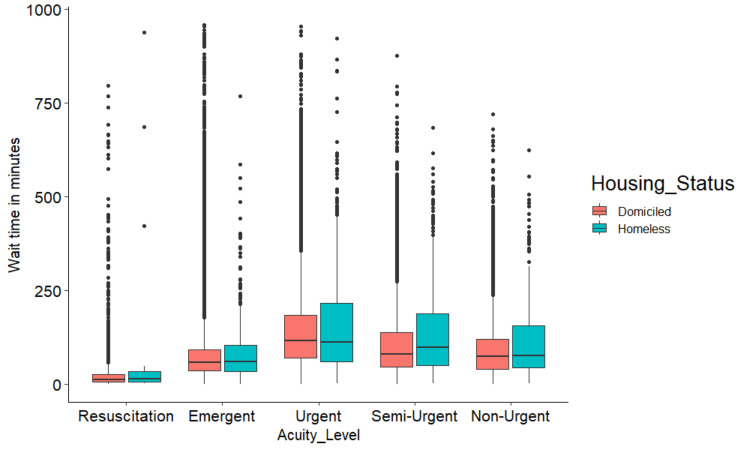
- For visits exceeding the three-hour CAEP benchmark, homeless patients waited significantly longer than acuity-matched domiciled patients for urgent CTAS-3 by 40 minutes (CI: 25–55), semi-urgent CTAS-4 by 31 minutes (CI: 17–45), and non-urgent CTAS-5 by 57 minutes (CI: 25–89); homeless emergent CTAS-2 visits were 28 minutes shorter (CI: −41 to −14).
- At the 50th-percentile benchmark, only CTAS-4 homeless patients waited significantly longer (median = 20 minutes, CI: 12–28); at the 90th percentile, homelessness was associated with longer waits at CTAS-3 (88 minutes), CTAS-4 (91 minutes), and CTAS-5 (127 minutes), but not CTAS-2.
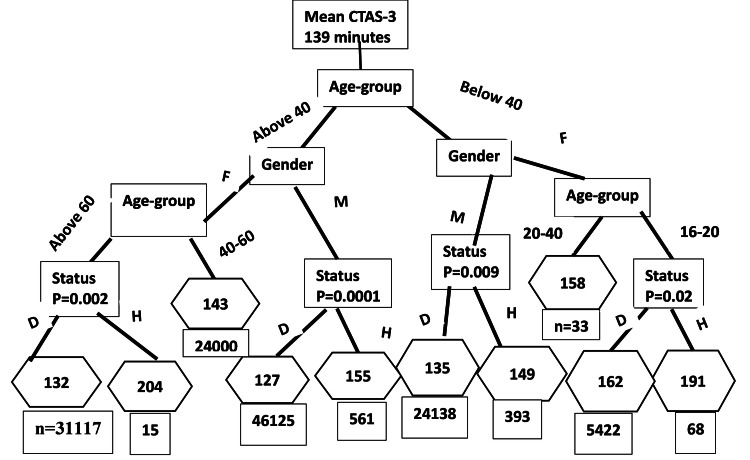
- CART analysis found homeless females over 40 had the longest non-urgent waits (mean = 173 minutes), 82 minutes longer than matched domiciled patients (p=0.0001); overall CTAS-5 homeless patients waited 30 minutes longer (p=0.0001), while homeless male 16–20-year-olds had the shortest wait at 72 minutes.
Methods
- Retrospective analysis of five years of Emergency Department Information System records from the Charles V. Keating Emergency and Trauma Centre, Halifax Infirmary, Queen Elizabeth II Health Sciences Center, Halifax, Nova Scotia, for 2011–2015; wait time was triage to physician, housing status was the main exposure, and age and gender were predictors.
- Homelessness was classified using inability to provide a valid residential address, following Statistics Canada; left-without-being-seen visits were excluded from detailed analyses, and CTAS-1 was excluded because there were very few homeless visits.
- Quantile regressions were fitted at the 50th and 90th percentiles and for the subset waiting over three hours across CTAS levels 2–5, adjusted for age and gender; classification and regression tree (CART) analysis identified demographic subgroups contributing to wait time disparities, using R version 4.1.
Limitations
- The paper states that findings come from a single ED site and may not reflect rural, non-teaching, or lower-volume EDs; the analysis did not incorporate presenting complaints within triage level, change of condition while waiting, volume, ED congestion, primary care access, or output flow.
- The paper notes that administrative data provided little beyond wait times and limited demographics, and that CTAS-1 and left-without-being-seen visits were excluded from detailed analyses.
- Evident from the text: the design is observational and cannot establish causality; homelessness was inferred from an invalid residential address, which may misclassify patients; CART used mean wait times because existing software did not support median classification.
Model-written summary. Check it against the paper before relying on it.
Integrity signals
Registry
Cites
Statistics
Figures
Verification
Claims the paper makes
0 Valid · 0 Not valid · 23 Not checked · 112 Own results and interpretations
A result the paper reports from its own data — it cites no other source for it, so there is none to check. The quote shows it is in the paper.
In the paper
“Homeless emergent-level visits that exceeded the three-hour benchmark were 28 minutes, on average, shorter than domiciled patients of the same acuity level.”
§ Homelessness and Emergency Department Use: Wait Time Disparities Across Triage Acuity Levels > Abstract
plainstates an association- Asserted: passes — The authors put it forward as true.
- Checkable: passes — It can be checked against evidence.
- Load-bearing: unclear — It is unclear whether the paper’s conclusions depend on it.
- Based: passes — The paper gives a reason why it holds.
A result the paper reports from its own data — it cites no other source for it, so there is none to check. The quote shows it is in the paper.
In the paper
“Homeless visit median wait times that exceeded the three-hour CAEP benchmark were significantly longer for urgent (by 40 minutes, CI: 25-55), semi-urgent (by 31 minutes, CI: 17-45), and non-urgent (by 57 minutes, CI: 25-89) than acuity level-matched domiciled visit wait times.”
§ Homelessness and Emergency Department Use: Wait Time Disparities Across Triage Acuity Levels > Abstract
plainstates an association- Asserted: passes — The authors put it forward as true.
- Checkable: passes — It can be checked against evidence.
- Load-bearing: passes — The paper’s conclusions depend on it.
- Based: passes — The paper gives a reason why it holds.
A result the paper reports from its own data — it cites no other source for it, so there is none to check. The quote shows it is in the paper.
In the paper
“Homelessness was the most prominent ED wait time classifier for non-urgent, ED visits.”
§ Homelessness and Emergency Department Use: Wait Time Disparities Across Triage Acuity Levels > Abstract
plainstates an association- Asserted: passes — The authors put it forward as true.
- Checkable: passes — It can be checked against evidence.
- Load-bearing: passes — The paper’s conclusions depend on it.
- Based: passes — The paper gives a reason why it holds.
A result the paper reports from its own data — it cites no other source for it, so there is none to check. The quote shows it is in the paper.
In the paper
“At the 50th percentile, one-hour benchmark homeless triaged as semi-urgent waited (median=20 minutes, CI: 12-28) longer, and no other triage-level differences were found at this benchmark.”
§ Homelessness and Emergency Department Use: Wait Time Disparities Across Triage Acuity Levels > Abstract
plain- Asserted: passes — The authors put it forward as true.
- Checkable: passes — It can be checked against evidence.
- Load-bearing: unclear — It is unclear whether the paper’s conclusions depend on it.
- Based: passes — The paper gives a reason why it holds.
77 more claims
Create a free account to see all 135 claims and to verify the 29 references still open.
- It may state two separate claims as one. 36
- Probably not a substantial claim. 28
Self-check
Percentages, sums and reported differences re-computed from the paper’s own numbers.
Each contradiction between two passages listed here was confirmed by an independent check.
Rated major: it would touch a result — a value a result rests on, reported and recomputed p-values on opposite sides of the significance level, two passages that conflict with no sign which is right, or a cited work retracted before this paper was published.
In the paper
§ Homelessness and Emergency Department Use: Wait Time Disparities Across Triage Acuity Levels > Conclusions
“Our findings coming from the largest ED in Atlantic Canada suggest homelessness was only an age-gender-related wait time disparity modifier in low acuity level ED visits.”
§ Homelessness and Emergency Department Use: Wait Time Disparities Across Triage Acuity Levels > Results
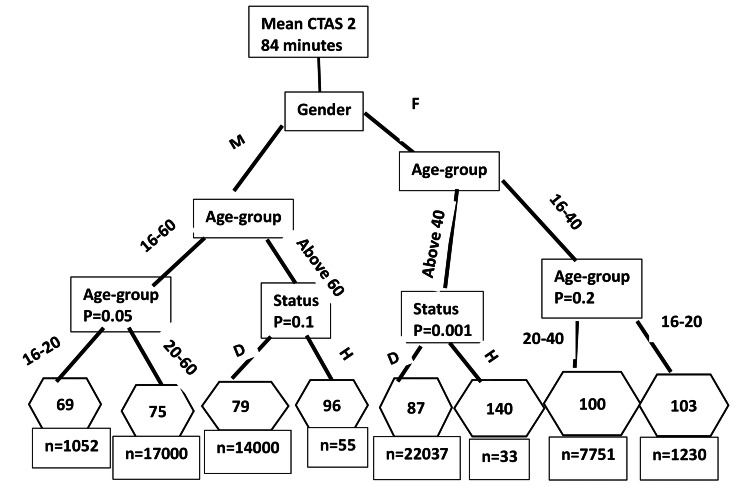
“The next important CTAS-2 classifier was the age group, and above 40-year-old homeless females stayed the longest, 53 minutes longer than age-gender-matched domiciled patients (p=0.001), who stayed 87 minutes on average.”
Rated minor: it would not touch a result — a value no result rests on, a p-value that stays on the same side of the significance level, or a conflict that is clerical, resolved elsewhere in the paper, or outside its own findings.
In the paper
§ Homelessness and Emergency Department Use: Wait Time Disparities Across Triage Acuity Levels > Results
“Homeless patients who visited between 11pm and 7am (p=0.04) and also those who visited ED in the spring (p=0.04) waited longer.”
§ Homelessness and Emergency Department Use: Wait Time Disparities Across Triage Acuity Levels > Results
“| Spring | 24.5 | 86 (52-141) | 80 (44-146) | 0.04* |”
Rated minor: it would not touch a result — a value no result rests on, a p-value that stays on the same side of the significance level, or a conflict that is clerical, resolved elsewhere in the paper, or outside its own findings.
In the paper
§ Homelessness and Emergency Department Use: Wait Time Disparities Across Triage Acuity Levels > Results
“ED visits that concluded without the patient being seen by an ED physician (LWBS) were more common (16%) among the homeless compared to domiciled patients (2%, p<0.0001).”
§ Homelessness and Emergency Department Use: Wait Time Disparities Across Triage Acuity Levels > Results
“| Left without being seen | 84 | - | - | - |”
Rated minor: it would not touch a result — a value no result rests on, a p-value that stays on the same side of the significance level, or a conflict that is clerical, resolved elsewhere in the paper, or outside its own findings.
In the paper
§ Homelessness and Emergency Department Use: Wait Time Disparities Across Triage Acuity Levels > Discussion
“Wait time disparities among subgroups of homeless female patients older than 40 were consistent across CTAS-2-5, with 40-76-minute longer waits compared to matched domiciled patients.”
§ Homelessness and Emergency Department Use: Wait Time Disparities Across Triage Acuity Levels > Results
“Homeless females above 60 waited 125 minutes longer (p=0.0001) and 40-60-year-old homeless females waited 95 minutes (p=0.0008) longer than age-gender-matched domiciled patients.”
Rated minor: it would not touch a result — a value no result rests on, a p-value that stays on the same side of the significance level, or a conflict that is clerical, resolved elsewhere in the paper, or outside its own findings.
In the paper
§ Homelessness and Emergency Department Use: Wait Time Disparities Across Triage Acuity Levels > Results
“Also, 21-40-year-old homeless patients had a significantly (p=0.03) shorter time to be seen by an ED physician compared to the same age group of domiciled ED patients.”
§ Homelessness and Emergency Department Use: Wait Time Disparities Across Triage Acuity Levels > Results
“| 21-40 (n=123229) | 37.4 | 92 (54-153) | 89 (48-178) | 0.53 |”
Citations
Cites
(2002) · Journal of Urban Health: Bulletin of the New York Academy of Medicine · doi:10.1093/jurban/79.suppl_1.s141 · Cited by 701
Mortality among residents of shelters, rooming houses, and hotels in Canada: 11 year follow-up study
Hwang, S. W., Wilkins, R., Tjepkema, M., O'Campo, P. J., & Dunn, J. R. (2009) · BMJ · doi:10.1136/bmj.b4036 · Cited by 388 · cited 1×
“Homeless individuals have significantly higher mortality rates than the poorest fifth of Canadians, and the life expectancy at the age of 25 is 42 years [21].”
BackgroundMyths versus facts in emergency department overcrowding and hospital access block
Richardson, D. B., & Mountain, D. (2009) · Medical Journal of Australia · doi:10.5694/j.1326-5377.2009.tb02451.x · Cited by 262
Hwang, S. W., Chambers, C., Chiu, S., Katic, M., Kiss, A., Redelmeier, D. A., & Levinson, W. (2013) · American Journal of Public Health · doi:10.2105/ajph.2013.301369 · Cited by 239 · cited 2×
“…healthcare utilization in Ontario revealed homeless patients had an 8.5 times higher rate of ED utilization than age-gender-matched low-income domiciled controls in the province, due to increased ambulatory care encounters [5], but acuity level-based wait time disparities remain under-reported.”
BackgroundInfluentialEmergency department overcrowding and access block
Affleck, A., Parks, P., Drummond, A., Rowe, B. H., & Ovens, H. J. (2013) · CJEM · doi:10.1017/s1481803500002451 · Cited by 238
The Health of Street Youth: A Canadian Perspective
Boivin, J., Roy, É., Haley, N., & du Fort, G. G. (2005) · Canadian Journal of Public Health · doi:10.1007/bf03405183 · Cited by 195
Primary healthcare needs and barriers to care among Calgary’s homeless populations
Campbell, D. J. T., O’Neill, B. G., Gibson, K., & Thurston, W. E. (2015) · BMC Family Practice · doi:10.1186/s12875-015-0361-3 · Cited by 164
Krausz, R. M., Clarkson, A. F., Strehlau, V., Torchalla, I., Li, K. K., & Schütz, C. G. (2013) · Social Psychiatry and Psychiatric Epidemiology · doi:10.1007/s00127-012-0649-8 · Cited by 141
The heaviest repeat users of an inner city emergency department are not general practice patients
Dent, A. W., Phillips, G. A., Chenhall, A. J., & McGregor, L. R. (2003) · Emergency Medicine · doi:10.1046/j.1442-2026.2003.00470.x · Cited by 91
The State of Homelessness in Canada 2013
Gaetz, S., Donaldson, J., Richter, T., & Gulliver, T. E. (2013) · York University Digital Library (York University) · Cited by 84
Cited by
Still being checked.
Metadata
- Authors
- Weerasinghe, S. S., & Campbell, S. G.
- Affiliations
- Dalhousie University (CA)
- Corresponding author
- Campbell, Samuel G
- ORCID
- Campbell, Samuel G
- Venue
- Cureus
- Published
- 2023-11-27
- Volume
- 15
- Issue
- 11
- Pages
- e49520-e49520
- ISSN
- 2168-8184 (ISSN-L)
- PMC
- PMC10756006
- OpenAlex
- W4389070734
- Cited by
- 2
- References
- 22
- Citations by year
- 2025: 1 · 2024: 1
- FWCI
- 0.43
- Type
- journal article
- Language
- en
- Open access
- diamond
- doi.org
- Licence
- cc-by
- Locations
- Cureus (publishedVersion, cc-by)
- PubMed Central (publishedVersion, cc-by)
- PubMed (publishedVersion)
- Topics
- Health Sciences › Medicine › Emergency Medicine › Emergency and Acute Care Studies
- Social Sciences › Sociology and Political Science › Homelessness and Social Issues
- Health Sciences › Medicine › Emergency Medicine › Trauma and Emergency Care Studies
- Keywords
- homelessness, emergency department waiting times, Canadian Triage and Acuity Scale, primary care access, health care disparities, non-urgent emergency visits, housing status, emergency department utilization, treatment delay, Atlantic Canada, tertiary care hospital, emergency department information systems
About these checks
Registry, retraction, Cites and statistics results are computed, not judged, with one exception: a printed reference that no index lists is read once by a model before it counts as a citation error. Claims are extracted by a model and kept only when their quote appears verbatim in the text; each cited source is then checked, with a model’s help, for whether it says what the claim relies on. Those verdicts can be wrong — read the claim’s quote and the cited source before relying on one.
A language model drew the claims from the paper on 2026-11-25, under version 3 of the claim definition (model deepseek-v4.1-flash, prompt extract-v3).
A second model labelled each claim on 2026-11-25 (model jev-1.13-20260917, definition revision gold-guideline-v0.2).
Statistics and arithmetic are recomputed, not judged.
Confidence bands are shown only for fields calibrated on our annotated test set. None is calibrated yet, so no band is shown.
What counts as a claim ›How we measure confidence ›How we check this ›
Are you an author, or do you see a problem with this page? Request a review
How to cite
Cite CoChat for the checks on this page, and the paper for its own findings.
- This page
- CoChat. (2026). Citation check: Homelessness and Emergency Department Use: Wait Time Disparities Across Triage Acuity Levels. https://app.cochat.ai/papers/10.7759/cureus.49520
- The paper
- Weerasinghe, S. S., & Campbell, S. G. (2023). Homelessness and Emergency Department Use: Wait Time Disparities Across Triage Acuity Levels. Cureus. https://doi.org/10.7759/cureus.49520
Data sources
Bibliographic data: Semantic Scholar, OpenAlex, Crossref.
Contains information from the Semantic Scholar Academic Graph Datasets, made available under the ODC Attribution License (ODC-BY 1.0).
Semantic Scholar’s data is described in: Kinney, R., et al. (2023). The Semantic Scholar Open Data Platform. arXiv:2301.10140.
