

The DOI matches its Crossref record; 36 of the 39 references it cites were found in a registry or an index.
Digital Rights, Digital Citizenship and Digital Literacy: What’s the Difference?
Open accessAbstract
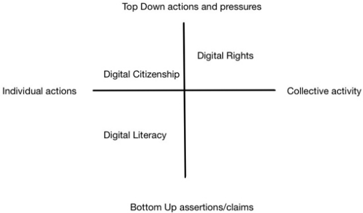
Using digital media is complicated. Invasions of privacy, increasing dataveillance, digital-by-default commercial and civic transactions and the erosion of the democratic sphere are just some of the complex issues in modern societies. Existential questions associated with digital life challenge the individual to come to terms with who they are, as well as their social interactions and realities. In this article, we identify three contemporary normative responses to these complex issues –digital citizenship, digital rights and digital literacy. These three terms capture epistemological and ontological frames that theorise and enact (both in policy and everyday social interactions) how individuals learn to live in digitally mediated societies. The article explores the effectiveness of each in addressing the philosophical, ethical and practical issues raised by datafication, and the limitations of human agency as an overarching goal within these responses. We examine how each response addresses challenges in policy, everyday social life and political rhetoric, tracing the fluctuating uses of these terms and their address to different stakeholders. The article concludes with a series of conceptual and practical ‘action points’ that might optimise these responses to the benefit of the individual and society.
Overview
The claims and statistics of this paper haven’t been checked yet.
Run the check — free, no account needed. It reads the open-access text and checks the sources it cites.
Integrity signals
Registry
Cites
Statistics
Figures
Verification
Claims the paper makes
The claims and statistics of this paper haven’t been checked yet.
Run the check — free, no account needed. It reads the open-access text and checks the sources it cites.
Claims other papers make about this one
Each is checked against this paper’s own text: does it say what the citing paper says it does?
In the citing paper
“Digital literacy (DL) has become a new core skill in work, learning, and communication (Farias-Gaytan et al. 2022; Pangrazio and Sefton-Green, 2021; Porat et al. 2018).”
From The causal relationship between digital literacy and students’ academic achievement: a meta-analysis (2025) · cites this paper as Pangrazio and Sefton-Green, 2021
Self-check
Percentages, sums and reported differences re-computed from the paper’s own numbers.
The self-check needs the paper’s full text.
Citations
Cites
Big Data, new epistemologies and paradigm shifts
Kitchin, R. (2014) · Big Data & Society · doi:10.1177/2053951714528481 · Cited by 2,355
D'Ignazio, C., & Klein, L. F. (2020) · doi:10.7551/mitpress/11805.001.0001 · Cited by 1,738
Mossberger, K., Tolbert, C. J., & McNeal, R. S. (2007) · The MIT Press eBooks · doi:10.7551/mitpress/7428.001.0001 · Cited by 1,230
Srnicek, N. (2016) · Cited by 1,099
Networked privacy: How teenagers negotiate context in social media
Marwick, A. E., & boyd, D. (2014) · New Media & Society · doi:10.1177/1461444814543995 · Cited by 954
Children and young people’s rights in the digital age: An emerging agenda
Livingstone, S., & Third, A. (2017) · New Media & Society · doi:10.1177/1461444816686318 · Cited by 556
Changing Citizenship in the Digital Age
Bennett, W. L. (2007) · The MIT Press eBooks · doi:10.7551/mitpress/7893.003.0002 · Cited by 533
The datafied child: The dataveillance of children and implications for their rights
Lupton, D. A., & Williamson, B. (2017) · New Media & Society · doi:10.1177/1461444816686328 · Cited by 514
We Are Data: Algorithms and the Making of Our Digital Selves
Cheney-Lippold, J. (2020) · doi:10.2307/j.ctt1gk0941 · Cited by 436
Wolfle, D. L. (1964) · Science · doi:10.1126/science.143.3608.767 · Cited by 407
Gray, J., Gerlitz, C., & Bounegru, L. (2018) · Big Data & Society · doi:10.1177/2053951718786316 · Cited by 359
Pangrazio, L., & Selwyn, N. (2018) · New Media & Society · doi:10.1177/1461444818799523 · Cited by 348
Self-citationBig Data, Big Questions| The Big Data Divide
Andrejevic, M. (2014) · International journal of communication · Cited by 325
Learning at the digital frontier: a review of digital literacies in theory and practice
Littlejohn, A. H., Beetham, H., & McGill, L. (2012) · Journal of Computer Assisted Learning · doi:10.1111/j.1365-2729.2011.00474.x · Cited by 309
Digital Citizenship: Addressing Appropriate Technology Behavior.
Ribble, M., Bailey, G. D., & Ross, T. W. (2004) · Learning and leading with technology · Cited by 251
Hockly, N., Dudeney, G., & Pegrum, M. A. (2014) · Routledge eBooks · doi:10.4324/9781315832913 · Cited by 233
Theorizing participatory intensities
Jenkins, H., & Carpentier, N. (2013) · Convergence The International Journal of Research into New Media Technologies · doi:10.1177/1354856513482090 · Cited by 225
Andrejevic, M. (2019) · doi:10.4324/9780429242595 · Cited by 217
The social utility of ‘data literacy’
Pangrazio, L., & Sefton‐Green, J. (2019) · Learning Media and Technology · doi:10.1080/17439884.2020.1707223 · Cited by 197
Self-citationDigital Agency: Empowering Equity in and through Education
Passey, D., Shonfeld, M., Appleby, L., Judge, M., Saito, T., & Smits, A. (2018) · Technology Knowledge and Learning · doi:10.1007/s10758-018-9384-x · Cited by 194
Isin, E. F., & Ruppert, E. S. (2015) · Choice Reviews Online · doi:10.5860/choice.193204 · Cited by 193
Digital Citizenship and Political Engagement
Vromen, A. (2016) · Palgrave Macmillan UK eBooks · doi:10.1057/978-1-137-48865-7 · Cited by 143
Shelley, M., Thrane, L. E., Shulman, S. W., Lang, E., Beisser, S. R., Larson, T. B., & Mutiti, J. (2004) · Social Science Computer Review · doi:10.1177/0894439303262580 · Cited by 132
Raffaghelli, J. E., & Stewart, B. E. (2020) · Teaching in Higher Education · doi:10.1080/13562517.2019.1696301 · Cited by 124
Digital Literacy in Higher Education, Part II: An NMC Horizon Project Strategic Brief
Alexander, B., Becker, S. A., Cummins, M., & Giesinger, C. H. (2017) · Cited by 85
Mačėnaitė, M. (2017) · New Media & Society · doi:10.1177/1461444816686327 · Cited by 83
Human Rights for the Digital Age
Mathiesen, K. (2014) · Journal of Mass Media Ethics · doi:10.1080/08900523.2014.863124 · Cited by 60
Human Rights and the Digital Divide
Peacock, A. (2019) · Routledge eBooks · doi:10.4324/9781351046794 · Cited by 37
Children's digital rights: a priority
Livingstone, S. (2014) · London School of Economics and Political Science Research Online (London School of Economics and Political Science) · Cited by 35
Goggin, G. M., Vromen, A., Weatherall, K. G., Martin, F. R., Webb, A., Sunman, L., & Bailo, F. (2017) · The Sydney eScholarship Repository (The University of Sydney) · Cited by 30
Young People’s Literacies in the Digital Age
Pangrazio, L. (2018) · Routledge eBooks · doi:10.4324/9780203728918 · Cited by 24
Self-citationLaw and the Philosophy of Privacy
Richardson, J. (2015) · Routledge eBooks · doi:10.4324/9780203516133 · Cited by 20
Young People's Literacies in the Digital Age: Continuities, Conflicts and Contradictions
Pangrazio, L. (2018) · Figshare · Cited by 19
Self-citationThrane, L. E., Shelley, M., Shulman, S. W., Beisser, S. R., & Larson, T. B. (2005) · Journal of E-Government · doi:10.1300/j399v01n04_03 · Cited by 14
Digital Literacy in Higher Education, Part II: An NMC Horizon Project Strategic Brief. Volume 3.4.
Alexander, B., Becker, S. A., Cummins, M., & Giesinger, C. H. (2017) · Cited by 10
Educating for Democracy in the Digital Age
Sefton‐Green, J. (2020) · Oxford University Press eBooks · doi:10.1093/acrefore/9780190264093.013.1005 · Cited by 3
Self-citation
Research works printed but not linked: 4
- Jenkins, H., Shresthova, S., & Gamber-Thompson, L. (2016). By Any Media Necessary: The New Youth Activism (Connected Youth and Digital Futures). NYU Press.
- Lankshear, C., & Knobel, M. (2011). New Literacies: Everyday Practices and Social Learning (3rd ed.). Open University Press.
- Ozalp, S. (2019). Unlawful data access and abuse of metadata for mass persecution of dissidents in Turkey: The by-lock case. In A. Daly, S. K. Devitt, & M. Mann (Eds.), Good Data (pp. 117–134). Institute of Network Cultures.
- Sarre, R. (2015). Metadata retention: A review of policy implications for Australians. Justice and Social Democracy Conference.
Cited by
Velander, J., Taiye, M. A., Otero, N., & Milrad, M. (2023) · Education and Information Technologies · doi:10.1007/s10639-023-11990-4 · Cited by 357
Learning to work with the black box: Pedagogy for a world with artificial intelligence
Bearman, M., & Ajjawi, R. (2023) · British Journal of Educational Technology · doi:10.1111/bjet.13337 · Cited by 346
Dimensions of Digital Literacy in the 21st Century Competency Frameworks
Martínez-Bravo, M. C., Sádaba, C., & Serrano-Puche, J. (2022) · Sustainability · doi:10.3390/su14031867 · Cited by 279
Designing assessment in a digital world: an organising framework
Bearman, M., Nieminen, J. H., & Ajjawi, R. (2022) · Assessment & Evaluation in Higher Education · doi:10.1080/02602938.2022.2069674 · Cited by 168
Bühler, M. M., Calzada, I., Cane, I., Jelinek, T., Kapoor, A., Mannan, M., Mehta, S., Micheli, M., Mookerjee, V. S., Nübel, K., et al. (2023) · Digital · doi:10.3390/digital3030011 · Cited by 162
Metadata
- Authors
- Pangrazio, L., & Sefton-Green, J.
- Affiliations
- Deakin University (AU)
- Venue
- Journal of New Approaches in Educational Research
- Published
- 2021-01
- Volume
- 10
- Issue
- 1
- Pages
- 15-27
- ISSN
- 2254-7339 (ISSN-L)
- OpenAlex
- W3118612437
- Cited by
- 284
- References
- 39
- Citations by year
- 2026: 57 · 2025: 70 · 2024: 42 · 2023: 64 · 2022: 28 · 2021: 22
- FWCI
- 375.06
- Type
- journal article
- Language
- en
- Open access
- gold
- doi.org
- Licence
- Locations
- Journal of New Approaches in Educational Research (publishedVersion, cc-by-nc-nd)
- Dialnet (Universidad de la Rioja) (submittedVersion)
- LA Referencia (Red Federada de Repositorios Institucionales de Publicaciones Científicas) (submittedVersion, cc-by)
- DOAJ (DOAJ: Directory of Open Access Journals) (submittedVersion, cc-by-sa)
- Own your potential (DEAKIN) (submittedVersion)
- Figshare (submittedVersion, cc-by)
- Journal of New Approaches in Educational Research (University of Alicante) (submittedVersion, cc-by-nc-nd)
- Repositorio Institucional de la Universidad de Alicante (Universidad de Alicante) (submittedVersion, cc-by)
- Funders
- Ministry of Economy and Competitiveness, Spain (EDU2015-70491-R)
- Topics
- Social Sciences › Education › Literacy, Media, and Education
- Social Sciences › Education › Digital Education and Society
- Social Sciences › Communication › Digital Media and Philosophy
- Keywords
- digital rights, digital citizenship, digital literacy, datafication, dataveillance, human agency, digital privacy, digital policy, digital media
About these checks
Registry, retraction, Cites and statistics results are computed, not judged, with one exception: a printed reference that no index lists is read once by a model before it counts as a citation error. Claims are extracted by a model and kept only when their quote appears verbatim in the text; each cited source is then checked, with a model’s help, for whether it says what the claim relies on. Those verdicts can be wrong — read the claim’s quote and the cited source before relying on one.
Statistics and arithmetic are recomputed, not judged.
Confidence bands are shown only for fields calibrated on our annotated test set. None is calibrated yet, so no band is shown.
What counts as a claim ›How we measure confidence ›How we check this ›
Are you an author, or do you see a problem with this page? Request a review
