

The DOI matches its Crossref record; 9 of the 9 references it cites were found in a registry or an index.
Assessment of ICT Literacy and Usage among Undergraduates in Yezin Agricultural University, Myanmar
Open accessAbstract
The study investigated the accessibility and use of Information and Communication Technology (ICT) among undergraduates at Yezin Agricultural University (YAU) in Myanmar, focusing on their ICT literacy competencies. Utilizing a descriptive survey research design, the study employed stratified random sampling to select 239 students for data collection through structured questionnaires during the first semester of the 2024-2025 academic year, complemented by face-to-face interviews. Findings revealed that students owned an average of two ICT devices and spent over seven hours daily using them, with mobile devices being particularly prominent. Senior students demonstrated more frequent computer use compared to juniors, and over 90% had taken ICT-related courses. Websites were the primary source for information retrieval, while group discussions were preferred for communication. However, the study noted minimal use of multimedia resources and artificial intelligence (AI). Students exhibited competent basic skills in computers and smartphones, but their proficiency in software like Microsoft Office and audio/video editing was only medium, with significant gaps in Learning Management Systems (LMS) and AI technologies. Upper-semester students showed slightly better ICT skills than their lower-semester counterparts. The undergraduates in the YAU were found to have moderate ICT literacy skills (mean = 2.99). The study highlighted the need for enhanced training in multimedia and AI applications to equip students for contemporary digital challenges. It also found a significant correlation between the number of ICT tools used and skill level (r = 0.242, P < 0.01). The insights gained from the study can be applied to refine educational practices, including those related to learning, teaching, and administration, thus supporting the pursuit of quality education in alignment with Sustainable Development Goal 4 (SDG 4).
Overview
AI snapshot
Written from the paper’s full text.
TL;DR
In a descriptive survey of 239 undergraduates at Yezin Agricultural University, students owned about two ICT devices, spent nearly seven hours daily using ICT, and had moderate overall ICT literacy (mean = 2.99). Websites and group discussions were most used, while multimedia and AI/LMS skills were low, and ICT skill correlated significantly with the number of ICT tools used (r = 0.242, P < 0.01).
Key findings
- Among 239 respondents, 44.35% were in the 5th semester, 27.20% in the 7th, and 28.45% in the 9th; 63.18% were female and 36.82% male, with a mean age of 23.61 years. Students owned a mean of 1.90 ICT devices and spent a mean of 6.98 hours/day using ICT; 61.51% used ICT 4–8 hours/day and 29.29% more than 8 hours/day.
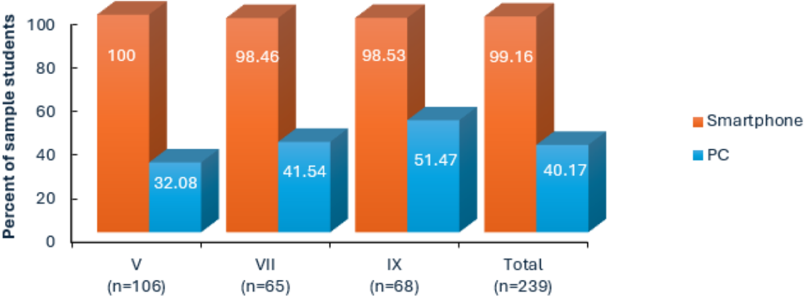
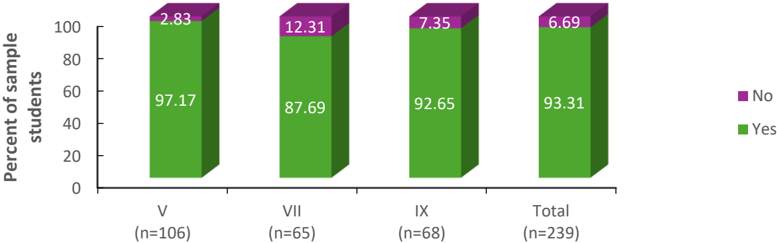
- Smartphone ownership was near universal (100% in 5th semester, 98.46% in 7th, 98.53% in 9th), while personal computer ownership rose from 32.08% in 5th semester to 41.54% in 7th and 51.47% in 9th. Overall, 93.31% had participated in ICT-related courses.
- Most-used ICT applications were websites (93.31%), group discussions (92.89%), email (90.38%), and social networks (82.01%); multimedia was least used (16.74%), and AI use was 61.92%.
- Overall ICT skills were moderate (mean = 2.99, SD = 0.70). Basic computer/phone skills were highest (mean = 3.49), internet/email moderate (3.31), LMS low (2.25), and AI lowest (1.91). The 7th semester had the highest mean ICT skill score (3.12), versus 2.93 for 5th and 2.96 for 9th. Significant correlates were number of ICT tools used (r = 0.242, P < 0.01) and receipt of ICT training (r = 0.159, P < 0.05); education level, gender, device ownership, and daily ICT time were not significant.
Methods
- Descriptive survey design using stratified random sampling: strata were 5th, 7th, and 9th semesters, with simple random selection within each stratum; inclusion required enrollment in those semesters and consent, while 1st–4th semester students and non-consenting students were excluded.
- Data were collected from 239 students during the first semester of the 2024–2025 academic year using structured questionnaires, face-to-face interviews, and observations; observations took place in June 2024.
- Data were analyzed in SPSS version 23 using frequencies, percentages, mean, and standard deviation, with Pearson’s correlation coefficient and Chi-square tests to examine relationships between ICT mastery, ICT use frequency, and demographic characteristics.
Limitations
- The paper does not state a limitations section.
- Evident from the text: the study is a single-institution, cross-sectional survey of 239 students from only the 5th, 7th, and 9th semesters, excluding 1st–4th semester students and non-consenting students, which limits generalizability to all YAU undergraduates or other institutions.
- Evident from the text: ICT use and skill measures rely on questionnaire responses, and the analysis reports correlations, so causal relationships between ICT training, tool use, and skill level cannot be established.
Model-written summary. Check it against the paper before relying on it.
Integrity signals
Registry
Cites
Statistics
Figures
Verification
Claims the paper makes
64 Own result · 19 Own interpretation · 10 No basis given · 3 Own method
A result the paper reports from its own data — it cites no other source for it, so there is none to check. The quote shows it is in the paper.
In the paper
“over 90% had taken Original Research ArticleICT-related courses.”
§ Assessment of ICT Literacy and Usage among Undergraduates in Yezin Agricultural University, Myanmar > Abstract
plain- Asserted: passes — The authors put it forward as true.
- Checkable: passes — It can be checked against evidence.
- Load-bearing: unclear — It is unclear whether the paper’s conclusions depend on it.
- Based: passes — The paper gives a reason why it holds.
The paper states this without a source or data behind it here, so there is nothing to check it against. The quote shows it is in the paper.
In the paper
“In this study, most of the students possessed approximately two ICT devices each.”
§ Assessment of ICT Literacy and Usage among Undergraduates in Yezin Agricultural University, Myanmar > 4. CONCLUSION
plain- Asserted: passes — The authors put it forward as true.
- Checkable: passes — It can be checked against evidence.
- Load-bearing: unclear — It is unclear whether the paper’s conclusions depend on it.
- Based: passes — The paper gives a reason why it holds.
A result the paper reports from its own data — it cites no other source for it, so there is none to check. The quote shows it is in the paper.
In the paper
“while their abilities in presentation software and audio/video editing were notably lower.”
§ Assessment of ICT Literacy and Usage among Undergraduates in Yezin Agricultural University, Myanmar > 3.3 ICT Literacy of Sample Students
plain- Asserted: passes — The authors put it forward as true.
- Checkable: passes — It can be checked against evidence.
- Load-bearing: unclear — It is unclear whether the paper’s conclusions depend on it.
- Based: passes — The paper gives a reason why it holds.
A result the paper reports from its own data — it cites no other source for it, so there is none to check. The quote shows it is in the paper.
In the paper
“Email and social networks followed closely in terms of usage for these purposes.”
§ Assessment of ICT Literacy and Usage among Undergraduates in Yezin Agricultural University, Myanmar > 4. CONCLUSION
plain- Asserted: passes — The authors put it forward as true.
- Checkable: passes — It can be checked against evidence.
- Load-bearing: unclear — It is unclear whether the paper’s conclusions depend on it.
- Based: passes — The paper gives a reason why it holds.
The paper states this without a source or data behind it here, so there is nothing to check it against. The quote shows it is in the paper.
In the paper
“This study indicated that senior students tend to utilize computers more frequently than junior students.”
§ Assessment of ICT Literacy and Usage among Undergraduates in Yezin Agricultural University, Myanmar > 4. CONCLUSION
hedgedcorrelational- Asserted: passes — The authors put it forward as true.
- Checkable: passes — It can be checked against evidence.
- Load-bearing: passes — The paper’s conclusions depend on it.
- Based: unclear — It is unclear why the paper says it holds.
A result the paper reports from its own data — it cites no other source for it, so there is none to check. The quote shows it is in the paper.
In the paper
“The research findings demonstrated a distinct preference among students for traditional and easily accessible digital communication and information tools, such as websites, email, and group discussions.”
§ Assessment of ICT Literacy and Usage among Undergraduates in Yezin Agricultural University, Myanmar > 3.2 ICT Applications Usage by Sample Students
boostedn = 239- Asserted: passes — The authors put it forward as true.
- Checkable: passes — It can be checked against evidence.
- Load-bearing: unclear — It is unclear whether the paper’s conclusions depend on it.
- Based: passes — The paper gives a reason why it holds.
A result the paper reports from its own data — it cites no other source for it, so there is none to check. The quote shows it is in the paper.
In the paper
“However, a significant positive correlation at the 0.05 level was observed, indicating that students who had undergone ICT training exhibited enhanced ICT skills.”
§ Assessment of ICT Literacy and Usage among Undergraduates in Yezin Agricultural University, Myanmar > 3.6 Relationship Between Independent Variables and ICT Skills of the Students
hedgedcorrelational- Asserted: passes — The authors put it forward as true.
- Checkable: passes — It can be checked against evidence.
- Load-bearing: passes — The paper’s conclusions depend on it.
- Based: passes — The paper gives a reason why it holds.
A result the paper reports from its own data — it cites no other source for it, so there is none to check. The quote shows it is in the paper.
In the paper
“It was seen that the respondents' ICT skills differed depending on their use of more than one mobile device and services.”
§ Assessment of ICT Literacy and Usage among Undergraduates in Yezin Agricultural University, Myanmar > 4. CONCLUSION
plaincorrelational- Asserted: passes — The authors put it forward as true.
- Checkable: passes — It can be checked against evidence.
- Load-bearing: passes — The paper’s conclusions depend on it.
- Based: passes — The paper gives a reason why it holds.
A result the paper reports from its own data — it cites no other source for it, so there is none to check. The quote shows it is in the paper.
In the paper
“Overall, students' information and communication technology (ICT) skills were assessed as moderate, with a mean score of 2.99 and a standard deviation of 0.70 (Table 4).”
- Also stated in: § 4. CONCLUSION · plain
“The study revealed that the average ICT skills among all students were at a moderate level.”
§ Assessment of ICT Literacy and Usage among Undergraduates in Yezin Agricultural University, Myanmar > 3.3 ICT Literacy of Sample Students
plain- Asserted: passes — The authors put it forward as true.
- Checkable: passes — It can be checked against evidence.
- Load-bearing: passes — The paper’s conclusions depend on it.
- Based: passes — The paper gives a reason why it holds.
- Also stated in: § 4. CONCLUSION · plain
A result the paper reports from its own data — it cites no other source for it, so there is none to check. The quote shows it is in the paper.
In the paper
“while those with two devices had a slightly lower mean score (mean = 2.90, SD = 0.64).”
§ Assessment of ICT Literacy and Usage among Undergraduates in Yezin Agricultural University, Myanmar > 3.5 ICT Literacy Based on Number of Owing ICT Devices
plain- Asserted: passes — The authors put it forward as true.
- Checkable: passes — It can be checked against evidence.
- Load-bearing: unclear — It is unclear whether the paper’s conclusions depend on it.
- Based: passes — The paper gives a reason why it holds.
- It may state two separate claims as one. 22
- The quote only partly states this claim. 2
- Probably not a substantial claim. 12
A result the paper reports from its own data — it cites no other source for it, so there is none to check. The quote shows it is in the paper.
In the paper
“In terms of short message services (SMS), 60.38% of 5 th Semester students utilized this method, which then rose to 72.31% in the 7 th Semester, only to decrease to 57.35% in the 9 th Semester.”
§ Assessment of ICT Literacy and Usage among Undergraduates in Yezin Agricultural University, Myanmar > 3.2 ICT Applications Usage by Sample Students
plain- Asserted: passes — The authors put it forward as true.
- Checkable: passes — It can be checked against evidence.
- Load-bearing: unclear — It is unclear whether the paper’s conclusions depend on it.
- Based: passes — The paper gives a reason why it holds.
It may state two separate claims as one.
A result the paper reports from its own data — it cites no other source for it, so there is none to check. The quote shows it is in the paper.
In the paper
“Among 5 th Semester students, 61.32% reported using digital assessment tools such as Google Forms, but this percentage fell to 50.77% by the 7 th Semester, before slightly increasing to 54.41% in the 9 th Semester.”
§ Assessment of ICT Literacy and Usage among Undergraduates in Yezin Agricultural University, Myanmar > 3.2 ICT Applications Usage by Sample Students
plainn = 106- Asserted: passes — The authors put it forward as true.
- Checkable: passes — It can be checked against evidence.
- Load-bearing: unclear — It is unclear whether the paper’s conclusions depend on it.
- Based: passes — The paper gives a reason why it holds.
It may state two separate claims as one.
A result the paper reports from its own data — it cites no other source for it, so there is none to check. The quote shows it is in the paper.
In the paper
“The data revealed that 42.26% of undergraduates possessed one ICT device, 31.80%owned two devices, and 25.94% had three or more devices (Table 2).”
§ Assessment of ICT Literacy and Usage among Undergraduates in Yezin Agricultural University, Myanmar > 3.1 Background Information of Sample Students
plain- Asserted: passes — The authors put it forward as true.
- Checkable: passes — It can be checked against evidence.
- Load-bearing: unclear — It is unclear whether the paper’s conclusions depend on it.
- Based: passes — The paper gives a reason why it holds.
It may state two separate claims as one.
A result the paper reports from its own data — it cites no other source for it, so there is none to check. The quote shows it is in the paper.
In the paper
“The data on email usage reveals a rate of 82.08% in the 5 th Semester, which rose to 95.38% in the 7 th Semester, and peaked at 98.53% in the 9 th Semester.”
§ Assessment of ICT Literacy and Usage among Undergraduates in Yezin Agricultural University, Myanmar > 3.2 ICT Applications Usage by Sample Students
plaincorrelational- Asserted: passes — The authors put it forward as true.
- Checkable: passes — It can be checked against evidence.
- Load-bearing: unclear — It is unclear whether the paper’s conclusions depend on it.
- Based: passes — The paper gives a reason why it holds.
It may state two separate claims as one.
A result the paper reports from its own data — it cites no other source for it, so there is none to check. The quote shows it is in the paper.
In the paper
“Websites were the primary source for information retrieval”
§ Assessment of ICT Literacy and Usage among Undergraduates in Yezin Agricultural University, Myanmar > Abstract
plain- Asserted: passes — The authors put it forward as true.
- Checkable: passes — It can be checked against evidence.
- Load-bearing: unclear — It is unclear whether the paper’s conclusions depend on it.
- Based: passes — The paper gives a reason why it holds.
The quote only partly states this claim.
A result the paper reports from its own data — it cites no other source for it, so there is none to check. The quote shows it is in the paper.
In the paper
“the number of male and female respondents was 36.82% and 63.18% respectively out of 239 respondents in YAU.”
§ Assessment of ICT Literacy and Usage among Undergraduates in Yezin Agricultural University, Myanmar > 3.1 Background Information of Sample Students
plainn = 239- Asserted: passes — The authors put it forward as true.
- Checkable: passes — It can be checked against evidence.
- Load-bearing: fails — The paper’s conclusions may not depend on it.
- Based: passes — The paper gives a reason why it holds.
Probably not a substantial claim. The paper’s conclusions may not depend on it.
A result the paper reports from its own data — it cites no other source for it, so there is none to check. The quote shows it is in the paper.
In the paper
“Among these, websites and group discussions were the most widely utilized, with usage rates exceeding 90% throughout all semesters.”
§ Assessment of ICT Literacy and Usage among Undergraduates in Yezin Agricultural University, Myanmar > 3.2 ICT Applications Usage by Sample Students
plain- Asserted: passes — The authors put it forward as true.
- Checkable: passes — It can be checked against evidence.
- Load-bearing: unclear — It is unclear whether the paper’s conclusions depend on it.
- Based: passes — The paper gives a reason why it holds.
It may state two separate claims as one.
A result the paper reports from its own data — it cites no other source for it, so there is none to check. The quote shows it is in the paper.
In the paper
“The mean scores of the IT skills of the students are 2.41, 2.84, 3.02, and 3.21 for the students choosing less than 5 tools, between 5 to 7 tools, between 8 to 7 tools, and higher than 10 tools accordingly.”
§ Assessment of ICT Literacy and Usage among Undergraduates in Yezin Agricultural University, Myanmar > 3.4 ICT Literacy Based on the Frequency of Utilization of Different ICT Tools
plaincorrelational- Asserted: passes — The authors put it forward as true.
- Checkable: passes — It can be checked against evidence.
- Load-bearing: passes — The paper’s conclusions depend on it.
- Based: passes — The paper gives a reason why it holds.
It may state two separate claims as one. The quote only partly states this claim.
A result the paper reports from its own data — it cites no other source for it, so there is none to check. The quote shows it is in the paper.
In the paper
“The participation rate for ICT-related courses in the 5 th Semester reached an impressive 97.17%, the highest among the three semesters assessed.In contrast, the 7 th Semester recorded the lowest participation at 87.69%.However, participation rebounded in the 9 th Semester, reaching 92.65%.Overall, 93.31% of students participated in ICT-related courses”
§ Assessment of ICT Literacy and Usage among Undergraduates in Yezin Agricultural University, Myanmar > 3.1 Background Information of Sample Students
plainn = 239- Asserted: passes — The authors put it forward as true.
- Checkable: passes — It can be checked against evidence.
- Load-bearing: unclear — It is unclear whether the paper’s conclusions depend on it.
- Based: passes — The paper gives a reason why it holds.
It may state two separate claims as one.
A result the paper reports from its own data — it cites no other source for it, so there is none to check. The quote shows it is in the paper.
In the paper
“Lastly, the correlation between perceived ease of use and ICT skills was weak and not significant”
§ Assessment of ICT Literacy and Usage among Undergraduates in Yezin Agricultural University, Myanmar > 3.6 Relationship Between Independent Variables and ICT Skills of the Students
plaincorrelational- Asserted: passes — The authors put it forward as true.
- Checkable: passes — It can be checked against evidence.
- Load-bearing: passes — The paper’s conclusions depend on it.
- Based: passes — The paper gives a reason why it holds.
It may state two separate claims as one.
The paper states this without a source or data behind it here, so there is nothing to check it against. The quote shows it is in the paper.
In the paper
“It was observed that ICT resources, specifically computers and internet connectivity, were readily accessible in different areas of the YAU campus, including its libraries and computer labs.”
§ Assessment of ICT Literacy and Usage among Undergraduates in Yezin Agricultural University, Myanmar > 3.1 Background Information of Sample Students
plain- Asserted: passes — The authors put it forward as true.
- Checkable: passes — It can be checked against evidence.
- Load-bearing: fails — The paper’s conclusions may not depend on it.
- Based: passes — The paper gives a reason why it holds.
Probably not a substantial claim. The paper’s conclusions may not depend on it.
A result the paper reports from its own data — it cites no other source for it, so there is none to check. The quote shows it is in the paper.
In the paper
“According to the results, 9.21% of respondents spend under four hours on ICT daily.Conversely, 61.51% utilize ICT for a period of four to eight hours, and 29.29% report using it for more than eight hours each day (Table 2).”
§ Assessment of ICT Literacy and Usage among Undergraduates in Yezin Agricultural University, Myanmar > 3.1 Background Information of Sample Students
plain- Asserted: passes — The authors put it forward as true.
- Checkable: passes — It can be checked against evidence.
- Load-bearing: unclear — It is unclear whether the paper’s conclusions depend on it.
- Based: passes — The paper gives a reason why it holds.
It may state two separate claims as one.
A result the paper reports from its own data — it cites no other source for it, so there is none to check. The quote shows it is in the paper.
In the paper
“It was shown that 71.55% of respondents were aged between 19 to 24 years, 21.76% were 25 to 30 years and 6.69% of respondents were more than 30 years among 239 respondents”
§ Assessment of ICT Literacy and Usage among Undergraduates in Yezin Agricultural University, Myanmar > 3.1 Background Information of Sample Students
plainn = 239- Asserted: passes — The authors put it forward as true.
- Checkable: passes — It can be checked against evidence.
- Load-bearing: fails — The paper’s conclusions may not depend on it.
- Based: passes — The paper gives a reason why it holds.
Probably not a substantial claim. The paper’s conclusions may not depend on it. It may state two separate claims as one.
A result the paper reports from its own data — it cites no other source for it, so there is none to check. The quote shows it is in the paper.
In the paper
“It was clearly shown that most of the respondents were from 5 th Semester students.”
§ Assessment of ICT Literacy and Usage among Undergraduates in Yezin Agricultural University, Myanmar > 3.1 Background Information of Sample Students
boostedn = 239- Asserted: passes — The authors put it forward as true.
- Checkable: passes — It can be checked against evidence.
- Load-bearing: fails — The paper’s conclusions may not depend on it.
- Based: passes — The paper gives a reason why it holds.
Probably not a substantial claim. The paper’s conclusions may not depend on it.
A result the paper reports from its own data — it cites no other source for it, so there is none to check. The quote shows it is in the paper.
In the paper
“with 20.75% of 5 th Semester students using them, rising slightly to 24.62% in the 7 th Semester, but declining again to 17.65% in the 9 th Semester.”
§ Assessment of ICT Literacy and Usage among Undergraduates in Yezin Agricultural University, Myanmar > 3.2 ICT Applications Usage by Sample Students
plaincorrelationaln = 239- Asserted: passes — The authors put it forward as true.
- Checkable: passes — It can be checked against evidence.
- Load-bearing: unclear — It is unclear whether the paper’s conclusions depend on it.
- Based: passes — The paper gives a reason why it holds.
It may state two separate claims as one.
A result the paper reports from its own data — it cites no other source for it, so there is none to check. The quote shows it is in the paper.
In the paper
“The result from the observation revealed that 44.35 % were studying on 5 th Semester, 27.20% on 7 th Semester and 28.45% on 9 th Semester respectively (Table 1).”
§ Assessment of ICT Literacy and Usage among Undergraduates in Yezin Agricultural University, Myanmar > 3.1 Background Information of Sample Students
plainn = 239- Asserted: passes — The authors put it forward as true.
- Checkable: passes — It can be checked against evidence.
- Load-bearing: fails — The paper’s conclusions may not depend on it.
- Based: passes — The paper gives a reason why it holds.
Probably not a substantial claim. The paper’s conclusions may not depend on it. It may state two separate claims as one.
The paper states this without a source or data behind it here, so there is nothing to check it against. The quote shows it is in the paper.
In the paper
“Students' ICT skills were not significantly related to their education level, gender, ICT equipment ownership, and duration of use.”
§ Assessment of ICT Literacy and Usage among Undergraduates in Yezin Agricultural University, Myanmar > 4. CONCLUSION
plain- Asserted: passes — The authors put it forward as true.
- Checkable: passes — It can be checked against evidence.
- Load-bearing: passes — The paper’s conclusions depend on it.
- Based: passes — The paper gives a reason why it holds.
It may state two separate claims as one.
The paper states this without a source or data behind it here, so there is nothing to check it against. The quote shows it is in the paper.
In the paper
“It was observed that undergraduates predominantly gained their ICT competencies through social networks and self-directed learning, frequently participating in paid computer literacy programs conducted by private training institutions.”
§ Assessment of ICT Literacy and Usage among Undergraduates in Yezin Agricultural University, Myanmar > 3.1 Background Information of Sample Students
plainn = 239- Asserted: passes — The authors put it forward as true.
- Checkable: passes — It can be checked against evidence.
- Load-bearing: fails — The paper’s conclusions may not depend on it.
- Based: fails — The paper may give no reason why it holds.
Probably not a substantial claim. The paper’s conclusions may not depend on it. The paper may give no reason why it holds. It may state two separate claims as one.
A result the paper reports from its own data — it cites no other source for it, so there is none to check. The quote shows it is in the paper.
In the paper
“Students' ICT skills were found to be significantly related to the number of ICT equipment and services used, as well as the receiving of ICT-related courses they had received.”
§ Assessment of ICT Literacy and Usage among Undergraduates in Yezin Agricultural University, Myanmar > 4. CONCLUSION
plaincorrelational- Asserted: passes — The authors put it forward as true.
- Checkable: passes — It can be checked against evidence.
- Load-bearing: passes — The paper’s conclusions depend on it.
- Based: passes — The paper gives a reason why it holds.
It may state two separate claims as one.
A result the paper reports from its own data — it cites no other source for it, so there is none to check. The quote shows it is in the paper.
In the paper
“the adoption of artificial intelligence (AI) learning tools showed variability, starting with 62.26% of 5 th Semester students using them, dropping to 53.85% in the 7 th Semester, and then sharply rising to 69.12% in the 9 th Semester.”
§ Assessment of ICT Literacy and Usage among Undergraduates in Yezin Agricultural University, Myanmar > 3.2 ICT Applications Usage by Sample Students
plain- Asserted: passes — The authors put it forward as true.
- Checkable: passes — It can be checked against evidence.
- Load-bearing: unclear — It is unclear whether the paper’s conclusions depend on it.
- Based: passes — The paper gives a reason why it holds.
It may state two separate claims as one.
A result the paper reports from its own data — it cites no other source for it, so there is none to check. The quote shows it is in the paper.
In the paper
“smartphone ownership was close to entirety among students throughout all semesters, with 100% in 5 th Semester, 98.46% in 7 th Semester, and 98.53% in 9 th Semester.”
§ Assessment of ICT Literacy and Usage among Undergraduates in Yezin Agricultural University, Myanmar > 3.1 Background Information of Sample Students
plain- Asserted: passes — The authors put it forward as true.
- Checkable: passes — It can be checked against evidence.
- Load-bearing: passes — The paper’s conclusions depend on it.
- Based: passes — The paper gives a reason why it holds.
It may state two separate claims as one.
A result the paper reports from its own data — it cites no other source for it, so there is none to check. The quote shows it is in the paper.
In the paper
“The average age of the sample students was 23.61 years.”
§ Assessment of ICT Literacy and Usage among Undergraduates in Yezin Agricultural University, Myanmar > 3.1 Background Information of Sample Students
plainn = 239- Asserted: passes — The authors put it forward as true.
- Checkable: passes — It can be checked against evidence.
- Load-bearing: fails — The paper’s conclusions may not depend on it.
- Based: passes — The paper gives a reason why it holds.
Probably not a substantial claim. The paper’s conclusions may not depend on it.
A result the paper reports from its own data — it cites no other source for it, so there is none to check. The quote shows it is in the paper.
In the paper
“The usage of social networks exhibited a comparable pattern, with 77.36% of students engaging with these platforms in the 5 th Semester, rising to 86.15% in the 7 th Semester, and experiencing a slight decline to 85.29% by the 9 th Semester.”
§ Assessment of ICT Literacy and Usage among Undergraduates in Yezin Agricultural University, Myanmar > 3.2 ICT Applications Usage by Sample Students
plaincorrelational- Asserted: passes — The authors put it forward as true.
- Checkable: passes — It can be checked against evidence.
- Load-bearing: unclear — It is unclear whether the paper’s conclusions depend on it.
- Based: passes — The paper gives a reason why it holds.
It may state two separate claims as one.
A result the paper reports from its own data — it cites no other source for it, so there is none to check. The quote shows it is in the paper.
In the paper
“In the 5 th Semester, 67.92% of students utilized Wikipedia, with its usage gradually increasing to 70.59% by the 9 th Semester.”
§ Assessment of ICT Literacy and Usage among Undergraduates in Yezin Agricultural University, Myanmar > 3.2 ICT Applications Usage by Sample Students
plaindirectn = 68- Asserted: passes — The authors put it forward as true.
- Checkable: passes — It can be checked against evidence.
- Load-bearing: unclear — It is unclear whether the paper’s conclusions depend on it.
- Based: passes — The paper gives a reason why it holds.
It may state two separate claims as one.
A conclusion the paper draws from its own results — it cites no other source for it, so there is none to check. The quote shows it is in the paper.
In the paper
“suggesting that increased exposure to multiple devices might have enhanced their proficiency.”
§ Assessment of ICT Literacy and Usage among Undergraduates in Yezin Agricultural University, Myanmar > 3.5 ICT Literacy Based on Number of Owing ICT Devices
hedgedconditional- Asserted: passes — The authors put it forward as true.
- Checkable: passes — It can be checked against evidence.
- Load-bearing: fails — The paper’s conclusions may not depend on it.
- Based: passes — The paper gives a reason why it holds.
Probably not a substantial claim. The paper’s conclusions may not depend on it.
A conclusion the paper draws from its own results — it cites no other source for it, so there is none to check. The quote shows it is in the paper.
In the paper
“In contrast, the limited ICT skills of 5th Semester students may stem from their minimal or nonexistent exposure to ICT prior to their enrollment at the university.”
§ Assessment of ICT Literacy and Usage among Undergraduates in Yezin Agricultural University, Myanmar > 3.3 ICT Literacy of Sample Students
hedgedconditionaln = 106- Asserted: passes — The authors put it forward as true.
- Checkable: passes — It can be checked against evidence.
- Load-bearing: fails — The paper’s conclusions may not depend on it.
- Based: fails — The paper may give no reason why it holds.
Probably not a substantial claim. The paper’s conclusions may not depend on it. The paper may give no reason why it holds.
What the paper did — it cites no source for this, so there is none to check. The quote shows it is in the paper.
In the paper
“As per international standards or university standards, Participants' written consent has been collected and preserved by the author(s).”
§ Assessment of ICT Literacy and Usage among Undergraduates in Yezin Agricultural University, Myanmar > CONSENT
plain- Asserted: passes — The authors put it forward as true.
- Checkable: passes — It can be checked against evidence.
- Load-bearing: fails — The paper’s conclusions may not depend on it.
- Based: passes — The paper gives a reason why it holds.
Probably not a substantial claim. The paper’s conclusions may not depend on it. It may state two separate claims as one.
A conclusion the paper draws from its own results — it cites no other source for it, so there is none to check. The quote shows it is in the paper.
In the paper
“Overall, the analysis implied that while students with more ICT devices tended to report slightly higher ICT skills, the relationship was not statistically significant.”
§ Assessment of ICT Literacy and Usage among Undergraduates in Yezin Agricultural University, Myanmar > 3.5 ICT Literacy Based on Number of Owing ICT Devices
hedged- Asserted: passes — The authors put it forward as true.
- Checkable: passes — It can be checked against evidence.
- Load-bearing: unclear — It is unclear whether the paper’s conclusions depend on it.
- Based: passes — The paper gives a reason why it holds.
It may state two separate claims as one.
What the paper did — it cites no source for this, so there is none to check. The quote shows it is in the paper.
In the paper
“Data collection was carried out using three primary instruments: a questionnaire, interviews, and observational methods.”
§ Assessment of ICT Literacy and Usage among Undergraduates in Yezin Agricultural University, Myanmar > 2. METHODOLOGY
plain- Asserted: passes — The authors put it forward as true.
- Checkable: passes — It can be checked against evidence.
- Load-bearing: fails — The paper’s conclusions may not depend on it.
- Based: passes — The paper gives a reason why it holds.
Probably not a substantial claim. The paper’s conclusions may not depend on it.
A conclusion the paper draws from its own results — it cites no other source for it, so there is none to check. The quote shows it is in the paper.
In the paper
“These findings highlight the changing landscape of ICT in higher education, demonstrating that smartphones are a fundamental tool for academic activities throughout all semesters, while personal computers become increasingly significant as students advance in their educational pursuits.”
§ Assessment of ICT Literacy and Usage among Undergraduates in Yezin Agricultural University, Myanmar > 3.1 Background Information of Sample Students
boostedcorrelational- Asserted: passes — The authors put it forward as true.
- Checkable: passes — It can be checked against evidence.
- Load-bearing: passes — The paper’s conclusions depend on it.
- Based: passes — The paper gives a reason why it holds.
It may state two separate claims as one.
A conclusion the paper draws from its own results — it cites no other source for it, so there is none to check. The quote shows it is in the paper.
In the paper
“The requirement for 7th Semester students to produce a special research project as part of their degree criteria likely explains their frequent engagement with information and communication technology (ICT) to gather necessary information.”
§ Assessment of ICT Literacy and Usage among Undergraduates in Yezin Agricultural University, Myanmar > 3.3 ICT Literacy of Sample Students
hedgedconditionaln = 65- Asserted: passes — The authors put it forward as true.
- Checkable: passes — It can be checked against evidence.
- Load-bearing: fails — The paper’s conclusions may not depend on it.
- Based: passes — The paper gives a reason why it holds.
Probably not a substantial claim. The paper’s conclusions may not depend on it.
The paper relies on this without support.
There is a significant lack of studies that focus specifically on ICT use by agricultural students.
“Despite the extensive research conducted on ICTs, there is a significant lack of studies that focus specifically on their use by agricultural students.”
The paper relies on this without support.
Frequent application of ICT is associated with enhancement of ICT skills, with extended usage leading to improved competencies.
“The frequent application of ICT is associated with the enhancement of ICT skills, with extended usage leading to improved competencies.”
The paper relies on this without support.
ICT plays a vital role in the education of undergraduate students in agriculture, enriching learning, advancing skill development, and supporting research.
“ICT plays a vital role in the education of undergraduate students in agriculture, as it enriches the learning experience, advances skill development, and supports research initiatives.”
The paper relies on this without support.
Undertaking ICT-related courses allows students to acquire important digital literacy skills, enhance problem-solving abilities, and nurture creativity.
“Undertaking ICT related-course allows students to acquire important digital literacy skills, enhance their problem-solving abilities, and nurture creativity, which is essential for thriving in a technology-oriented future.”
The paper relies on this without support.
ICT competence plays a significant role in students' academic success.
“It is essential for students, parents, and university administrators to prioritize ICT competence, as it plays a significant role in students' academic success.”
The paper relies on this without support.
Incorporating information literacy into the curriculum would help students better understand how to effectively utilize their ICT skills and enhance their academic success and performance.
“Therefore, incorporating information literacy into the curriculum would help students better understand how to effectively utilize their ICT skills, ultimately enhancing their academic success and performance.”
The paper relies on this without support.
The integration of ICT is crucial in higher education, particularly for undergraduates at YAU, as it facilitates the processing, access, and communication of information.
“The integration of ICT is crucial in higher education, particularly for undergraduates at YAU, as it facilitates the processing, access, and communication of information.”
The paper relies on this without support.
ICT can enhance the learning process by contributing to time efficiency and facilitating ease of learning.
“ICT can enhance the learning process by contributing to time efficiency and facilitating ease of learning.”
Self-check
Percentages, sums and reported differences re-computed from the paper’s own numbers.
Each contradiction between two passages listed here was confirmed by an independent check.
Rated minor: it would not touch a result — a value no result rests on, a p-value that stays on the same side of the significance level, or a conflict that is clerical, resolved elsewhere in the paper, or outside its own findings.
In the paper
§ Assessment of ICT Literacy and Usage among Undergraduates in Yezin Agricultural University, Myanmar > Abstract
“spent over seven hours daily using them”
§ Assessment of ICT Literacy and Usage among Undergraduates in Yezin Agricultural University, Myanmar > 3.1 Background Information of Sample Students
“Time spent (hr/day) < 4 22 9.21 4 -8 147 61.51 6.98 2.00 13.43 2.20 > 8 70 29.29”
Rated minor: it would not touch a result — a value no result rests on, a p-value that stays on the same side of the significance level, or a conflict that is clerical, resolved elsewhere in the paper, or outside its own findings.
In the paper
§ Assessment of ICT Literacy and Usage among Undergraduates in Yezin Agricultural University, Myanmar > 3.3 ICT Literacy of Sample Students
“One 78 2.94 1.36 4.64 0.71 Two 29 2.90 1.38 4.49 0.64 4.05 ns 0.18 Three and more 132 3.20 1.78 4.72 0.73”
§ Assessment of ICT Literacy and Usage among Undergraduates in Yezin Agricultural University, Myanmar > 3.3 ICT Literacy of Sample Students
“Total 239 2.99 1.36 4.72 0.70”
Citations
Cites
The publisher hasn’t deposited this paper’s reference list.
Research works printed but not linked: 4
- Khaing Nyein Thant and Nu Nu Khaing. (2020). A Study on Stress and Internet Addiction of Myanmar University Students. Myanmar Academy of Arts and Science (MAAS) Journal, XVIII, No.9B.
- Khin May Oo, Pa Pa Soe, and Win Myint Oo. (2021). Study on internet usage and internet addiction of medical students in universities of Myanmar. International Journal of Community Medicine and Public Health, 8(5), 2212.
- Li, F., Cheng, L., Wang, X., Shen, L., Ma, Y., and Islam, A. Y. M. (2025). The causal relationship between digital literacy and students' academic achievement: a meta- analysis. Humanities and Social Sciences Communications, 12(1), 1-12.
- Nwosu, J. C., John, H. C., Izang, A. A., and Akorede, O. J. (2018). Assessment of Utilizing Student Digital Literacy Towards the Ability to Utilize Information and Communication Technology Based on Kahoot Technology. In Proceedings of International Conference on Education, Society, and Management, 1(1), 1-9.
Cited by
Still being checked.
Metadata
- Authors
- Mon, Y. P., Myint, T., Hein, Y., & Oo, S. P.
- Affiliations
- Yezin Agricultural University (MM)
- Corresponding author
- Mon, Yee Phyo
- Venue
- Asian Journal of Agricultural Extension, Economics & Sociology
- Publisher
- Sciencedomain International
- Published
- 2025-05-17
- Volume
- 43
- Issue
- 5
- Pages
- 213-224
- ISSN
- 2320-7027 (ISSN-L)
- OpenAlex
- W4410462726
- Cited by
- 0
- References
- 0
- FWCI
- 0.00
- Type
- journal article
- Language
- en
- Open access
- diamond
- doi.org
- Licence
- cc-by
- Locations
- Asian Journal of Agricultural Extension Economics & Sociology (publishedVersion, cc-by)
- SSRN Electronic Journal (acceptedVersion)
- AgEcon Search (University of Minnesota, USA) (submittedVersion)
- HAL (submittedVersion)
- Topics
- Social Sciences › Education › Digital literacy in education
- Social Sciences › Library and Information Sciences › Library Science and Information Literacy
- Physical Sciences › Computer Science › Information Systems › ICT in Developing Communities
- Keywords
- ICT literacy, ICT use, undergraduate students, agricultural university students, mobile device use, virtual learning environments, artificial intelligence use, multimedia skills, information sources, digital skills training
About these checks
Registry, retraction, Cites and statistics results are computed, not judged, with one exception: a printed reference that no index lists is read once by a model before it counts as a citation error. Claims are extracted by a model and kept only when their quote appears verbatim in the text; each cited source is then checked, with a model’s help, for whether it says what the claim relies on. Those verdicts can be wrong — read the claim’s quote and the cited source before relying on one.
A language model drew the claims from the paper on 2026-11-08, under version 3 of the claim definition (model deepseek-v4.1-flash, prompt extract-v3).
A second model labelled each claim on 2026-11-08 (model jev-1.13-20260917, definition revision gold-guideline-v0.2).
Statistics and arithmetic are recomputed, not judged.
Confidence bands are shown only for fields calibrated on our annotated test set. None is calibrated yet, so no band is shown.
What counts as a claim ›How we measure confidence ›How we check this ›
Are you an author, or do you see a problem with this page? Request a review
