

The DOI matches its Crossref record; 50 of the 50 references it cites were found in a registry or an index.
Effectiveness of an Intervention Supporting Shared Decision Making for Destination Therapy Left Ventricular Assist Device: The DECIDE-LVAD Randomized Clinical Trial
Open accessAbstract
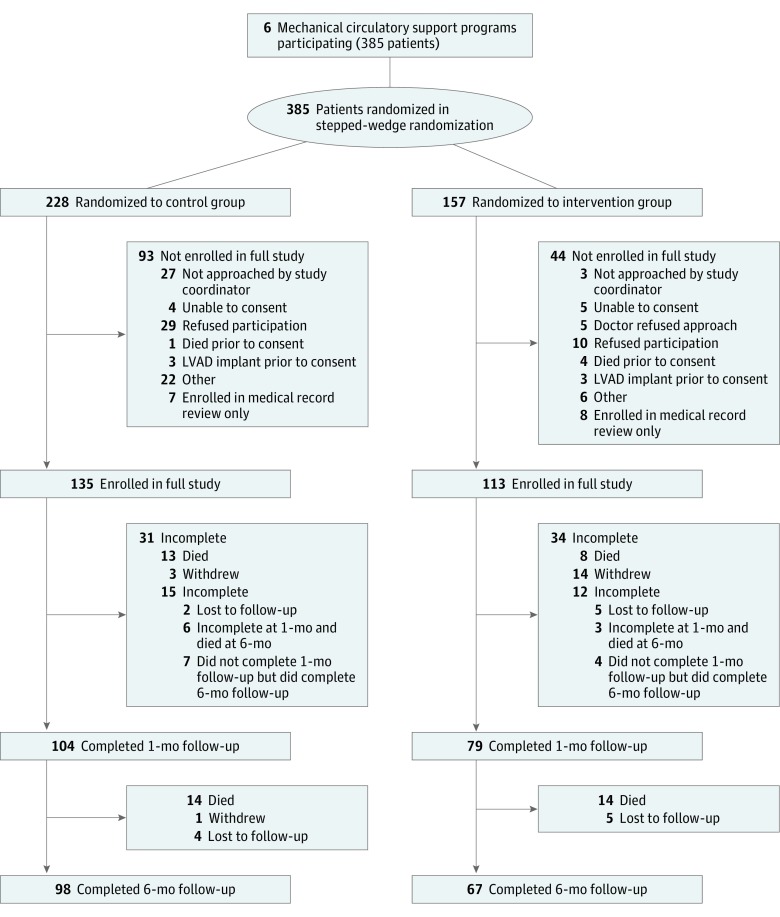
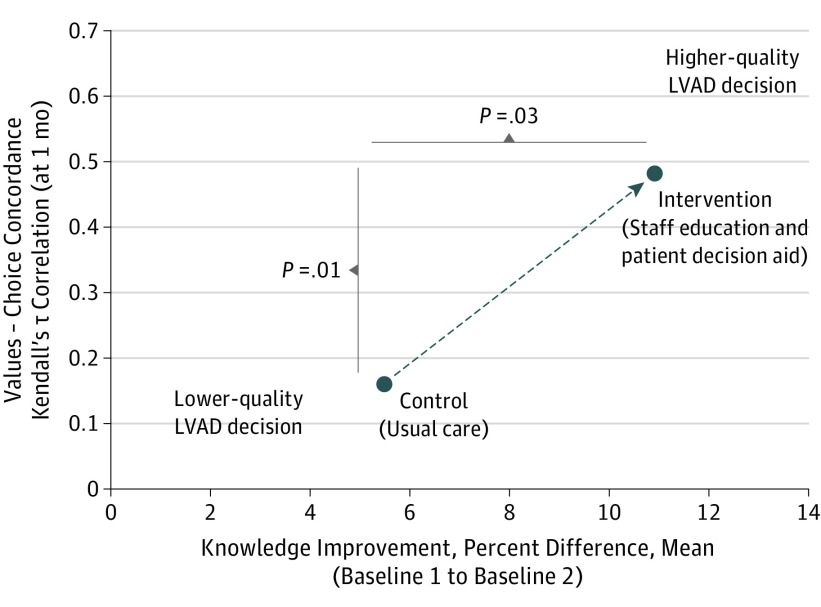
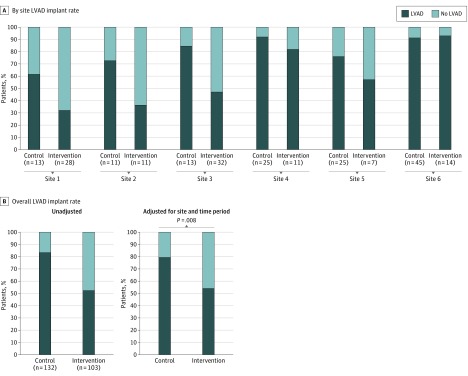
Importance: Shared decision making helps patients and clinicians elect therapies aligned with patients' values and preferences. This is particularly important for invasive therapies with considerable trade-offs. Objective: To assess the effectiveness of a shared decision support intervention for patients considering destination therapy left ventricular assist device (DT LVAD) placement. Design, Setting, and Participants: From 2015 to 2017, a randomized, stepped-wedge trial was conducted in 6 US LVAD implanting centers including 248 patients being considered for DT LVAD. After randomly varying time in usual care, sites were transitioned to an intervention consisting of clinician education and use of DT LVAD pamphlet and video patient decision aids. Follow up occurred at 1 and 6 months. Main Outcomes and Measures: Decision quality as measured by knowledge and values-choice concordance. Results: In total, 135 patients were enrolled during control and 113 during intervention periods. At enrollment, 59 (23.8%) participants were in intensive care, 60 (24.1%) were older than 70 years, 39 (15.7%) were women, 45 (18.1%) were racial/ethnic minorities, and 62 (25.0%) were college graduates. Patient knowledge (mean test performance) during the decision-making period improved from 59.5% to 64.9% in the control group vs 59.1% to 70.0% in the intervention group (adjusted difference of difference, 5.5%; P = .03). Stated values at 1 month (scale 1 = "do everything I can to live longer…" to 10 = "live with whatever time I have left…") were a mean of 2.37 in control and 3.33 in intervention (P = .03). Patient-reported treatment choice at 1 month favored LVAD more in the control group (than in the intervention group (47 [59.5%] vs 95 [91.3%], P < .001). Correlation between stated values and patient-reported treatment choice at 1 month was stronger in the intervention group than in the control group (difference in Kendall's τ, 0.28; 95% CI, 0.05-0.45); however, there was no improved correlation between stated values and actual treatment received by 6 months for the intervention compared with the control group (difference in Kendall's τ, 0.01; 95% CI, -0.24 to 0.25). The adjusted rate of LVAD implantation by 6 months was higher for those in the control group (79.9%) than those in the intervention group (53.9%, P = .008), with significant variation by site. There were no differences in decision conflict, decision regret, or preferred control. Conclusions and Relevance: A shared decision-making intervention for DT LVAD modestly improved patient decision quality as measured by patient knowledge and concordance between stated values and patient-reported treatment choice, but did not improve concordance between stated values and actual treatment received. The rate of implantation of LVADs was substantially lower in the intervention compared with the control group. Trial Registration: clinicaltrials.gov Identifier: NCT02344576.
Overview
The claims and statistics of this paper haven’t been checked yet.
Run the check — free, no account needed. It reads the open-access text and checks the sources it cites.
Integrity signals
Registry
Cites
Statistics
Figures
Verification
Claims the paper makes
The claims and statistics of this paper haven’t been checked yet.
Run the check — free, no account needed. It reads the open-access text and checks the sources it cites.
Claims other papers make about this one
Each is checked against this paper’s own text: does it say what the citing paper says it does?
The source backs part of the claim, not all of it — or backs it for a different population, condition or comparison.
In the citing paper
“decreased rates of implementation of left ventricular assist devices in outpatients with congestive heart failure”
From Effects of a Personalized Web-Based Decision Aid for Surrogate Decision Makers of Patients With Prolonged Mechanical Ventilation (2019) · cites this paper as [31]
Experimental — accuracy not yet measuredThe source backs part of the claim, not all of it — or backs it for a different population, condition or comparison.
In the citing paper
“However, some recent studies found that family support interventions did not reduce psychological symptoms in family members. 66,67,75,79”
From European Resuscitation Council Guidelines 2021: Ethics of resuscitation and end of life decisions (2021) · cites this paper as [75]
Experimental — accuracy not yet measuredThe source backs part of the claim, not all of it — or backs it for a different population, condition or comparison.
In the citing paper
“Furthermore, according to recent studies, communication supported by other strategies such as video decision aids may be associated with improved family satisfaction. 67,75,78”
From European Resuscitation Council Guidelines 2021: Ethics of resuscitation and end of life decisions (2021) · cites this paper as [75]
Experimental — accuracy not yet measuredThe check wasn’t confident either way, so it gives no verdict — never disputed.
In the citing paper
“decreased hospital transfer rates in nursing home residents with dementia (31, 32)”
From Effects of a Personalized Web-Based Decision Aid for Surrogate Decision Makers of Patients With Prolonged Mechanical Ventilation (2019) · cites this paper as [31]
Experimental — accuracy not yet measured
Self-check
Percentages, sums and reported differences re-computed from the paper’s own numbers.
The self-check needs the paper’s full text.
Citations
Cites
Harris, P. A., Taylor, R., Thielke, R., Payne, J., Gonzalez, N., & Conde, J. G. (2009) · Journal of Biomedical Informatics · doi:10.1016/j.jbi.2008.08.010 · Cited by 51,384
A Global Measure of Perceived Stress
Cohen, S., Kamarck, T., & Mermelstein, R. (1983) · Journal of Health and Social Behavior · doi:10.2307/2136404 · Cited by 32,807
The Patient Health Questionnaire-2: Validity of a Two-Item Depression Screener
Kroenke, K., Spitzer, R. L., & Williams, J. B. W. (2003) · Medical Care · doi:10.1097/01.mlr.0000093487.78664.3c · Cited by 6,359
EuroQol: the current state of play
Brooks, R. (1996) · Health Policy · doi:10.1016/0168-8510(96)00822-6 · Cited by 5,815
Pfeiffer, E. A. (1975) · Journal of the American Geriatrics Society · doi:10.1111/j.1532-5415.1975.tb00927.x · Cited by 5,320
Curran, G. M., Bauer, M., Mittman, B., Pyne, J. M., & Stetler, C. (2012) · Medical Care · doi:10.1097/mlr.0b013e3182408812 · Cited by 4,058 · cited 1×
“18 PEACE: struggle with illness score (7-28), mean (SE)l BL1 14.”
Validation of a Decisional Conflict Scale
O'Connor, A. M. C. (1995) · Medical Decision Making · doi:10.1177/0272989x9501500105 · Cited by 2,462
Elwyn, G. (2006) · BMJ · doi:10.1136/bmj.38926.629329.ae · Cited by 1,824
Validation of a Decision Regret Scale
Brehaut, J., O'Connor, A. M. C., Wood, T. J., Hack, T. F., Siminoff, L. A., Gordon, E. J., & Feldman‐Stewart, D. (2003) · Medical Decision Making · doi:10.1177/0272989x03256005 · Cited by 1,465
Feldman, D. S., Pamboukian, S. V., Teuteberg, J. J., Birks, E. J., Lietz, K., Moore, S. A., Morgan, J. A., Arabía, F. A., Bauman, M. E., Buchholz, H. W., et al. (2013) · The Journal of Heart and Lung Transplantation · doi:10.1016/j.healun.2012.09.013 · Cited by 1,384
Cited by
Sorted by citations
Crespo-Leiro, M. G., Metra, M., Lund, L. H., Miličić, D., Costanzo, M. R., Filippatos, G. S., Gustafsson, F., Tsui, S. S. L., Barge‐Caballero, E., de Jonge, N., et al. (2018) · European Journal of Heart Failure · doi:10.1002/ejhf.1236 · Cited by 920
Decision aids for people facing health treatment or screening decisions
Stacey, D., Lewis, K. B., Smith, M., Carley, M. E., Volk, R. J., Douglas, E. E., Pacheco‐Brousseau, L., Finderup, J., Gunderson, J., Barry, M. J., et al. (2024) · Cochrane Database of Systematic Reviews · doi:10.1002/14651858.cd001431.pub6 · Cited by 416
Geller, B. J., Sinha, S. S., Kapur, N. K., Bakitas, M. A., Balsam, L. B., Chikwe, J., Klein, D. G., Kochar, A., Masri, S. C., Sims, D. B., et al. (2022) · Circulation · doi:10.1161/cir.0000000000001076 · Cited by 286
European Resuscitation Council Guidelines 2021: Ethics of resuscitation and end of life decisions
Mentzelopoulos, S. D., Couper, K., Voorde, P. V. D., Druwé, P., Blom, M., Perkins, G. D., Lulic, I., Djakow, J., Raffay, V., Lilja, G., et al. (2021) · Resuscitation · doi:10.1016/j.resuscitation.2021.02.017 · Cited by 246
“However, some recent studies found that family support interventions did not reduce psychological symptoms in family members.(66,67,75,79)”
BackgroundMorris, A. A., Khazanie, P., Drazner, M. H., Albert, N. M., Breathett, K. K., Cooper, L. B., Eisen, H. J., O’Gara, P. T., & Russell, S. D. (2021) · Circulation · doi:10.1161/cir.0000000000001016 · Cited by 210
Metadata
- Authors
- Allen, L. A., McIlvennan, C. K., Thompson, J. S., Dunlay, S. M., LaRue, S. J., Lewis, E. F., Patel, C. B., Blue, L., Fairclough, D. L., Leister, E. C., Glasgow, R. E., Cleveland, J. C., Phillips, C., Baldridge, V., Walsh, M. N., & Matlock, D. D.
- Affiliations
- University of Colorado Anschutz (US)
- Mayo Clinic (US)
- Washington University in St. Louis (US)
- Brigham and Women's Hospital (US)
- Duke Medical Center (US)
- Colorado School of Public Health (US)
- VA Eastern Colorado Health Care System (US)
- Patient stakeholder
- Caregiver stakeholder
- St Vincent Hospital (US)
- Corresponding author
- Allen, Larry A.
- ORCID
- Venue
- JAMA Internal Medicine
- Publisher
- American Medical Association (AMA)
- Published
- 2018-04-01
- Volume
- 178
- Issue
- 4
- Pages
- 520
- ISSN
- 2168-6106 (ISSN-L)
- PMC
- PMC5876922
- OpenAlex
- W2792883637
- Cited by
- 179
- References
- 50
- Citations by year
- 2026: 16 · 2025: 11 · 2024: 23 · 2023: 21 · 2022: 23 · 2021: 27 · 2020: 21 · 2019: 27 · 2018: 10
- FWCI
- 32.45
- Type
- journal article
- Language
- en
- Open access
- hybrid
- doi.org
- Licence
- cc-by
- Locations
- JAMA Internal Medicine (publishedVersion, cc-by)
- Europe PMC (PubMed Central) (publishedVersion, cc-by)
- PubMed Central (publishedVersion, cc-by)
- PubMed (publishedVersion)
- Digital Commons@Becker (Washington University School of Medicine) (submittedVersion, cc-by)
- Funders
- Patient-Centered Outcomes Research Institute
- Topics
- Health Sciences › Health Professions › General Health Professions › Patient-Provider Communication in Healthcare
- Health Sciences › Medicine › Public Health, Environmental and Occupational Health › Palliative Care and End-of-Life Issues
- Health Sciences › Medicine › Cardiology and Cardiovascular Medicine › Mechanical Circulatory Support Devices
- Keywords
- shared decision-making, patient decision aids, patient education, patient knowledge, treatment selection, end-of-life care, advanced heart failure, clinician education, patient-centered care, intervention effectiveness, patient-reported outcomes, quality of life, health-related quality of life, patient satisfaction
- MeSH terms
- Aged, Decision Making, Decision Support Techniques, Female, Heart Failure, Heart-Assist Devices, Humans, Health Knowledge, Attitudes, Practice, Male, Middle Aged, Patient Participation, Patient Preference
About these checks
Registry, retraction, Cites and statistics results are computed, not judged, with one exception: a printed reference that no index lists is read once by a model before it counts as a citation error. Claims are extracted by a model and kept only when their quote appears verbatim in the text; each cited source is then checked, with a model’s help, for whether it says what the claim relies on. Those verdicts can be wrong — read the claim’s quote and the cited source before relying on one.
Statistics and arithmetic are recomputed, not judged.
Confidence bands are shown only for fields calibrated on our annotated test set. None is calibrated yet, so no band is shown.
What counts as a claim ›How we measure confidence ›How we check this ›
Are you an author, or do you see a problem with this page? Request a review
