

The DOI matches its Crossref record; 53 of the 55 references it cites were found in a registry or an index.
Prevalence of Missing Data in the National Cancer Database and Association With Overall Survival
Open accessPublished version of a preprint
Abstract
Importance: Cancer registries are important real-world data sources consisting of data abstraction from the medical record; however, patients with unknown or missing data are underrepresented in studies that use such data sources. Objective: To assess the prevalence of missing data and its association with overall survival among patients with cancer. Design, Setting, and Participants: In this retrospective cohort study, all variables within the National Cancer Database were reviewed for missing or unknown values for patients with the 3 most common cancers in the US who received diagnoses from January 1, 2006, to December 31, 2015. The prevalence of patient records with missing data and the association with overall survival were assessed. Data analysis was performed from February to August 2020. Exposures: Any missing data field within a patient record among 63 variables of interest from more than 130 total variables in the National Cancer Database. Main Outcomes and Measures: Prevalence of missing data in the medical records of patients with cancer and associated 2-year overall survival. Results: A total of 1 198 749 patients with non-small cell lung cancer (mean [SD] age, 68.5 [10.9] years; 628 811 men [52.5%]), 2 120 775 patients with breast cancer (mean [SD] age, 61.0 [13.3] years; 2 101 758 women [99.1%]), and 1 158 635 patients with prostate cancer (mean [SD] age, 65.2 [9.0] years; 100% men) were included in the analysis. Among those with non-small cell lung cancer, 851 295 patients (71.0%) were missing data for variables of interest; 2-year overall survival was 33.2% for patients with missing data and 51.6% for patients with complete data (P < .001). Among those with breast cancer, 1 161 096 patients (54.7%) were missing data for variables of interest; 2-year overall survival was 93.2% for patients with missing data and 93.9% for patients with complete data (P < .001). Among those with prostate cancer, 460 167 patients (39.7%) were missing data for variables of interest; 2-year overall survival was 91.0% for patients with missing data and 95.6% for patients with complete data (P < .001). Conclusions and Relevance: This study found that within a large cancer registry-based real-world data source, there was a high prevalence of missing data that were unable to be ascertained from the medical record. The prevalence of missing data among patients with cancer was associated with heterogeneous differences in overall survival. Improvements in documentation and data quality are necessary to make optimal use of real-world data for clinical advancements.
Overview
The claims and statistics of this paper haven’t been checked yet.
Run the check — free, no account needed. It reads the open-access text and checks the sources it cites.
Integrity signals
Registry
Cites
Statistics
Figures
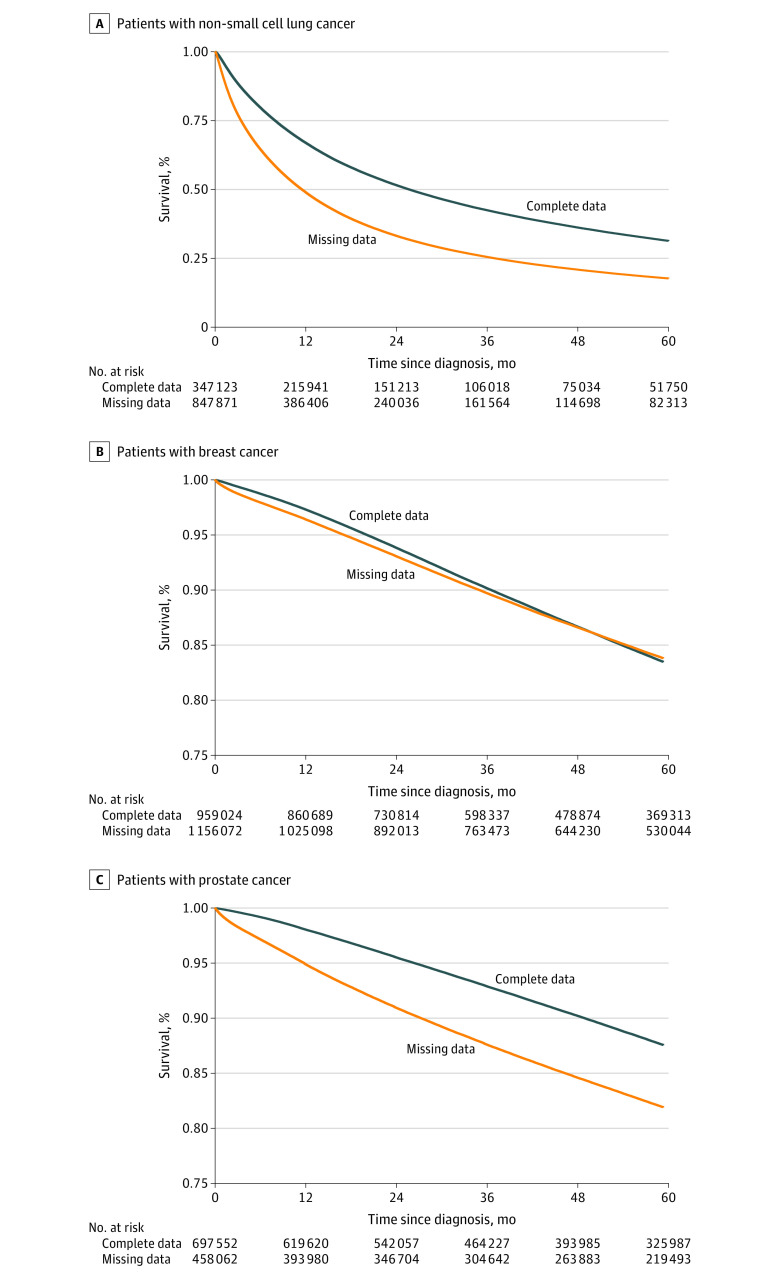
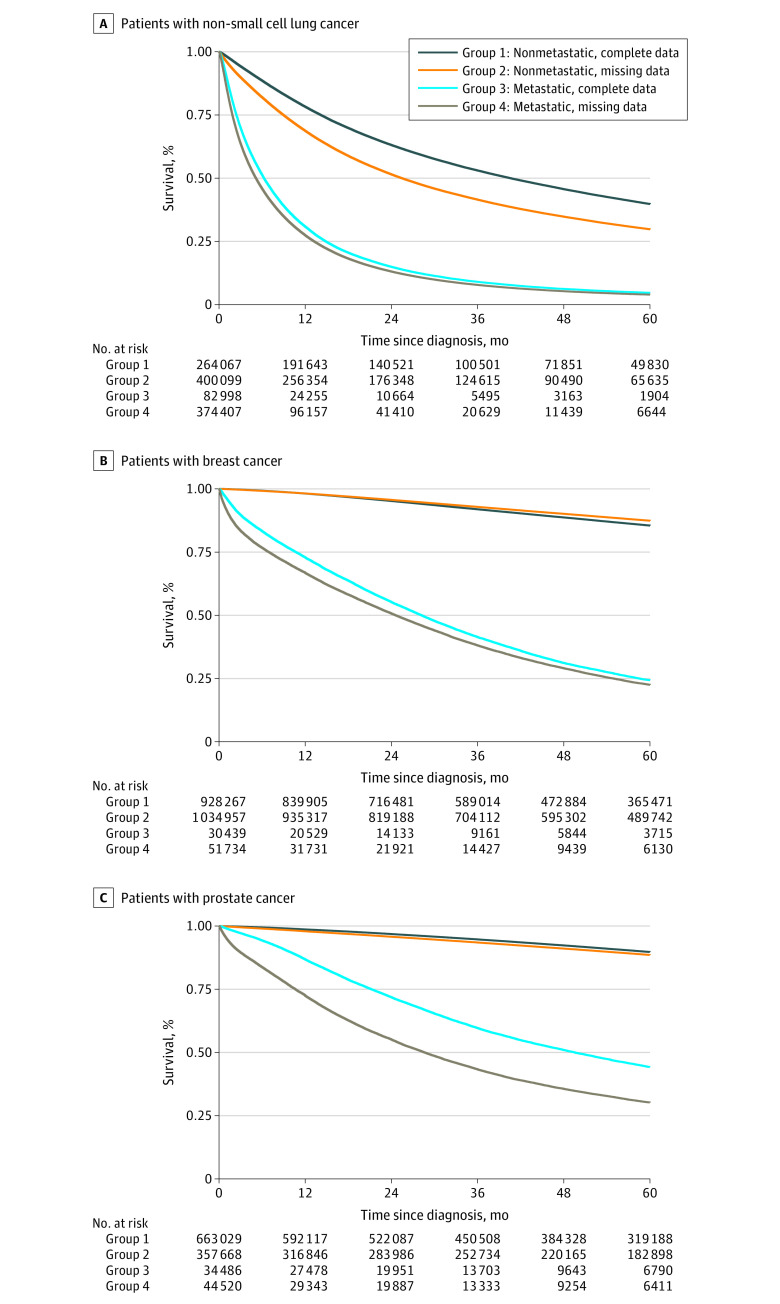
Verification
Claims the paper makes
The claims and statistics of this paper haven’t been checked yet.
Run the check — free, no account needed. It reads the open-access text and checks the sources it cites.
Claims other papers make about this one
Each is checked against this paper’s own text: does it say what the citing paper says it does?
The source backs part of the claim, not all of it — or backs it for a different population, condition or comparison.
In the citing paper
“For example, studies on cancer registries reveal frequent missing data due to inadequate documentation, such as absent cancer stage or test results, which affects the diagnosis and evaluation process and lowers survival rates [178].”
From Toward Safer Diagnoses: A SEIPS-Based Narrative Review of Diagnostic Errors (2026) · cites this paper as [178]
Experimental — accuracy not yet measured
Self-check
Percentages, sums and reported differences re-computed from the paper’s own numbers.
The self-check needs the paper’s full text.
Citations
Cites
Sterne, J. A. C., White, I. R., Carlin, J. B., Spratt, M., Royston, P., Kenward, M. G., Wood, A. M., & Carpenter, J. R. (2009) · BMJ · doi:10.1136/bmj.b2393 · Cited by 7,299
The National Cancer Data Base: A Powerful Initiative to Improve Cancer Care in the United States
Bilimoria, K. Y., Stewart, A. K., Winchester, D. P., & Ko, C. Y. (2008) · Annals of Surgical Oncology · doi:10.1245/s10434-007-9747-3 · Cited by 1,853
Using the National Cancer Database for Outcomes Research
Boffa, D. J., Rosen, J. E., Mallin, K., Loomis, A. M., Gay, G., Palis, B. E., Thoburn, K. K., Gress, D. M., McKellar, D. P., Shulman, L. N., et al. (2017) · JAMA Oncology · doi:10.1001/jamaoncol.2016.6905 · Cited by 1,079
Racial and Ethnic Disparities in the Receipt of Cancer Treatment
Shavers, V. L. (2002) · JNCI Journal of the National Cancer Institute · doi:10.1093/jnci/94.5.334 · Cited by 953
Cancer health disparities in racial/ethnic minorities in the United States
Zavala, V. A., Bracci, P. M., Carethers, J. M., Carvajal‐Carmona, L. G., Halmai, N. B., Cruz-Correa, M. R., Davis, M. B., de Smith, A. J., Dutil, J., Figueiredo, J. C., et al. (2020) · British Journal of Cancer · doi:10.1038/s41416-020-01038-6 · Cited by 952
Morgensztern, D., Ng, S. H., Gao, F., & Govindan, R. (2010) · Journal of Thoracic Oncology · doi:10.1097/jto.0b013e3181c5920c · Cited by 548
Rezvan, P. H., Lee, K. J., & Simpson, J. A. (2015) · BMC Medical Research Methodology · doi:10.1186/s12874-015-0022-1 · Cited by 483
The evolution of the population-based cancer registry
Parkin, D. M. (2006) · Nature reviews. Cancer · doi:10.1038/nrc1948 · Cited by 420
Mallin, K., Browner, A. E., Palis, B. E., Gay, G., McCabe, R. M., Nogueira, L., Yabroff, K. R., Shulman, L. N., Facktor, M. A., Winchester, D. P., et al. (2019) · Annals of Surgical Oncology · doi:10.1245/s10434-019-07213-1 · Cited by 397
Real-world data: towards achieving the achievable in cancer care
Booth, C. M., Karim, S., & Mackillop, W. J. (2019) · Nature Reviews Clinical Oncology · doi:10.1038/s41571-019-0167-7 · Cited by 349
Cited by
Sorted by citations
Vince, R., Jiang, R., Bank, M., Quarles, J., Patel, M., Sun, Y., Hartman, H. E., Zaorsky, N. G., Jia, A. Y., Shoag, J. E., et al. (2023) · JAMA Network Open · doi:10.1001/jamanetworkopen.2022.50416 · Cited by 87
Proportions and incidence of locally advanced cervical cancer: a global systematic literature review
Monk, B. J., Tan, D. S. P., Chagüi, J. D. H., Takyar, J., Paskow, M. J., Nunes, A. T., & Pujade-Lauraine, É. (2022) · International Journal of Gynecological Cancer · doi:10.1136/ijgc-2022-003801 · Cited by 81
Taparra, K., Dee, E. C., Dao, D., Patel, R. K., Santos, P. M. G., & Chino, F. L. (2022) · JCO Oncology Practice · doi:10.1200/op.22.00001 · Cited by 64
Implications of missing data on reported breast cancer mortality
Plichta, J. K., Rushing, C. N., Lewis, H. C., Rooney, M. M., Blazer, D. G., Thomas, S. M., Hwang, E. S., & Greenup, R. A. (2022) · Breast Cancer Research and Treatment · doi:10.1007/s10549-022-06764-4 · Cited by 60
Replacing RCTs with real world data for regulatory decision making: a self-fulfilling prophecy?
Wieseler, B., Neyt, M., Kaiser, T., Hulstaert, F., & Windeler, J. (2023) · BMJ · doi:10.1136/bmj-2022-073100 · Cited by 47
Metadata
- Authors
- Yang, D. X., Khera, R., Miccio, J. A., Jairam, V., Chang, E., Yu, J. B., Park, H. S., Krumholz, H. M., & Aneja, S.
- Affiliations
- Yale University (US)
- Corresponding author
- Aneja, Sanjay
- ORCID
- Venue
- JAMA Network Open
- Publisher
- American Medical Association (AMA)
- Published
- 2021-03-23
- Volume
- 4
- Issue
- 3
- Pages
- e211793
- ISSN
- 2574-3805 (ISSN-L)
- PMC
- PMC7988369
- OpenAlex
- W3135917060
- Cited by
- 135
- References
- 55
- Citations by year
- 2026: 28 · 2025: 22 · 2024: 23 · 2023: 33 · 2022: 26 · 2021: 3
- FWCI
- 7.74
- Type
- journal article
- Language
- en
- Open access
- gold
- doi.org
- Licence
- cc-by
- Locations
- JAMA Network Open (publishedVersion, cc-by)
- medRxiv (acceptedVersion)
- PubMed Central (publishedVersion, cc-by)
- PubMed (publishedVersion)
- Funders
- Conquer Cancer Foundation
- Yale University
- Yale SPORE in Lung Cancer
- Topics
- Health Sciences › Medicine › Oncology › Global Cancer Incidence and Screening
- Health Sciences › Health Professions › Health Information Management › Medical Coding and Health Information
- Health Sciences › Health Professions › Health Information Management › Electronic Health Records Systems
- Keywords
- missing data, data quality, cancer registry, National Cancer Database, overall survival, non-small cell lung cancer, breast cancer, prostate cancer, data abstraction, real-world data, data sharing restrictions, data access restrictions
- MeSH terms
- Data Management, Aged, Female, Follow-Up Studies, Humans, Male, Middle Aged, Neoplasms, Registries, Retrospective Studies, United States, Prevalence, Survival Rate, Databases, Factual
About these checks
Registry, retraction, Cites and statistics results are computed, not judged, with one exception: a printed reference that no index lists is read once by a model before it counts as a citation error. Claims are extracted by a model and kept only when their quote appears verbatim in the text; each cited source is then checked, with a model’s help, for whether it says what the claim relies on. Those verdicts can be wrong — read the claim’s quote and the cited source before relying on one.
Statistics and arithmetic are recomputed, not judged.
Confidence bands are shown only for fields calibrated on our annotated test set. None is calibrated yet, so no band is shown.
What counts as a claim ›How we measure confidence ›How we check this ›
Are you an author, or do you see a problem with this page? Request a review
