

The DOI matches its Crossref record; 6 of the 6 references it cites were found in a registry or an index.
Use of E-Cigarettes and Cigarettes During Late Pregnancy Among Adolescents
Abstract
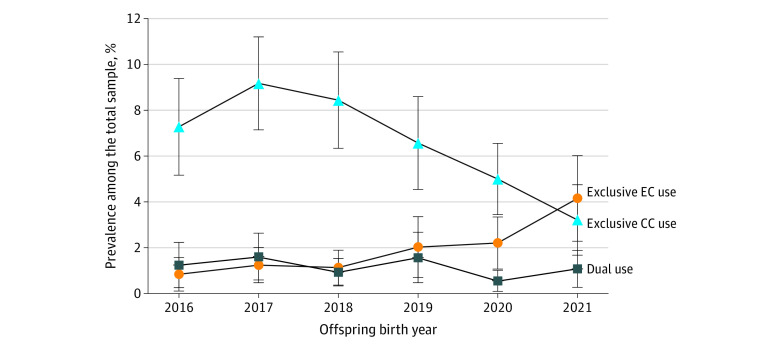
Importance: Pregnant adolescents sometimes use cigarettes; however, little is known about e-cigarette use among pregnant adolescents, a population with increased health vulnerability. Objective: To examine yearly trends, sociodemographic and pregnancy-related determinants, and the association with small-for-gestational-age (SGA) birth of e-cigarette and/or cigarette use during late pregnancy among adolescents. Design, Setting, and Participants: This cohort study used existing data from the 2016-2021 Pregnancy Risk Assessment Monitoring System on 10 428 US adolescents aged 10 to 19 years who had a singleton birth with complete data on e-cigarette or cigarette use and SGA birth. Exposure: Adolescents reported e-cigarette and cigarette use during the last 3 months of pregnancy. Main Outcomes and Measures: SGA birth (birth weight below the 10th percentile for the same sex and gestational duration) was determined from birth certificates. Multivariable logistic regression was used to compare the odds of SGA birth across pregnant adolescents who exclusively used e-cigarettes, exclusively used cigarettes, used e-cigarettes and cigarettes, or did not use either. Results: Of the 10 428 pregnant adolescents, 72.7% were aged 18 or 19 years; 58.9% self-identified as White and 23.3% as Black; and 69.8% were non-Hispanic. The weighted prevalence of exclusive e-cigarette use during late pregnancy increased from 0.8% in 2016 to 4.1% in 2021, while the prevalence of exclusive cigarette use decreased from 9.2% in 2017 to 3.2% in 2021. The prevalence of dual use fluctuated, ranging from 0.6% to 1.6%. White pregnant adolescents were more likely than those who self-identified as another race and ethnicity to use e-cigarettes (2.7% vs 1.0% for American Indian or Alaska Native adolescents, 0.8% for Asian or other race adolescents, 0.6% for Black adolescents, and 0.7% for multiracial adolescents). Compared with those who did not use either product, adolescents who exclusively used e-cigarettes (16.8% vs 12.9%; confounder-adjusted odds ratio [AOR], 1.68 [95% CI, 0.89-3.18]) or who used cigarettes and e-cigarettes (17.6% vs 12.9%; AOR, 1.68 [95% CI, 0.79-3.53]) had no statistically significant difference in risk of SGA birth. However, adolescents who exclusively used cigarettes had a more than 2-fold higher risk of SGA birth (24.6% vs 12.9%; AOR, 2.51 [95% CI, 1.79-3.52]). Conclusions and Relevance: This cohort study suggests that pregnant adolescents increasingly used e-cigarettes, with the highest use among White adolescents. Results from this analysis found that, unlike cigarette use, e-cigarette use during late pregnancy was not statistically significantly associated with an increased risk of SGA birth among adolescents. Due to the uncertainty of this nonsignificant association, future research could benefit from a larger sample size.
Overview
The claims and statistics of this paper haven’t been checked yet.
Run the check — free, no account needed. It reads the open-access text and checks the sources it cites.
Integrity signals
Registry
Cites
Statistics
Figures
Verification
Claims the paper makes
The claims and statistics of this paper haven’t been checked yet.
Run the check — free, no account needed. It reads the open-access text and checks the sources it cites.
Claims other papers make about this one
Each is checked against this paper’s own text: does it say what the citing paper says it does?
In the citing paper
“In one PRAMS sample, ENDS use increased among pregnant adolescents from 0.8% to 4.1% between 2016 and 2021.52”
From Birth outcomes following intrauterine exposure to electronic nicotine delivery systems: a systematic review and meta-analysis (2026) · cites this paper as [52]
Self-check
Percentages, sums and reported differences re-computed from the paper’s own numbers.
The self-check needs the paper’s full text.
Citations
Cites
Sawyer, S. M., Azzopardi, P. S., Wickremarathne, D., & Patton, G. C. (2018) · The Lancet Child & Adolescent Health · doi:10.1016/s2352-4642(18)30022-1 · Cited by 3,666
Racial Disparities in Adverse Pregnancy Outcomes and Psychosocial Stress
Grobman, W. A., Parker, C. B., Willinger, M., Wing, D. A., Silver, R. M., Wapner, R. J., Simhan, H. N., Parry, S., Mercer, B. M., Haas, D. M., et al. (2018) · Obstetrics & Gynecology · doi:10.1097/aog.0000000000002441 · Cited by 260
Wang, X., Lee, N. L., & Burstyn, I. (2020) · Preventive Medicine · doi:10.1016/j.ypmed.2020.106041 · Cited by 86
Adverse Birth Outcomes Associated With Prepregnancy and Prenatal Electronic Cigarette Use
Regan, A. K., Bombard, J. M., O’Hegarty, M. M., Smith, R. A., & Tong, V. T. (2021) · Obstetrics & Gynecology · doi:10.1097/aog.0000000000004432 · Cited by 74
Kim, S., & Oancea, S. C. (2020) · BMC Pregnancy and Childbirth · doi:10.1186/s12884-020-03247-6 · Cited by 74
Cardenas, V., Cen, R., Clemens, M., Moody, H., Ekanem, U., Policherla, A., Fischbach, L., Eswaran, H., Magann, E., Delongchamp, R., et al. (2019) · Tobacco Induced Diseases · doi:10.18332/tid/106089 · Cited by 72
Research works printed but not linked: 56
- Cooper, 2022, Notes from the field: e-cigarette use among middle and high school students—United States, 2022., MMWR Morb Mortal Wkly Rep, 71, 1283, 10.15585/mmwr.mm7140a3 · DOI
- Cullen, 2018, Notes from the field: use of electronic cigarettes and any tobacco product among middle and high school students—United States, 2011-2018., MMWR Morb Mortal Wkly Rep, 67, 1276, 10.15585/mmwr.mm6745a5 · DOI
- Little, 2000, Behavioral mechanisms underlying the link between smoking and drinking., Alcohol Res Health, 24, 215
- Venditti, 2011, Effects of chronic carbon monoxide exposure on fetal growth and development in mice., BMC Pregnancy Childbirth, 11, 101, 10.1186/1471-2393-11-101 · DOI
- Peterson, 2017, Tobacco, e-cigarettes, and child health., Curr Opin Pediatr, 29, 225, 10.1097/MOP.0000000000000456 · DOI
- Bowker, 2020, Addressing and overcoming barriers to e-cigarette use for smoking cessation in pregnancy: a qualitative study., Int J Environ Res Public Health, 17, 4823, 10.3390/ijerph17134823 · DOI
- Etter, 2014, Levels of saliva cotinine in electronic cigarette users., Addiction, 109, 825, 10.1111/add.12475 · DOI
- Agarwal, 2020, E-cigarette use in reproductive-aged women and pregnancy: a rising health concern., Fertil Steril, 113, 1133, 10.1016/j.fertnstert.2020.01.031 · DOI
- Battaglia, 1967, A practical classification of newborn infants by weight and gestational age., J Pediatr, 71, 159, 10.1016/S0022-3476(67)80066-0 · DOI
- Jensen, 2019, Adverse effects of small for gestational age differ by gestational week among very preterm infants., Arch Dis Child Fetal Neonatal Ed, 104, F192, 10.1136/archdischild-2017-314171 · DOI
- Black, 2015, Global prevalence of small for gestational age births., Nestle Nutr Inst Workshop Ser, 81, 1, 10.1159/issn.1664-2147 · DOI
- Ewing, 2017, Full-term small-for-gestational-age newborns in the U.S.: characteristics, trends, and morbidity., Matern Child Health J, 21, 786, 10.1007/s10995-016-2165-z · DOI
- Liu, 2021, Comparison of growth curves for predicting small for gestational age infants among contemporary US populations., Am J Obstet Gynecol, 224, S450, 10.1016/j.ajog.2020.12.741 · DOI
- De Jesus, 2013, J Pediatr, 10.1016/j.jpeds.2012.12.097 · DOI
- Savchev, 2013, Neurodevelopmental outcome of full-term small-for-gestational-age infants with normal placental function., Ultrasound Obstet Gynecol, 42, 201, 10.1002/uog.2013.42.issue-2 · DOI
- Karlberg, 1995, Growth in full-term small-for-gestational-age infants: from birth to final height., Pediatr Res, 38, 733, 10.1203/00006450-199511000-00017 · DOI
- Jaquet, 2003, Born small for gestational age: increased risk of type 2 diabetes, hypertension and hyperlipidaemia in adulthood., Horm Res, 59, 131, 10.1159/000067848 · DOI
- Scholl, 1986, Smoking and adolescent pregnancy outcome., J Adolesc Health Care, 7, 390, 10.1016/S0197-0070(86)80240-6 · DOI
- Cornelius, 1995, Prenatal tobacco and marijuana use among adolescents: effects on offspring gestational age, growth, and morphology., Pediatrics, 95, 738, 10.1542/peds.95.5.738 · DOI
- Shulman, 2018, The Pregnancy Risk Assessment Monitoring System (PRAMS): overview of design and methodology., Am J Public Health, 108, 1305, 10.2105/AJPH.2018.304563 · DOI · Paper page
- Singh, 2019, World Health Organization guidance on ethical considerations in planning and reviewing research studies on sexual and reproductive health in adolescents., J Adolesc Health, 64, 427, 10.1016/j.jadohealth.2019.01.008 · DOI
- Haight, 2021, Frequency of cannabis use during pregnancy and adverse infant outcomes, by cigarette smoking status—8 PRAMS states, 2017., Drug Alcohol Depend, 220, 10.1016/j.drugalcdep.2021.108507 · DOI · Paper page
- World Health Organization Expert Committee, 1995, Physical status: the use and interpretation of anthropometry: report of a WHO Expert Committee., World Health Organ Tech Rep Ser, 854, 1
- Goldenberg, 1997, Small for gestational age and intrauterine growth restriction: definitions and standards., Clin Obstet Gynecol, 40, 704, 10.1097/00003081-199712000-00004 · DOI
- Cornelius, 2004, Characteristics of persistent smoking among pregnant teenagers followed to young adulthood., Nicotine Tob Res, 6, 159, 10.1080/14622200310001656975 · DOI
- Albrecht, 2002, Characteristics of inner-city pregnant smoking teenagers., J Obstet Gynecol Neonatal Nurs, 31, 462, 10.1111/j.1552-6909.2002.tb00069.x · DOI
- Beck, 2022, An examination of how e-cigarette/cigarette use during adolescence is associated with future use during the third trimester of pregnancy., Subst Abus, 43, 344, 10.1080/08897077.2021.1941519 · DOI
- Obisesan, 2020, E-cigarette use patterns and high-risk behaviors in pregnancy: Behavioral Risk Factor Surveillance System, 2016-2018., Am J Prev Med, 59, 187, 10.1016/j.amepre.2020.02.015 · DOI · Paper page
- Kramer, 1998, Socioeconomic determinants of intrauterine growth retardation., Eur J Clin Nutr, 52, S29
- Campbell, 2012, Determinants of small for gestational age birth at term., Paediatr Perinat Epidemiol, 26, 525, 10.1111/ppe.2012.26.issue-6 · DOI
- Cheng, 2020, Analysis of perinatal risk factors for small-for-gestational-age and appropriate-for-gestational-age late-term infants., Exp Ther Med, 19, 1719, 10.3892/etm · DOI
- Alexander, 1999, Racial differences in birthweight for gestational age and infant mortality in extremely-low-risk US populations., Paediatr Perinat Epidemiol, 13, 205, 10.1046/j.1365-3016.1999.00174.x · DOI
- La Merrill, 2011, Prepregnancy body mass index, smoking during pregnancy, and infant birth weight., Ann Epidemiol, 21, 413, 10.1016/j.annepidem.2010.11.012 · DOI
- Miech, 2021, Trends in use and perceptions of nicotine vaping among US youth from 2017 to 2020., JAMA Pediatr, 175, 185, 10.1001/jamapediatrics.2020.5667 · DOI
- Levy, 2019, Examining the relationship of vaping to smoking initiation among US youth and young adults: a reality check., Tob Control, 28, 629, 10.1136/tobaccocontrol-2018-054446 · DOI
- Dai, 2021, Racial disparities of e-cigarette use among US youths: 2014–2019., Am J Public Health, 111, 2050, 10.2105/AJPH.2021.306448 · DOI
- Mitchell, 2002, Smoking, nicotine and tar and risk of small for gestational age babies., Acta Paediatr, 91, 323, 10.1111/apa.2002.91.issue-3 · DOI
- Djordjevic, 2000, Doses of nicotine and lung carcinogens delivered to cigarette smokers., J Natl Cancer Inst, 92, 106, 10.1093/jnci/92.2.106 · DOI
- IARC Working Group on the Evaluation of Carcinogenic Risks to Humans, 2004, Tobacco smoke and involuntary smoking., IARC Monogr Eval Carcinog Risks Hum, 83, 1
- Moir, 2008, A comparison of mainstream and sidestream marijuana and tobacco cigarette smoke produced under two machine smoking conditions., Chem Res Toxicol, 21, 494, 10.1021/tx700275p · DOI
- Int J Environ Res Public Health, 10.3390/ijerph17082767 · DOI
- Pinto, 2022, Chemical characterisation of the vapour emitted by an e-cigarette using a ceramic wick-based technology., Sci Rep, 12, 16497, 10.1038/s41598-022-19761-w · DOI
- Voos, 2019, What is the nicotine delivery profile of electronic cigarettes?, Expert Opin Drug Deliv, 16, 1193, 10.1080/17425247.2019.1665647 · DOI
- Cullen, 2019, E-cigarette use among youth in the United States, 2019., JAMA, 322, 2095, 10.1001/jama.2019.18387 · DOI
- Chen, 2017, Initiation of electronic cigarette use by age among youth in the U.S., Am J Prev Med, 53, 396, 10.1016/j.amepre.2017.02.011 · DOI
- Sharapova, 2020, Age of tobacco use initiation and association with current use and nicotine dependence among US middle and high school students, 2014-2016., Tob Control, 29, 49, 10.1136/tobaccocontrol-2018-054593 · DOI
- Raatikainen, 2007, Smoking in early gestation or through pregnancy: a decision crucial to pregnancy outcome., Prev Med, 44, 59, 10.1016/j.ypmed.2006.07.017 · DOI
- Lopez, 2015, The collection and analysis of carbon monoxide levels as an indirect measure of smoke exposure in pregnant adolescents at a multidisciplinary teen obstetrics clinic., J Pediatr Adolesc Gynecol, 28, 538, 10.1016/j.jpag.2015.04.007 · DOI
- Salmasi, 2010, Environmental tobacco smoke exposure and perinatal outcomes: a systematic review and meta-analyses., Acta Obstet Gynecol Scand, 89, 423, 10.3109/00016340903505748 · DOI
- Wiley, 2023, Nicotine and nicotine-free vaping behavior among a sample of Canadian high school students: a cross-sectional study., Children (Basel), 10, 368, 10.3390/children10020368 · DOI
- Abdelwahab, 2022, Association between prenatal marijuana and tobacco smoke exposures and small for gestational age at birth., Am J Perinatol, 39, 1726, 10.1055/s-0042-1753489 · DOI
- Baía, The effects of cannabis use during pregnancy on low birth weight and preterm birth: a systematic review and meta-analysis., Am J Perinatol, 10.1055/a-1911-3326 · DOI
- Wong, 2020, Risk factors and birth outcomes associated with teenage pregnancy: a Canadian sample., J Pediatr Adolesc Gynecol, 33, 153, 10.1016/j.jpag.2019.10.006 · DOI
- Emond, 2018, Better diet quality during pregnancy is associated with a reduced likelihood of an infant born small for gestational age: an analysis of the Prospective New Hampshire Birth Cohort study., J Nutr, 148, 22, 10.1093/jn/nxx005 · DOI
- Reyes-López, 2021, Diet quality is associated with a high newborn size and reduction in the risk of low birth weight and small for gestational age in a group of Mexican pregnant women: an observational study., Nutrients, 13, 1853, 10.3390/nu13061853 · DOI
- Office on Smoking and Health, Centers for Disease Control and Prevention, A Report of the Surgeon General: Preventing Tobacco Use Among Youth and Young Adults
Cited by
Sorted by citations
Johnstone, S., Schenkel, A., Canazzi, S., Eiden, R. D., & Hawk, Jr. (2026) · Nicotine & Tobacco Research · doi:10.1093/ntr/ntag118 · Cited by 2
Metadata
- Authors
- Wen, X., Liu, L., Moe, A. A., Ormond, I. K., Shuren, C. C., Scott, I. N., Ozga, J. E., Stanton, C. A., Ruybal, A. L., Hart, J. L., Goniewicz, M. L., Lee, D., & Vargees, C.
- Affiliations
- Division of Behavioral Medicine, Department of Pediatrics, Jacobs School of Medicine and Biomedical Sciences, State University of New York at Buffalo, Buffalo
- Rochester Institute of Technology, Rochester, New York
- Behavioral Health and Health Policy, Westat, Rockville, Maryland
- Center for Tobacco Products, Food and Drug Administration, Silver Spring, Maryland
- Department of Communication, College of Arts and Sciences, University of Louisville, Louisville, Kentucky
- Department of Health Behavior, Roswell Park Comprehensive Cancer Center, Buffalo, New York
- New York Medical College, Valhalla
- Venue
- JAMA Network Open
- Publisher
- American Medical Association (AMA)
- Published
- 2023-12-13
- Volume
- 6
- Issue
- 12
- Pages
- e2347407
- ISSN
- 2574-3805
- PMC
- PMC10719752
- Cited by
- 19
- References
- 6
- Language
- en
About these checks
Registry, retraction, Cites and statistics results are computed, not judged, with one exception: a printed reference that no index lists is read once by a model before it counts as a citation error. Claims are extracted by a model and kept only when their quote appears verbatim in the text; each cited source is then checked, with a model’s help, for whether it says what the claim relies on. Those verdicts can be wrong — read the claim’s quote and the cited source before relying on one.
Statistics and arithmetic are recomputed, not judged.
Confidence bands are shown only for fields calibrated on our annotated test set. None is calibrated yet, so no band is shown.
What counts as a claim ›How we measure confidence ›How we check this ›
Are you an author, or do you see a problem with this page? Request a review
