

The DOI matches its Crossref record; 45 of the 45 references it cites were found in a registry or an index.
Estimated Exposure to 6 Potentially Hepatotoxic Botanicals in US Adults
Abstract
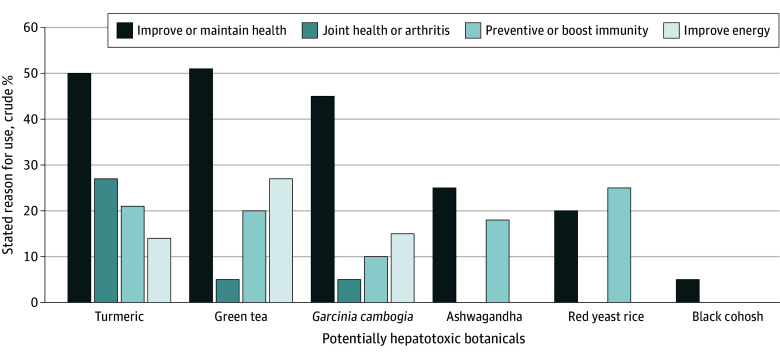
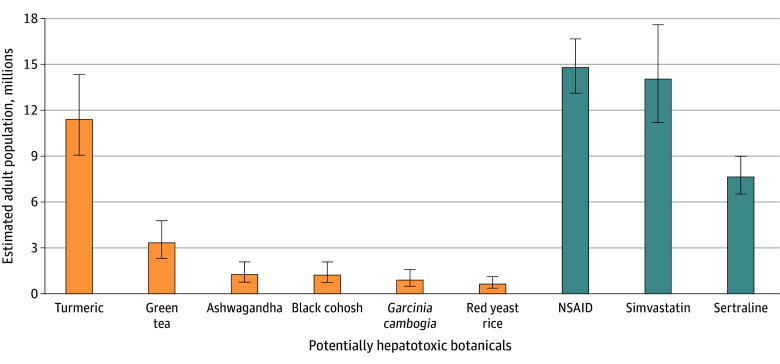
Importance: Use of herbal and dietary supplements (HDSs) accounts for an increasing proportion of drug hepatotoxicity cases. Turmeric or curcumin, green tea extract, Garcinia cambogia, black cohosh, red yeast rice, and ashwagandha are the most frequently reported hepatoxic botanicals, but their prevalence and reasons for use in the general population are unknown. Objective: To assess the prevalence and clinical characteristics of adult consumers of 6 potentially hepatoxic botanicals. Design, Setting, and Participants: This survey study analyzed nationally representative data from the National Health and Nutrition Examination Survey (NHANES), a nationally representative, cross-sectional survey of the general US population. Prescription drug and HDS exposure data in the past 30 days were analyzed, and 2020 US Census data were used for population estimates. Data were analyzed July 1, 2023, to February 1, 2024. Exposures: Adult NHANES participants enrolled between January 2017 and March 2020. Main Outcomes and Measures: Baseline weighted characteristics of HDS users and users of 6 potentially hepatotoxic botanical products were compared with non–HDS users. Multivariable analysis was undertaken to identify factors associated with HDS use or at-risk botanical use. Results: Among 9685 adults enrolled in this NHANES cohort, the mean (SE) age was 47.5 (0.5) years, and 51.8% (95% CI, 50.2%-53.4%) were female. The overall prevalence of HDS product use was 57.6% (95% CI, 55.9%-59.4%), while the prevalence of using the 6 botanicals of interest was 4.7% (95% CI, 3.9%-5.7%). Turmeric-containing botanicals were most commonly used (n = 236), followed by products containing green tea (n = 92), ashwagandha (n = 28), Garcinia cambogia (n = 20), red yeast rice (n = 20), and black cohosh (n = 19). Consumers of these 6 botanicals were significantly older (adjusted odds ratio [AOR], 2.36 [95% CI, 1.06-5.25]; P = .04 for 40-59 years of age and AOR, 3.96 [95% CI, 1.93-8.11]; P = .001 for ≥60 years of age), had a higher educational level (AOR, 4.78 [95% CI, 2.62-8.75]; P < .001), and were more likely to have arthritis (AOR, 2.27 [95% CI, 1.62-3.29]; P < .001) compared with non–HDS users. An estimated 15 584 599 (95% CI, 13 047 571-18 648 801) US adults used at least 1 of the 6 botanical products within the past 30 days, which was similar to the estimated number of patients prescribed potentially hepatotoxic drugs, including simvastatin (14 036 024 [95% CI, 11 202 460-17 594 452]) and nonsteroidal anti-inflammatory drugs (14 793 837 [95% CI, 13 014 623-16 671 897]). The most common reason for consuming turmeric and green tea was to improve or maintain health. Conclusions and Relevance: In this survey study, an estimated 15.6 million US adults consumed at least 1 botanical product with liver liability within the past 30 days, comparable with the number of people who consumed nonsteroidal anti-inflammatory drugs and a commonly prescribed hypolipidemic drug. Given a lack of regulatory oversight on the manufacturing and testing of botanical products, clinicians should be aware of possible adverse events from consumption of these largely unregulated products.
Overview
The claims and statistics of this paper haven’t been checked yet.
Run the check — free, no account needed. It reads the open-access text and checks the sources it cites.
Integrity signals
Registry
Cites
Statistics
Figures
Verification
Claims the paper makes
The claims and statistics of this paper haven’t been checked yet.
Run the check — free, no account needed. It reads the open-access text and checks the sources it cites.
Claims other papers make about this one
Each is checked against this paper’s own text: does it say what the citing paper says it does?
In the citing paper
“A recent population-based study demonstrated that nearly 15 million Americans are using botanical products for general well-being. 57”
From The contemporary epidemiology, causes, and management of drug-induced liver injury (2026) · cites this paper as [57]
Self-check
Percentages, sums and reported differences re-computed from the paper’s own numbers.
The self-check needs the paper’s full text.
Citations
Cites
Curcumin: A Review of Its Effects on Human Health
Hewlings, S., & Kalman, D. (2017) · Foods · doi:10.3390/foods6100092 · Cited by 2,720
Performance of Transient Elastography for the Staging of Liver Fibrosis: A Meta-Analysis
Friedrich‐Rust, M., Ong, M. F., Martens, S., Sarrazin, C., Bojunga, J., Zeuzem, S., & Herrmann, E. M. (2008) · Gastroenterology · doi:10.1053/j.gastro.2008.01.034 · Cited by 1,505
National health and nutrition examination survey: plan and operations, 1999-2010.
Zipf, G., Chiappa, M. M., Porter, K. S., Ostchega, Y., Lewis, B. G., & Dostal, J. (2013) · PubMed · Cited by 1,182
Radimer, K. (2004) · American Journal of Epidemiology · doi:10.1093/aje/kwh207 · Cited by 818
Chalasani, N., Fontana, R. J., Bonkovsky, H. L., Watkins, P. B., Davern, T., Serrano, J., Yang, H., & Rochon, J. (2008) · Gastroenterology · doi:10.1053/j.gastro.2008.09.011 · Cited by 755
Self-citationEmergency Department Visits for Adverse Events Related to Dietary Supplements
Geller, A. I., Shehab, N., Weidle, N. J., Lovegrove, M. C., Wolpert, B. J., Timbo, B. B., Mozersky, R. P., & Budnitz, D. S. (2015) · New England Journal of Medicine · doi:10.1056/nejmsa1504267 · Cited by 502
Drug-Induced Liver Injury Network (DILIN) Prospective Study: Rationale, Design and Conduct
Fontana, R. J., Watkins, P. B., Bonkovsky, H. L., Chalasani, N., Davern, T., Serrano, J., & Rochon, J. (2009) · Drug Safety · doi:10.2165/00002018-200932010-00005 · Cited by 486
Self-citationNHSR 158. National Health and Nutrition Examination Survey 2017–March 2020 Pre-pandemic Data Files
Bryan, S., Afful, J., Carroll, M., Te-Ching, C., Orlando, D., Fink, S., & Fryar, C. (2021) · doi:10.15620/cdc:106273 · Cited by 479
Liver injury from herbal and dietary supplements
Navarro, V. J., Khan, I., Björnsson, E., Seeff, L. B., Serrano, J., & Hoofnagle, J. H. (2017) · Hepatology · doi:10.1002/hep.28813 · Cited by 462
Multivitamin-multimineral supplements: who uses them?
Rock, C. L. (2007) · American Journal of Clinical Nutrition · doi:10.1093/ajcn/85.1.277s · Cited by 345
Research works printed but not linked: 4
- Zipf, 2013, Vital Health Stat 1
- US Food and Drug Administration, 1994, Dietary Supplement Health and Education Act of 1994; Public Law 103–417
- American Medical Association. Dietary supplements: underregulated, unknown, and maybe unsafe. Accessed January 19, 2024. https://www.ama-assn.org/delivering-care/public-health/dietary-supplements-underregulated-unknown-and-maybe-unsafe
- National Institute of Diabetes and Digestive and Kidney Diseases. LiverTox: clinical and research information on drug-induced liver injury, 2012-. Updated June 20, 2024. Accessed January 19, 2024. https://www.ncbi.nlm.nih.gov/books/NBK547852/
Cited by
The contemporary epidemiology, causes, and management of drug-induced liver injury
Swanson, L., & Fontana, R. J. (2026) · Hepatology Communications · doi:10.1097/hc9.0000000000001011
Self-citation
Metadata
- Authors
- Likhitsup, A., Chen, V. L., & Fontana, R. J.
- Affiliations
- Department of Internal Medicine, Division of Gastroenterology and Hepatology, University of Michigan, Ann Arbor, Michigan
- Venue
- JAMA Network Open
- Publisher
- American Medical Association (AMA)
- Published
- 2024-08-05
- Volume
- 7
- Issue
- 8
- Pages
- e2425822
- ISSN
- 2574-3805
- PMC
- PMC11301549
- Cited by
- 30
- References
- 45
- Language
- en
About these checks
Registry, retraction, Cites and statistics results are computed, not judged, with one exception: a printed reference that no index lists is read once by a model before it counts as a citation error. Claims are extracted by a model and kept only when their quote appears verbatim in the text; each cited source is then checked, with a model’s help, for whether it says what the claim relies on. Those verdicts can be wrong — read the claim’s quote and the cited source before relying on one.
Statistics and arithmetic are recomputed, not judged.
Confidence bands are shown only for fields calibrated on our annotated test set. None is calibrated yet, so no band is shown.
What counts as a claim ›How we measure confidence ›How we check this ›
Are you an author, or do you see a problem with this page? Request a review
How to cite
Cite CoChat for the checks on this page, and the paper for its own findings.
- This page
- CoChat. (2026). Citation check: Estimated Exposure to 6 Potentially Hepatotoxic Botanicals in US Adults. https://app.cochat.ai/papers/10.1001/jamanetworkopen.2024.25822
- The paper
- Likhitsup, A., Chen, V. L., & Fontana, R. J. (2024). Estimated Exposure to 6 Potentially Hepatotoxic Botanicals in US Adults. JAMA Network Open. https://doi.org/10.1001/jamanetworkopen.2024.25822
Data sources
Bibliographic data: Semantic Scholar, OpenAlex, Crossref.
Contains information from the Semantic Scholar Academic Graph Datasets, made available under the ODC Attribution License (ODC-BY 1.0).
Semantic Scholar’s data is described in: Kinney, R., et al. (2023). The Semantic Scholar Open Data Platform. arXiv:2301.10140.
