

Homelessness, Patient Navigation, and Lung Cancer Screening in a Health Center Setting: A Subgroup Analysis of a Randomized Clinical Trial
Open accessThe DOI matches its Crossref record; 61 of the 61 references it cites were found in a registry or an index; none of the 16 sources its claims cite is checked for support yet.
Abstract
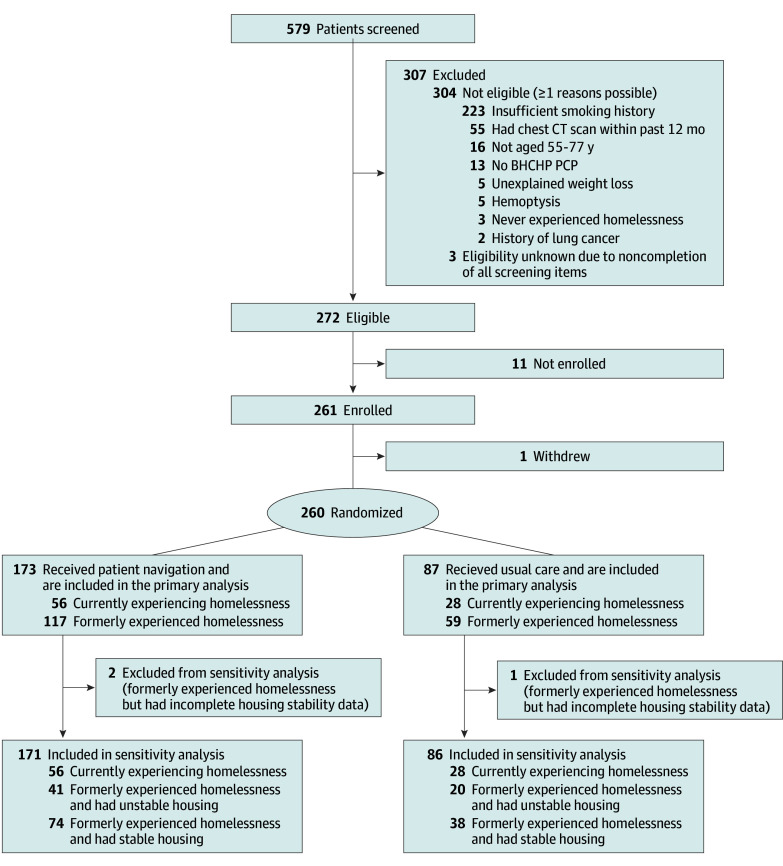
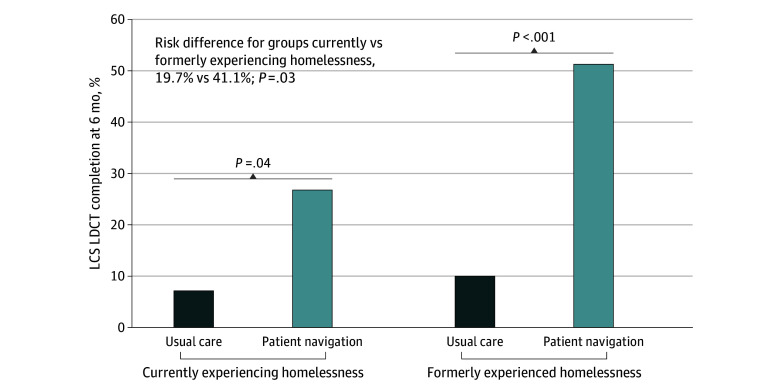
Importance: Lung cancer is a major cause of death among people who experience homelessness. Patient navigation is an effective strategy for promoting lung cancer screening (LCS) in Health Care for the Homeless (HCH) settings, but little is known about whether the impact of this intervention differs for patients currently vs formerly experiencing homelessness. Objectives: To examine the effect of LCS patient navigation on individuals currently vs formerly experiencing homelessness, and to explore how navigation process measures differ for these subgroups. Design, Setting, and Participants: This is a subgroup analysis of the Investigating Navigation to Help Advance Lung Equity (INHALE) pragmatic randomized clinical trial of LCS patient navigation. The INHALE trial was conducted at Boston Health Care for the Homeless Program (BHCHP), a federally qualified health center serving nearly 10 000 patients who have experienced homelessness annually. The study included BHCHP primary care patients with a lifetime history of homelessness who were proficient in English and eligible for LCS under pre-2022 Medicare coverage criteria. The study was conducted between November 20, 2020, and March 29, 2023. Exposure: Current vs former homelessness, defined by self-reported responses to a detailed residential inventory. Sensitivity analyses further categorized individuals who formerly experienced homelessness as having stable or unstable housing. Main Outcomes and Measures: The primary outcome was verified receipt of a 1-time LCS low-dose computed tomography (LDCT) scan within 6 months after randomization. The risk difference (RD) in primary outcome attainment between navigation and usual care within each homelessness subgroup was calculated, and these RDs were compared by testing the interaction between study group and homelessness status in a linear binomial regression model with the identity link. Results: This study included 260 participants (mean [SD] age, 60.5 [4.7] years; 184 male individuals [70.8%]). At baseline, 84 patients (32.3%) were currently experiencing homelessness and 176 (67.7%) had formerly experienced homelessness. Patient navigation significantly increased LCS LDCT completion among both those currently (15 of 56 [26.8%] vs 2 of 28 [7.1%]; P = .04) and formerly (60 of 117 [51.3%] vs 6 of 59 [10.2%]; P < .001) experiencing homelessness. However, the treatment effect was significantly smaller among participants currently experiencing homelessness (RD, 19.7% vs 41.1%; P = .03), such that a disparity in LCS completion between these subgroups emerged under the navigation condition. Navigation process measures highlighted communication challenges with participants currently experiencing homelessness. In sensitivity analyses, LCS LDCT completion rates and navigation process measures were generally similar for stably vs unstably housed participants who formerly experienced homelessness. Conclusions and Relevance: In this subgroup analysis of a randomized clinical trial, patient navigation increased LCS participation among both patients currently and formerly experiencing homelessness; however, the effect size was smaller for those currently experiencing homelessness. Further improving cancer outcomes among HCH patients may require refinement of the patient navigation intervention, coupled with policy efforts to promote housing attainment among people experiencing homelessness. Trial Registration: ClinicalTrials.gov Identifier: NCT04308226
Overview
CoChat Summary
TL;DR
In a prespecified subgroup analysis of the INHALE randomized clinical trial (260 patients at a Boston Health Care for the Homeless Program), patient navigation increased 6-month lung cancer screening completion among both currently and formerly homeless participants, but the absolute increase was about half as large for those currently experiencing homelessness (19.7% vs 41.1%). Communication barriers and fewer navigation contacts may have contributed to this differential effect.
Key findings
- Navigation vs usual care increased LCS LDCT completion within 6 months among participants currently experiencing homelessness (15 of 56 [26.8%] vs 2 of 28 [7.1%]; RD, 19.7%; P = .04) and formerly experiencing homelessness (60 of 117 [51.3%] vs 6 of 59 [10.2%]; RD, 41.1%; P < .001); the difference between these effects was significant (P = .03).
- The screening gap between currently and formerly homeless participants widened under navigation: RD, 24.5% under navigation vs 3.1% under usual care.
- Navigation process measures were generally lower among participants currently experiencing homelessness: fewer total contacts (mean, 7.7 vs 10.5; P = .049), fewer telephone contacts (mean, 7.6 vs 10.4; P = .049), marginally less likely to be reminded about an LCS appointment (25 of 56 [44.6%] vs 70 of 117 [59.8%]; P = .07), less likely to have LCS follow-up arranged (19 of 56 [33.9%] vs 65 of 117 [55.6%]; P = .01), and less likely to have insurance issues addressed (9 of 56 [16.1%] vs 41 of 117 [35.0%]; P = .01).
- In sensitivity analyses among formerly homeless participants, navigation vs usual care RDs were 48.5% (95% CI, 28.5%-68.5%) for unstable housing and 35.4% (95% CI, 20.5%-50.4%) for stable housing. At baseline, currently homeless participants were less likely to have a cell phone (73.8% vs 98.9%), more likely to have high subsistence difficulties (47.6% vs 6.3%), more likely to have a mental health disorder (39.3% vs 24.1%), more likely to currently smoke (96.4% vs 79.5%), had fewer pack-years (44.0 vs 50.1), and were less likely to have previously discussed LCS with their PCP (28.6% vs 42.6%); lung cancer risk perceptions did not differ substantially.
Methods
- Prespecified subgroup analysis of the INHALE pragmatic randomized clinical trial at Boston Health Care for the Homeless Program; recruitment began November 20, 2020, and data collection concluded March 29, 2023. Participants had lifetime homelessness, a BHCHP primary care practitioner, English proficiency, and met pre-2022 Medicare LCS criteria (aged 55-77 years, ≥30 pack-year smoking history, smoking within past 15 years).
- Participants were randomized 2:1 to usual care with or without patient navigation, stratified by homelessness status (current vs former), smoking status, prior LCS discussion with PCP, and primary clinical site. The primary outcome was receipt of a 1-time LCS LDCT scan within 6 months (26 weeks) of randomization, ascertained by standardized blinded medical record review.
- Analyses compared LCS completion by homelessness subgroup, calculated risk differences, and tested the interaction between study group and homelessness status in a linear binomial regression model with identity link. Fisher exact tests and t tests compared baseline characteristics and navigation process measures; sensitivity analyses used a 3-level housing variable (currently homeless, formerly homeless with unstable housing, formerly homeless with stable housing). Navigation process measures came from navigator checklist logs.
Limitations
- Stated: parent-trial limitations are described elsewhere; homelessness status was measured only at baseline, so housing changes during the 6-month follow-up were not captured, and resulting misclassification would be expected to bias analyses toward the null. Findings may not be generalizable to other geographic settings because homelessness is influenced by local contextual factors. Post hoc unstable vs stable housing examinations were not necessarily free from confounding bias. Comparisons of navigation process measures were likely underpowered, and differences in these measures should be regarded as hypothesis-generating rather than causal, with possible unmeasured confounding.
- Text makes evident: the current-homelessness subgroup was small (n = 84; usual care n = 28), so subgroup effect estimates are imprecise; the paper itself notes power limitations for the 3-way sensitivity comparisons.
Model-written summary. Check it against the paper before relying on it.
Integrity signals
Registry
Cites
Statistics
Figures
Verification
Claims the paper makes
0 Valid · 0 Not valid · 10 Not checked · 37 Own results and interpretations
A result the paper reports from its own data — it cites no other source for it, so there is none to check. The quote shows it is in the paper.
In the paper
“In this pragmatic trial of LCS patient navigation at a large HCH program in Boston, the patient navigation intervention produced sizable and significant effects on screening participation among both patients currently and formerly experiencing homelessness”
- Also stated in: § Conclusions · plain
“In this subgroup analysis of a randomized clinical trial, patient navigation improved LCS participation among HCH patients both currently and formerly experiencing homelessness”
§ Homelessness, Patient Navigation, and Lung Cancer Screening in a Health Center Setting > Discussion
plainstates a cause- Asserted: passes — The authors put it forward as true.
- Checkable: passes — It can be checked against evidence.
- Load-bearing: passes — The paper’s conclusions depend on it.
- Based: passes — The paper gives a reason why it holds.
- Also stated in: § Conclusions · plain
A result the paper reports from its own data — it cites no other source for it, so there is none to check. The quote shows it is in the paper.
In the paper
“Interestingly, despite having a higher burden of difficulty meeting basic survival needs, participants currently experiencing homelessness did not differ from those who formerly experienced homelessness in their lung cancer risk perceptions, including level of worry about lung cancer and perceived benefits of screening.”
§ Homelessness, Patient Navigation, and Lung Cancer Screening in a Health Center Setting > Discussion
plain- Asserted: passes — The authors put it forward as true.
- Checkable: passes — It can be checked against evidence.
- Load-bearing: passes — The paper’s conclusions depend on it.
- Based: passes — The paper gives a reason why it holds.
A result the paper reports from its own data — it cites no other source for it, so there is none to check. The quote shows it is in the paper.
In the paper
“Individuals currently experiencing homelessness were less likely at baseline to have been counseled previously about LCS by their PCP”
§ Homelessness, Patient Navigation, and Lung Cancer Screening in a Health Center Setting > Discussion
plainstates an association- Asserted: passes — The authors put it forward as true.
- Checkable: passes — It can be checked against evidence.
- Load-bearing: unclear — It is unclear whether the paper’s conclusions depend on it.
- Based: passes — The paper gives a reason why it holds.
A result the paper reports from its own data — it cites no other source for it, so there is none to check. The quote shows it is in the paper.
In the paper
“combined with patients currently experiencing homelessness being less likely to have cell phones at baseline”
§ Homelessness, Patient Navigation, and Lung Cancer Screening in a Health Center Setting > Discussion
plainstates an association- Asserted: passes — The authors put it forward as true.
- Checkable: passes — It can be checked against evidence.
- Load-bearing: passes — The paper’s conclusions depend on it.
- Based: passes — The paper gives a reason why it holds.
In the paper
“resulting in LCS screening rates for both subgroups that were higher than LCS estimates in the US general population during a similar time frame.61”
§ Homelessness, Patient Navigation, and Lung Cancer Screening in a Health Center Setting > Discussion
What the sources say
- Not checked yetcites [61] Henderson LM, Su IH, Rivera MP,. Prevalence of lung cancer screening in the US, 2022. JAMA Netw Open. 2024; 7(3): e243190. doi: 10.1001/jamanetworkopen.2024.3190 38512257 PMC10958241 source
plainstates an association- Asserted: passes — The authors put it forward as true.
- Checkable: passes — It can be checked against evidence.
- Load-bearing: unclear — It is unclear whether the paper’s conclusions depend on it.
- Based: passes — The paper gives a reason why it holds.
29 more claims
Create a free account to see all 47 claims and to verify the 16 references still open.
- It may state two separate claims as one. 4
- Probably not a substantial claim. 9
Self-check
Percentages, sums and reported differences re-computed from the paper’s own numbers.
Each contradiction between two passages listed here was confirmed by an independent check.
Rated minor: it would not touch a result — a value no result rests on, a p-value that stays on the same side of the significance level, or a conflict that is clerical, resolved elsewhere in the paper, or outside its own findings.
In the paper
“| Facilitated transportation | 27 (15.6) | 6 (1.7) | 21 (17.9) | .27 |”
§ Homelessness, Patient Navigation, and Lung Cancer Screening in a Health Center Setting > Results > Navigation Process Measures by Homelessness Status
Reported 1.7 · recomputed 10.714286
Rated minor: it would not touch a result — a value no result rests on, a p-value that stays on the same side of the significance level, or a conflict that is clerical, resolved elsewhere in the paper, or outside its own findings.
In the paper
§ Homelessness, Patient Navigation, and Lung Cancer Screening in a Health Center Setting > Results > Navigation Process Measures by Homelessness Status
“Other dimensions of navigation engagement were generally lower among those currently experiencing homelessness compared with those formerly experiencing homelessness, but this was not significant.”
§ Homelessness, Patient Navigation, and Lung Cancer Screening in a Health Center Setting > Results > Navigation Process Measures by Homelessness Status
“| Addressed insurance issues | 50 (28.9) | 9 (16.1) | 41 (35.0) | .01 |”
Rated minor: it would not touch a result — a value no result rests on, a p-value that stays on the same side of the significance level, or a conflict that is clerical, resolved elsewhere in the paper, or outside its own findings.
In the paper
“| Provided smoking cessation support | 58 (33.5) | 17 (3.4) | 41 (35.0) | .61 |”
§ Homelessness, Patient Navigation, and Lung Cancer Screening in a Health Center Setting > Results > Navigation Process Measures by Homelessness Status
Reported 3.4 · recomputed 30.357143
Citations
Cites
KESSLER, R. C., ANDREWS, G., COLPE, L. J., HIRIPI, E., MROCZEK, D. K., NORMAND, S.-L. T., WALTERS, E. E., & ZASLAVSKY, A. M. (2002) · Psychological Medicine · doi:10.1017/s0033291702006074 · Cited by 10,327
Bush, K. (1998) · Archives of Internal Medicine · doi:10.1001/archinte.158.16.1789 · Cited by 6,196
Screening for serious mental illness in the general population
Kessler, R. C., Barker, P. R., Colpe, L. J., Epstein, J. F., Gfroerer, J. C., Hiripi, E., Howes, M. J., Normand, S.-L. T., Manderscheid, R. W., Walters, E. E., et al. (2003) · Archives of General Psychiatry · doi:10.1001/archpsyc.60.2.184 · Cited by 5,692
Skinner, H. A. (1982) · Addictive Behaviors · doi:10.1016/0306-4603(82)90005-3 · Cited by 3,134
Mortality prediction with a single general self-rated health question: A meta-analysis
DeSalvo, K. B., Bloser, N., Reynolds, K., He, J., & Muntner, P. (2006) · Journal of General Internal Medicine · doi:10.1111/j.1525-1497.2005.00291.x · Cited by 2,290
Is General Self-Efficacy a Universal Construct?1
Scholz, U., Gutiérrez Doña, B., Sud, S., & Schwarzer, R. (2002) · European Journal of Psychological Assessment · doi:10.1027//1015-5759.18.3.242 · Cited by 1,637
Fazel, S., Geddes, J. R., & Kushel, M. (2014) · The Lancet · doi:10.1016/s0140-6736(14)61132-6 · Cited by 1,568
A comprehensive review of the psychometric properties of the Drug Abuse Screening Test
Yudko, E., Lozhkina, O., & Fouts, A. (2007) · Journal of Substance Abuse Treatment · doi:10.1016/j.jsat.2006.08.002 · Cited by 906
Housing instability and food insecurity as barriers to health care among low-income americans
Kushel, M. B., Gupta, R., Gee, L., & Haas, J. S. (2006) · Journal of General Internal Medicine · doi:10.1111/j.1525-1497.2005.00278.x · Cited by 834
Bradley, K. A., Bush, K. R., Epler, A. J., Dobie, D. J., Davis, T. M., Sporleder, J. L., Maynard, C., Burman, M. L., & Kivlahan, D. R. (2003) · Archives of Internal Medicine · doi:10.1001/archinte.163.7.821 · Cited by 738
History and principles of patient navigation
Freeman, H. P., & Rodriguez, R. L. (2011) · Cancer · doi:10.1002/cncr.26262 · Cited by 666
Disparities in Health Care and the Digital Divide
Saeed, S. A., & Masters, R. M. (2021) · Current Psychiatry Reports · doi:10.1007/s11920-021-01274-4 · Cited by 578
Patient navigation: State of the art or is it science?
Wells, K. J., Battaglia, T. A., Dudley, D. J., Garcia, R., Greene, A., Calhoun, E., Mandelblatt, J. S., Paskett, E. D., Raich, P. C., & Program, T. P. N. R. (2008) · Cancer · doi:10.1002/cncr.23815 · Cited by 571
Mortality Among Homeless Adults in Boston: Shifts in Causes of Death Over a 15-Year Period
Baggett, T. P., Hwang, S. W., O’Connell, J. J., Porneala, B. C., Stringfellow, E. J., Orav, E. J., Singer, D. E., & Rigotti, N. A. (2013) · JAMA Internal Medicine · doi:10.1001/jamainternmed.2013.1604 · Cited by 566
Self-citationPatient navigation: An update on the state of the science
Paskett, E. D., Harrop, J. P., & Wells, K. J. (2011) · CA: A Cancer Journal for Clinicians · doi:10.3322/caac.20111 · Cited by 458
Competing priorities as a barrier to medical care among homeless adults in Los Angeles.
Gelberg, L., Gallagher, T. C., Andersen, R. M., & Koegel, P. (1997) · American Journal of Public Health · doi:10.2105/ajph.87.2.217 · Cited by 452
The psychological lives of the poor
Schilbach, F., Schofield, H., & Mullainathan, S. (2016) · American Economic Review · doi:10.1257/aer.p20161101 · Cited by 404
Mortality among residents of shelters, rooming houses, and hotels in Canada: 11 year follow-up study
Hwang, S. W., Wilkins, R., Tjepkema, M., O'Campo, P. J., & Dunn, J. R. (2009) · BMJ · doi:10.1136/bmj.b4036 · Cited by 388
Percac-Lima, S., Grant, R. W., Green, A. R., Ashburner, J. M., Gamba, G., Oo, S., Richter, J. M., & Atlas, S. J. (2009) · Journal of General Internal Medicine · doi:10.1007/s11606-008-0864-x · Cited by 344
Patient Navigation in Breast Cancer: A Systematic Review
Robinson-White, S., Conroy, B., Slavish, K. H., & Rosenzweig, M. (2010) · Cancer Nursing · doi:10.1097/ncc.0b013e3181c40401 · Cited by 261
Jandorf, L. (2005) · Journal of Urban Health: Bulletin of the New York Academy of Medicine · doi:10.1093/jurban/jti046 · Cited by 229
Lebrun‐Harris, L. A., Baggett, T. P., Jenkins, D. M., Sripipatana, A., Sharma, R., Hayashi, A. S., Daly, C. A., & Ngo‐Metzger, Q. (2013) · Health Services Research · doi:10.1111/1475-6773.12009 · Cited by 216
Self-citationMortality Among Unsheltered Homeless Adults in Boston, Massachusetts, 2000-2009
Roncarati, J. S., Baggett, T. P., O’Connell, J. J., Hwang, S. W., Cook, E. F., Krieger, N., & Sorensen, G. (2018) · JAMA Internal Medicine · doi:10.1001/jamainternmed.2018.2924 · Cited by 213
Self-citationLasser, K. E., Murillo, J., Lisboa, S., Casimir, A. N., Valley-Shah, L., Emmons, K. M., Fletcher, R. H., & Ayanian, J. Z. (2011) · Archives of Internal Medicine · doi:10.1001/archinternmed.2011.201 · Cited by 203
Christie, J., Itzkowitz, S., Lihau-Nkanza, I., Castillo, A., Redd, W., & Jandorf, L. (2008) · Journal of the National Medical Association · doi:10.1016/s0027-9684(15)31240-2 · Cited by 180
Use of the SF‐12 Instrument for Measuring the Health of Homeless Persons
Larson, C. O. (2002) · Health Services Research · doi:10.1111/1475-6773.00046 · Cited by 173
A Program to Enhance Completion of Screening Colonoscopy Among Urban Minorities
Chen, L. A., Santos, S., Jandorf, L. H., Christie, J. A., Castillo, A. G., Winkel, G. H., & Itzkowitz, S. H. (2008) · Clinical Gastroenterology and Hepatology · doi:10.1016/j.cgh.2007.12.009 · Cited by 165
Patient Navigation to Increase Mammography Screening Among Inner City Women
Phillips, C. E., Rothstein, J. D., Beaver, K. A., Sherman, B. J., Freund, K. M., & Battaglia, T. A. (2010) · Journal of General Internal Medicine · doi:10.1007/s11606-010-1527-2 · Cited by 139
Prevalence of lung cancer screening in the US, 2022
Henderson, L. M., Su, I.-H., Rivera, M. P., Pak, J., Chen, X., Reuland, D. S., & Lund, J. L. (2024) · JAMA Network Open · doi:10.1001/jamanetworkopen.2024.3190 · Cited by 138
The Boston Health Care for the Homeless Program: A Public Health Framework
O’Connell, J. J., Oppenheimer, S. C., Judge, C. M., Taube, R. L., Blanchfield, B. B., Swain, S. E., & Koh, H. K. (2010) · American Journal of Public Health · doi:10.2105/ajph.2009.173609 · Cited by 130
Park, E. R., Ostroff, J. S., Rakowski, W., Gareen, I. F., Diefenbach, M. A., Feibelmann, S., & Rigotti, N. A. (2009) · Annals of Behavioral Medicine · doi:10.1007/s12160-009-9112-9 · Cited by 119
Self-citationPercac‐Lima, S., Ashburner, J. M., Bond, B., Oo, S. A., & Atlas, S. J. (2013) · Journal of General Internal Medicine · doi:10.1007/s11606-013-2491-4 · Cited by 115
Disparities in Cancer Incidence, Stage, and Mortality at Boston Health Care for the Homeless Program
Baggett, T. P., Chang, Y., Porneala, B., Bharel, M., Singer, D. E., & Rigotti, N. A. (2015) · American Journal of Preventive Medicine · doi:10.1016/j.amepre.2015.03.038 · Cited by 108
Self-citationJandorf, L., Braschi, C., Ernstoff, E., Wong, C. R., Thelemaque, L., Winkel, G., Thompson, H. S., Redd, W. H., & Itzkowitz, S. H. (2013) · Cancer Epidemiology, Biomarkers & Prevention · doi:10.1158/1055-9965.epi-12-1275 · Cited by 107
Lasser, K. E., Murillo, J., Medlin, E., Lisboa, S., Valley-Shah, L., Fletcher, R. H., Emmons, K. M., & Ayanian, J. Z. (2009) · BMC Family Practice · doi:10.1186/1471-2296-10-37 · Cited by 104
Cancer risk behaviors and screening rates among homeless adults in Los Angeles County.
Chau, S., Chin, M., Chang, J., Luecha, A., Cheng, E. M., Schlesinger, J., Rao, V., Huang, D. Y. C., Maxwell, A. E., Usatine, R. P., et al. (2002) · PubMed · Cited by 103
Comparing Homeless Persons’ Care Experiences in Tailored Versus Nontailored Primary Care Programs
Kertesz, S. G., Holt, C. L., Steward, J., Jones, R. N., Roth, D. L., Stringfellow, E. J., Gordon, A. J., Kim, T. W., Austin, E. L., Henry, S. R., et al. (2013) · American Journal of Public Health · doi:10.2105/ajph.2013.301481 · Cited by 102
Racial Inequity and Homelessness: Findings from the SPARC Study
Olivet, J., Wilkey, C. M., Richard, M. K., Dones, M., Tripp, J., Beit-Arie, M., Yampolskaya, S., & Cannon, R. (2021) · The Annals of the American Academy of Political and Social Science · doi:10.1177/0002716221991040 · Cited by 91
Wang, X., Fang, C., Tan, Y., Liu, A., & Ma, G. X. (2010) · Journal of Women's Health · doi:10.1089/jwh.2009.1422 · Cited by 90
Honeycutt, S., Green, R., Ballard, D., Hermstad, A. K., Brueder, A., Haardörfer, R., Yam, J., & Arriola, K. J. (2013) · Cancer · doi:10.1002/cncr.28033 · Cited by 86
Horne, H. N., Phelan-Emrick, D. F., Pollack, C. E., Markakis, D., Wenzel, J. A., Ahmed, S., Garza, M. A., Shapiro, G. R., Bone, L., Johnson, L. B., et al. (2014) · Cancer Causes & Control · doi:10.1007/s10552-014-0505-0 · Cited by 81
Development and Validation of an Instrument to Assess Imminent Risk of Homelessness among Veterans
Montgomery, A. E., Fargo, J. D., Kane, V. R., & Culhane, D. P. (2014) · Public Health Reports · doi:10.1177/003335491412900506 · Cited by 78
Reducing Cancer Screening Disparities in Medicare Beneficiaries Through Cancer Patient Navigation
Braun, K. L., Thomas, W. L., Domingo, J. B., Allison, A. L., Ponce, A., Haunani Kamakana, P., Brazzel, S. S., Emmett Aluli, N., & Tsark, J. U. (2015) · Journal of the American Geriatrics Society · doi:10.1111/jgs.13192 · Cited by 77
Factors Associated With Mortality Among Homeless Older Adults in California: The HOPE HOME Study.
Brown, R. T., Evans, J. L., Valle, K. A., Guzman, D., Chen, Y.-H., & Kushel, M. (2022) · JAMA Internal Medicine · doi:10.1001/jamainternmed.2022.3697 · Cited by 73
Increasing Colon Cancer Screening in Primary Care Among African Americans
Myers, R. E., Sifri, R., Daskalakis, C., DiCarlo, M., Geethakumari, P. R., Cocroft, J., Minnick, C., Brisbon, N., & Vernon, S. W. (2014) · JNCI Journal of the National Cancer Institute · doi:10.1093/jnci/dju344 · Cited by 69
Percac‐Lima, S., López, L., Ashburner, J. M., Green, A. R., & Atlas, S. J. (2014) · Cancer · doi:10.1002/cncr.28682 · Cited by 63
Colorectal Cancer Screening Among the Homeless Population of New York City Shelter-Based Clinics
Asgary, R. G., Garland, V., Jakubowski, A. U., & Sckell, B. M. (2014) · American Journal of Public Health · doi:10.2105/ajph.2013.301792 · Cited by 59
Cancer screening in the homeless population.
Asgary, R. (2018) · The Lancet Oncology · doi:10.1016/s1470-2045(18)30200-6 · Cited by 54
Cancer Screening in Homeless Women: Attitudes and Behaviors
Long, H. L., Tulsky, J. P., Chambers, D. B., Alpers, L. S., Robertson, M. J., Moss, A. R., & Chesney, M. A. (1998) · Journal of Health Care for the Poor and Underserved · doi:10.1353/hpu.2010.0070 · Cited by 46
Opt-Out Patient Navigation to Improve Breast and Cervical Cancer Screening Among Homeless Women
Asgary, R. G., Naderi, R., & Wisnivesky, J. P. (2017) · Journal of Women s Health · doi:10.1089/jwh.2016.6066 · Cited by 43
Program, S. A. T. F. S., Affairs, P. A. G., Board on Population Health and Public Health Practice, et al. (2018) · National Academies Press eBooks · doi:10.17226/25133 · Cited by 40
Breast Cancer Screening Among Homeless Women of New York City Shelter-Based Clinics
Asgary, R. G., Garland, V., & Sckell, B. M. (2014) · Women s Health Issues · doi:10.1016/j.whi.2014.06.002 · Cited by 36
Baggett, T. P., Sporn, N., Barbosa Teixeira, J., Rodriguez, E. C., Anandakugan, N., Critchley, N., Kennedy, E., Hart, K., Joyce, A., Chang, Y., et al. (2024) · JAMA Internal Medicine · doi:10.1001/jamainternmed.2024.1662 · Cited by 35
Self-citationHousing Boston’s Chronically Homeless Unsheltered Population: 14 Years Later
Roncarati, J. S., Tiemeier, H. W., Tachick, R., VanderWeele, T. J., & O’Connell, J. J. (2021) · Medical Care · doi:10.1097/mlr.0000000000001409 · Cited by 30
SmokefreeTXT for Homeless Smokers: Pilot Randomized Controlled Trial
Baggett, T. P., McGlave, C., Kruse, G. R., Yaqubi, A., Chang, Y., & Rigotti, N. A. (2019) · JMIR mhealth and uhealth · doi:10.2196/13162 · Cited by 24
Self-citationFine, D., Dickins, K. A., Adams, L., Horick, N., Critchley, N., Hart, K., Gaeta, J. M., Lewis, E., Looby, S., & Baggett, T. (2023) · JAMA Network Open · doi:10.1001/jamanetworkopen.2023.31004 · Cited by 22
Self-citationPrevalence of Housing Problems Among Community Health Center Patients
Baggett, T. P., Berkowitz, S. A., Fung, V., & Gaeta, J. M. (2018) · JAMA · doi:10.1001/jama.2017.19869 · Cited by 21
Self-citationBaggett, T. P., Barbosa Teixeira, J., Rodriguez, E. C., Anandakugan, N., Sporn, N., Chang, Y., Percac-Lima, S., Park, E. R., & Rigotti, N. A. (2022) · Contemporary Clinical Trials · doi:10.1016/j.cct.2021.106666 · Cited by 18
Self-citationBaggett, T. P., Yaqubi, A., Berkowitz, S. A., Kalkhoran, S. M., McGlave, C., Chang, Y., Campbell, E. G., & Rigotti, N. A. (2018) · BMC Public Health · doi:10.1186/s12889-018-5375-z · Cited by 17
Self-citationZordan, R., Mackelprang, J. L., Hutton, J., Moore, G., & Sundararajan, V. (2023) · International Journal of Epidemiology · doi:10.1093/ije/dyad006 · Cited by 11
Patient-level factors associated with receipt of preventive care in the safety net
Hatch, B., Tillotson, C. J., Hoopes, M. J., Huguet, N., Marino, M., & DeVoe, J. E. (2022) · Preventive Medicine · doi:10.1016/j.ypmed.2022.107024 · Cited by 8
Research works printed but not linked: 4
- Hardin V, Tangka FKL, Wood T,. The effectiveness and cost to improve colorectal cancer screening in a federally qualified homeless clinic in Eastern Kentucky. Health Promot Pract. 2020; 21(6): 905- 909. doi: 10.1177/1524839920954165 32990049 PMC7894067 · doi:10.1177/1524839920954165
- Schwarzer R, Jerusalem M. Generalized Self-Efficacy Scale. In: Weinman J, Wright S, Johnston M, eds. Measures in Health Psychology: A User’s Portfolio Causal and Control Beliefs. NFER-Nelson; 1995: 35- 37.
- Baggett TP, Kertesz SG. Health care of people experiencing homelessness in the United States. In: Schwenk TL, Law K, eds. UpToDate. Wolters Kluwer Health; 2024.
- Baggett TP, Jenkins DM. Homelessness and health: key themes from three decades of research. In: Fitzpatrick KP, ed. Poverty and Health. Vol 1. Praeger; 2013:105-141.
Cited by
Still being checked.
Metadata
- Authors
- Baggett, T. P., Sporn, N., Barbosa Teixeira, J., Rodriguez, E. C., Anandakugan, N., Little, B. R., Chang, Y., Park, E. R., Rigotti, N. A., & Fine, D. R.
- Affiliations
- Harvard University (US)
- Massachusetts General Hospital (US)
- Ragon Institute, Boston, Massachusetts
- New York University (US)
- University of Massachusetts Chan Medical School (US)
- Corresponding author
- Baggett, Travis P.
- Venue
- JAMA Network Open
- Publisher
- American Medical Association (AMA)
- Published
- 2025-07-17
- Volume
- 8
- Issue
- 7
- Pages
- e2519780
- ISSN
- 2574-3805 (ISSN-L)
- PMC
- PMC12272284
- OpenAlex
- W4412488487
- Cited by
- 9
- References
- 61
- Citations by year
- 2026: 8 · 2025: 1
- FWCI
- 4.07
- Type
- journal article
- Language
- en
- Open access
- gold
- doi.org
- Licence
- cc-by
- Locations
- JAMA Network Open (publishedVersion, cc-by)
- PubMed Central (publishedVersion, cc-by)
- PubMed (publishedVersion)
- Topics
- Health Sciences › Medicine › Pulmonary and Respiratory Medicine › Lung Cancer Diagnosis and Treatment
- Social Sciences › Sociology and Political Science › Homelessness and Social Issues
- Health Sciences › Medicine › Oncology › Global Cancer Incidence and Screening
- Keywords
- lung cancer screening, patient navigation, homelessness, low-dose CT, health care for the homeless, federally qualified health centers, stable housing, primary care, Medicare eligibility, subgroup analysis, health disparities, housing instability, health equity interventions
- MeSH terms
- Aged, Boston, Female, Ill-Housed Persons, Humans, Lung Neoplasms, Male, Middle Aged, Early Detection of Cancer, Patient Navigation
About these checks
Registry, retraction, Cites and statistics results are computed, not judged, with one exception: a printed reference that no index lists is read once by a model before it counts as a citation error. Claims are extracted by a model and kept only when their quote appears verbatim in the text; each cited source is then checked, with a model’s help, for whether it says what the claim relies on. Those verdicts can be wrong — read the claim’s quote and the cited source before relying on one.
A language model drew the claims from the paper on 2026-11-25, under version 3 of the claim definition (model deepseek-v4.1-flash, prompt extract-v3).
A second model labelled each claim on 2026-11-25 (model jev-1.13-20260917, definition revision gold-guideline-v0.2).
Statistics and arithmetic are recomputed, not judged.
Confidence bands are shown only for fields calibrated on our annotated test set. None is calibrated yet, so no band is shown.
What counts as a claim ›How we measure confidence ›How we check this ›
Are you an author, or do you see a problem with this page? Request a review
Data sources
Bibliographic data: Semantic Scholar, OpenAlex, Crossref.
Contains information from the Semantic Scholar Academic Graph Datasets, made available under the ODC Attribution License (ODC-BY 1.0).
Semantic Scholar’s data is described in: Kinney, R., et al. (2023). The Semantic Scholar Open Data Platform. arXiv:2301.10140.
