

Dissecting the Association Between Inflammation, Metabolic Dysregulation, and Specific Depressive Symptoms: A Genetic Correlation and 2-Sample Mendelian Randomization Study
Open accessThe DOI matches its Crossref record; 78 of the 83 references it cites were found in a registry or an index.
Abstract
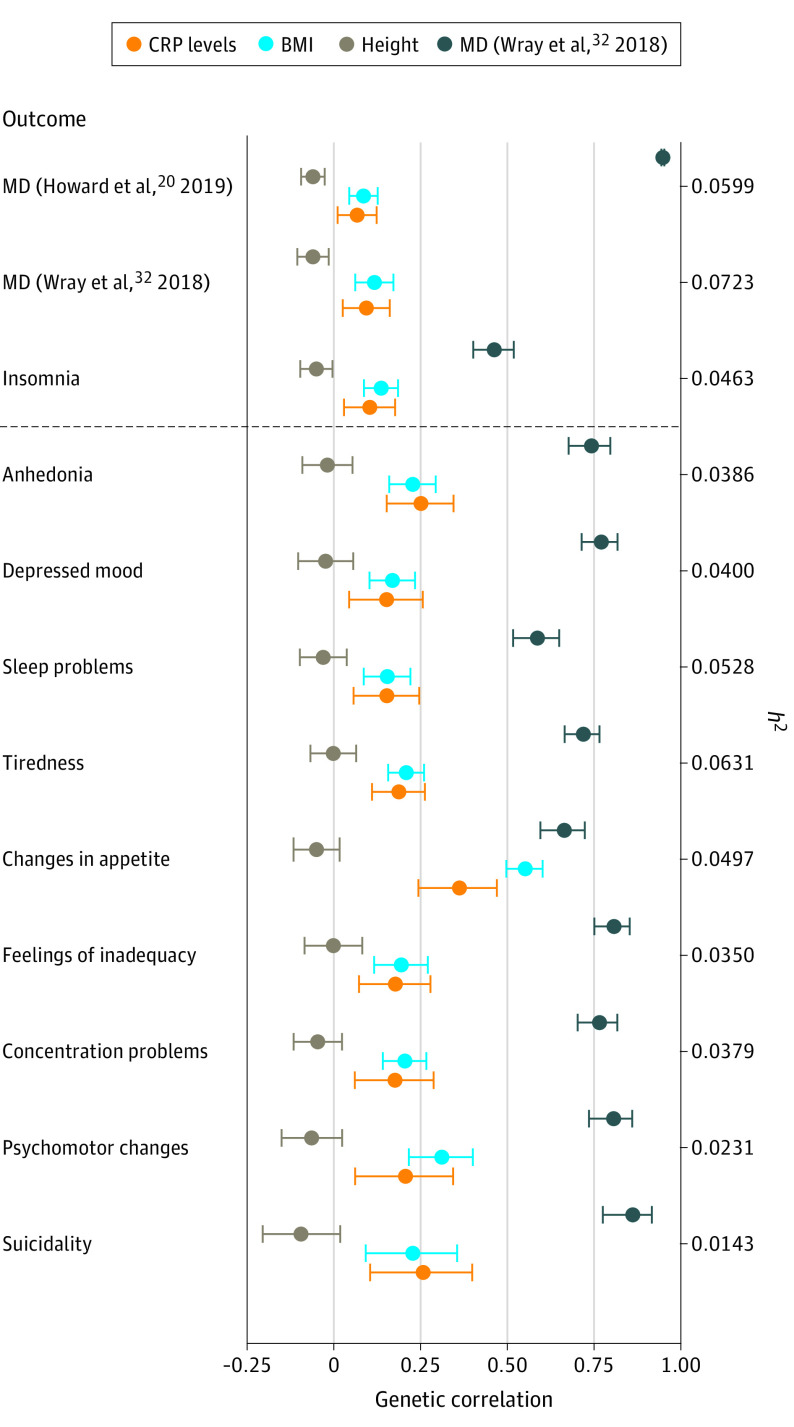
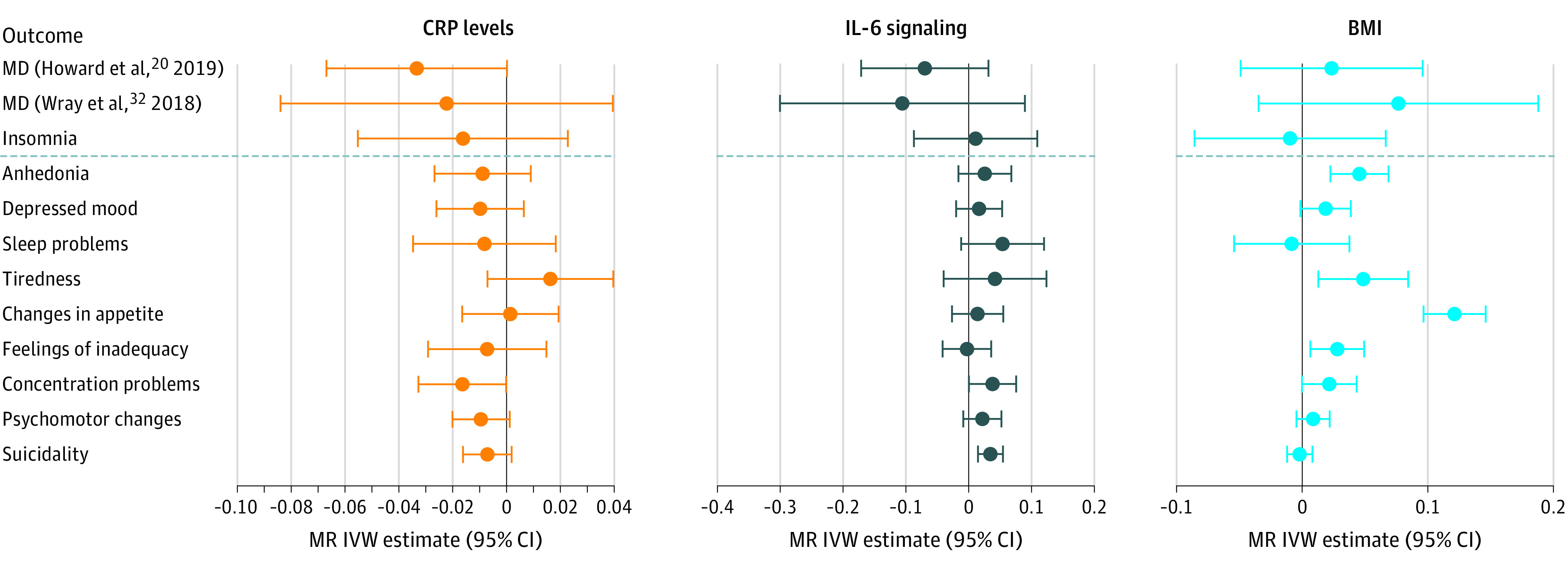
Importance: Observational studies highlight associations of C-reactive protein (CRP), a general marker of inflammation, and interleukin 6 (IL-6), a cytokine-stimulating CRP production, with individual depressive symptoms. However, it is unclear whether inflammatory activity is associated with individual depressive symptoms and to what extent metabolic dysregulation underlies the reported associations. Objective: To explore the genetic overlap and associations between inflammatory activity, metabolic dysregulation, and individual depressive symptoms. GWAS Data Sources: Genome-wide association study (GWAS) summary data of European individuals, including the following: CRP levels (204 402 individuals); 9 individual depressive symptoms (3 of which did not differentiate between underlying diametrically opposite symptoms [eg, insomnia and hypersomnia]) as measured with the Patient Health Questionnaire 9 (up to 117 907 individuals); summary statistics for major depression, including and excluding UK Biobank participants, resulting in sample sizes of 500 199 and up to 230 214 individuals, respectively; insomnia (up to 386 533 individuals); body mass index (BMI) (up to 322 154 individuals); and height (up to 253 280 individuals). Design: In this genetic correlation and 2-sample mendelian randomization (MR) study, linkage disequilibrium score (LDSC) regression was applied to infer single-nucleotide variant-based heritability and genetic correlation estimates. Two-sample MR tested potential causal associations of genetic variants associated with CRP levels, IL-6 signaling, and BMI with depressive symptoms. The study dates were November 2019 to April 2020. Results: Based on large GWAS data sources, genetic correlation analyses revealed consistent false discovery rate (FDR)-controlled associations (genetic correlation range, 0.152-0.362; FDR P = .006 to P < .001) between CRP levels and depressive symptoms that were similar in size to genetic correlations of BMI with depressive symptoms. Two-sample MR analyses suggested that genetic upregulation of IL-6 signaling was associated with suicidality (estimate [SE], 0.035 [0.010]; FDR plus Bonferroni correction P = .01), a finding that remained stable across statistical models and sensitivity analyses using alternative instrument selection strategies. Mendelian randomization analyses did not consistently show associations of higher CRP levels or IL-6 signaling with other depressive symptoms, but higher BMI was associated with anhedonia, tiredness, changes in appetite, and feelings of inadequacy. Conclusions and Relevance: This study reports coheritability between CRP levels and individual depressive symptoms, which may result from the potentially causal association of metabolic dysregulation with anhedonia, tiredness, changes in appetite, and feelings of inadequacy. The study also found that IL-6 signaling is associated with suicidality. These findings may have clinical implications, highlighting the potential of anti-inflammatory approaches, especially IL-6 blockade, as a putative strategy for suicide prevention.
Overview
The claims and statistics of this paper haven’t been checked yet.
Free: it reads the open-access text and checks the first 5 claims that cite a source we can check. Create a free account to check every claim.
Integrity signals
Registry
Cites
Statistics
Figures
Verification
Claims the paper makes
The claims and statistics of this paper haven’t been checked yet.
Free: it reads the open-access text and checks the first 5 claims that cite a source we can check. Create a free account to check every claim.
Claims other papers make about this one
Each is checked against this paper’s own text: does it say what the citing paper says it does?
In the citing paper
“we didn’t find evidence for an association of CRP with depression, in line with other MR evidence (Kappelmann et al., 2021).”
From Associations of Immunological Proteins/Traits with Schizophrenia, Major Depression and Bipolar Disorder: A Bi-Directional Two-Sample Mendelian Randomization Study (2021) · cites this paper as Kappelmann et al., 2021
In the citing paper
“in a separate study using depressive symptoms as outcome, we found the reverse pattern of association, whereby point estimates suggested a risk-increase for depression with the Georgakis et al instrument and a risk-decrease with Swerdlow et al and Sarwar et al instruments (Kappelmann et al., 2021), although the confidence intervals overlapped with our present findings.”
From Associations of Immunological Proteins/Traits with Schizophrenia, Major Depression and Bipolar Disorder: A Bi-Directional Two-Sample Mendelian Randomization Study (2021) · cites this paper as Kappelmann et al., 2021
In the citing paper
“For instance, elevated CRP was reported to be protective for schizophrenia (Hartwig et al., 2017) but a risk factor for depression (Khandaker et al., 2020), while other studies have reported null findings for depression (Kappelmann et al., 2021; Wium-Andersen et al., 2014).”
From Associations of Immunological Proteins/Traits with Schizophrenia, Major Depression and Bipolar Disorder: A Bi-Directional Two-Sample Mendelian Randomization Study (2021) · cites this paper as Kappelmann et al., 2021
In the citing paper
“Existing MR studies have reported mixed findings regarding a potential causal role for inflammation in serious mental disorders.”
From Associations of Immunological Proteins/Traits with Schizophrenia, Major Depression and Bipolar Disorder: A Bi-Directional Two-Sample Mendelian Randomization Study (2021) · cites this paper as Kappelmann et al., 2021
Self-check
Percentages, sums and reported differences re-computed from the paper’s own numbers.
The self-check needs the paper’s full text.
Citations
Cites
1 retracted
Davis, K. A. S., Coleman, J. R. I., Adams, M., Allen, N., Breen, G., Cullen, B., Dickens, C., Fox, E., Graham, N., Holliday, J., et al. (2018) · BJPsych Open · doi:10.1192/bjo.2018.12 · Cited by 236
RetractedDiagnostic and Statistical Manual of Mental Disorders
American Psychiatric Association (2013) · doi:10.1176/appi.books.9780890425596 · Cited by 116,369
Diagnostic and Statistical Manual of Mental Disorders
Williams, J. B. W., & First, M. (2013) · Encyclopedia of Social Work · doi:10.1093/acrefore/9780199975839.013.104 · Cited by 109,519
Controlling the False Discovery Rate: A Practical and Powerful Approach to Multiple Testing
Benjamini, Y., & Hochberg, Y. (1995) · Journal of the Royal Statistical Society Series B: Statistical Methodology · doi:10.1111/j.2517-6161.1995.tb02031.x · Cited by 109,482
A global reference for human genetic variation
The 1000 Genomes Project Consortium, authors, C., Auton, A., Abecasis, G. R., Steering committee, Altshuler, D. M., Durbin, R. M., Abecasis, G. R., Bentley, D. R., Chakravarti, A., et al. (2015) · Nature · doi:10.1038/nature15393 · Cited by 18,247
Bowden, J., Davey Smith, G., & Burgess, S. (2015) · International Journal of Epidemiology · doi:10.1093/ije/dyv080 · Cited by 9,816
Bowden, J., Davey Smith, G., Haycock, P. C., & Burgess, S. (2016) · Genetic Epidemiology · doi:10.1002/gepi.21965 · Cited by 8,922
The MR-Base platform supports systematic causal inference across the human phenome
Hemani, G., Zheng, J., Elsworth, B., Wade, K. H., Haberland, V., Baird, D., Laurin, C., Burgess, S., Bowden, J., Langdon, R., et al. (2018) · eLife · doi:10.7554/elife.34408 · Cited by 7,959
From inflammation to sickness and depression: when the immune system subjugates the brain
Dantzer, R., O'Connor, J. C., Freund, G. G., Johnson, R. W., & Kelley, K. W. (2008) · Nature Reviews Neuroscience · doi:10.1038/nrn2297 · Cited by 7,395
Davey Smith, G., & Ebrahim, S. (2003) · International Journal of Epidemiology · doi:10.1093/ije/dyg070 · Cited by 5,882
Cited by
Milaneschi, Y., Kappelmann, N., Ye, Z., Lamers, F., Moser, S., Jones, P. B., Burgess, S., Penninx, B. W. J. H., & Khandaker, G. M. (2021) · Molecular Psychiatry · doi:10.1038/s41380-021-01188-w · Cited by 350
Self-citationImmune targets for therapeutic development in depression: towards precision medicine
Drevets, W. C., Wittenberg, G. M., Bullmore, E. T., & Manji, H. K. (2022) · Nature Reviews Drug Discovery · doi:10.1038/s41573-021-00368-1 · Cited by 348
Williams, J. A., Burgess, S., Suckling, J., Lalousis, P. A., Batool, F., Griffiths, S. L., Palmer, E., Karwath, A., Barsky, A., Gkoutos, G. V., et al. (2022) · JAMA Psychiatry · doi:10.1001/jamapsychiatry.2022.0407 · Cited by 304
Self-citationAndreassen, O. A., Hindley, G. F. L., Frei, O., & Smeland, O. B. (2023) · World Psychiatry · doi:10.1002/wps.21034 · Cited by 243
Obesity and psychological distress
Steptoe, A., & Frank, P. (2023) · Philosophical Transactions of the Royal Society B Biological Sciences · doi:10.1098/rstb.2022.0225 · Cited by 194
Metadata
- Authors
- Kappelmann, N., Arloth, J., Georgakis, M. K., Czamara, D., Rost, N., Ligthart, S., Khandaker, G. M., & Binder, E. B.
- Venue
- JAMA Psychiatry
- Publisher
- American Medical Association (AMA)
- Published
- 2021-02-01
- Volume
- 78
- Issue
- 2
- Pages
- 161
- ISSN
- 2168-622X (ISSN-L)
- PMC
- PMC7577200
- OpenAlex
- W3093381089
- Cited by
- 266
- References
- 83
- FWCI
- 7.79
- Type
- journal article
- Language
- en
- Open access
- hybrid
About these checks
Registry, retraction, Cites and statistics results are computed, not judged, with one exception: a printed reference that no index lists is read once by a model before it counts as a citation error. Claims are extracted by a model and kept only when their quote appears verbatim in the text; each cited source is then checked, with a model’s help, for whether it says what the claim relies on. Those verdicts can be wrong — read the claim’s quote and the cited source before relying on one.
Statistics and arithmetic are recomputed, not judged.
Confidence bands are shown only for fields calibrated on our annotated test set. None is calibrated yet, so no band is shown.
What counts as a claim ›How we measure confidence ›How we check this ›
Are you an author, or do you see a problem with this page? Request a review
Data sources
Bibliographic data: Semantic Scholar, OpenAlex, Crossref.
Contains information from the Semantic Scholar Academic Graph Datasets, made available under the ODC Attribution License (ODC-BY 1.0).
Semantic Scholar’s data is described in: Kinney, R., et al. (2023). The Semantic Scholar Open Data Platform. arXiv:2301.10140.
