

The DOI matches its Crossref record; 49 of the 50 references it cites were found in a registry or an index.
Stringing Bimetallic Metal–Organic Framework‐Derived Cobalt Phosphide Composite for High‐Efficiency Overall Water Splitting
Open accessAbstract
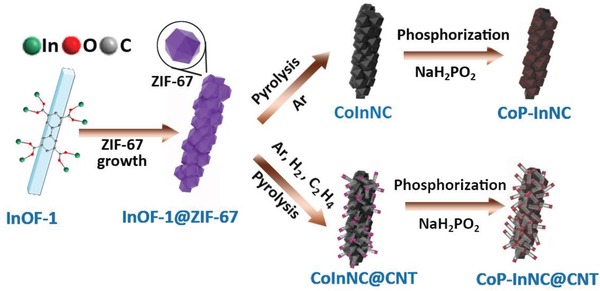
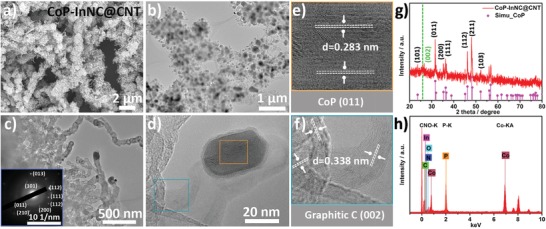
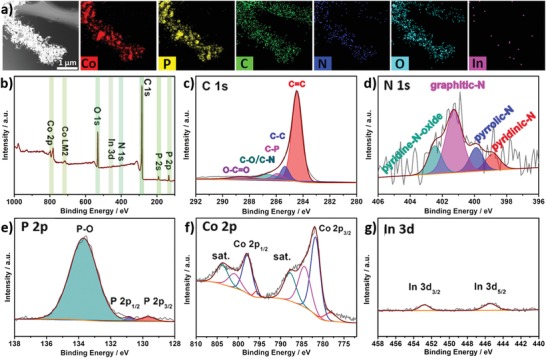
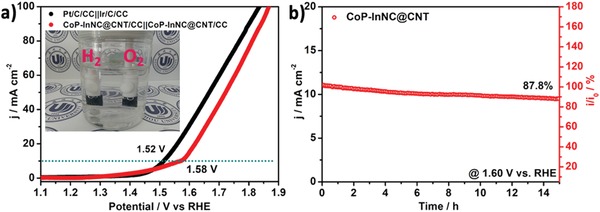
Water electrolysis is an emerging energy conversion technology, which is significant for efficient hydrogen (H 2 ) production. Based on the high‐activity transition metal ions and metal alloys of ultrastable bifunctional catalyst, the hydrogen evolution reaction (HER) and oxygen evolution reaction (OER) are the key to achieving the energy conversion method by overall water splitting (OWS). This study reports that the Co‐based coordination polymer (ZIF‐67) anchoring on an indium–organic framework (InOF‐1) composite (InOF‐1@ZIF‐67) is treated followed by carbonization and phosphorization to successfully obtain CoP nanoparticles–embedded carbon nanotubes and nitrogen‐doped carbon materials (CoP‐InNC@CNT). As HER and OER electrocatalysts, it is demonstrated that CoP‐InNC@CNT simultaneously exhibit high HER performance (overpotential of 153 mV in 0.5 m H 2 SO 4 and 159 mV in 1.0 m KOH) and OER performance (overpotential of 270 mV in 1.0 m KOH) activities to reach the current density of 10 mA cm −2 . In addition, these CoP‐InNC@CNT rods, as a cathode and an anode, can display an excellent OWS performance with η 10 = 1.58 V and better stability, which shows the satisfying electrocatalyst for the OWS compared to control materials. This method ensures the tight and uniform growth of the fast nucleating and stable materials on substrate and can be further applied for practical electrochemical reactions.
Overview
The claims and statistics of this paper haven’t been checked yet.
Free: it reads the open-access text and checks the first 5 claims that cite a source we can check. Create a free account to check every claim.
Integrity signals
Registry
Cites
Statistics
Figures



Verification
Claims the paper makes
The claims and statistics of this paper haven’t been checked yet.
Free: it reads the open-access text and checks the first 5 claims that cite a source we can check. Create a free account to check every claim.
Claims other papers make about this one
Each is checked against this paper’s own text: does it say what the citing paper says it does?
The source backs part of the claim, not all of it — or backs it for a different population, condition or comparison.
In the citing paper
“The density of states (DOS) calculations reveal that all samples exhibit metallic behavior, as demonstrated by the presence of electronic states crossing the Fermi level, suggesting that these HEA clusters possess excellent electrical conductivity to facilitate electron migration and transport (Figure 5b) [35,36].”
From Synergistic High Entropy and Inductive Effects in Aerogels Accelerate pH‐Universal Hydrogen Evolution (2026) · cites this paper as [35]
Experimental — accuracy not yet measured
Self-check
Percentages, sums and reported differences re-computed from the paper’s own numbers.
The self-check needs the paper’s full text.
Citations
Cites
Reier, T., Oezaslan, M., & Strasser, P. (2012) · ACS Catalysis · doi:10.1021/cs3003098 · Cited by 2,589
Recent Progress in Cobalt‐Based Heterogeneous Catalysts for Electrochemical Water Splitting
Wang, J., Cui, W., Liu, Q., Xing, Z., Asiri, A. M., & Sun, X. (2016) · Advanced Materials · doi:10.1002/adma.201502696 · Cited by 2,446
Innovative Strategies for Electrocatalytic Water Splitting
You, B., & Sun, Y. (2018) · Accounts of Chemical Research · doi:10.1021/acs.accounts.8b00002 · Cited by 1,966
Pan, Y., Sun, K., Liu, S., Cao, X., Wu, K., Cheong, W.-C., Chen, Z., Wang, Y., Li, Y., Liu, Y., et al. (2018) · Journal of the American Chemical Society · doi:10.1021/jacs.7b12420 · Cited by 1,942
The Mechanism of Water Oxidation: From Electrolysis via Homogeneous to Biological Catalysis
Dau, H., Limberg, C., Reier, T., Risch, M., Roggan, S., & Strasser, P. (2010) · ChemCatChem · doi:10.1002/cctc.201000126 · Cited by 1,783
Jin, H., Wang, J., Su, D., Wei, Z., Pang, Z., & Wang, Y. (2015) · Journal of the American Chemical Society · doi:10.1021/ja5127165 · Cited by 1,765
Molybdenum phosphide as an efficient electrocatalyst for the hydrogen evolution reaction
Xiao, P., Sk, M. A., Thia, L., Ge, X., Lim, R. J., Wang, J.-Y., Lim, K. H., & Wang, X. (2014) · Energy Environ. Sci. · doi:10.1039/c4ee00957f · Cited by 1,297
Self-citationHighly Active Electrocatalysis of the Hydrogen Evolution Reaction by Cobalt Phosphide Nanoparticles
Popczun, E. J., Read, C. G., Roske, C. W., Lewis, N. S., & Schaak, R. E. (2014) · Angewandte Chemie International Edition · doi:10.1002/anie.201402646 · Cited by 1,240
Construction of ZnIn2S4–In2O3 Hierarchical Tubular Heterostructures for Efficient CO2 Photoreduction
Wang, S., Guan, B. Y., & Lou, X. W. D. (2018) · Journal of the American Chemical Society · doi:10.1021/jacs.8b02200 · Cited by 1,218
High-performance bifunctional porous non-noble metal phosphide catalyst for overall water splitting
Yu, F., Zhou, H., Huang, Y., Sun, J., Qin, F., Bao, J., Goddard, W. A., Chen, S., & Ren, Z. (2018) · Nature Communications · doi:10.1038/s41467-018-04746-z · Cited by 1,165
Cited by
Jadhav, H. S., Bandal, H. A., Ramakrishna, S., & Kim, H. (2022) · Advanced Materials · doi:10.1002/adma.202107072 · Cited by 447
Nanostructured metal phosphides: from controllable synthesis to sustainable catalysis
Li, S.-H., Qi, M.-Y., Tang, Z.-R., & Xu, Y.-J. (2021) · Chemical Society Reviews · doi:10.1039/d1cs00323b · Cited by 326
Self-citationLi, W., Liu, J., Guo, P., Li, H., Fei, B., Guo, Y., Pan, H., Sun, D., Fang, F., & Wu, R. (2021) · Advanced Energy Materials · doi:10.1002/aenm.202102134 · Cited by 296
Rational Design and Growth of MOF‐on‐MOF Heterostructures
Chai, L., Pan, J., Hu, Y., Qian, J., & Hong, M. (2021) · Small · doi:10.1002/smll.202100607 · Cited by 287
Self-citationMOF‐derived Carbon‐Based Materials for Energy‐Related Applications
Chai, L., Li, R., Sun, Y., Zhou, K., & Pan, J. (2025) · Advanced Materials · doi:10.1002/adma.202413658 · Cited by 250
Self-citation
Metadata
- Authors
- Chai, L., Hu, Z., Wang, X., Xu, Y., Zhang, L., Li, T., Hu, Y., Qian, J., & Huang, S.
- Affiliations
- Wenzhou University (CN)
- Collège de France (FR)
- School of Materials Science and Chemical Engineering Ningbo University Ningbo 315211 China
- Guangdong University of Technology (CN)
- Corresponding author
- Qian, Jinjie
- Huang, Shaoming
- Venue
- Advanced Science
- Publisher
- Wiley
- Published
- 2020-01-23
- Volume
- 7
- Issue
- 5
- Pages
- 1903195-1903195
- ISSN
- 2198-3844 (ISSN-L)
- PMC
- PMC7055562
- OpenAlex
- W3001022602
- Cited by
- 296
- References
- 50
- Citations by year
- 2026: 14 · 2025: 32 · 2024: 40 · 2023: 47 · 2022: 54 · 2021: 76 · 2020: 32
- FWCI
- 10.33
- Type
- journal article
- Language
- en
- Open access
- gold
- doi.org
- Licence
- Locations
- Advanced Science (publishedVersion, cc-by)
- PubMed Central (publishedVersion, cc-by)
- PubMed (publishedVersion)
- DOAJ (DOAJ: Directory of Open Access Journals) (submittedVersion, cc-by-sa)
- Funders
- National Natural Science Foundation of China (21601137, 51920105004)
- Chinese Academy of Sciences (20190008)
- National Social Science Fund Youth Project (21601187)
- Topics
- Physical Sciences › Energy › Renewable Energy, Sustainability and the Environment › Electrocatalysts for Energy Conversion
- Physical Sciences › Energy › Renewable Energy, Sustainability and the Environment › CO2 Reduction Techniques and Catalysts
- Physical Sciences › Energy › Renewable Energy, Sustainability and the Environment › Advanced Photocatalysis Techniques
- Keywords
- overall water splitting, cobalt phosphide, metal-organic framework derived catalysts, ZIF-67, carbon nanotubes, nitrogen-doped carbon, hydrogen evolution reaction, oxygen evolution reaction, bifunctional electrocatalysts, hydrogen production, phosphorization, carbonization
About these checks
Registry, retraction, Cites and statistics results are computed, not judged, with one exception: a printed reference that no index lists is read once by a model before it counts as a citation error. Claims are extracted by a model and kept only when their quote appears verbatim in the text; each cited source is then checked, with a model’s help, for whether it says what the claim relies on. Those verdicts can be wrong — read the claim’s quote and the cited source before relying on one.
Statistics and arithmetic are recomputed, not judged.
Confidence bands are shown only for fields calibrated on our annotated test set. None is calibrated yet, so no band is shown.
What counts as a claim ›How we measure confidence ›How we check this ›
Are you an author, or do you see a problem with this page? Request a review
How to cite
Cite CoChat for the checks on this page, and the paper for its own findings.
- This page
- CoChat. (2026). Citation check: Stringing Bimetallic Metal–Organic Framework‐Derived Cobalt Phosphide Composite for High‐Efficiency Overall Water Splitting. https://app.cochat.ai/papers/10.1002/advs.201903195
- The paper
- Chai, L., Hu, Z., Wang, X., Xu, Y., Zhang, L., Li, T., Hu, Y., Qian, J., & Huang, S. (2020). Stringing Bimetallic Metal–Organic Framework‐Derived Cobalt Phosphide Composite for High‐Efficiency Overall Water Splitting. Advanced Science. https://doi.org/10.1002/advs.201903195
Data sources
Bibliographic data: Semantic Scholar, OpenAlex, Crossref.
Contains information from the Semantic Scholar Academic Graph Datasets, made available under the ODC Attribution License (ODC-BY 1.0).
Semantic Scholar’s data is described in: Kinney, R., et al. (2023). The Semantic Scholar Open Data Platform. arXiv:2301.10140.
