

High Entropy van der Waals Materials
Open accessThe DOI matches its Crossref record; 73 of the 73 references it cites were found in a registry or an index.
Abstract
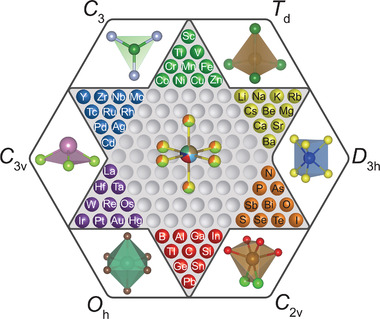
By breaking the restrictions on traditional alloying strategy, the high entropy concept has promoted the exploration of the central area of phase space, thus broadening the horizon of alloy exploitation. This review highlights the marriage of the high entropy concept and van der Waals systems to form a new family of materials category, namely the high entropy van der Waals materials (HEX, HE = high entropy, X = anion clusters) and describes the current issues and next challenges. The design strategy for HEX has integrated the local feature (e.g., composition, spin, and valence states) of structural units in high entropy materials and the holistic degrees of freedom (e.g., stacking, twisting, and intercalating species) in van der Waals materials, and is successfully used for the discovery of high entropy dichalcogenides, phosphorus tri‐chalcogenides, halogens, and MXene. The rich combination and random distribution of the multiple metallic constituents on the nearly regular 2D lattice give rise to a flexible platform to study the correlation features behind a range of selected physical properties, e.g., superconductivity, magnetism, and metal–insulator transition. The deliberate design of structural units and their stacking configuration can also create novel catalysts to enhance their performance in a bunch of chemical reactions.
Overview
The claims and statistics of this paper haven’t been checked yet.
Free: it reads the open-access text and checks the first 5 claims that cite a source we can check. Create a free account to check every claim.
Integrity signals
Registry
Cites
Statistics
Figures




Verification
Claims the paper makes
The claims and statistics of this paper haven’t been checked yet.
Free: it reads the open-access text and checks the first 5 claims that cite a source we can check. Create a free account to check every claim.
Claims other papers make about this one
Each is checked against this paper’s own text: does it say what the citing paper says it does?
The cited source says what the claim attributes to it.
In the citing paper
“High-entropy superconductivity is also found in layered structures 61 -64 , σ -type structures 65,66 , and CuAl2-type structures 67 .”
From Recent advances in high-entropy superconductors (2024) · cites this paper as [62]
Self-check
Percentages, sums and reported differences re-computed from the paper’s own numbers.
The self-check needs the paper’s full text.
Citations
Cites
Electric Field Effect in Atomically Thin Carbon Films
Novoselov, K. S., Geim, A. K., Morozov, S. V., Jiang, D., Zhang, Y., Dubonos, S. V., Grigorieva, I. V., & Firsov, A. A. (2004) · Science · doi:10.1126/science.1102896 · Cited by 66,834
VESTA 3 for three-dimensional visualization of crystal, volumetric and morphology data
Momma, K., & Izumi, F. (2011) · Journal of Applied Crystallography · doi:10.1107/s0021889811038970 · Cited by 26,054
Yeh, J. ‐., Chen, S. ‐., Lin, S. ‐., Gan, J. ‐., Chin, T. ‐., Shun, T. ‐., Tsau, C. ‐., & Chang, S. ‐. (2004) · Advanced Engineering Materials · doi:10.1002/adem.200300567 · Cited by 15,281
Absence of Diffusion in Certain Random Lattices
Anderson, P. W. (1958) · Physical Review · doi:10.1103/physrev.109.1492 · Cited by 12,468
Two‐Dimensional Nanocrystals Produced by Exfoliation of Ti3AlC2
Naguib, M., Kurtoglu, M., Presser, V., Lu, J., Niu, J., Heon, M., Hultman, L., Gogotsi, Y., & Barsoum, M. W. (2011) · Advanced Materials · doi:10.1002/adma.201102306 · Cited by 11,855
Microstructural development in equiatomic multicomponent alloys
Cantor, B., Chang, I. T. H., Knight, P., & Vincent, A. J. B. (2004) · Materials Science and Engineering: A · doi:10.1016/j.msea.2003.10.257 · Cited by 10,130
A critical review of high entropy alloys and related concepts
Miracle, D. B., & Senkov, O. N. (2017) · Acta Materialia · doi:10.1016/j.actamat.2016.08.081 · Cited by 8,973
Unconventional superconductivity in magic-angle graphene superlattices
Cao, Y., Fatemi, V., Fang, S., Watanabe, K., Taniguchi, T., Kaxiras, E., & Jarillo-Herrero, P. (2018) · Nature · doi:10.1038/nature26160 · Cited by 8,300
2D transition metal dichalcogenides
Manzeli, S., Ovchinnikov, D., Pasquier, D., Yazyev, O. V., & Kis, A. (2017) · Nature Reviews Materials · doi:10.1038/natrevmats.2017.33 · Cited by 6,075
Layer-dependent ferromagnetism in a van der Waals crystal down to the monolayer limit
Huang, B., Clark, G., Navarro-Moratalla, E., Klein, D. R., Cheng, R., Seyler, K. L., Zhong, D., Schmidgall, E., McGuire, M. A., Cobden, D. H., et al. (2017) · Nature · doi:10.1038/nature22391 · Cited by 5,926
Research works printed but not linked: 3
- X.Chen J. J.Wang T. P.Ying D. J.Huang H. Y.Gou Q. H.Zhang Y. C.Li H.Hosono J.‐G.Guo X. L.Chen arXiv: 2207.08589. · arXiv
- Troparevsky M. C., 2015, Phys. Rev. X, 5, 011041
- Hume‐Rothery W., 1936, The Structure of Metals and Alloys
Cited by
Anionic high-entropy doping engineering for electromagnetic wave absorption
Tao, J., Yan, Y., Zhou, J., Wang, J., Chen, P., Tan, R., Xu, L., Zhu, H., Zhu, W., Huang, H., et al. (2025) · Nature Communications · doi:10.1038/s41467-025-58448-4 · Cited by 162
“Compared with 3D materials, the weak interlayer interactions of 2D-vdW materials provide them with a larger atomic modulation space in the vertical direction 23 .”
Two-Dimensional High-Entropy Selenides for Boosting Visible-Light-Driven Photocatalytic Performance
Wang, J., Wang, Z., Zhang, J., Mamatkulov, S. I., Dai, K., Ruzimuradov, O., & Low, J. (2024) · ACS Nano · doi:10.1021/acsnano.4c06954 · Cited by 61
He, H., Yao, H., Sun, L., Yang, Y., Qiao, Z., & Liu, B. (2025) · Advanced Materials · doi:10.1002/adma.202508982 · Cited by 51
Luo, R., Gao, M., Wang, C., Zhu, J., Guzmán, R., & Zhou, W. (2023) · Advanced Functional Materials · doi:10.1002/adfm.202307625 · Cited by 46
Que, H., Li, B., Sun, L., Zhang, P., Jiang, H., Wang, X., Si, K., Gao, B., He, Q., Jia, Y., et al. (2025) · Nature Synthesis · doi:10.1038/s44160-025-00737-3 · Cited by 39
“High-entropy 2D materials have attracted great attention due to their excellent mechanical performance, outstanding resistance to degradation, and modification flexibility with promising applications in catalysis, electronic and spin-tronic devices 37,38 .”
Recent advances in high-entropy superconductors
Zeng, L., Li, L., Li, K., Chen, R., & Luo, H. (2024) · NPG Asia Materials · doi:10.1038/s41427-024-00579-z · Cited by 38
Xie, Y., Xuan, X., Tang, Y., Bi, Z., Wang, P., Zou, J., Kang, Y., Zhang, A., Yamauchi, Y., & Yang, C. (2025) · Advanced Energy Materials · doi:10.1002/aenm.202505156 · Cited by 33
“Moreover, multi-element doping often leads to nonuniform distribution, inducing local stress and chem-icalinhomogeneitythatcantriggerdefectsandphasesegregation, thereby degrading performance [27].”
Synthesis methods and applications of high entropy nanoparticles
Lu, Y., Zhang, G., Yang, F., Yao, M., Liu, L., & Pang, H. (2023) · Rare Metals · doi:10.1007/s12598-023-02460-4 · Cited by 33
“However, contrary to these prospects, the results of investigations show that the superior entropy of mixing in these alloys easily promotes the constitution of solid-solution phases with ordinary structures, consequently reducing the number of phases [8].”
ResultEntropy Engineering of 2D Materials
Mei, H., Zhang, Y., Zhang, P., Ricciardulli, A. G., Samorí, P., & Yang, S. (2024) · Advanced Science · doi:10.1002/advs.202409404 · Cited by 32
Germanium-telluride-based thermoelectrics
Yu, Y., Xu, X. C., Bosman, M., Nielsch, K., & He, J. (2024) · Nature Reviews Electrical Engineering · doi:10.1038/s44287-023-00013-6 · Cited by 30
Chen, N.-L., Sun, G.-T., He, C., Liu, B., Feng, H., Liu, G., & Gao, X. (2024) · Materials Today Physics · doi:10.1016/j.mtphys.2024.101363 · Cited by 28
Understanding and tuning magnetism in van der Waals-type metal thiophosphates
Basnet, R., & Hu, J. (2024) · Nanoscale · doi:10.1039/d4nr01577k · Cited by 27
Anomalous broadening of specific heat jump at T c in high-entropy-alloy-type superconductor Tr Zr 2
Kasem, M. R., Yamashita, A., Hatano, T., Sakurai, K., Oono, N., Goto, Y., Miura, O., & Mizuguchi, Y. (2021) · Superconductor Science and Technology · doi:10.1088/1361-6668/ac2554 · Cited by 25
Jin, Z., Cao, Z., Jin, L., Ding, S., & Xi, K. (2026) · Nano-Micro Letters · doi:10.1007/s40820-025-02023-5 · Cited by 23
“…(HE-ZIFs) [22], high-entropy Prussian blue analogues (HE-PBAs) [23], high-entropy oxyfluorides (HEOFs) [24], high-entropy selenides (HESes) [25], high-entropy sulfides (HESs) [26, 27], high-entropy MXenes (HEMXs) [28, 29], high-entropy van der Waals materials (1) x i ln x i [30], and others.”
Nie, X., Xue, J. Q., Zhao, L., Deng, S., & Xiong, H. (2024) · Energy · doi:10.1016/j.energy.2024.130553 · Cited by 23
Liu, Y., Deng, C., Wu, P., Liu, H., Liu, F., Liu, R., Zhu, W., & Xu, C. (2023) · Fuel · doi:10.1016/j.fuel.2023.130375 · Cited by 22
Synthesis, calculations and energy storage applications of high-entropy MXene
Zhao, X., Chen, Y., Feng, M., Xu, C., Du, J., Wang, X., & Liu, Z. (2024) · Journal of Alloys and Compounds · doi:10.1016/j.jallcom.2024.174586 · Cited by 20
Chen, Y.-H., Wang, A., Shi, Y.-C., Mei, L.-P., Song, P., Zhao, T., & Feng, J. (2025) · Chemical Engineering Journal · doi:10.1016/j.cej.2025.166558 · Cited by 17
Growth of Highly Oriented (VNbMoTaW)S2 Layers
Tanaka, K., Zaid, H., Aoki, T., Deshpande, A., Hojo, K., Ciobanu, C. V., & Kodambaka, S. K. (2023) · Nano Letters · doi:10.1021/acs.nanolett.3c04521 · Cited by 16
Liu, Y., Lu, Y., Wang, W. Y., Li, J. Z., Zhang, Y., Yin, J., Pan, X., Gao, X., Chen, Y., Song, H., et al. (2023) · Journal of Materials Informatics · doi:10.20517/jmi.2023.19 · Cited by 15
High entropy MXenes in energy storage: structural design, characterization, and applications
Yu, F., Wang, Y., Zhang, K., Shen, H., Zhang, Y., Yang, Z., Zeng, G., Cui, D., Xia, J., Li, B., et al. (2025) · Journal of Materials Chemistry A · doi:10.1039/d5ta02503f · Cited by 14
Dual Character of the Insulating State in the van der Waals Fe1–xNixPS3 Alloyed Compounds
Li, K., Yan, M., Jin, Y., Jin, Y., Guo, Y., Voloshina, E. N., & Dedkov, Y. S. (2022) · The Journal of Physical Chemistry Letters · doi:10.1021/acs.jpclett.2c03492 · Cited by 14
Xu, Y., Li, M., Ding, N., & Huang, Q. (2025) · Journal of Materials Chemistry A · doi:10.1039/d4ta08853k · Cited by 13
Dong, Y., Zhang, L., Wu, T. S., Zhan, Y., Zhou, B., Wei, F., Zhang, D., & Long, X. (2024) · ChemSusChem · doi:10.1002/cssc.202401261 · Cited by 12
Dedkov, Y. S., & Voloshina, E. N. (2025) · Small Science · doi:10.1002/smsc.202500307 · Cited by 12
First-principles and Monte Carlo simulations of high-entropy MXenes
Oyeniran, N. D., Chowdhury, O., & Hu, C. (2025) · Applied Physics Letters · doi:10.1063/5.0258487 · Cited by 11
Paštika, J., Güngen, D., Subramani, A., Mazánek, V., Serra, M., Zeng, L. J., Olsson, E., Gusmão, R., & Sofer, Z. (2025) · ACS Applied Materials & Interfaces · doi:10.1021/acsami.5c05482 · Cited by 11
From metal nitrides to high-entropy nitrides: advances in spectrally selective absorber coatings
Wang, Q.-S., Zhao, X.-B., Dong, M., Zheng, R.-B., Gao, R.-T., He, C., & Gao, X. (2025) · EES solar. · doi:10.1039/d5el00115c · Cited by 11
Cation Segregation in Alloyed Thiophosphates Fe2–xCoxP2S6
Cheng, M., Iyer, A. K., Douvalis, A. P., Ribet, S. M., Kanatzidis, M. G., & Dravid, V. P. (2023) · Chemistry of Materials · doi:10.1021/acs.chemmater.2c03738 · Cited by 11
Chen, H., Zhao, E., Wen, X., Liu, S., Li, S., Fu, J., Fan, H., Xiao, B., & Zhang, Y. (2024) · Journal of Advanced Ceramics · doi:10.26599/jac.2024.9220991 · Cited by 10
Geng, X., Cao, Y., Li, Z., Li, M., Cao, C., Yu, C., Chu, X., Hu, L., Sun, Y., Qiao, L., et al. (2025) · Energy Materials · doi:10.20517/energymater.2024.46 · Cited by 9
Gao, W., Yu, M., Yan, Y., Geng, C., & Yin, H. (2025) · Physical review. B./Physical review. B · doi:10.1103/physrevb.111.155444 · Cited by 9
Zhang, X., Li, W., Feng, J., Song, M., Wang, G., Liu, J., Wang, Z., Jiang, S., Sheng, H. W., Chen, B., et al. (2024) · Advanced Quantum Technologies · doi:10.1002/qute.202300365 · Cited by 8
Influence of dimensionality on superconductivity in pressurized 3D SnPSe 3 single crystal
Wang, J., Liu, X., Zhang, L., Guo, J., & Ying, T. (2024) · Physical Review Materials · doi:10.1103/physrevmaterials.8.074803 · Cited by 7
Self-citationReview of high-entropy thermoelectric materials: Design, synthesis, characterization, and properties
Li, S., Zhang, R., & Reece, M. J. (2025) · Journal of Alloys and Compounds · doi:10.1016/j.jallcom.2025.184368 · Cited by 7
Application of Transition Metal Dichalcogenides in Electrocatalytic Hydrogen Evolution Reaction
Liu, Y., Li, Y., Chu, Y., Yang, B., Ma, L., Du, L., Chen, L., Wang, H., & Pei, Y. (2026) · Catalysts · doi:10.3390/catal16030266 · Cited by 5
“Some novel 2D TMD materials with some effective strategies have even achieved activity and stability comparable to commercial Pt/C catalysts in acidic or alkaline electrolytes [4,16,19].”
Structural and Magnetic Properties of Van der Waals Layered Metal Phosphorous Trichalcogenides
Peng, J., & Tong, X. (2025) · physica status solidi (b) · doi:10.1002/pssb.202400517 · Cited by 5
Li, J., Zhang, Y., Wei, H., Ma, T., Liu, F., Hu, F., Xu, W., Tao, Z., Xia, S., Cui, Q., et al. (2025) · Composites Part B Engineering · doi:10.1016/j.compositesb.2025.113083 · Cited by 4
Strongly Correlated High-Entropy Materials: Electronic and Phononic States under Disorder
Hirai, D. (2025) · Chemistry of Materials · doi:10.1021/acs.chemmater.5c02598 · Cited by 4
Controlled growth and emergent properties of 2D high-entropy materials
Wang, M., Zhang, Q., Wang, Y., Li, L., Zhang, R., & Geng, D. (2026) · 2D Materials · doi:10.1088/2053-1583/ae44aa · Cited by 2
Long-range magnetic order with disordered spin orientations in a high-entropy antiferromagnet
Shen, Y., Zhang, G., Zhang, Q., Gui, X., Zhang, Y., Lee, H., Kuo, C., Lee, J., Sutarto, R., Ye, F., et al. (2026) · Nature Communications · doi:10.1038/s41467-026-70184-x · Cited by 2
Self-citationHigh-entropy noble-metal-based nanostructures with advanced regulations for electrocatalysis
Zhang, Y., Zhang, X., Gao, F., & Huang, X. (2026) · Science China Materials · doi:10.1007/s40843-026-4258-0 · Cited by 2
“The sustainable development goals and the carbon neutrality goal have been put forward to cope with the crisis of environmental pollution and energy problem [1–3].”
Composition Engineering and Crystal Growth of High-Entropy Rare-Earth Monoclinic Aluminates
Tratsiak, Y. V., Claes, B., Melcher, C. L., & Zhuravleva, M. (2024) · Crystal Growth & Design · doi:10.1021/acs.cgd.4c00633 · Cited by 2
Lee, C., & Yamada‐Takamura, Y. (2025) · Physical review. B./Physical review. B · doi:10.1103/physrevb.111.035120 · Cited by 1
Magnetic Kagome Lattice (Gd,Tb,Dy,Ho,Er)Mn 6 Sn 6 with High Configuration Entropy
liu, W., Dhale, N., Chen, Y., Joshi, P., Zhai, Z., Wang, X., Liu, J. P., Birgeneau, R. J., Maiorov, B., Mizzi, C. A., et al. (2025) · Inorganic Chemistry · doi:10.1021/acs.inorgchem.5c03461 · Cited by 1
Francis, M. A., Abhinisha, B. C., Saxena, S., & Mehar, K. (2026) · Materials Today Electronics · doi:10.1016/j.mtelec.2026.100206 · Cited by 1
Cuadra, L., & Borge, J. C. N. (2024) · Chaos Solitons & Fractals · doi:10.1016/j.chaos.2024.115021 · Cited by 1
High Entropy van der Waals Superconductors
Yu, T., & Ying, T. (2024) · Springer series in solid-state sciences · doi:10.1007/978-981-97-4129-8_9
Self-citationElectrokinetics of High‐Entropy Materials for Energy Storage Devices
Setia, Y., Bhatt, N., Bellamkonda, S., & Sahoo, M. K. (2026) · Wiley eBooks · doi:10.1002/9783527853670.ch5
Research progress in the magnetic properties of high-entropy oxides
Yucheng, L., Lingyong, Z., & Huixia, L. (2026) · Acta Physica Sinica · doi:10.7498/aps.75.20260580
Jia, M., Gao, W., Jiang, S., & Yin, H. (2026) · Physical Review Materials · doi:10.1103/4rwh-q3l3
Superconductivity without spin crossover in pressurized 3 d 10 ZnPSe 3
Anonymous, Grzeszczyk, M., Liu, X., Muhammad, Z., Zhao, W. S., Yang, D., Li, Y., Koperski, M., Guo, J., & Ying, T. (2026) · Physical review. B./Physical review. B · doi:10.1103/ywwr-jkz3
Self-citationDang, T. K., Tuan, N. H., Nguyen, T. T., Shen, Z., Lee, H.-J., Hwang, J. Y., Kim, N. H., Tran, D. T., & Lee, J. H. (2026) · Small · doi:10.1002/smll.75539
Zhang, L., Tao, H., Lu, T.-F., Cui, Y., He, M., Song, B., Zhang, Z., & Ying, T. (2026) · Superconductor Science and Technology · doi:10.1088/1361-6668/aeb2c3
Self-citationData-Driven Prediction of Impedance Matching in High-Entropy Electromagnetic Absorbers
Huang, Y.-J., Maurya, S. N., Dezfoli, A. R. A., Hadidchi, S., Khaleghi, M., & Chaji, M. (2026) · JOM · doi:10.1007/s11837-026-08893-3
Metadata
- Authors
- Ying, T., Yu, T., Qi, Y., Chen, X., & Hosono, H.
- Affiliations
- Tokyo Institute of Technology (JP)
- Gusu Laboratory of Materials Jiangsu 215123 China
- ShanghaiTech University (CN)
- Chinese Academy of Sciences (CN)
- Corresponding author
- Chen, Xiaolong
- Hosono, Hideo
- Venue
- Advanced Science
- Publisher
- Wiley
- Published
- 2022-08-25
- Volume
- 9
- Issue
- 30
- Pages
- e2203219-e2203219
- ISSN
- 2198-3844 (ISSN-L)
- PMC
- PMC9596826
- OpenAlex
- W3132287826
- Semantic Scholar
- c939c7291b1c58c8a16ec2debf1f76ae69eb2e18
- Cited by
- 51
- References
- 72
- Citations by year
- 2026: 10 · 2025: 19 · 2024: 15 · 2023: 6 · 2022: 1
- FWCI
- 0.75
- Type
- journal article
- Language
- en
- Open access
- gold
- doi.org
- Licence
- Locations
- Advanced Science (publishedVersion, cc-by)
- PubMed Central (publishedVersion, cc-by)
- PubMed (publishedVersion)
- arXiv (Cornell University) (submittedVersion)
- DOAJ (DOAJ: Directory of Open Access Journals) (submittedVersion, cc-by-sa)
- arXiv (Cornell University)
- Funders
- National Key Research and Development Program of China (2021YFA1401800)
- Topics
- Physical Sciences › Engineering › Mechanical Engineering › High Entropy Alloys Studies
- Physical Sciences › Materials Science › Materials Chemistry › 2D Materials and Applications
- Physical Sciences › Materials Science › Materials Chemistry › Machine Learning in Materials Science
- Keywords
- high-entropy materials, van der Waals materials, cluster anions, MXene, stacking configurations, torsion, intercalation, superconductivity, magnetism, metal-insulator transition, catalysts, alloy design
About these checks
Registry, retraction, Cites and statistics results are computed, not judged, with one exception: a printed reference that no index lists is read once by a model before it counts as a citation error. Claims are extracted by a model and kept only when their quote appears verbatim in the text; each cited source is then checked, with a model’s help, for whether it says what the claim relies on. Those verdicts can be wrong — read the claim’s quote and the cited source before relying on one.
Statistics and arithmetic are recomputed, not judged.
Confidence bands are shown only for fields calibrated on our annotated test set. None is calibrated yet, so no band is shown.
What counts as a claim ›How we measure confidence ›How we check this ›
Are you an author, or do you see a problem with this page? Request a review
Data sources
Bibliographic data: Semantic Scholar, OpenAlex, Crossref.
Contains information from the Semantic Scholar Academic Graph Datasets, made available under the ODC Attribution License (ODC-BY 1.0).
Semantic Scholar’s data is described in: Kinney, R., et al. (2023). The Semantic Scholar Open Data Platform. arXiv:2301.10140.
