

The DOI matches its Crossref record.
Molten‐Volcanic‐Ash‐Phobic Thermal Barrier Coating based on Biomimetic Structure
Open accessAbstract
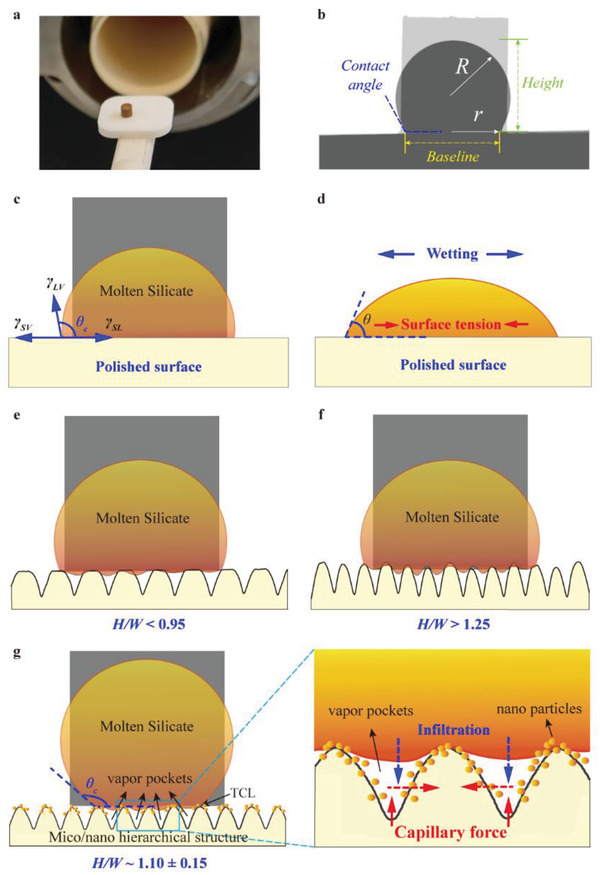
Volcanic ash is a major threat to aviation safety. The softening/melting temperatures of volcanic ash lie far below typical aero‐engine operating temperatures. Thus, molten ash can accelerate the failure of thermal barrier coatings (TBCs). Here, inspired by natural superhydrophobic surfaces (e.g., the lotus leaf), a molten‐volcanic‐ash‐phobic TBC, which provides a large possibility to eliminate molten ash issues of TBCs, is developed. A hierarchically structured surface is first prepared on a (Gd 0.9 Yb 0.1)2 Zr 2 O 7 (GYbZ) pellet by ultrafast laser direct writing technology, aiming to confirm the feasibility of the biomimetic microstructure to repel molten volcanic ash wetting. Then biomimetic‐structured GYbZ TBCs are successfully fabricated using plasma spray physical vapor deposition, which reveals “silicate” phobicity at high temperatures. The exciting molten‐volcanic‐ash‐phobic attribute of the designed surfaces is attributed to the lotus‐leaf‐like dual‐scale microstructure, emulating in particular the existence of nanoparticles. These findings may be an important step toward the development of next‐generation aviation engines with greatly reduced vulnerability to environmental siliceous debris.
Overview
The claims and statistics of this paper haven’t been checked yet.
Run the check — free, no account needed. It reads the open-access text and checks the sources it cites.
Integrity signals
Registry
Cites
Statistics
Figures
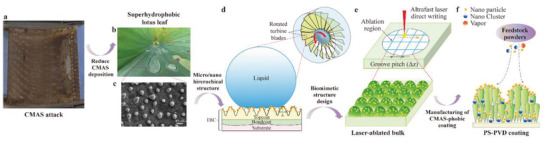
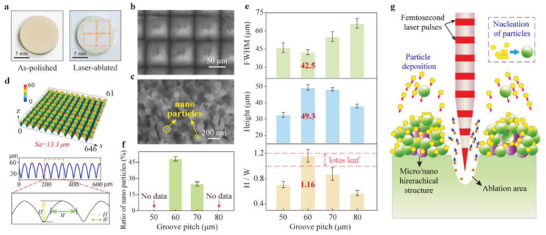
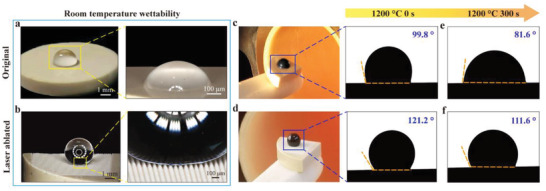
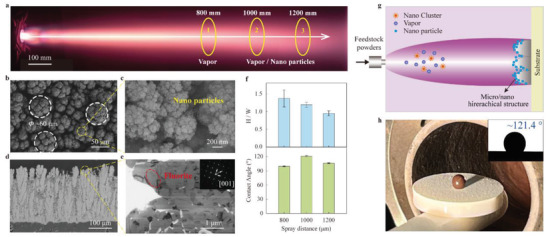
Verification
Claims the paper makes
The claims and statistics of this paper haven’t been checked yet.
Run the check — free, no account needed. It reads the open-access text and checks the sources it cites.
Claims other papers make about this one
Each is checked against this paper’s own text: does it say what the citing paper says it does?
The source backs part of the claim, not all of it — or backs it for a different population, condition or comparison.
In the citing paper
“Moreover, SPS offers a less complex approach to produce coatings that may potentially alter the wettability of molten ash particles in boilers compared to similar coating prepared by plasma spray physical vapour deposition (PS-PVD) [166].”
From High Temperature Corrosion Resistant and Anti-slagging Coatings for Boilers: A Review (2024) · cites this paper as [166]
Experimental — accuracy not yet measured
Self-check
Percentages, sums and reported differences re-computed from the paper’s own numbers.
The self-check needs the paper’s full text.
Citations
Cites
No references could be resolved yet.
Research works printed but not linked: 45
- 10.1007/s11069-008-9254-2 · DOI
- 10.1007/s11069-009-9415-y · DOI
- 10.1111/j.1365-2451.2010.00757.x · DOI
- 10.1038/nmat4687 · DOI
- 10.1016/j.actamat.2019.04.011 · DOI
- 10.1016/j.surfcoat.2010.08.151 · DOI
- 10.1179/1743280413Y.0000000019 · DOI
- Stecura S., 1978, NASA TM‐78976
- 10.1007/BF02646310 · DOI
- 10.4236/epe.2011.34063 · DOI
- 10.2514/1.33739 · DOI
- 10.1016/j.actamat.2017.06.055 · DOI
- 10.1016/j.actamat.2015.12.044 · DOI
- 10.1016/j.scriptamat.2015.09.029 · DOI
- 10.1016/j.scriptamat.2018.12.028 · DOI
- 10.1007/s11666-009-9416-0 · DOI
- 10.1111/j.1551-2916.2006.01209.x · DOI
- 10.1111/jace.13241 · DOI
- 10.1016/j.jeurceramsoc.2018.04.013 · DOI
- 10.1016/j.jeurceramsoc.2020.11.037 · DOI
- 10.1557/mrs.2012.230 · DOI
- 10.1016/j.corsci.2021.109660 · DOI
- 10.1016/j.jeurceramsoc.2013.11.035 · DOI
- 10.1016/j.ceramint.2015.06.090 · DOI
- 10.1016/j.ceramint.2015.05.128 · DOI
- 10.1007/s004250050096 · DOI
- 10.1006/anbo.1997.0400 · DOI
- 10.1039/b804854a · DOI
- 10.3762/bjnano.2.19 · DOI
- 10.1002/admi.202001205 · DOI
- 10.1007/s00396-012-2753-4 · DOI
- 10.1016/j.optlastec.2012.06.037 · DOI
- 10.1103/PhysRevB.62.13167 · DOI
- 10.1103/PhysRevLett.88.097603 · DOI
- 10.1029/2011JD016790 · DOI
- 10.1186/2191-5040-3-4 · DOI
- 10.1177/0954410015623372 · DOI
- 10.1016/j.surfcoat.2016.12.117 · DOI
- 10.1016/j.ceramint.2015.12.111 · DOI
- 10.1209/epl/i2000-00418-8 · DOI
- 10.1098/rstl.1805.0005 · DOI
- 10.1016/S0169-4332(96)00611-3 · DOI
- 10.1007/BF01567638 · DOI
- 10.1016/j.msea.2006.05.104 · DOI
- 10.1016/j.surfcoat.2019.125243 · DOI
Cited by
Sorted by citations
High Temperature Corrosion Resistant and Anti-slagging Coatings for Boilers: A Review
Khantisopon, K., Singh, S., Jitputti, J., Berndt, C. C., & Ang, A. S. M. (2024) · High Temperature Corrosion of Materials · doi:10.1007/s11085-024-10251-0 · Cited by 30
Metadata
- Authors
- Guo, Y., Song, W., Guo, L., Li, X., He, W., Yan, X., Dingwell, D. B., & Guo, H.
- Affiliations
- Beihang University (CN)
- Tianmushan Laboratory (CN)
- Tianjin University (CN)
- Ludwig-Maximilians-Universität München (DE)
- Corresponding author
- Song, Wenjia
- Guo, Hongbo
- Venue
- Advanced Science
- Publisher
- Wiley
- Published
- 2023-02-02
- Volume
- 10
- Issue
- 10
- Pages
- e2205156-e2205156
- ISSN
- 2198-3844 (ISSN-L)
- PMC
- PMC10074056
- OpenAlex
- W4318924034
- Cited by
- 112
- References
- 0
- Citations by year
- 2026: 23 · 2025: 38 · 2024: 21 · 2023: 30
- FWCI
- 13.62
- Type
- journal article
- Language
- en
- Open access
- gold
- doi.org
- Licence
- Locations
- Advanced Science (publishedVersion, cc-by)
- PubMed Central (publishedVersion, cc-by)
- PubMed (publishedVersion)
- DOAJ (DOAJ: Directory of Open Access Journals) (submittedVersion, cc-by-sa)
- Funders
- National Natural Science Foundation of China (52102057, U21B2052)
- Natural Science Foundation of Zhejiang Province (LZ23E010003)
- Topics
- Physical Sciences › Materials Science › Surfaces, Coatings and Films › High-Temperature Coating Behaviors
- Physical Sciences › Materials Science › Surfaces, Coatings and Films › Surface Modification and Superhydrophobicity
- Physical Sciences › Engineering › Mechanical Engineering › Surface Treatment and Coatings
- Keywords
- thermal barrier coatings, biomimetic surfaces, lotus effect, superhydrophobic surfaces, hierarchical microstructure, plasma spray-physical vapor deposition
About these checks
Registry, retraction, Cites and statistics results are computed, not judged, with one exception: a printed reference that no index lists is read once by a model before it counts as a citation error. Claims are extracted by a model and kept only when their quote appears verbatim in the text; each cited source is then checked, with a model’s help, for whether it says what the claim relies on. Those verdicts can be wrong — read the claim’s quote and the cited source before relying on one.
Statistics and arithmetic are recomputed, not judged.
Confidence bands are shown only for fields calibrated on our annotated test set. None is calibrated yet, so no band is shown.
What counts as a claim ›How we measure confidence ›How we check this ›
Are you an author, or do you see a problem with this page? Request a review
