

Ru–W Pair Sites Enabling the Ensemble Catalysis for Efficient Hydrogen Evolution
Open accessThe DOI matches its Crossref record; 37 of the 38 references it cites were found in a registry or an index.
Abstract
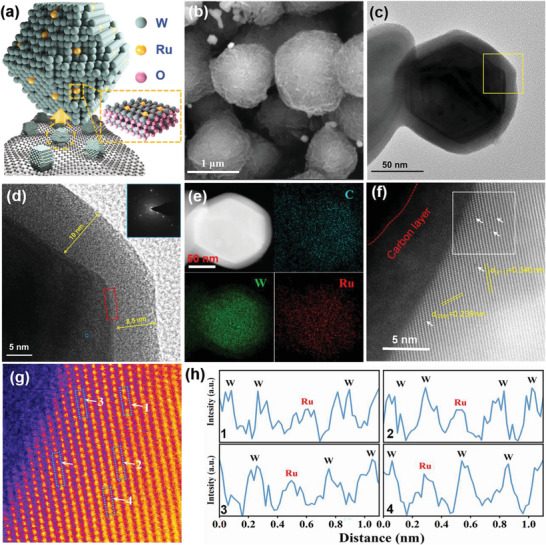
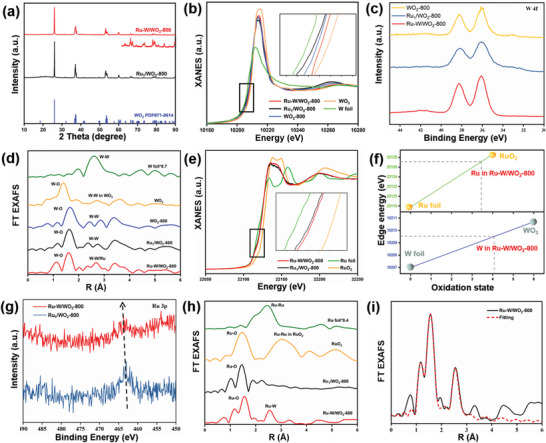
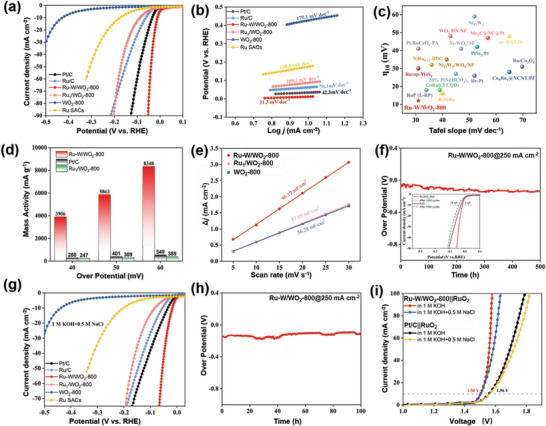
Simultaneously optimizing elementary steps, such as water dissociation, hydroxyl transferring, and hydrogen combination, is crucial yet challenging for achieving efficient hydrogen evolution reaction (HER) in alkaline media. Herein, Ru single atom‐doped WO 2 nanoparticles with atomically dispersed Ru–W pair sites (Ru–W/WO 2 ‐800) are developed using a crystalline lattice‐confined strategy, aiming to gain efficient alkaline HER. It is found that Ru–W/WO 2 ‐800 exhibits remarkable HER activity, characterized by a low overpotential (11 mV at 10 mA cm −2 ), notable mass activity (5863 mA mg −1 Ru at 50 mV), and robust stability (500 h at 250 mA cm −2 ). The highly efficient activity of Ru–W/WO 2 ‐800 is attributed to the synergistic effect of Ru–W sites through ensemble catalysis. Specifically, the W sites expedite rapid hydroxyl transferring and water dissociation, while the Ru sites accelerate the hydrogen combination process, synergistically facilitating the HER activity. This study opens a promising pathway for tailoring the coordination environment of atomic‐scale catalysts to achieve efficient electro‐catalysis.
Overview
The claims and statistics of this paper haven’t been checked yet.
Free: it reads the open-access text and checks the first 5 claims that cite a source we can check. Create a free account to check every claim.
Integrity signals
Registry
Cites
Statistics
Figures

Verification
Claims the paper makes
The claims and statistics of this paper haven’t been checked yet.
Free: it reads the open-access text and checks the first 5 claims that cite a source we can check. Create a free account to check every claim.
Self-check
Percentages, sums and reported differences re-computed from the paper’s own numbers.
The self-check needs the paper’s full text.
Citations
Cites
Energy and fuels from electrochemical interfaces
Stamenkovic, V. R., Strmcnik, D., Lopes, P. P., & Markovic, N. M. (2017) · Nature Materials · doi:10.1038/nmat4738 · Cited by 2,030
In situ Raman spectroscopy reveals the structure and dissociation of interfacial water
Wang, Y.-H., Zheng, S., Yang, W.-M., Zhou, R.-Y., He, Q.-F., Radjenovic, P., Dong, J.-C., Li, S., Zheng, J., Yang, Z.-L., et al. (2021) · Nature · doi:10.1038/s41586-021-04068-z · Cited by 1,703
Self-citationLu, B., Guo, L., Wu, F., Peng, Y., Lu, J. E., Smart, T. J., Wang, N., Finfrock, Y. Z., Morris, D., Zhang, P., et al. (2019) · Nature Communications · doi:10.1038/s41467-019-08419-3 · Cited by 629
Chen, J., Chen, C., Qin, M., Li, B., Lin, B., Mao, Q., Yang, H., Liu, B., & Wang, Y. (2022) · Nature Communications · doi:10.1038/s41467-022-33007-3 · Cited by 616
Self-citationChen, W., Pei, J., He, C., Wan, J., Ren, H., Wang, Y., Dong, J., Wu, K., Cheong, W., Mao, J., et al. (2018) · Advanced Materials · doi:10.1002/adma.201800396 · Cited by 613
Self-citationAnantharaj, S., Noda, S., Jothi, V. R., Yi, S., Driess, M., & Menezes, P. W. (2021) · Angewandte Chemie International Edition · doi:10.1002/anie.202015738 · Cited by 563
Strategies for design of electrocatalysts for hydrogen evolution under alkaline conditions
Wang, X., Zheng, Y., Sheng, W., Xu, Z. J., Jaroniec, M., & Qiao, S.-Z. (2020) · Materials Today · doi:10.1016/j.mattod.2019.12.003 · Cited by 533
Oxygen-evolving catalytic atoms on metal carbides
Li, S., Chen, B., Wang, Y., Ye, M.-Y., van Aken, P. A., Cheng, C., & Thomas, A. (2021) · Nature Materials · doi:10.1038/s41563-021-01006-2 · Cited by 451
Self-citationWu, L., Zhang, F., Song, S., Ning, M., Zhu, Q., Zhou, J., Gao, G., Chen, Z., Zhou, Q., Xing, X., et al. (2022) · Advanced Materials · doi:10.1002/adma.202201774 · Cited by 393
Zhu, P., Xiong, X., & Wang, D. (2022) · Nano Research · doi:10.1007/s12274-022-4265-y · Cited by 375
Research works printed but not linked: 2
- Zhou X., 2022, Adv. Mater., 34
- Liu J., 2022, Adv. Energy Mater., 12
Cited by
Zhu, Y., Klingenhof, M., Gao, C., Koketsu, T., Weiser, G., Pi, Y., Liu, S., Sui, L., Hou, J., Li, J., et al. (2024) · Nature Communications · doi:10.1038/s41467-024-45654-9 · Cited by 444
Reversible hydrogen spillover at the atomic interface for efficient alkaline hydrogen evolution
Chao, T., Xie, W., Hu, Y., Yu, G., Zhao, T., Chen, C., Zhang, Z., Hong, X., Jin, H., Wang, D., et al. (2024) · Energy & Environmental Science · doi:10.1039/d3ee02760k · Cited by 215
Self-citationZhang, W., Yang, L., Li, Z., Nie, G., Cao, X., Fang, Z., Wang, X., Ramakrishna, S., Long, Y., & Jiao, L. (2024) · Angewandte Chemie International Edition · doi:10.1002/anie.202400888 · Cited by 196
Insights into the pH effect on hydrogen electrocatalysis
Cui, W.-G., Gao, F., Na, G., Wang, X., Li, Z., Yang, Y., Niu, Z., Qu, Y., Wang, D., & Pan, H. (2024) · Chemical Society Reviews · doi:10.1039/d4cs00370e · Cited by 172
Self-citationFu, H., Lu, S., Xin, Y., Xiao, S., Chen, L., Li, Y., & Shen, K. (2024) · Energy & Environmental Science · doi:10.1039/d4ee03970j · Cited by 130
Nanoconfinement Effects in Electrocatalysis and Photocatalysis
Bie, C., Yang, J., Zeng, X., Wang, Z., Sun, X., Yang, Z., Yu, J., & Zhang, X. (2025) · Small · doi:10.1002/smll.202411184 · Cited by 116
RuO 2 with Short‐Range Ordered Tantalum Single Atoms for Enhanced Acidic Oxygen Evolution Reaction
Wang, X., Li, Z., Jang, H., Chen, C., Liu, S., Wang, L., Kim, M. G., Cho, J., Qin, Q., & Liu, X. (2024) · Advanced Energy Materials · doi:10.1002/aenm.202403388 · Cited by 81
Liu, T., Wang, L., Chen, B., Liu, H., Wang, S., Feng, Y., Zhang, J., Yin, Y. S., & Guiver, M. D. (2025) · Angewandte Chemie International Edition · doi:10.1002/anie.202421869 · Cited by 73
Self-citationZhang, F.-F., Hong, S., Qiao, R., Huang, W., Tang, Z., Tang, J., Pao, C., Yeh, M., Dai, J., Chen, Y., et al. (2025) · ACS Nano · doi:10.1021/acsnano.4c18216 · Cited by 66
Chen, M., Yang, Y., Ding, Y., & Liu, J. (2025) · Coordination Chemistry Reviews · doi:10.1016/j.ccr.2025.216651 · Cited by 69
Fan, H., Wan, X., Sun, S., Zhou, X., Bu, X., Ye, J., Bai, R., Lou, H., Chen, Y., Gao, J., et al. (2025) · Advanced Energy Materials · doi:10.1002/aenm.202405681 · Cited by 70
Zhu, K. N., Yang, H., Guo, G., Wang, Y., Tan, W., Ma, F., Zhang, H., & Peng, S. (2025) · ACS Catalysis · doi:10.1021/acscatal.5c01725 · Cited by 46
Self-citationOxygen spillover on supported Pt-cluster for anti-CO-poisoning hydrogen oxidation
Shen, D., Sun, F., Liang, Z., Mei, B., Xie, Y. H., Wang, Y., Wang, L., & Fu, H. (2025) · Nature Communications · doi:10.1038/s41467-025-58735-0 · Cited by 49
Self-citationChen, X., Ye, L., Wu, W., Chen, S., Wang, Z., Zhu, Y., Jiang, H., Chen, R., & Cheng, N. (2024) · Chemical Engineering Journal · doi:10.1016/j.cej.2024.150457 · Cited by 28
Lin, C., Tang, H., Xu, J., Zhang, Q., Chen, D., Zuo, X., Yang, Q., & Li, G. (2025) · Applied Surface Science · doi:10.1016/j.apsusc.2025.162575 · Cited by 25
Yu, H., Zhang, L., Jiang, S., Liu, W., Deng, K., Wang, Z., Xu, Y. P., Wang, H., & Wang, L. (2024) · Small · doi:10.1002/smll.202406107 · Cited by 25
Lee, G., Jun, S. E., Lim, J., Kim, J., Lee, H., Cheon, W. S., Ryoo, G. W., Cho, B., Lee, S., Kwon, M. S., et al. (2025) · Advanced Science · doi:10.1002/advs.202414622 · Cited by 30
Yao, H., Fan, Z., Xu, L., Wang, X., Chu, L., Kong, Z., Zhang, C., Zhou, J. W., Zheng, L., Huang, M., et al. (2025) · Advanced Energy Materials · doi:10.1002/aenm.202504124 · Cited by 23
Self-citationLi, D., Wang, W., Lian, C., & Lai, Z. (2025) · Applied Surface Science · doi:10.1016/j.apsusc.2025.164273 · Cited by 22
Self-citationCo-hydrogenation of CO2 and CO to methanol: a perspective
Li, K., Cai, J., Wang, Y., Cheng, X., Li, D., Li, Z., Zhao, H., Tian, D., Zhu, T., & Wang, H. (2025) · Carbon Neutral Systems · doi:10.1007/s44438-025-00006-y · Cited by 21
Self-citationShi, J., Li, R., Zhang, J., Wang, Y., Ma, W., Yue, Z., Jin, C., Liu, Y., Zheng, L., Bai, J., et al. (2023) · ACS Applied Materials & Interfaces · doi:10.1021/acsami.3c16300 · Cited by 16
Self-citationZhang, W., Yang, L., Li, Z., Nie, G., Cao, X., Fang, Z., Wang, X., Ramakrishna, S., Long, Y., & Jiao, L. (2024) · Angewandte Chemie · doi:10.1002/ange.202400888 · Cited by 51
Huang, S., Kong, L.-X., Wang, M.-M., Li, H.-H., Liu, X.-Q., Xue, M.-L., Fang, Y., Li, J.-S., & Xiao, Q. (2024) · Journal of Colloid and Interface Science · doi:10.1016/j.jcis.2024.04.092 · Cited by 17
Chlorine Coordination Engineering Optimizes Hydrogen Evolution Reaction Kinetics on Ru(100) Facet
Zhang, X., Lian, X., Jiao, H., Wang, Y., Li, H., Chang, X., Li, Y., Zhang, J., & Bu, X. (2025) · Advanced Functional Materials · doi:10.1002/adfm.202508730 · Cited by 23
Self-citationLü, C., Cai, X., Liu, X., Tian, D., Li, B., Li, J., & Lou, Z. (2024) · Journal of Materials Chemistry A · doi:10.1039/d3ta07045j · Cited by 14
Zhang, Y., Feng, B., Tian, J., Zhou, S., Zhou, C., Chen, Y., Xia, X., Wang, X., Yang, L., Peng, L., et al. (2025) · Nature Communications · doi:10.1038/s41467-025-65909-3 · Cited by 30
Li, F., Wu, Q., Yuan, W., & Chen, Z. (2024) · Dalton Transactions · doi:10.1039/d4dt01285b · Cited by 14
Jo, S., Shin, K. H., Kim, E., & Sohn, J. I. (2025) · Small · doi:10.1002/smll.202411883 · Cited by 13
Inorganic crystal-supported precious metal single-atom catalysts for photo/electrocatalysis
Liu, Z., Zhang, Z., Fu, L., Wang, M., & Zhou, J. (2024) · Nano Energy · doi:10.1016/j.nanoen.2024.109869 · Cited by 11
Liu, M., Ning, S., Xiao, D., Zhang, Y., Han, J., Li, C., Nie, A., Zhang, X., Zhang, A., Feng, X., et al. (2025) · Materials Futures · doi:10.1088/2752-5724/add415 · Cited by 16
Liu, J., Wei, X., Lu, S., Song, N., Liu, Y., Yang, S., Dai, F., Du, Y., & Wang, L. (2025) · Applied Catalysis B: Environmental · doi:10.1016/j.apcatb.2025.126113 · Cited by 11
Shang, M., Zhou, B., Qiu, H., Gong, Y., Xin, L., Xiao, W., Xu, G., Dai, C., Zhang, H., Wu, Z., et al. (2024) · Journal of Colloid and Interface Science · doi:10.1016/j.jcis.2024.05.049 · Cited by 7
Lattice‐Confined Single‐Atom Catalyst: Preparation, Application and Electron Regulation Mechanism
Ma, T., Li, H., Yu, Y., Wang, K., Yu, W. H., Shang, Y., Bai, Y., Zhang, R., Yang, Y., & Nie, X. (2024) · Small Methods · doi:10.1002/smtd.202400530 · Cited by 14
Liu, T., Wang, L., Chen, B., Liu, H., Wang, S., Feng, Y., Zhang, J., Yin, Y. S., & Guiver, M. D. (2025) · Angewandte Chemie · doi:10.1002/ange.202421869 · Cited by 34
Self-citationWei, Z., Chong, Z., Wang, S., Chen, Y., Cai, R., Yao, C., Ma, Z., & Li, G. (2025) · International Journal of Hydrogen Energy · doi:10.1016/j.ijhydene.2025.04.288 · Cited by 6
Self-citationRan, L., Xu, Y., Zhang, Y., Zhou, J., Sun, M., Zhang, Y., Ran, B., Zhang, C., Hu, J., Huang, B., et al. (2026) · Small · doi:10.1002/smll.202510427 · Cited by 8
Zeng, Y., Huang, J., Lu, Z., Chen, K., Lin, S., Hu, F., Chen, Q., Wang, F., Xu, C., Chen, J., et al. (2026) · Advanced Energy Materials · doi:10.1002/aenm.70921 · Cited by 4
Wan, Z., Yang, Y., Wang, Z., Wu, L., Zhang, H., Shi, Q., Liu, X., Yang, H., Kang, B., Xu, Q., et al. (2026) · CHINESE JOURNAL OF CATALYSIS (CHINESE VERSION) · doi:10.1016/s1872-2067(26)65000-0 · Cited by 4
Li, D., Zhu, P., Zhang, Y., Chen, S., Yan, W., Zhou, H., & Fan, X. (2025) · International Journal of Hydrogen Energy · doi:10.1016/j.ijhydene.2025.04.491 · Cited by 4
Self-citationLi, B., Qian, J., Chen, Z., Cao, M., Cao, Y., Li, Y., Shen, Q., Tang, Z., Xie, W., & Gu, W. (2025) · Small · doi:10.1002/smll.202506642 · Cited by 2
Polyoxometalates-derived lattice-confined atomically dispersed catalysts for water electrolysis
He, P., Wang, W., Cai, M., Hou, S., Liu, H., & Wang, X. (2025) · Nano Research · doi:10.26599/nr.2025.94908188 · Cited by 1
Qian, C., Ma, M., Cheng, Y., Zhou, Y., Lv, S., Li, F., Yang, X., Wu, Q., Wang, J., & Chen, Z. (2026) · Science China Materials · doi:10.1007/s40843-025-3842-8 · Cited by 3
Self-citationHong, S., Ng, S., Zhang, W., Wang, D., Liu, L., Dong, H., Yu, Y.-Y., & Li, C. (2026) · Chemical Communications · doi:10.1039/d6cc01148a · Cited by 1
Efficient Cleavage of C–F Bond via Bridging Hydroxyl Group for FVOCs Hydrolysis–Oxidation
Yu, X., Liu, N., Sun, Q., Hou, Z., Wei, L., Gao, R., Feng, Y., Jia, Y., Zhang, Z., Zhao, Z., et al. (2026) · Environmental Science & Technology · doi:10.1021/acs.est.6c02779 · Cited by 1
Fang, L., Xie, Y., Xu, F., & Guo, P. (2025) · Journal of Electroanalytical Chemistry · doi:10.1016/j.jelechem.2025.119414 · Cited by 1
Song, Y., Zhang, Y., & Yao, Y. (2026) · Journal of Materials Chemistry A · doi:10.1039/d6ta02364a
Zhang, J., Chen, X., Wu, B., Guo, X. S., Qu, X., Ma, Q., Wang, Y., Li, J. Q., Liu, W. T., Li, X., et al. (2026) · Nano-Micro Letters · doi:10.1007/s40820-026-02289-3 · Cited by 1
Self-citationLi, N., Ge, J., Gao, S., Xiao, L., Zhang, C., Zhou, S., An, X., Kong, Q., Liu, W., & Hu, G. (2026) · Advanced Functional Materials · doi:10.1002/adfm.77468
Wei, J.-P., Sun, Y., Shi, W., Wang, Y., Ma, Y., & Hao, Z. (2026) · 中国科学通报:英文版 · doi:10.1016/j.scib.2026.08.027
Self-citationXie, Y., Zhao, G., Xu, D., Yin, X., & Fang, L. (2026) · International Journal of Hydrogen Energy · doi:10.1016/j.ijhydene.2026.157295
Wang, H., Shang, Y., Mei, Z., Liang, Z., Ye, X., He, B., Zhang, C., He, S., & Wu, H. (2026) · Advanced Energy Materials · doi:10.1002/aenm.71540 · Cited by 2
Wang, J., Jin, W., Yin, J., Wang, J., Wang, H., Cao, J., Ji, K., Wu, J., Yang, Z., & Yan, Y. (2026) · Small · doi:10.1002/smll.76129
Metadata
- Authors
- Ma, W., Yang, X., Li, D., Xu, R., Nie, L., Zhang, B., Wang, Y., Wang, S., Wang, G., Diao, J., Zheng, L., Bai, J., Leng, K., Li, X., & Qu, Y.
- Affiliations
- Northwest University (CN)
- Central South University (CN)
- Xi'an Aeronautical Polytechnic Institute (CN)
- Chinese Academy of Sciences (CN)
- Centre National de la Recherche Scientifique (FR)
- Shenzhen Polytechnic University (CN)
- Corresponding author
- Leng, Kunyue
- Li, Xiaolin
- Qu, Yunteng
- ORCID
- Venue
- Advanced Science
- Publisher
- Wiley
- Published
- 2023-07-12
- Volume
- 10
- Issue
- 26
- Pages
- e2303110-e2303110
- ISSN
- 2198-3844 (ISSN-L)
- PMC
- PMC10502621
- OpenAlex
- W4383998459
- Cited by
- 53
- References
- 38
- Citations by year
- 2026: 13 · 2025: 23 · 2024: 15 · 2023: 2
- FWCI
- 2.53
- Type
- journal article
- Language
- en
- Open access
- gold
- doi.org
- Licence
- Locations
- Advanced Science (publishedVersion, cc-by)
- PubMed Central (publishedVersion, cc-by)
- PubMed (publishedVersion)
- HAL (submittedVersion, other-oa)
- DOAJ (DOAJ: Directory of Open Access Journals) (submittedVersion, cc-by-sa)
- Funders
- National Natural Science Foundation of China (22275147, 21902150, 52105307)
- China Postdoctoral Science Foundation (2020M673461)
- Topics
- Physical Sciences › Energy › Renewable Energy, Sustainability and the Environment › Electrocatalysts for Energy Conversion
- Physical Sciences › Energy › Renewable Energy, Sustainability and the Environment › Advanced Photocatalysis Techniques
- Physical Sciences › Energy › Renewable Energy, Sustainability and the Environment › CO2 Reduction Techniques and Catalysts
- Keywords
- hydrogen evolution reaction, single-atom catalysts, tungsten oxide nanoparticles, alkaline hydrogen evolution reaction, water dissociation, lattice confinement, electrocatalysis, coordination environment
About these checks
Registry, retraction, Cites and statistics results are computed, not judged, with one exception: a printed reference that no index lists is read once by a model before it counts as a citation error. Claims are extracted by a model and kept only when their quote appears verbatim in the text; each cited source is then checked, with a model’s help, for whether it says what the claim relies on. Those verdicts can be wrong — read the claim’s quote and the cited source before relying on one.
Statistics and arithmetic are recomputed, not judged.
Confidence bands are shown only for fields calibrated on our annotated test set. None is calibrated yet, so no band is shown.
What counts as a claim ›How we measure confidence ›How we check this ›
Are you an author, or do you see a problem with this page? Request a review
Data sources
Bibliographic data: Semantic Scholar, OpenAlex, Crossref.
Contains information from the Semantic Scholar Academic Graph Datasets, made available under the ODC Attribution License (ODC-BY 1.0).
Semantic Scholar’s data is described in: Kinney, R., et al. (2023). The Semantic Scholar Open Data Platform. arXiv:2301.10140.
