

The DOI matches its Crossref record; 2 of the 2 references it cites were found in a registry or an index.
Dissecting the Determinants of Domain Insertion Tolerance and Allostery in Proteins
Open accessPublished version of a preprint
Abstract
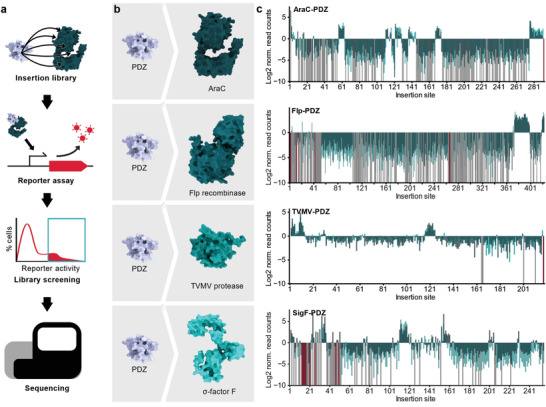
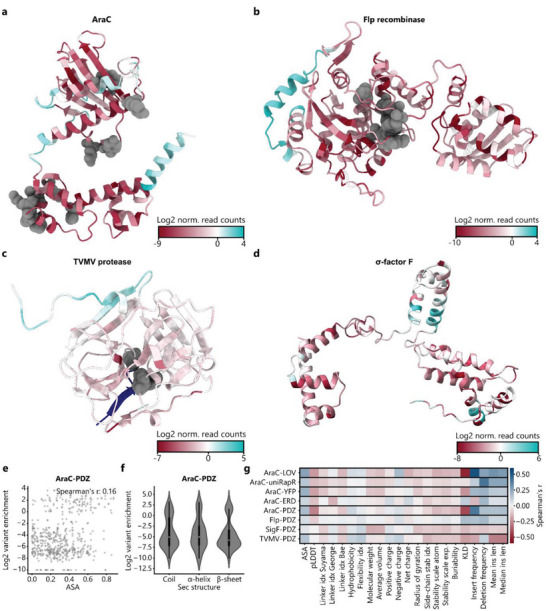
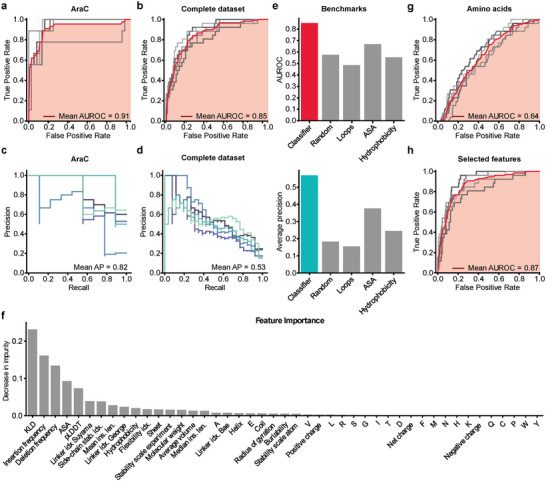
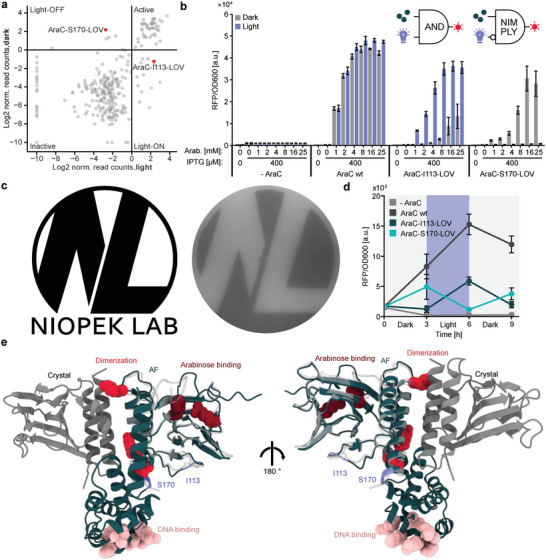
Domain insertion engineering is a promising approach to recombine the functions of evolutionarily unrelated proteins. Insertion of light‐switchable receptor domains into a selected effector protein, for instance, can yield allosteric effectors with light‐dependent activity. However, the parameters that determine domain insertion tolerance and allostery are poorly understood. Here, an unbiased screen is used to systematically assess the domain insertion permissibility of several evolutionary unrelated proteins. Training machine learning models on the resulting data allow to dissect features informative for domain insertion tolerance and revealed sequence conservation statistics as the strongest indicators of suitable insertion sites. Finally, extending the experimental pipeline toward the identification of switchable hybrids results in opto‐chemogenetic derivatives of the transcription factor AraC that function as single‐protein Boolean logic gates. The study reveals determinants of domain insertion tolerance and yielded multimodally switchable proteins with unique functional properties.
Overview
The claims and statistics of this paper haven’t been checked yet.
Run the check — free, no account needed. It reads the open-access text and checks the sources it cites.
Integrity signals
Registry
Cites
Statistics
Figures
Verification
Claims the paper makes
The claims and statistics of this paper haven’t been checked yet.
Run the check — free, no account needed. It reads the open-access text and checks the sources it cites.
Self-check
Percentages, sums and reported differences re-computed from the paper’s own numbers.
The self-check needs the paper’s full text.
Citations
Cites
Highly accurate protein structure prediction with AlphaFold
Jumper, J., Evans, R., Pritzel, A., Green, T., Figurnov, M., Ronneberger, O., Tunyasuvunakool, K., Bates, R., Žídek, A., Potapenko, A., et al. (2021) · Nature · doi:10.1038/s41586-021-03819-2 · Cited by 43,764
A structural biology community assessment of AlphaFold2 applications
Akdel, M., Pires, D. E. V., Pardo, E. P., Jänes, J., Zalevsky, A. O., Mészáros, B., Bryant, P., Good, L. L., Laskowski, R. A., Pozzati, G., et al. (2022) · Nature Structural & Molecular Biology · doi:10.1038/s41594-022-00849-w · Cited by 675
Research works printed but not linked: 51
- 10.1146/annurev.biophys.31.082901.134314 · DOI
- 10.1126/scisignal.2000546 · DOI
- 10.1126/science.aah3404 · DOI
- 10.1016/S0896-6273(00)80955-1 · DOI
- 10.1126/science.1159052 · DOI
- 10.1093/protein/gzi048 · DOI
- 10.1073/pnas.0502673102 · DOI
- 10.1038/s41596-019-0165-3 · DOI
- 10.1093/nar/gkaa1198 · DOI
- 10.1038/s41592-018-0178-9 · DOI
- 10.1038/nbt.3528 · DOI
- 10.1038/ncomms12266 · DOI
- 10.1016/j.cell.2011.10.049 · DOI
- 10.1093/nar/gkn363 · DOI
- 10.1093/nar/gkz1110 · DOI
- 10.1038/s41467-018-08171-0 · DOI
- 10.1038/s41467-021-27342-0 · DOI
- 10.1093/nar/gkw537 · DOI
- 10.1126/science.273.5280.1392 · DOI
- 10.1073/pnas.1218319110 · DOI
- 10.1038/s41592-022-01488-1 · DOI · Paper page
- 10.1093/nar/gkm998 · DOI
- 10.1093/nar/28.1.374 · DOI
- 10.1093/bioinformatics/btg031 · DOI
- 10.1093/protein/15.11.871 · DOI
- 10.1093/bioinformatics/bti363 · DOI
- 10.1016/S0167-9473(01)00065-2 · DOI · Paper page
- G.Louppe 10.48550/arXiv.1407.7502 2015. · DOI · Paper page
- 10.1002/adbi.202000181 · DOI
- 10.1126/science.276.5311.421 · DOI
- 10.1111/j.1574-6976.2010.00226.x · DOI
- 10.1016/j.cell.2009.07.038 · DOI
- 10.1038/s41589-021-00787-6 · DOI
- 10.1016/j.jmb.2021.167107 · DOI
- 10.1093/nar/gkaa044 · DOI
- 10.1093/nar/gkw548 · DOI
- 10.1021/acssynbio.8b00280 · DOI
- 10.1371/journal.pone.0003647 · DOI
- 10.1073/pnas.082243699 · DOI
- 10.1016/j.molcel.2006.04.027 · DOI
- 10.1093/protein/14.12.993 · DOI
- 10.1002/pro.506 · DOI
- 10.1093/nar/gky010 · DOI
- 10.1002/pro.3235 · DOI · Paper page
- 10.1002/pro.3943 · DOI
- 10.1093/nar/25.17.3389 · DOI · Paper page
- 10.1016/S0022-2836(05)80360-2 · DOI · Paper page
- 10.1093/nar/gkh340 · DOI · Paper page
- Bairoch A., 1997, J Mol Med (Berl), 75, 312
- 10.1371/journal.pcbi.1004091 · DOI
- Pedregosa F., 2011, J Mach Learn Res, 12, 2825
Metadata
- Authors
- Mathony, J., Aschenbrenner, S., Becker, P., & Niopek, D.
- Affiliations
- Heidelberg University (DE)
- Technische Universität Darmstadt (DE)
- Corresponding author
- Mathony, Jan
- Niopek, Dominik
- Venue
- Advanced Science
- Publisher
- Wiley
- Published
- 2023-08-10
- Volume
- 10
- Issue
- 28
- Pages
- e2303496-e2303496
- ISSN
- 2198-3844 (ISSN-L)
- PMC
- PMC10558690
- OpenAlex
- W4385728485
- Cited by
- 16
- References
- 2
- Citations by year
- 2026: 4 · 2025: 6 · 2024: 4 · 2023: 2
- FWCI
- 1.42
- Type
- journal article
- Language
- en
- Open access
- gold
- doi.org
- Locations
- Advanced Science (publishedVersion, cc-by)
- PubMed Central (publishedVersion, cc-by)
- PubMed (publishedVersion)
- DOAJ (DOAJ: Directory of Open Access Journals) (submittedVersion, cc-by-sa)
- Funders
- H2020 European Research Council (101041570)
- Deutsche Forschungsgemeinschaft (453202693)
- Topics
- Life Sciences › Biochemistry, Genetics and Molecular Biology › Molecular Biology › Biochemical and Structural Characterization
- Life Sciences › Biochemistry, Genetics and Molecular Biology › Molecular Biology › Protein Structure and Dynamics
- Life Sciences › Biochemistry, Genetics and Molecular Biology › Molecular Biology › Gene Regulatory Network Analysis
- Keywords
- protein allostery, allosteric effectors, sequence conservation, optogenetics, chemogenetics, Boolean logic gates, machine learning prediction
- MeSH terms
- Allosteric Regulation, Transcription Factors
About these checks
Registry, retraction, Cites and statistics results are computed, not judged, with one exception: a printed reference that no index lists is read once by a model before it counts as a citation error. Claims are extracted by a model and kept only when their quote appears verbatim in the text; each cited source is then checked, with a model’s help, for whether it says what the claim relies on. Those verdicts can be wrong — read the claim’s quote and the cited source before relying on one.
Statistics and arithmetic are recomputed, not judged.
Confidence bands are shown only for fields calibrated on our annotated test set. None is calibrated yet, so no band is shown.
What counts as a claim ›How we measure confidence ›How we check this ›
Are you an author, or do you see a problem with this page? Request a review
How to cite
Cite CoChat for the checks on this page, and the paper for its own findings.
- This page
- CoChat. (2026). Citation check: Dissecting the Determinants of Domain Insertion Tolerance and Allostery in Proteins. https://app.cochat.ai/papers/10.1002/advs.202303496
- The paper
- Mathony, J., Aschenbrenner, S., Becker, P., & Niopek, D. (2023). Dissecting the Determinants of Domain Insertion Tolerance and Allostery in Proteins. Advanced Science. https://doi.org/10.1002/advs.202303496
