

Genome‐wide meta‐analysis identifies ancestry‐specific loci for Alzheimer's disease
Open accessThe DOI matches its Crossref record; 68 of the 68 references it cites were found in a registry or an index; none of the 48 sources its claims cite is checked for support yet.
Abstract
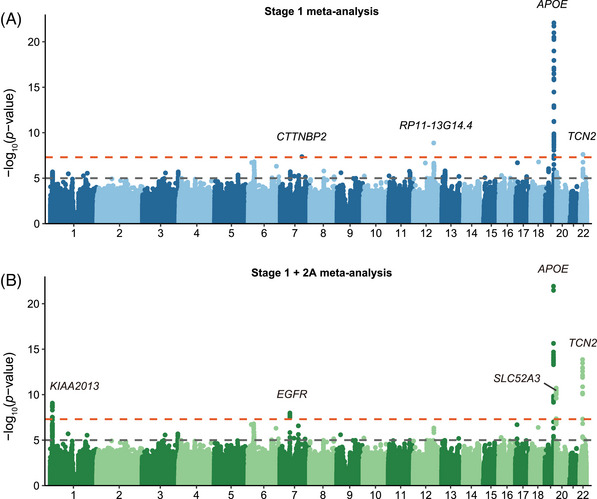
INTRODUCTION: Alzheimer's disease (AD) is a devastating neurological disease with complex genetic etiology. Yet most known loci have only identified from the late‐onset type AD in populations of European ancestry. METHODS: We performed a two‐stage genome‐wide association study (GWAS) of AD totaling 6878 Chinese and 63,926 European individuals. RESULTS: In addition to the apolipoprotein E (APOE) locus, our GWAS of two independent Chinese samples uncovered three novel AD susceptibility loci (KIAA2013, SLC52A3, and TCN2) and a novel ancestry‐specific variant within EGFR (rs1815157). More replicated variants were observed in the Chinese (31%) than in the European samples (15%). In combining genome‐wide associations and functional annotations, EGFR and TCN2 were prioritized as two of the most biologically significant genes. Phenome‐wide Mendelian randomization suggests that high mean corpuscular hemoglobin concentration might protect against AD. DISCUSSION: The current study reveals novel AD susceptibility loci, emphasizes the importance of diverse populations in AD genetic research, and advances our understanding of disease etiology. Highlights: Loci KIAA2013, SLC52A3, and TCN2 were associated with Alzheimer's disease (AD) in Chinese populations. rs1815157 within the EGFR locus was associated with AD in Chinese populations. The genetic architecture of AD varied between Chinese and European populations. EGFR and TCN2 were prioritized as two of the most biologically significant genes. High mean corpuscular hemoglobin concentrations might have protective effects against AD.
Overview
CoChat Summary
TL;DR
A two-stage GWAS meta-analysis in 6,878 Chinese and 63,926 European individuals identified novel Alzheimer’s disease loci in Chinese populations, including KIAA2013, SLC52A3, TCN2, and an EGFR variant, with ancestry-specific effects. Functional prioritization highlighted EGFR and TCN2, and phenome-wide Mendelian randomization suggested higher mean corpuscular hemoglobin concentration may protect against early-onset AD.
Key findings
- In the Stage 1 + 2A Chinese meta-analysis, five loci reached genome-wide significance: APOE, KIAA2013 (rs6682554, OR = 0.79, p = 8.65 × 10⁻¹⁰), EGFR (rs1815157, OR = 0.80, p = 1.04 × 10⁻⁸), SLC52A3 (rs6117562, OR = 1.29, p = 1.82 × 10⁻¹¹), and TCN2 (rs75680863, OR = 0.66, p = 1.38 × 10⁻¹⁴). KIAA2013, SLC52A3, and TCN2 were novel AD susceptibility loci, and rs1815157 within EGFR was a novel ancestry-specific variant.
- Replication was stronger in Chinese samples: 31% of Stage 1 suggestive variants replicated in Stage 2A after Bonferroni correction, whereas Stage 2B European samples showed no Bonferroni-significant associations except in the APOE region. TCN2 replicated in Stage 2A with OR = 0.67, p = 1.79 × 10⁻⁸, and its lead variant frequency was 0.12 in Chinese versus <0.01 in Europeans.
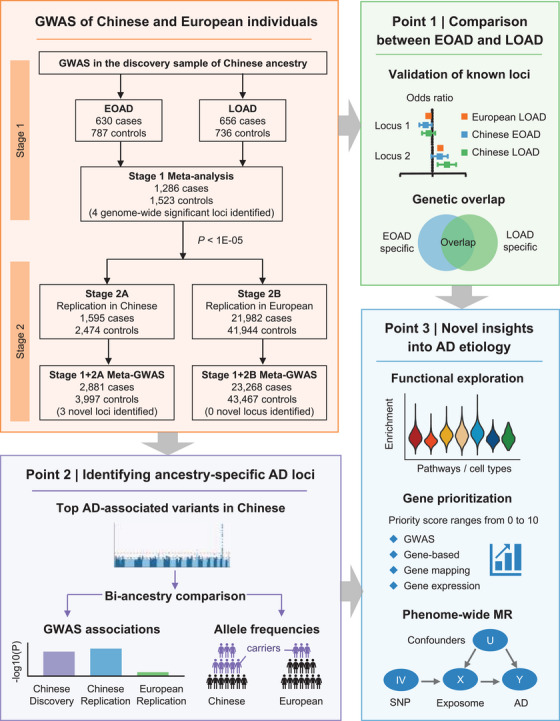
- EOAD and LOAD showed genetic overlap: APOE was the only genome-wide significant shared signal, and the shared proportion of variants was 100% at p < 1 × 10⁻⁷, 92% at p < 5 × 10⁻⁷, 73% at p < 1 × 10⁻⁶, 38% at p < 5 × 10⁻⁶, and 26% at p < 1 × 10⁻⁵. APOE effects were similar for EOAD (OR = 2.32) and LOAD (OR = 2.49).
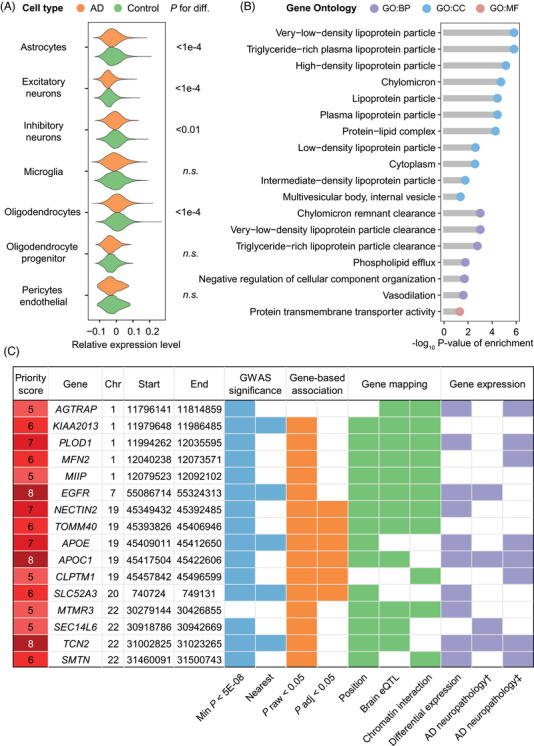
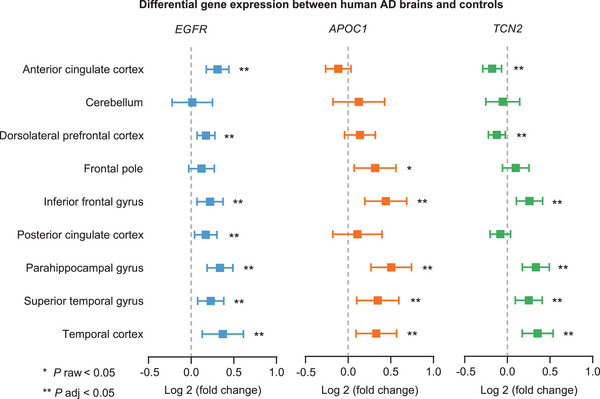
- Functional prioritization scored EGFR, APOC1, and TCN2 highest. Phenome-wide MR in Asian populations found genetically determined MCHC had a protective effect on EOAD (IVW OR = 0.30, p raw = 4.09 × 10⁻⁴, p adj = 0.03), with no significant effect on LOAD.
Methods
- Two-stage GWAS: Stage 1 discovery included 1,286 clinically diagnosed AD cases and 1,523 cognitively normal Chinese controls after QC (630 EOAD cases, 656 LOAD cases; 7,676,018 autosomal variants). Stage 2A replication included Chinese LOAD cases and controls (Table 1: 1,595 cases, 2,474 controls), and Stage 2B used European summary statistics from Kunkle et al. (21,982 AD cases, 41,944 controls).
- Genotyping used the Infinium Asian Screening Array; imputation used IMPUTE5 with 1000G phase 3 CHB/CHS reference. Stage 1 GWAS used fastGWA-GLMM in GCTA adjusting for age, sex, and first PC; EOAD and LOAD were meta-analyzed with METAL. Replication used logistic regression in PLINK, and meta-analyses combined Stage 1 + 2A and Stage 1 + 2B.
- Follow-up analyses included gene-based association (mBAT-combo), FUMA positional/eQTL/chromatin mapping, enrichment and cell-type analyses, candidate gene prioritization using Agora/AlzData, and phenome-wide MR using BioBank Japan exposures with IVW, MR-Egger, weighted median, and weighted mode.
Limitations
- The paper states that patients with known pathogenic PSEN1, PSEN2, or APP mutations were not excluded before GWAS, though it considers the influence minimal because 90%–95% of EOAD cases do not carry these mutations; most AD diagnoses were clinical (NINCDS-ADRDA), requiring validation in biologically defined AD; heritability and polygenicity of EOAD/LOAD could not be quantified due to the relatively small discovery sample; a large deep-sequencing reference panel such as TOPMed might improve low-frequency variant imputation; and the prioritization scoring did not assess directional consistency/causal relationships between eQTL and gene expression or include protein isoforms and epigenetic modifications.
- Evident from the text: the European replication relied on external summary statistics rather than the same genotyping/QC pipeline, and Stage 2B yielded no Bonferroni-significant non-APOE associations, limiting cross-ancestry replication of the novel Chinese findings.
Model-written summary. Check it against the paper before relying on it.
Integrity signals
Registry
Cites
Statistics
Figures
Verification
Claims the paper makes
0 Valid · 1 Not valid · 39 Not checked · 107 Own results and interpretations
A result the paper reports from its own data — it cites no other source for it, so there is none to check. The quote shows it is in the paper.
In the paper
“Of note, except for NME8, all of the nominally significant variants associated with Chinese EOAD or LOAD showed consistent directions with the original European LOAD GWAS”
§ Genome‐wide meta‐analysis identifies ancestry‐specific loci for Alzheimer's disease > RESULTS > Genetic overlap between EOAD and LOAD
plainstates an association- Asserted: passes — The authors put it forward as true.
- Checkable: passes — It can be checked against evidence.
- Load-bearing: passes — The paper’s conclusions depend on it.
- Based: passes — The paper gives a reason why it holds.
A check of a cited source is scheduled, or we don’t hold its full text yet; the claim is checked once it runs.
In the paper
“We confirmed that APOE plays a critical and comparable role in EOAD and LOAD, 45”
§ Genome‐wide meta‐analysis identifies ancestry‐specific loci for Alzheimer's disease > DISCUSSION
What the sources say
- Not checked yetcites [45] Cacace R, Sleegers K, Van Broeckhoven C. Molecular genetics of early‐onset Alzheimer's disease revisited. Alzheimers Dement. 2016; 12: 733‐ 748. 27016693 source
A check is scheduled.
plainstates a cause- Asserted: passes — The authors put it forward as true.
- Checkable: passes — It can be checked against evidence.
- Load-bearing: passes — The paper’s conclusions depend on it.
- Based: passes — The paper gives a reason why it holds.
- Not checked yet
A result the paper reports from its own data — it cites no other source for it, so there is none to check. The quote shows it is in the paper.
In the paper
“a novel ancestry‐specific variant within EGFR (rs1815157)”
- Also stated in: § Highlights · plain
“rs1815157 within the EGFR locus was associated with AD in Chinese populations.”
- Also stated in: § Genome‐wide meta‐analysis and replication identify new ancestry‐specific loci · plain
“the lead signal of EGFR, rs1815157 has been identified as a novel susceptibility variant for AD for the first time.”
§ Genome‐wide meta‐analysis identifies ancestry‐specific loci for Alzheimer's disease > Abstract > RESULTS
plainstates an association- Asserted: passes — The authors put it forward as true.
- Checkable: passes — It can be checked against evidence.
- Load-bearing: passes — The paper’s conclusions depend on it.
- Based: passes — The paper gives a reason why it holds.
- Rests on an assumption not shown here.
- Also stated in: § Highlights · plain
A result the paper reports from its own data — it cites no other source for it, so there is none to check. The quote shows it is in the paper.
In the paper
“The most significant signal was APOE rs429358, which showed similar associations with EOAD (odds ratio [OR] = 2.32, Pp = 3.57 × 10⁻¹⁵, p adj = 2.39 × 10⁻¹³) and LOAD (OR = 2.49, p = 4.34 × 10⁻²¹, p adj = 2.91 × 10⁻¹⁹).”
§ Genome‐wide meta‐analysis identifies ancestry‐specific loci for Alzheimer's disease > RESULTS > Genetic overlap between EOAD and LOAD
plainstates an association- Asserted: passes — The authors put it forward as true.
- Checkable: passes — It can be checked against evidence.
- Load-bearing: passes — The paper’s conclusions depend on it.
- Based: passes — The paper gives a reason why it holds.
None of the sources cited for this claim have been checked yet.
In the paper
“the MAF of rs757278 in 7q31.2 was 0.01 in 1000G East Asian populations but 0.35 in 1000G European populations.”
§ Genome‐wide meta‐analysis identifies ancestry‐specific loci for Alzheimer's disease > RESULTS > Genome‐wide meta‐analysis and replication identify new ancestry‐specific loci
plain- Asserted: passes — The authors put it forward as true.
- Checkable: passes — It can be checked against evidence.
- Load-bearing: passes — The paper’s conclusions depend on it.
- Based: passes — The paper gives a reason why it holds.
83 more claims
Create a free account to see all 147 claims and to verify the 47 references still open.
- It may state two separate claims as one. 35
- Probably not a substantial claim. 36
Self-check
Percentages, sums and reported differences re-computed from the paper’s own numbers.
Each contradiction between two passages listed here was confirmed by an independent check.
Rated minor: it would not touch a result — a value no result rests on, a p-value that stays on the same side of the significance level, or a conflict that is clerical, resolved elsewhere in the paper, or outside its own findings.
In the paper
§ Genome‐wide meta‐analysis identifies ancestry‐specific loci for Alzheimer's disease > RESULTS > Functional interpretation and prioritization of AD candidate genes
“Brain cell–type analysis revealed that these candidate AD genes exhibited differential expression in astrocytes, oligodendrocytes, and neurons when comparing AD cases with controls (Figure 3A). Furthermore, enrichment analyses of gene ontologies (GOs) for these candidate AD genes showed that the top enriched GO terms were related to lipid metabolism (Figure 3B).”
§ Genome‐wide meta‐analysis identifies ancestry‐specific loci for Alzheimer's disease > RESULTS > Functional interpretation and prioritization of AD candidate genes
“(A) Enriched gene ontologies of all candidate AD genes. (B), Relative expression levels in brain cell types of all candidate AD genes.”
Citations
Cites
PLINK: a tool set for whole-genome association and population-based linkage analyses.
Purcell, S., Neale, B., Todd-Brown, K., Thomas, L., Ferreira, M. A. R., Bender, D., Maller, J., Sklar, P., de Bakker, P. I. W., Daly, M. J., et al. (2007) · The American Journal of Human Genetics · doi:10.1086/519795 · Cited by 34,089
McKhann, G., Drachman, D., Folstein, M., Katzman, R., Price, D., & Stadlan, E. M. (1984) · Neurology · doi:10.1212/wnl.34.7.939 · Cited by 27,915
McKhann, G. M., Knopman, D. S., Chertkow, H., Hyman, B. T., Jack, C. R., Kawas, C. H., Klunk, W. E., Koroshetz, W. J., Manly, J. J., Mayeux, R., et al. (2011) · Alzheimer's & Dementia · doi:10.1016/j.jalz.2011.03.005 · Cited by 18,657
A global reference for human genetic variation
The 1000 Genomes Project Consortium, authors, C., Auton, A., Abecasis, G. R., Steering committee, Altshuler, D. M., Durbin, R. M., Abecasis, G. R., Bentley, D. R., Chakravarti, A., et al. (2015) · Nature · doi:10.1038/nature15393 · Cited by 18,247
Self-citationAlbert, M. S., DeKosky, S. T., Dickson, D., Dubois, B., Feldman, H. H., Fox, N. C., Gamst, A., Holtzman, D. M., Jagust, W. J., Petersen, R. C., et al. (2011) · Alzheimer's & Dementia · doi:10.1016/j.jalz.2011.03.008 · Cited by 10,152
The MR-Base platform supports systematic causal inference across the human phenome
Hemani, G., Zheng, J., Elsworth, B., Wade, K. H., Haberland, V., Baird, D., Laurin, C., Burgess, S., Bowden, J., Langdon, R., et al. (2018) · eLife · doi:10.7554/elife.34408 · Cited by 7,959
Population Structure and Eigenanalysis
Patterson, N., Price, A. L., & Reich, D. (2006) · PLoS Genetics · doi:10.1371/journal.pgen.0020190 · Cited by 5,280
METAL: fast and efficient meta-analysis of genomewide association scans
Willer, C. J., Li, Y., & Abecasis, G. R. (2010) · Bioinformatics · doi:10.1093/bioinformatics/btq340 · Cited by 5,205
Warde-Farley, D., Donaldson, S. L., Comes, O., Zuberi, K., Badrawi, R., Chao, P., Franz, M., Grouios, C., Kazi, F., Lopes, C. T., et al. (2010) · Nucleic Acids Research · doi:10.1093/nar/gkq537 · Cited by 4,835
Functional mapping and annotation of genetic associations with FUMA
Watanabe, K., Taskesen, E., van Bochoven, A., & Posthuma, D. (2017) · Nature Communications · doi:10.1038/s41467-017-01261-5 · Cited by 4,083
Cited by
Neurodegenerative diseases and immune system: From pathogenic mechanism to therapy
Chen, Y., Yin, P., Chen, Q., Zhang, Y., Tang, Y., Jin, W., & Yu, L. (2025) · Neural Regeneration Research · doi:10.4103/nrr.nrr-d-25-00274 · Cited by 38
Self-citationJiao, H., Ge, Y., Huang, L.-Y., Liu, Y., Wu, B., Lian, P., Hao, Y., Han, S., Li, Y., Wu, K., et al. (2025) · Molecular Neurodegeneration · doi:10.1186/s13024-025-00887-0 · Cited by 16
“Standard quality control was then performed, as described in our previous study [37].”
Self-citationVariables associated with cognitive function: an exposome-wide and mendelian randomization analysis
Zhao, Y., Hao, Y., Ge, Y., Zhang, Y., Huang, L., Fu, Y., Zhang, D., Ou, Y., Cao, X., Feng, J., et al. (2025) · Alzheimer s Research & Therapy · doi:10.1186/s13195-025-01670-5 · Cited by 9
“Both genetic [2, 3] and environmental [4, 5] variables exert a substantial influence on cognitive function.”
Self-citationCacabelos, R. (2025) · International Journal of Molecular Sciences · doi:10.3390/ijms26157175 · Cited by 9
Advances in Alzheimer’s disease: mechanistic insights and therapeutic targets
Jia, Y.-J., Ge, Y., Li, B., Yang, Y., Chen, H., Liu, J., Guo, J., Yu, J., Ye, K., Wang, J., et al. (2026) · Science China Life Sciences · doi:10.1007/s11427-025-2991-7 · Cited by 7
“…AD genetic studies in non-European ancestries have uncovered ancestry-specific risk loci, including KIAA2013 , SLC52A3 , and TCN2 in Chinese (Ge et al., 2024a), as well as COBL , SLC10A , FBXL7 , and FAM47E in other populations (Mez et al., 2017; Shigemizu et al., 2021; Tosto et al., 2015).”
Self-citation
Metadata
- Authors
- Ge, Y., Chen, S., Wu, B., Zhang, Y., Wang, J., He, X., Liu, W., Chen, Y., Ou, Y., Shen, X., Huang, Y., Gan, Y., Yang, L., Ma, L., Ma, Y., Chen, K., Chen, S., Cui, M., Tan, L., Dong, Q., Zhao, Q., Wang, Y., Jia, J., & Yu, J.
- Affiliations
- Shanghai Medical College of Fudan University (CN)
- Army Medical University (CN)
- Department of Neurology and Institute of Neurology Huashan Hospital State Key Laboratory of Medical Neurobiology and MOE Frontiers Center for Brain Science Shanghai Medical College National Center for Neurological Disorders Fudan University Shanghai China
- Qingdao University (CN)
- Department of Neurology Qingdao Municipal Hospital Qingdao University Qingdao China
- Affiliated Hospital of Qingdao University (CN)
- Innovation Center for Neurological Disorders and Department of Neurology National Clinical Research Center for Geriatric Diseases Xuanwu Hospital Capital Medical University Beijing China
- Corresponding author
- Wang, Yan‐Jiang
- Yu, Jin‐Tai
- ORCID
- Venue
- Alzheimer's & Dementia
- Publisher
- Wiley
- Published
- 2024-07-18
- Volume
- 20
- Issue
- 9
- Pages
- 6243-6256
- ISSN
- 1552-5260 (ISSN-L)
- 1552-5279
- PMC
- PMC11497642
- OpenAlex
- W4400781233
- Semantic Scholar
- 24122b95f65d93c42f8241662724f42ea66f8e45
- Cited by
- 16
- References
- 67
- Citations by year
- 2026: 7 · 2025: 9
- FWCI
- 0.60
- Type
- journal article
- Language
- en
- Open access
- hybrid
- doi.org
- Licence
- Locations
- Alzheimer s & Dementia (publishedVersion, cc-by-nc)
- PubMed Central (publishedVersion, cc-by-nc)
- PubMed (publishedVersion)
- Funders
- National Natural Science Foundation of China (92249305, 82071201, 82271475)
- National Postdoctoral Program for Innovative Talents (BX20230087)
- Topics
- Life Sciences › Neuroscience › Cellular and Molecular Neuroscience › Alzheimer's disease research and treatments
- Health Sciences › Medicine › Psychiatry and Mental health › Dementia and Cognitive Impairment Research
- Life Sciences › Biochemistry, Genetics and Molecular Biology › Genetics › Genetic Associations and Epidemiology
- Keywords
- Alzheimer's disease, genetic susceptibility loci
- MeSH terms
- East Asian People, Aged, Alzheimer Disease, Apolipoproteins E, Female, Humans, Male, Genetic Predisposition to Disease, Polymorphism, Single Nucleotide, White People, Genome-Wide Association Study, ErbB Receptors
About these checks
Registry, retraction, Cites and statistics results are computed, not judged, with one exception: a printed reference that no index lists is read once by a model before it counts as a citation error. Claims are extracted by a model and kept only when their quote appears verbatim in the text; each cited source is then checked, with a model’s help, for whether it says what the claim relies on. Those verdicts can be wrong — read the claim’s quote and the cited source before relying on one.
A language model drew the claims from the paper on 2026-11-28, under version 3 of the claim definition (model deepseek-v4.1-flash, prompt extract-v3).
A second model labelled each claim on 2026-11-28 (model jev-1.13-20260917, definition revision gold-guideline-v0.2).
Statistics and arithmetic are recomputed, not judged.
Confidence bands are shown only for fields calibrated on our annotated test set. None is calibrated yet, so no band is shown.
What counts as a claim ›How we measure confidence ›How we check this ›
Are you an author, or do you see a problem with this page? Request a review
How to cite
Cite CoChat for the checks on this page, and the paper for its own findings.
- This page
- CoChat. (2026). Citation check: Genome‐wide meta‐analysis identifies ancestry‐specific loci for Alzheimer's disease. https://app.cochat.ai/papers/10.1002/alz.14121
- The paper
- Ge, Y., Chen, S., Wu, B., Zhang, Y., Wang, J., He, X., Liu, W., Chen, Y., Ou, Y., Shen, X., Huang, Y., Gan, Y., Yang, L., Ma, L., Ma, Y., Chen, K., Chen, S., Cui, M., Tan, L., . . . Yu, J. (2024). Genome‐wide meta‐analysis identifies ancestry‐specific loci for Alzheimer's disease. Alzheimer's & Dementia. https://doi.org/10.1002/alz.14121
Data sources
Bibliographic data: Semantic Scholar, OpenAlex, Crossref.
Contains information from the Semantic Scholar Academic Graph Datasets, made available under the ODC Attribution License (ODC-BY 1.0).
Semantic Scholar’s data is described in: Kinney, R., et al. (2023). The Semantic Scholar Open Data Platform. arXiv:2301.10140.
